Care and Maintenance
Commercial Window Cleaning Phoenix: Costs and Schedules
Commercial Window Cleaning Phoenix explained: services, squeegee vs pure-water methods, pricing factors, heat-safe scheduling and how to request a quote.


You've sent a property manager a price, followed up, and heard nothing. Then someone asks whether your insurance covers the required limits, whether you can work before tenants arrive, and whether the price includes the upper glass. You're still discussing what the job involves, even though you've already quoted it.
Learning how to get commercial window cleaning contracts means learning to sell a defined, manageable obligation. The cleaning matters, but so do access, paperwork, staffing, payment terms, and a price that survives the first difficult visit.
Commercial bids stall when cleaners pitch before they qualify. A contact asks for a number, the cleaner sends one, and nobody confirms who approves the contract or how the crew will reach the glass.
There's a substantial buying ecosystem to pursue. The Bureau of Labor Statistics counted approximately 2,199,900 janitors and cleaners, excluding maids and housekeeping cleaners, in May 2024. For a specialist window cleaner, that's a reason to pursue recurring vendor and subcontractor relationships with building managers and facility firms, rather than treating every opportunity like a homeowner inquiry.
Use the following as a working pipeline, not a list of sales activities. The timing entries are planning allowances, not promises about how quickly a buyer will decide.
Commercial contract stages, outputs and timing
| Stage | What You Do | Output You Produce | Typical Timing |
|---|---|---|---|
| 1. Target | Pick property types and territories | Account list of 50 to 100 names per market | Allow 1-2 weeks |
| 2. Qualify | Identify the economic buyer, facilities contact and renewal date | Qualified account sheet with service cycle and access notes | Allow 1-2 weeks |
| 3. Site walk | Measure elevations, pane counts, frames and access | Site survey with equipment and crew requirements | Reserve 1 visit per building, 1-3 hours |
| 4. Price | Build labor hours, access, risk and margin into the scope | Priced scope passed through the bid/no-bid gate | Allow 2-5 days |
| 5. Propose | Send scope, response-time commitment, safety plan, insurance and exclusions | Written proposal with compliance packet | Allow 3-5 business days |
| 6. Follow up | Contact on a fixed cadence until award or documented loss | Award decision or recorded reason for loss | Reserve 2-6 weeks |
| 7. Onboard | Set schedule, inspection method and reporting format | First-visit report and service calendar | Before mobilization, then after the first completed visit |
A small single-site account might close within a few weeks. A portfolio can require several months because facilities staff, procurement, ownership, and legal reviewers may all need to approve it. Don't count a positive conversation as an award.
For a more structured qualification workflow, Voicedial.ai's resource can help you streamline your B2B lead qualification process. Apply that discipline to buyer authority, access, timing, and purchasing requirements.
Copy the stage table into a spreadsheet, add stage-entry dates, and review it every Monday. An account sitting at “qualified” without a booked walk needs a different action from a submitted proposal waiting on insurance approval.
Start with the buyer, not the building. A property manager, facility-service company, or dealership group may control several sites, while the person working behind a storefront counter may have no authority over exterior maintenance.
Segment your territory into property managers, medical offices, car dealerships, professional stadiums, high-rise condominiums, and multi-tenant buildings. Build a manageable list of 50 to 100 accounts per market rather than collecting names you won't research or contact.

Say a dealership group in Scottsdale has eight showroom buildings and wants one vendor for interior and exterior glass across every lot. That's a hypothetical portfolio opportunity, not eight identical jobs. Survey each location, then offer consolidated administration with site-specific scopes.
Property-manager portfolios are useful prospecting targets in Phoenix as well. Search management-company websites for named properties, then verify which services the manager buys.
A local manager may make the decision directly; a larger organization may require vendor onboarding before discussing a start date. Fypion Marketing's enterprise and SMB comparison provides context for adjusting your sales process to those different buying structures.
Prepare a concise capabilities statement instead of sending a general advertising flyer. The Maryland Department of Commerce capabilities-statement guide recommends qualifications, certifications, NAICS codes, past performance, and verifiable recognitions. Connect those capabilities to the services and territory you've committed to in your window cleaning business plan.
Prospecting rule: Log every contact. Silence means the next action needs scheduling, not that the account has been disqualified.
Close an opportunity only with a recorded reason, such as unsuitable access, an unacceptable payment condition, or a confirmed purchasing decision.
Buyers can screen out a vendor on paperwork before comparing prices. Treat the compliance packet as part of the bid, with preparation time included in your selling costs.
Keep the core documents ready, but tailor what you send. An oversized attachment folder won't help a manager find the certificate that procurement needs.
The following checklist also covers administrative documents a buyer may request. Confirm applicability rather than promising bonding or coverage you haven't arranged.
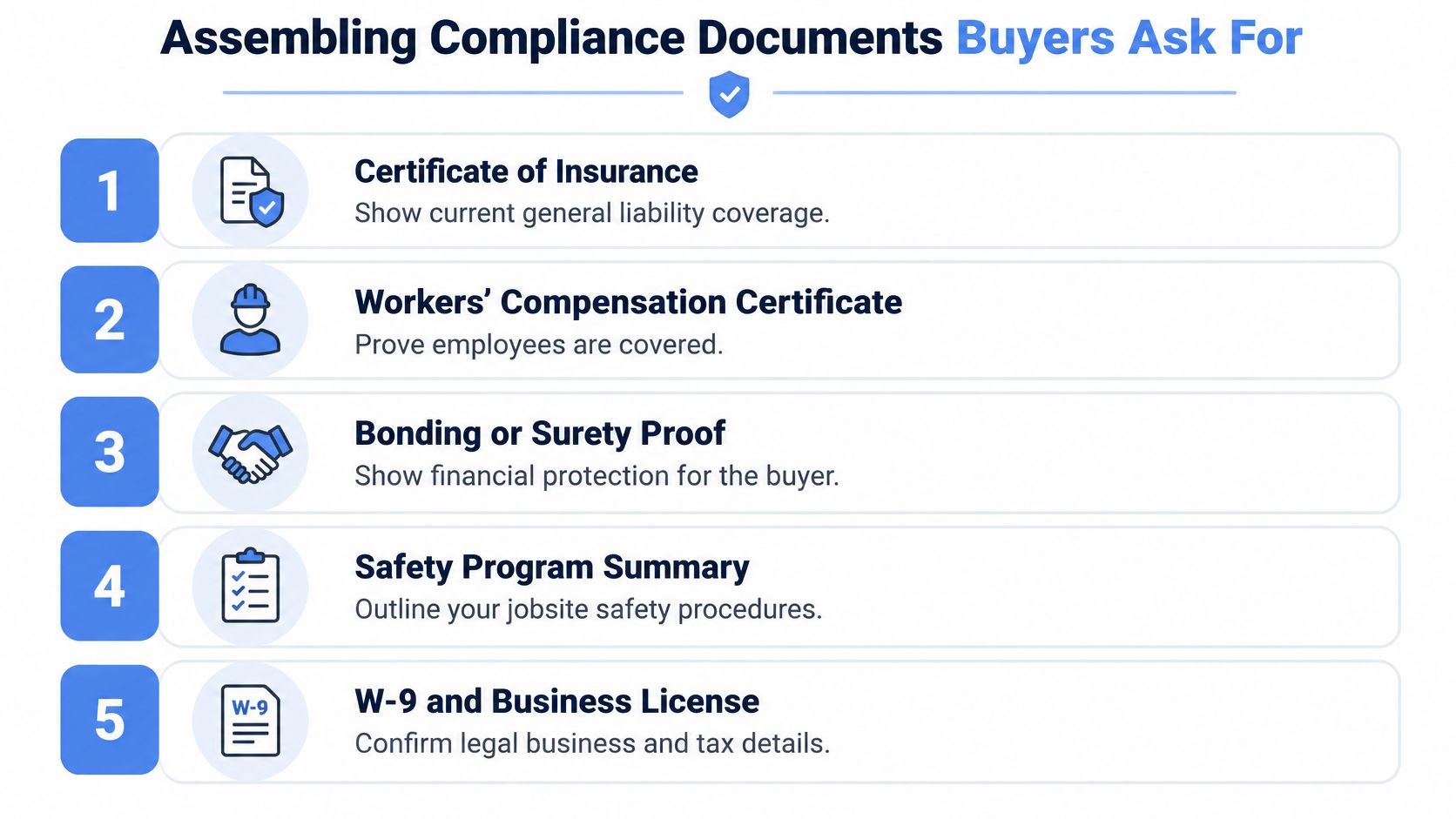
For a concrete example of safety obligations, California's window-cleaning regulation requires employers to provide compliant safety equipment, maintain it, instruct employees in its use, and supervise safe working practices. That's a California rule, not a substitute for checking the requirements where your crew will work.
For buyers with green programs, prepare a sustainability summary with chemical safety data sheets, dilution practices, water-use controls, wastewater procedures, equipment-maintenance records, and applicable product certifications.
The LEED v5 Operations and Maintenance rating system recognizes cleaning-service standards including Green Seal GS-42 and ISSA CIMS, and requires at least 75% of cleaning products and materials by cost to meet approved standards within the applicable program. Ask which requirements apply to your window scope and which belong to the building's broader janitorial contract.
Don't claim that using purified water makes your company certified. Describe the actual procedure and provide evidence the buyer can evaluate.
Before submission, make these checks:
Build the packet once, store it as dated PDFs, and send only the parts each buyer requests. Assign someone responsibility for replacing expired documents.
Government bidding begins with scope and classification, not searching for the largest advertised contract. Define what you can perform directly, what requires a qualified subcontractor, and which NAICS classification matches the solicitation.
The GSA business-registration guide directs contractors through SAM registration and obtaining a Unique Entity ID; registration is free and generally renewed every 12 months. Federal offerors generally need active registration when submitting an offer, at award, and throughout performance.
Use SAM.gov for official opportunities and notices. A discovery tool such as SamSearch's government RFP database can help organize searches, but verify deadlines, amendments, and submission instructions against the official solicitation.
Registration makes you eligible to compete. It doesn't make an incomplete bid responsive.
Mirror this workflow for state, municipal, school-district, airport, and public-authority portals. Check each buyer's wage, background-screening, insurance, and access requirements rather than assuming federal registration covers them.
Keep each solicitation, due date, amendment acknowledgment, and requirement map in one tracker. Don't submit while a mandatory requirement remains unanswered.
A flat square-foot price hides the expensive parts of commercial window work. Height, restricted access, weekend staffing, equipment delivery, and insurance requirements can consume the margin before anyone cleans a pane.
Use square footage as a reference only after you've built the job from labor, equipment, access, and risk. The examples below illustrate estimating scenarios, not standard rates or guaranteed production times.
Cost factors that change a commercial window price
| Cost Factor | How It Changes the Price | Example |
|---|---|---|
| Height and access equipment | Adds lift booking, rope-access crew or fall-protection time | Five-storey mid-rise with lift booked for one day |
| Cleaning method | Pure-water work adds filtration, rinsing and setup allowances | 200 panes cleaned with a water-fed pole instead of a squeegee |
| After-hours access | Adds the cost of evening, weekend or holiday staffing | Medical office admitting crews only on Saturday mornings |
| Traffic control | Adds staffing, signage and sometimes permits | Storefront on a busy arterial road with limited parking |
| Insurance limits | Higher required limits may add premium costs to recover | Buyer requires a higher liability limit than your current coverage |
| Recurring frequency | Can support a lower per-visit price when condition and routing justify it | Quarterly exterior service versus an urgent one-time visit |
| Call-out work | Requires a separately priced visit and minimum service charge | Extra cleaning after tenant turnover or storm dust |
Professional window cleaning uses two cleaning methods: a squeegee or a pure-water system. Lifts, ropes, ladders, and poles provide access; they aren't additional cleaning methods.
Squeegee hand cleaning suits small single-storey offices, interior glass, and areas requiring controlled water use. For reachable, glass-heavy exterior facades, pure-water work may reduce repositioning and make the route more efficient, but you still need to test the access and drainage assumptions.
The Squeegee professional window-cleaning guide explains that pure-water filtration removes impurities, a water-fed brush loosens dirt from glass, frames, and sills, and purified water rinses the surface so it can dry without detergent residue. Include filtration maintenance, water availability, hose management, and final inspection in the estimate.
Don't assume a ground-based water-fed pole can service every high-rise elevation. Check safe reach, setbacks, obstructions, and the building's approved access arrangements before selecting the method.
Before quoting, require confirmed scope, safe access, acceptable payment terms, achievable certificate requirements, and your minimum gross-margin target. If a condition fails, resolve it, qualify the offer, or decline.
Calculate labor by elevation and task, then add travel, loading, setup, breakdown, supervision, and reporting. Include payroll burden and applicable equipment costs, not just the hourly wage paid to the cleaner.
Price = estimated job cost ÷ (1 − target gross-margin rate). Use consistent cost definitions, and don't confuse gross margin with markup. For a detailed estimating framework, use this commercial window cleaning pricing guide.
Say a medical office in Denver permits work only on Saturday mornings. Price the actual weekend staffing arrangement, security check-in, room access, and any restricted finish time. If someone must escort the crew, identify who supplies that person and what happens if they're unavailable.
Pricing judgment: Don't discount a known access cost in the hope that the crew will somehow work faster.
A budget-conscious manager may accept a baseline quarterly or semiannual service with optional call-outs more readily than an inflexible schedule. Mordor Intelligence's contract-cleaning market analysis reports that long-term agreements represented 62.76% of contract-cleaning revenue in 2025 and describes master service agreements with adjustable call-off orders. That's broader cleaning-market evidence, not a window-cleaning pricing benchmark.
Keep the baseline and optional work separate. Define minimum service charges, geographic service zones, response-time tiers, cancellation rules, and who can authorize an additional visit.
An urgent call-out shouldn't replace scheduled work or guarantee immediate attendance at the normal route price. State whether the commitment means acknowledgment, inspection, or completed cleaning, and include weather and safe-access conditions.
Build the document from the survey, not a recycled paragraph promising clean windows. Specify interior and exterior glass, frames, screens where included, water-fed-pole work, lifts, access arrangements, frequency, and inspection standards.
List hard-water restoration, construction residue, damaged glass, and inaccessible areas as separate inclusions or exclusions. Require written approval for changes rather than letting a technician negotiate extra work at the building.
Use this submission sequence:
Ask whether the scope is approved, whether procurement has missing documents, and who owns the next decision. Once awarded, reconcile the signed agreement with your proposal before assigning the crew.
Treat renewals as the foundation of recurring revenue, not a conversation to start when the agreement is about to expire. Account management starts when the buyer awards the work.
During the first 30 days, use a deliberate onboarding plan: confirm the named facilities contact, issue the service calendar, and deliver a first-visit report with before-and-after photographs and a window-condition note. Record actual production time while the details are fresh.
Contract metrics to track and what to do when they slip
| Metric | What It Tells You | Action When It Slips |
|---|---|---|
| Proposal-to-award rate | Whether pricing and positioning fit the buyer | Review scope and price on every lost bid |
| Average sales cycle | How quickly qualified accounts move through the stages | Shorten the gap between site walk and proposal |
| Renewal rate | Whether accounts continue, alongside feedback from facilities contacts | Hold a review call 90 days before term end |
| Complaint rate | Consistency of service across visits and crews | Add inspection sampling to every visit |
| Labor hours versus estimate | Accuracy of the production assumptions | Reprice the account at the next renewal |
Read these metrics together. A strong award rate paired with repeated labor overruns may mean you're winning underpriced work, not selling particularly well.
Likewise, don't assume every lost renewal means poor cleaning. Record whether the buyer changed ownership, consolidated vendors, reduced spending, or had an unresolved service problem.
Send a quarterly summary with completion dates, missed-access notes, and observed defects such as failed seals or damaged frames. Describe visible conditions without presenting a cleaning technician's observation as an engineering diagnosis.
Documenting operations fits how institutional owners already manage buildings. ENERGY STAR reports that more than 330,000 U.S. buildings have used Portfolio Manager to track energy, water, and waste. Offer similarly auditable maintenance records, without claiming window cleaning produces a particular energy saving.
A missed-access note should identify the area, reason, notification, and proposed resolution. It supports your invoice under the agreed terms and gives the manager a specific action, such as arranging keys or removing an obstruction.
Renewals are won on documented reliability, not on the lowest bid.
Set your renewal review for 90 days before term end. Compare actual labor hours and equipment costs with the estimate, discuss occupancy changes, and offer an appropriate call-out tier rather than carrying forward an unsuitable schedule.
Add a renewal calendar entry for every contract and assign the review to a named person. A calendar reminder without an owner is easy to ignore.
Choose three accounts you can qualify properly: a property manager with several buildings, a single-site medical office or dealership, and a condominium or stadium-style property with defined access rules. These are working targets, not a reason to chase work beyond your equipment or staffing capacity.
Keep the next action visible, whether you manage outreach from a desk or between jobs.

Aim to book all three walks within two weeks so proposals can leave before month-end. Apply the bid/no-bid gate before committing substantial estimating time, then set a follow-up date while the buyer is still engaged.
Before any quote leaves your desk, confirm:
Use the stage tracker to record where each account sits and its target proposal date. Keep each account sheet to one page, with supporting surveys and documents attached separately.
Use the accompanying video as a separate viewing resource while organizing your outreach.
Record one decision for each account: pursue, pass, or revisit on a set date, with the reason written down. A smaller pipeline of qualified, safely priced opportunities is more useful than a long list of unanswered quotes.
Professional Window Cleaning offers commercial and high-rise window cleaning and has been cleaning windows for over 26 years, with its operating history documented on its company page. If you're responsible for a building or portfolio, visit Professional Window Cleaning to discuss your locations, access requirements, and recurring service needs so a proposal can be built around the actual work.
Read our blog posts regularly and keep learning.