Care and Maintenance
Window Cleaning Mesa AZ: Methods, Pricing, and Booking Tips
Learn how Window Cleaning Mesa AZ services work for homes, offices, and high-rises, from squeegee vs pure-water methods to booking.


You're probably in one of two spots right now. You either know how to clean glass and want to turn that skill into a real company, or you already have a few jobs and can tell that winging it won't hold up for long. That's the point where a proper window cleaning business plan stops being paperwork and starts being a tool.
After more than 26 years in this trade, one thing is clear. The operators who last don't just know how to clean windows. They know what they're selling, who they're selling to, how they'll price risk, and how they'll stay busy when weather or seasonality slows exterior work. They also understand a basic truth about the craft itself. Professional window cleaners use two methods: the squeegee and the pure-water system. Everything else is support equipment, access equipment, or sales talk.
In Southwestern markets, the plan has to be even tighter. Work in Phoenix, Scottsdale, Denver, or Las Vegas, and you'll deal with dust, heat, wind, cold snaps, multi-story liability, and very different customer expectations depending on whether you're cleaning a ranch home, a storefront, or a tower.
The initial focus often lands on tools. That's usually the first mistake.
They buy a squeegee, a ladder, maybe a water-fed pole, print a few shirts, and think they're in business. Then the difficult questions show up. Which jobs are worth taking? What do you charge when access gets difficult? How many recurring customers do you need before hiring? Which neighborhoods fit your route? What do you do when weather knocks out a week of exterior jobs?
A real window cleaning business plan answers those questions before they turn into expensive lessons. It's your operating playbook. If you ever apply for financing, it also becomes the document that shows whether you've thought through the business side, not just the cleaning side. If funding is part of your launch path, this guide to writing your SBA loan business plan is a practical reference for structuring the financial and lender-facing parts correctly.
The strongest plans aren't long. They're clear. They tell you:
Practical rule: If your plan doesn't help you decide whether to accept or reject a job, it's too vague.
A generic cleaning business template treats all work like it's interchangeable. It isn't. Residential jobs depend heavily on lead flow, show-up quality, and repeat service. Commercial work depends more on contracts, reliability, and route efficiency. High-rise work adds a completely different layer of risk and compliance.
That's why the planning sequence matters. Industry guidance recommends a stepwise model: define the target segment, specify service lines, map the local competitive environment, set staffing and management roles, and then build a 5-year financial forecast with the first 12 months broken out monthly rather than relying on a single broad annual estimate, as noted in this window cleaning planning guide.
Your executive summary should read like you know exactly what business you're in. Not cleaning in general. Not “property services.” Window cleaning, with a specific market, a specific method, and a specific operating model.

A weak summary says you provide high-quality service to homes and businesses. That could describe half the service industry. A strong one says you deliver residential, commercial, or specialized window cleaning using the two professional methods that matter: traditional squeegee work and pure-water cleaning systems.
Keep it tight. The summary should answer five questions.
Who are you serving?
Pick the segment first. If you're serving residential customers in suburban neighborhoods, say that. If you're targeting storefronts and small commercial accounts, say that. If you want to move toward commercial and high-rise later, say that too, but don't pretend all three segments are the same on day one.
What makes your service professional?
State your standards clearly. Squeegee work matters for detail-heavy interior glass, French panes, and finish-sensitive work. Pure-water systems matter for efficient spot-free exterior cleaning, especially on larger homes, solar-adjacent properties, and commercial glass.
Where will you operate?
Geography matters more in this business than most new owners expect. Route density, travel time, weather exposure, and building type all change your margins.
How will you win work?
Not with vague promises. You win through reliability, clear quoting, consistent method selection, and matching service type to client need.
Why will customers stay?
Recurring service, professional communication, and visible results keep the account.
Your mission shouldn't sound borrowed from a franchise brochure. It should reflect what customers buy from you. In this trade, they're buying appearance, maintenance, trust, and convenience.
A useful mission sounds more like this in plain English: keep homes and commercial properties looking sharp with reliable service, professional-grade methods, and crews who understand the difference between a simple storefront job and a higher-risk access job.
The best mission statements are operational. They tell your team how to behave, not just how to sound.
Many plans often become vague at this stage. Don't do that. There are only two cleaning methods professionals rely on:
That distinction belongs in your executive summary because it shapes equipment purchases, training, job times, and your value proposition. It also tells customers you understand the trade beyond surface-level marketing.
You can buy a van, poles, and a water-fed setup in a week. You cannot buy the right market. In Phoenix, I would build around recurring commercial routes and selective residential work. In Denver, I would plan for weather interruptions and a shorter production window in parts of the year. In Las Vegas, I would pay close attention to resort-adjacent commercial demand, retail turnover, and how fast exterior glass gets dirty in heat, wind, and dust.
A real market analysis answers one question. Where can this business get profitable work consistently without training customers to shop on price alone?
The U.S. window washing trade is big enough to support specialists and local independents at the same time. IBISWorld reports the industry at $2.9 billion in 2024, with 35,344 businesses operating in the category, according to its window washing industry profile. That matters for one reason. You are entering a crowded field, so your plan has to define which jobs you want, which jobs you will refuse, and why your market gives you room to do that.
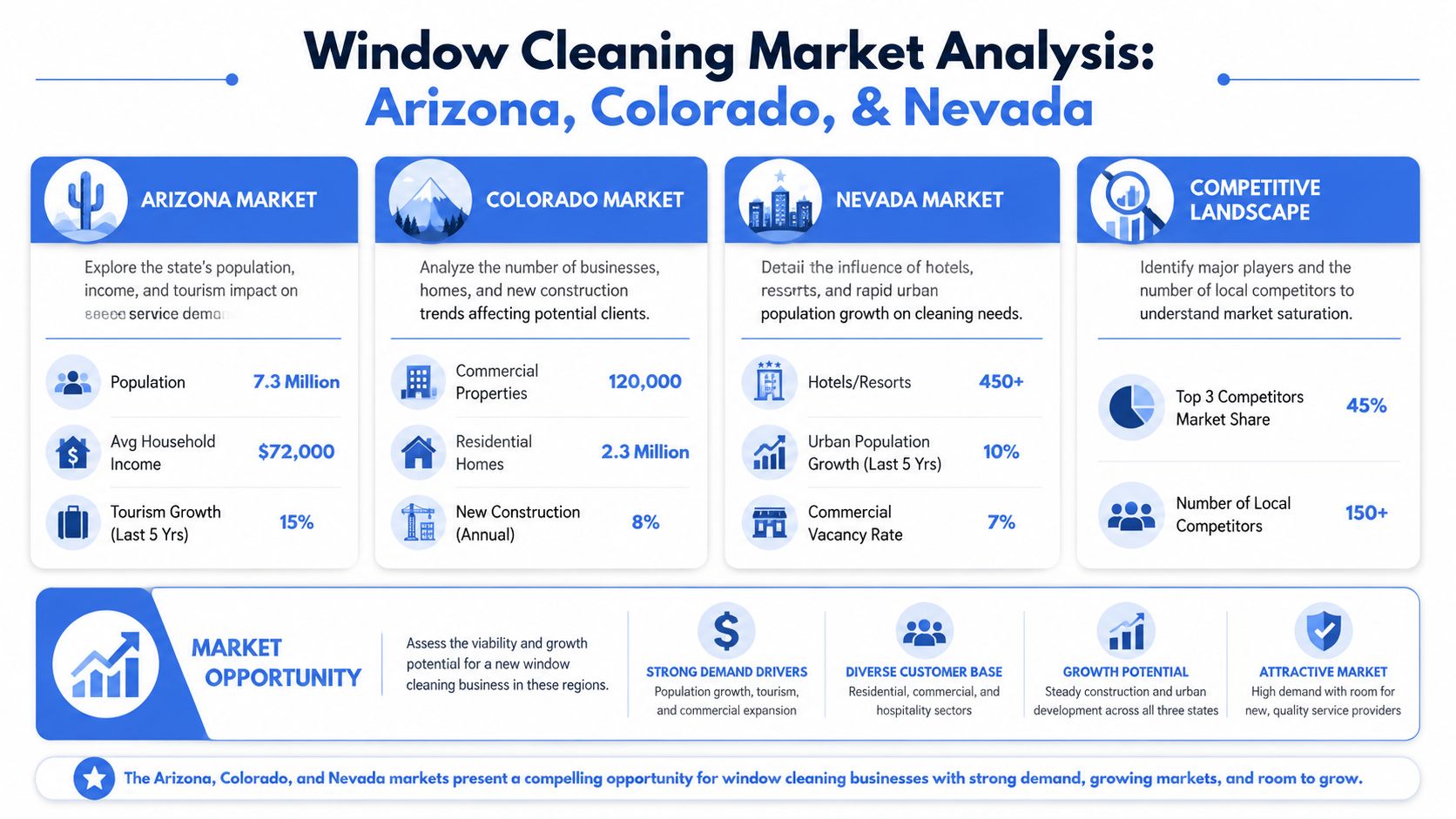
Arizona, Colorado, and Nevada do not behave the same way, even inside the same metro.
In the Southwest, your service mix is shaped by climate, building stock, and how owners buy maintenance. Desert markets often support more year-round exterior work, but they also expose glass to hard water, dust, and heat-related wear on equipment and crews. Colorado can produce strong commercial demand, but snow, wind, and freeze-thaw conditions affect scheduling, ladder safety, and monthly recurring commitments.
That is why I separate the market into three buckets before I estimate startup demand:
If those buckets get blended into one sales plan, quoting gets sloppy and capacity planning falls apart.
General cleaning industry research is useful as background, not as a pricing guide. SBDCNet's cleaning services market overview notes that commercial cleaning holds the largest share of the broader market. For a window cleaning operator, that lines up with what happens on the ground. Commercial work can produce denser routes and steadier scheduling. Residential work often gives better gross dollars per stop, but it usually comes with more estimating time, more customer hand-holding, and more seasonal swings.
The trade-off is simple. A monthly storefront route can stabilize cash flow. A badly priced multi-story commercial account can eat that gain fast.
Use local average window cleaning rates by service type and building complexity as a starting reference, then adjust for access, travel, setup time, and the liability profile in your target city. That adjustment matters more in Phoenix, Denver, and Las Vegas than generic templates admit. A ground-floor retail route and a suspended-stage commercial job should never sit inside the same quoting model.
Do not stop at counting how many companies show up on Google Maps. Study what kind of work they appear built to handle.
Check four things:
That last point matters. In many markets, the opening is not low price. It is showing up on time, keeping route dates tight, and sending crews who do not need the client to manage them.
A quick visual can help frame how to think about the region before you build your route strategy.
Many new operators in the Southwest get blindsided.
Phoenix and Las Vegas can support long exterior cleaning seasons, but summer heat changes crew speed, water use, and acceptable work hours. Denver can produce solid spring and fall demand, yet winter weather can interrupt residential schedules and delay exterior commercial work. If your plan assumes flat demand across all twelve months, your staffing and cash reserves will be wrong.
I would map demand like this before launch:
| Market Segment | What to Check First | What Usually Wins | Common Mistake |
|---|---|---|---|
| Residential | Neighborhood density, home value, and seasonal booking patterns | Trust, clean technician presentation, repeat scheduling | Ignoring quote time and cancellation rates |
| Storefront and small commercial | Route density, parking, and manager access | Reliability, tight service windows, simple recurring plans | Underpricing travel and low-ticket stops |
| Mid-rise and high-rise | Access method, insurance burden, and site coordination | Risk-based quoting, compliance, and professional communication | Bidding by pane count instead of hazard and setup time |
A market analysis is finished when you can answer three practical questions without guessing. Which segment will you open with? Why does that segment fit the city? What conditions would make you expand into higher-risk commercial work later?
Often, many new operators get into trouble. They price for volume, not for margin. Then they stay busy and broke.
The fix is to separate service lines clearly and price based on labor, access, risk, and setup time. Don't lump a ranch home, a retail storefront, and a tall commercial property into one quoting formula. They don't use the same tools, they don't move at the same pace, and they don't carry the same liability.
A clean service menu does more than help sales. It protects your schedule and keeps crews from improvising on site.
Build your offer around these lanes:
Don't add every possible service just because a prospect asks. Add-ons should support your core route and skill set.
OSHA consistently flags fall hazards as a top risk in maintenance. A nuanced business plan has to price high-rise jobs based on access complexity and liability, not just pane count, as discussed in this high-risk window cleaning startup guide. That matters in markets like Las Vegas and Denver where multi-story work can look attractive from the outside but become unprofitable fast if you quote it like standard residential work.
A lot of startup plans fail because they use a simple formula everywhere. Per-pane pricing can work as a rough estimator on straightforward residential jobs. It breaks down once you add difficult access, ladder repositioning, lift coordination, rope access preparation, security requirements, or tight commercial scheduling windows.
Field note: If the job needs extra planning, it needs its own pricing logic.
| Service Tier | Target Client | Pricing Metric | Example Rate | Key Considerations |
|---|---|---|---|---|
| Basic Residential | Homeowners | Per home or per window set | Custom quote | Access, screens, tracks, interior vs exterior scope |
| Premium Residential | Larger homes, detailed interior work | Scope-based quote | Custom quote | French panes, hard water, ladder time, detailing intensity |
| Storefront Route | Retail and small businesses | Recurring service quote | Custom quote | Route density, frequency, glass exposure, morning access |
| Commercial Low-Rise | Offices, medical, dealerships | Site quote | Custom quote | Exterior method choice, scheduling, crew size |
| Elevated or High-Risk Commercial | Mid-rise and high-rise properties | Risk-tiered contract quote | Custom quote | Insurance, compliance, access method, rescue prep, site restrictions |
If you want a practical benchmark for how service businesses talk through quoting structure, this overview of average window cleaning rates helps frame the conversation. The important part isn't copying someone else's rate sheet. It's understanding why one property gets a straightforward quote and another gets a site-specific contract price.
What works:
What doesn't:
For equipment-heavy service lines, some operators use in-house reference checklists and outside suppliers for setup decisions. Professional Window Cleaning also publishes practical trade content on methods and service considerations, but whatever source you use, the pricing decision has to come back to your own labor, access, and risk.
A smart business plan gets specific about operations fast. If you stay vague here, the day-to-day business will run you instead of the other way around.
The good news is that the operating model in window cleaning is simple when you strip away the fluff. You need the right tools, a clean workflow, a hiring trigger, and full compliance before you take on jobs that can expose you to real liability.
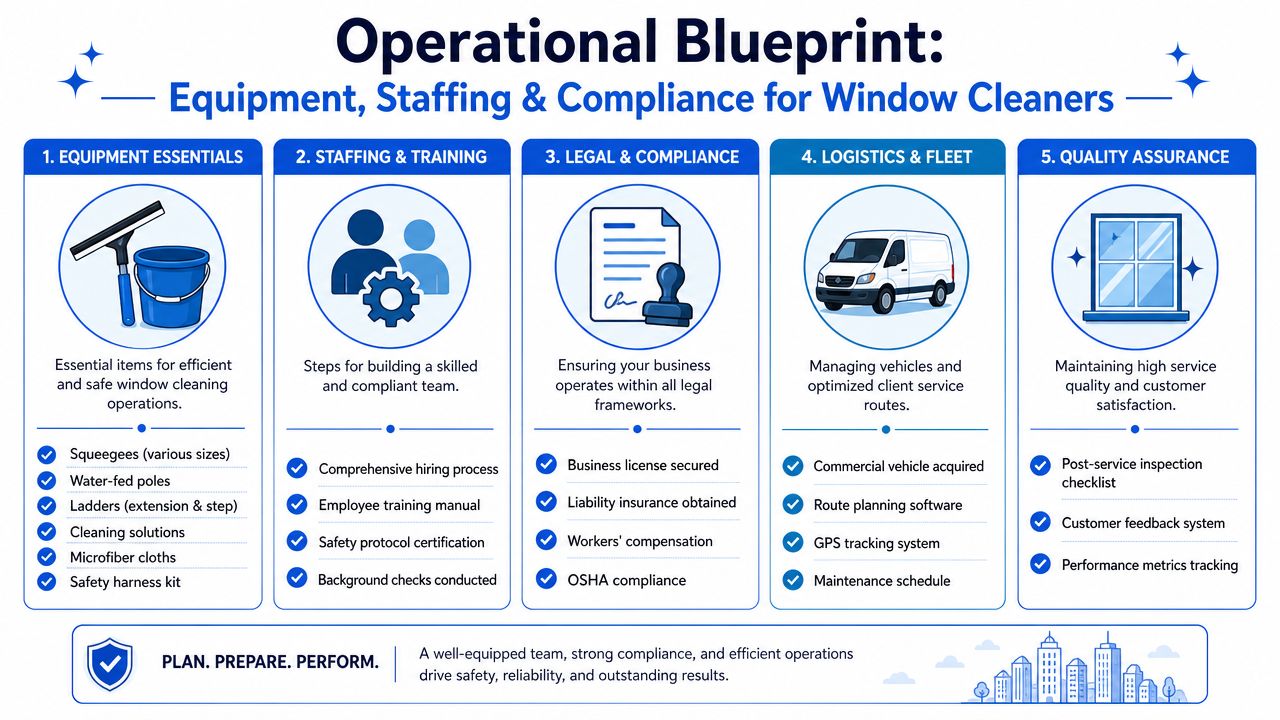
This trade only has two professional cleaning methods, so your gear should support one or both of them.
For squeegee work, think in terms of detail and control. You need quality squeegee channels and rubbers, applicators, buckets, towels, scrapers where appropriate, and poles that don't fight you during the job.
For pure-water work, you're planning around the system, the pole, the brush setup, hose management, and transport. This method can dramatically change how you handle exterior residential and commercial glass, but only if the setup is reliable and the crew knows when it's the right choice.
A practical gear stack usually includes:
If you're building your purchasing list from scratch, this guide to professional window cleaning equipment is a useful reference point for organizing the tool categories.
New owners often hire from emotion. They feel busy, so they add payroll. That's backwards. You hire when the workload is recurring enough to support training time, non-billable time, and inevitable mistakes during ramp-up.
Expert operators recommend setting early KPIs like the number of recurring clients and a specific hiring trigger for the first employee within the first six months so cash flow stays manageable and residential lead flow is kept separate from B2B contract planning, as noted in this startup guide for window cleaning operators.
A few KPIs matter more than the rest:
A first hire should remove a bottleneck, not create a bigger one.
Licensing and insurance aren't things you “clean up later.” They belong in the launch phase.
Your plan should identify:
| Area | What needs to be defined |
|---|---|
| Business setup | Entity choice, registration, banking, tax handling |
| Insurance | Liability coverage and any additional coverage needed for your service mix |
| Employment | Worker classification, payroll process, workers' compensation where required |
| Safety | Method-specific procedures, ladder practice, elevated-work standards |
| Documentation | Quotes, work orders, site notes, customer approvals |
The mistake I've seen over and over is a new operator taking on a more complex job before the systems are ready. If the property requires higher-risk access, your paperwork, coverage, and job planning have to be as professional as your cleaning.
You launch in Phoenix in April. The phone rings for house washes and exterior glass, but by June the heat changes customer behavior, midday jobs get harder to schedule, and your route starts wasting time if you spread too far. In Denver, spring storms and fall slowdowns create a different problem. In Las Vegas, you can build steady work fast, but only if your pricing and territory choices protect your margins. A real go-to-market plan has to match those conditions.
Early clients rarely come from one source. They come from a tight local presence, consistent follow-up, and offers that fit the buyer. That matters even more in Southwestern markets, where travel time, seasonality, and service mix can make a busy month look profitable when it is not.
I would start with two or three ZIP codes, not a whole metro. Route density drives profit. If your crew burns an hour crossing town for a small residential job, your marketing worked and your business still lost ground.
Start with the basics that help people book:
For residential work, local search and neighborhood visibility usually produce the first steady flow. For commercial work, direct outreach still matters more than waiting for inbound leads.
The sequence is usually uneven, and that is fine.
The first few jobs often come from personal contacts, yard signs where allowed, community groups, or a neighbor who sees you working. The next wave comes from search visibility, review momentum, and referrals. After that, the stronger opportunities come from relationship channels such as property managers, retail centers, HOAs, real estate agents, and maintenance companies that already serve your target customer.
In Phoenix and Vegas, I would push hard on storefront and small commercial outreach before peak summer slowdown affects residential close rates. In Denver, I would use spring and early fall for heavier residential promotion and keep interior commercial work in the mix for weather interruptions.
Homeowners buy speed, clarity, and trust. Commercial buyers buy risk reduction, reliability, and documentation.
That means your sales process should split early.
Residential sales process
Commercial sales process
High-margin commercial work in Arizona, Nevada, and Colorado usually comes from jobs other cleaners underprice. Multi-tenant storefronts, low-rise offices with difficult access, medical sites with strict scheduling, and accounts with inconsistent glass condition can all produce good revenue. They can also wreck your margin if you quote them like basic route work. Risk-based pricing matters here. If ladder moves, access restrictions, after-hours scheduling, or hard water removal raise the labor burden, the price has to reflect it.
A new operation does not need six channels. It needs two or three that can be measured.
Use channels like this:
Paid ads can help, but I would not rely on them until the quote process, close rate, and route planning are under control. Buying leads before your operations are tight usually creates expensive chaos.
If you want a broader framework for lead generation and follow-up, this marketing guide for contractors is useful. Apply the parts that support local intent and booked jobs, not vanity traffic.
A bad lead in the wrong part of town is not progress. Track which ZIP codes produce repeat work, which referral partners send profitable jobs, and which commercial proposals stall out.
The numbers that matter here are simple:
Good marketing fills the calendar. Good sales fill it with the right work, in the right areas, at prices that hold up.
A new owner in Phoenix can book a strong spring, buy more gear, add payroll, and still run short on cash by July. The problem usually is not sales. It is weak monthly planning, poor seasonality assumptions, and pricing that does not reflect ladder risk, access issues, or slow-paying commercial accounts.
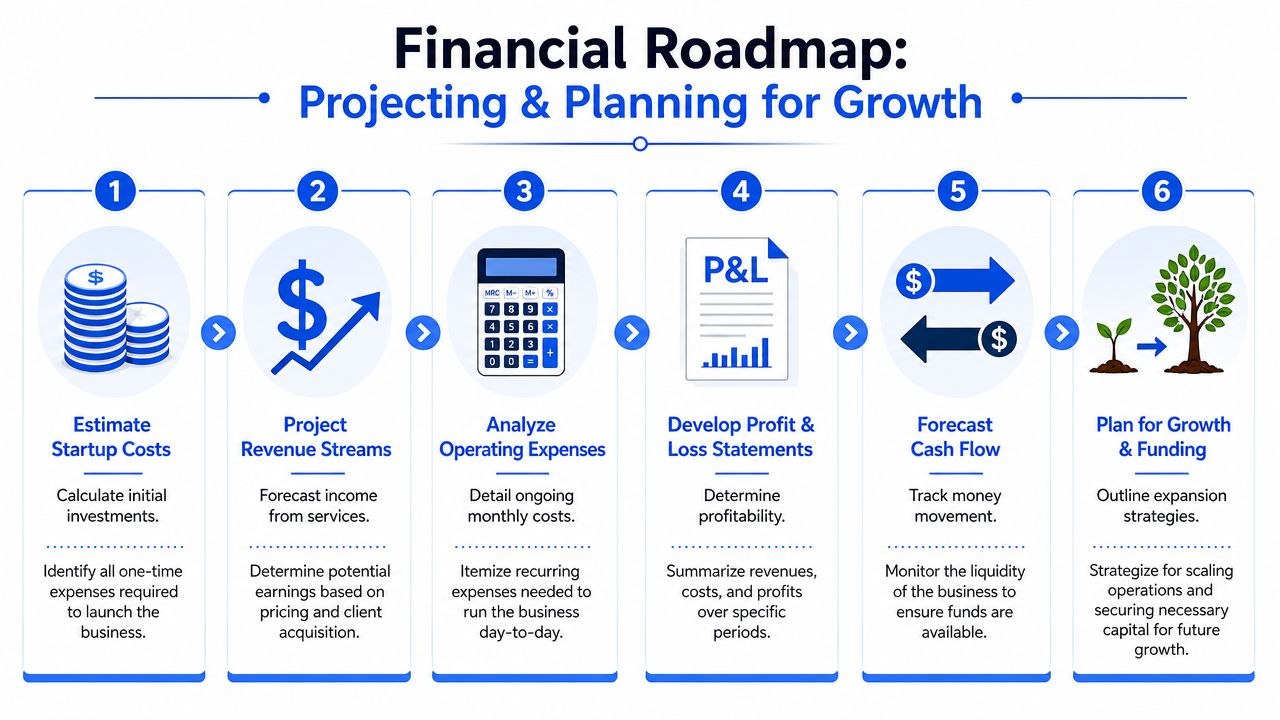
Annual revenue targets are too blunt to run a window cleaning company. A useful plan breaks the first year into months and ties each month to realistic production. That means estimating work by service type, average ticket, route density, close rate, crew capacity, and expected weather disruption.
I build revenue in separate buckets because each one behaves differently:
That separation matters in Southwestern markets. Phoenix and Las Vegas can produce strong exterior demand, then punish sloppy scheduling when heat spikes. Denver can give you productive stretches, then throw snow and wind into the week. If all revenue sits on one line in the spreadsheet, you cannot see where the pressure is coming from.
Do the same on the expense side. Fuel, glass restoration supplies, insurance, payroll taxes, equipment replacement, marketing, admin time, and merchant fees all need a place in the plan. If you intend to chase commercial work, add longer collection cycles and proposal costs. High-margin commercial jobs can be worth it, but only if the pricing covers site complexity, certificate requirements, safety compliance, and the time your team spends off the glass.
In Arizona, Nevada, and Colorado, seasonality changes staffing, marketing, and cash reserves. It should be built into the forecast from the start.
A practical plan includes slower months and a clear response for each one. As noted in this window cleaning startup checklist, off-season offers help steady revenue when exterior demand softens.
The usual stabilizers are straightforward:
I would also separate best-case scheduling from workable scheduling. Best case assumes ideal routing, no access delays, and no cancellations. Workable scheduling assumes reality. Gates are locked. Tenants reschedule. Crews lose time on hard water, screens, and detailing. A growth plan built on best-case production usually breaks fast.
Growth should follow capacity and cash, not excitement after a busy month. The right trigger is operational, not emotional.
| Stage | What should happen before you move up |
|---|---|
| Solo operator stage | Quote process is consistent, schedule stays controlled, callbacks stay low |
| First employee stage | Recurring work covers payroll, training time, and slower production during onboarding |
| Small crew stage | Route density is improving, systems are documented, quality holds across different technicians |
| Expansion stage | A new area or segment can be added without hurting response time, supervision, or current account retention |
Owners often get in trouble with commercial work. They win a few decent accounts, assume they have arrived, then discover the jobs are scattered, underbid, and slow to pay. Risk-based pricing fixes part of that. The other part is discipline. Some jobs look large on paper but drain margin through travel, access problems, night scheduling, or special insurance demands.
Before adding trucks or territory, stress-test the cash side. This guide to cash flow management for businesses is worth reviewing because it focuses on liquidity, budgeting, and timing gaps. Those gaps hit window cleaning companies hard when labor and supply costs go out weekly but receivables come in much later.
A good window cleaning business becomes stronger when repeat work grows, systems are documented, and the owner stops solving every problem personally. That does not mean expanding fast. It usually means getting tighter first. Tighter routes. Better account fit. Better pricing discipline. Better control of labor hours per job.
If I were launching today in Phoenix, Denver, or Las Vegas, I would keep the first version of the financial plan simple and strict. Pick a core segment. Forecast by month. Build in seasonality. Price commercial risk correctly. Add recurring work early. Hire only after the schedule, margin, and collections support it.
If you want to see how an established operator approaches residential, commercial, and high-rise work across Southwestern markets, visit Professional Window Cleaning. We've been in the trade since 1999, and our service experience across Arizona, Colorado, and Nevada reflects the practical operating conditions this kind of business plan needs to account for.
Read our blog posts regularly and keep learning.