Care and Maintenance
Medical Office Windows: Complete Care and Cleaning Guide
Learn how to keep medical office windows clean, safe, and code-compliant. Covers protocols, schedules, costs, and what to expect from professionals.


TL;DR: Average window cleaning rates in 2026 are about $10 per window or $45 to $75 per hour for residential labor, with most full residential jobs falling between $150 and $450 based on access, pane count, and whether both sides are cleaned. Commercial work usually costs more, and high-rise service costs more again because taller buildings require extra equipment, trained crews, and stricter safety procedures.
You’re probably looking at glass that’s gone hazy, spotted, dusty, or streaked and trying to answer one simple question. What should this cost?
That’s a fair question, because window cleaning prices can look inconsistent until you know what drives them. A small single-story home with easy access is priced very differently from a medical office with large panes, and both are priced differently from a high-rise condo or commercial tower.
After more than 26 years in the trade, one thing stays true. Clean windows aren’t priced by guesswork. Professionals usually base the quote on the glass itself, the difficulty of reaching it, the condition of the windows, and the method needed to clean them properly. In our industry, there are only two professional cleaning methods used on the glass: the squeegee and the pure-water system.
Window cleaning typically comes to mind when the dirt becomes obvious from inside the house. Property managers usually notice it sooner, especially when tenants, visitors, or customers start seeing film on the glass from the curb. Either way, the quote matters because you’re balancing appearance, maintenance, and budget at the same time.
Window cleaning is also a real, established service industry. The U.S. window washing industry was valued at $2.9 billion in 2024, with a 2.3% compound annual growth rate over the past five years, and it employs over 100,000 individuals, according to IBISWorld’s U.S. window washing industry overview. That matters because it tells you this isn’t a side gig with random pricing. It’s a mature service category with standard pricing patterns, recurring maintenance demand, and clear differences between residential, commercial, and high-rise work.
For homeowners, clean windows improve how the whole home feels. More light gets in, rooms look sharper, and the exterior looks cared for. For building owners and managers, clean glass affects first impressions fast. A storefront, dealership, office, condo tower, or medical office can look neglected even when the rest of the property is maintained.
Professional cleaners don’t rely on paper towels and spray bottles. They use one of two systems:
Practical rule: If a company can’t clearly explain when it uses a squeegee and when it uses pure water, it may not be pricing the work with much precision.
That pricing precision matters even more in markets with very different property conditions. Homes and buildings in Las Vegas, Phoenix, Scottsdale, Denver, Flagstaff, Tempe, Chandler, and Gilbert don’t all collect the same kind of dirt or mineral buildup. Regional conditions shape labor time, equipment choice, and final cost.
If you manage rentals, it also helps to place glass care inside the bigger maintenance picture. This guide to understanding rental property maintenance costs is useful because window cleaning makes more sense when you compare it with other routine property expenses instead of treating it as a surprise line item.
A good way to think about pricing is to think about a restaurant menu. Sometimes you order item by item. Sometimes you pay for the whole meal. Sometimes you’re paying for the chef’s time because the order is unusual.
Window cleaning quotes work the same way.
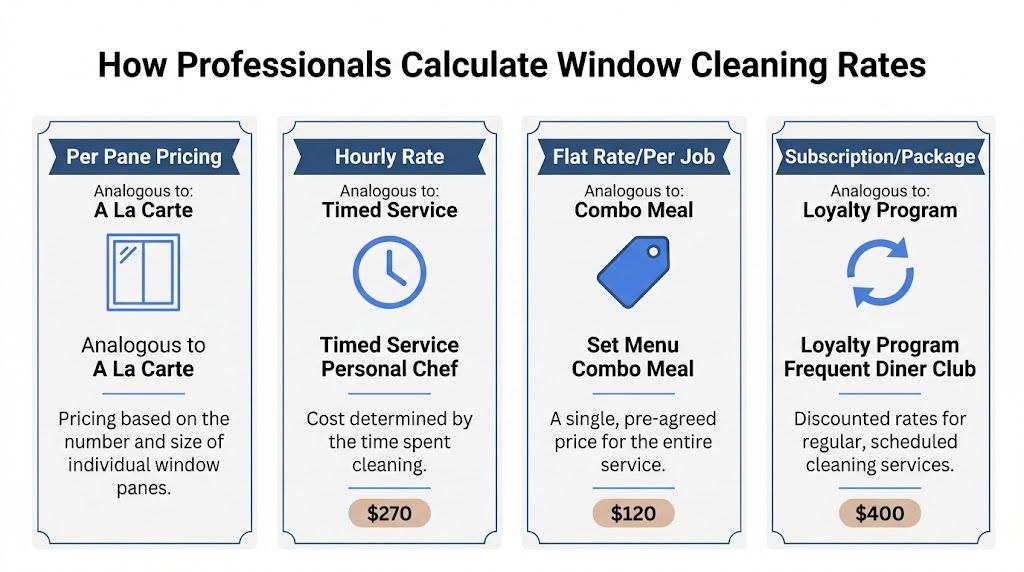
This is the most transparent format. The cleaner counts the panes and assigns a value based on size, style, and access.
Customers usually like this model because it’s easy to follow. If you add a skylight, sliding glass door, or storm window, you can see why the quote changes. The downside is that homes with mixed window styles can feel more complicated on paper than they really are.
Hourly pricing is common when the property is irregular. Think custom homes, mixed-use buildings, deep detailing, or a project where condition is hard to judge until the crew is on site.
For the customer, hourly pricing can be fair when access is tricky or when the job includes more than straightforward glass cleaning. The trade-off is predictability. Some owners prefer a fixed total because they don’t want to watch the clock.
A flat rate is the bundled-meal version. The company assesses the property, decides what the work involves, and gives one price for the agreed scope.
This is often the easiest quote to compare because you know the total before the work starts. It’s especially helpful for homeowners who just want the house done without parsing every pane. The only caution is scope. You need to know whether the quote includes both sides, screens, tracks, and specialty glass or only standard panes.
Many professionals also offer a maintenance price for scheduled cleanings. That’s not a different cleaning method. It’s a different billing approach.
A recurring plan usually makes sense when you want the glass kept at a steady standard instead of letting it drift into heavy buildup. If you’re comparing options, a window washing price calculator can help you understand how count, access, and service frequency affect the quote structure.
| Pricing model | Best for | What customers like | What to watch |
|---|---|---|---|
| Per pane | Standard homes with varied windows | Clear line-item visibility | Large window lists can feel busy |
| Hourly | Custom or unpredictable jobs | Flexible for unusual work | Final total can be less fixed |
| Flat rate | Most homeowners and many small businesses | Easy budgeting | Scope must be clearly defined |
| Recurring package | Ongoing maintenance | Better long-term planning | Only worth it if you’ll use it |
A clean quote should tell you how the company arrived at the number, not just what the number is.
Two homes can have the same square footage and very different window cleaning prices. That’s normal. Windows aren’t priced by house size alone.
What matters most is the glass itself, how hard it is to reach, and what condition it’s in when the crew arrives.

In 2026, average pricing stands at about $10 per window, but per-pane rates vary by type. Double-hung windows average $4 per pane, casement windows $7 per pane, sliding glass doors $7 per pane, and large skylights can be $12 per pane, according to Housecall Pro’s window cleaning pricing guide.
That range makes sense in the field. A standard double-hung window is usually straightforward. A skylight or large slider takes more reach, more detailing, and more time to leave clean without marks. A tri-fold bay or large picture window can also slow the work because the technician has to manage angles, edges, and drip control carefully.
If a cleaner can walk up to the glass, clean it, and move on, the rate stays lower. If the crew needs ladders, extension poles, roof access, or has to work around landscaping, awnings, or furniture, time goes up.
Accessibility often changes the method too. Exterior upper-story glass may be best handled with a pure-water system. Interior detail work is often done with a squeegee because it gives tighter control on edges and corners.
Here’s a simple breakdown of what usually pushes a quote higher:
A quick visual helps show what professionals are assessing on site.
Many customers ask for exterior-only service first. That can make sense if the biggest issue is dirt, pollen, or water spotting outside. But interior glass often carries dust film, fingerprints, pet nose marks, and cooking residue that become obvious once the outside is clean.
That’s why a quote usually changes based on scope:
| Scope | What’s involved | Why the price changes |
|---|---|---|
| Exterior only | Outside glass | Faster access, less interior handling |
| Interior only | Inside glass | May involve screens, furniture clearance, and careful detail work |
| Inside and outside | Both sides | More labor, more setup, more finishing time |
If your windows haven’t been cleaned in a long time, the first visit is usually a restoration-style clean. Maintenance visits after that are usually easier to price and easier to complete.
A homeowner with 18 standard windows is shopping for a very different service than a property manager pricing a three-story office or a mid-rise condo building. The job title is the same. The labor, risk, equipment, and scheduling are not.

Most residential pricing is built around how many panes are being cleaned, how difficult they are to reach, and whether the work is outside only or inside and outside. If you want a broader comparison of how service categories are priced, this cleaning services cost guide gives useful context.
For a typical house, the final number often lands in a moderate range, then shifts upward fast if the property has French panes, high foyer glass, skylights, storm windows, or heavy mineral buildup. After 26 years in this trade, I can tell you that two homes with the same square footage can price very differently if one has simple sliders and the other has cut-ups, tall ladders, and tight backyard access.
Homeowners usually want three things from the quote:
That last point matters more than many people expect. Interior work is slower because crews have to move carefully, protect surfaces, and detail glass under close indoor light.
Commercial work is usually priced by pane, by project, or by recurring service schedule. A small storefront can be straightforward. A medical office, dealership, restaurant, or multi-tenant property usually is not.
The price goes up for practical reasons. Crews may need to work before opening hours, coordinate around customers and staff, carry more liability coverage, and clean larger panes that show every streak. On many commercial sites, the glass is not especially difficult to clean, but the timing and access rules make the job less efficient.
Recurring service can bring the per-visit cost down. Glass that gets cleaned every two or four weeks usually takes less labor than glass left for six months or a year.
High-rise pricing sits in its own category. Rates can rise sharply because access equipment, safety planning, and crew training change the whole job.
Brye A+ Cleaning’s breakdown of commercial and high-rise pricing points out how quickly costs climb once suspended access or specialized exterior methods are involved. That matches what experienced crews see in the field. The glass itself may be ordinary. Reaching it safely is what changes the price.
| Property type | Typical pricing pattern | Main cost drivers |
|---|---|---|
| Residential | Per pane, flat rate, or hourly | Window mix, interior scope, ladder work |
| Commercial low-rise | Flat rate, hourly, or service contract | Larger panes, operating hours, repeat scheduling |
| High-rise | Per window or per project | Access systems, safety requirements, specialized labor |
For property managers, this is the dividing line. Ground-level and low-rise work is still routine window cleaning. Rope access, suspended stages, controlled drop zones, and engineered tie-off points put the job closer to technical exterior maintenance than a standard house wash and window visit.
A homeowner in Phoenix, a casino-adjacent property manager in Las Vegas, and a building owner in Denver can all ask for the same thing. Clean exterior glass. The quotes still come back different because the work is different.

National averages help as a starting point, but they flatten the actual conditions crews deal with in Southwest markets. After years of cleaning in dry, high-mineral, high-sun environments, I can say the biggest pricing difference usually comes down to what is happening on the glass before the technician even unloads a ladder or water-fed pole.
Las Vegas often prices above the national midpoint for one reason. Hard water changes a basic cleaning into stain removal faster than owners expect.
Angi’s window cleaning cost guide gives a general cost framework, but in Las Vegas a significant swing factor is mineral buildup from sprinklers, pool splash, and overspray. If those deposits are fresh, standard methods may handle them. If they have baked into the glass for months in desert heat, the crew may need restoration pads, specialty products, and more time on each pane.
That extra labor is why two Vegas quotes can look far apart even when the homes are similar.
If you own or manage property in Las Vegas, ask whether the price covers maintenance cleaning only or includes hard water treatment. That one detail decides whether the quote is realistic.
Phoenix and Scottsdale create a different kind of pressure on pricing. The issue is not just dirt. It is heat, dust, fast drying glass, and a climate that punishes slow technique.
Crews have to time the work carefully, especially on west-facing glass and large exposed elevations. Cleaning solution can flash off too quickly in direct sun, which means more detailing and more redo work if the method is wrong. On many homes and low-rise commercial properties, pure-water cleaning is the practical choice because it helps control residue and speed up exterior work in hot conditions.
That is why local rates in Phoenix and Scottsdale often sit above what a national average suggests. The climate adds labor even before access or window count enters the picture.
Denver has its own pricing logic. Less mineral spotting than Las Vegas is common, but crews deal with quick weather shifts, colder mornings, wind exposure, and more multi-story layouts that slow production.
Building design matters more here than many owners expect. Steep grades, walk-out basements, narrow side yards, rooftop access points, and upper glass exposed to wind can turn a straightforward quote into a slower job. Commercial scheduling can also be tighter because weather windows close faster.
As noted earlier, Denver local pricing reflects those conditions. If you want a broader local benchmark before booking service, this guide to cleaning services cost in different markets gives useful context.
The biggest pricing mistake I see is comparing a Phoenix dust-and-heat job, a Las Vegas hard-water job, and a Denver weather-sensitive job as if the labor matches pane for pane. It does not.
The cheapest quote isn’t always the lowest-cost decision. If the crew skips detail work, leaves mineral spotting behind, or prices too low to spend enough time on the job, you often pay for it later.
The smarter way to save is to reduce difficulty before the crew arrives and avoid letting the glass get bad enough to need corrective work.
Some cost-saving ideas backfire.
Trying to mix DIY exterior cleaning on upper-story glass with a professional interior cleaning often creates uneven results. So does asking for only the glass when the screens are loaded with dust and the tracks are visibly dirty. Once the sunlight hits, the whole window still looks unfinished.
Another weak strategy is shopping only by the lowest price without asking how the company plans to clean the glass. The method matters. A squeegee is often best for detail-heavy surfaces. A pure-water system is often best for many exterior sections. If the company uses the wrong approach for the property, lower pricing won’t feel like a bargain.
When you request pricing, include details such as:
| Tell the company this | Why it helps |
|---|---|
| Number of stories | Affects access and equipment |
| Window types | Changes labor time |
| Interior, exterior, or both | Defines scope immediately |
| Last cleaning date | Helps estimate buildup |
| Special issues like hard water or paint | Flags add-on work early |
For homeowners and property managers in Arizona, Nevada, and Colorado, free estimates are worth using because they let you compare scope, not just price. That matters whether the property is in Chandler, Gilbert, Tempe, Flagstaff, or a larger metro area.
A clear quote should tell you exactly what “window cleaning” means for that visit. If it doesn’t, ask before the appointment is booked.
In most standard jobs, the core service is the cleaning of the glass itself using either a squeegee or a pure-water system, depending on the window location and access. Many companies also include a light wipe of the immediate frame area as part of normal finishing. That’s the basic service typically expected.
Standard service usually covers:
Add-ons are where many misunderstandings happen. These are often separate because they take extra labor or specialized treatment:
Ask one direct question before you approve the quote: “What exactly is not included in this price?” That answer is often more useful than the total itself.
If the quote is for a commercial or multi-unit property, also confirm whether the service covers all accessible glass, entry doors, interior partitions, and any specialty windows. Good quotes remove surprises before the crew arrives.
That depends on location, exposure, and standards. Desert properties often need more regular exterior attention because dust and hard water show quickly. Buildings in climates with more seasonal swings may need service timed around weather and tenant expectations instead.
For most owners, the best schedule is the one that prevents buildup from becoming restoration work. If the glass is already noticeably spotted or hazy from inside, you’ve probably waited too long for the easiest pricing.
Usually, yes, especially once ladders, upper-story access, mineral spots, large sliders, or skylights enter the picture. Professionals have the right poles, scrubbers, squeegees, towels, and pure-water equipment to clean faster and leave the glass more consistent.
DIY can make sense for a small amount of reachable glass. It usually breaks down when safety, speed, and finish quality matter.
For exterior-only work, many homeowners don’t need to be present as long as the crew has access and instructions are clear. Interior work is different. Someone usually needs to be there to let the technicians in, move through the house, and answer any scope questions.
Property managers often handle this by coordinating access in advance, especially for condo units, offices, or occupied commercial space.
Because “similar” homes often have different glass. One home may have standard double-hung windows, while the other has sliders, skylights, divided panes, or harder backyard access. Even the condition of the glass can shift the labor enough to change the price.
That’s why average window cleaning rates are useful as a guide, not a final answer. The final answer comes from the actual windows on the property.
If you want a clear, no-pressure estimate from a team that’s been cleaning windows since 1999, contact Professional Window Cleaning. They provide residential, commercial, and high-rise window cleaning across Arizona, Nevada, and Colorado, including Las Vegas, Phoenix, Denver, Scottsdale, Flagstaff, Tempe, Chandler, and Gilbert.
Read our blog posts regularly and keep learning.