Care and Maintenance
How Much Can a Window Cleaning Business Make in 2026
Wondering how much can a window cleaning business make in 2026? See real revenue, profit margin, and owner income numbers for solo, crew, and high-rise


You're usually thinking about the contract after something goes sideways.
A property manager says the walkway still looks stained. A homeowner thought gutter brightening was included. A retail center wants a re-clean after a dust storm. Your crew shows up and there's no usable water access, no clear staging area, and cars still parked in the work zone. None of that feels like a legal problem at first. It feels like a jobsite problem. Then it turns into a billing problem, a liability problem, or a reputation problem.
That's why serious pressure cleaning contracts matter. They don't exist because you distrust the client. They exist because exterior cleaning has moving parts, and every one of those moving parts needs to be clear before water starts flowing.
In a crowded market, clarity is a competitive advantage. The pressure washer market was valued at USD 3.28 billion in 2024 and is projected to reach USD 4.03 billion by 2030, and the U.S. has over 32,000 pressure washing businesses, according to Jobber's pressure washing industry statistics. More companies bidding the same work means more clients comparing proposals that look similar on the surface. The contract is where professionals separate themselves.
Written agreements also reflect how established cleaning companies operate. Professional Window Cleaning has been cleaning windows for over 26 years, using the two methods professionals use: a squeegee or a pure-water system. That same discipline shows up in exterior cleaning work. Clear paperwork, realistic scope, and documented expectations are part of why companies last in places like Denver and Scottsdale, where surfaces, weather, and access issues can change the job fast.
A handshake works right up until memory gets involved.
The client remembers “full cleaning.” You remember “flatwork only.” They expected rust reduction. You priced dirt, buildup, and normal organic staining. They thought the back wall would be done. Your crew never had access through the locked side gate. Once those versions harden, you're no longer discussing service. You're arguing over assumptions.
Pressure cleaning jobs fail in familiar ways:
None of these are rare. They're normal.
A pressure cleaning contract should answer the question both sides ask after a complaint: “What exactly did we agree to?”
That's the purpose of the document. It creates a common record before conditions, expectations, and memories change.
In Phoenix and Las Vegas, contracts need more detail than generic templates usually provide. Desert dust returns quickly. Hard water can affect rinsing. Heat changes production pace. Some surfaces look solid until pressurized water exposes failed paint, weak grout lines, dried sealant, or old repairs.
A contract has to account for those realities in plain language. If it doesn't, the company absorbs risk that should have been identified before the first estimate. If the writing is vague, the client also loses because they don't know what result is realistic on porous concrete, aged stucco, painted block, or neglected pavers.
A professional agreement protects both sides. The client gets defined service, defined limits, and a clear path for change orders. The contractor gets a clean scope, payment terms, and a way to manage risk before it becomes an expensive misunderstanding.
A strong contract starts with precision, not legal jargon. Most disputes come from vague wording, not from complex law.
Because they do.
Your Scope of Work should identify each area by name and condition. Don't write “pressure wash exterior.” Write the exact surfaces, the service method, the service level, and the expected outcome. If a wall is getting a low-pressure treatment and the concrete pad is getting higher-pressure surface cleaning with a rotary surface cleaner, say that. If gum, rust, grease, paint, or efflorescence need separate treatment, spell it out.
Must-have language: Identify what will be cleaned, how it will be cleaned, what level of stain reduction is included, and what result is not guaranteed on porous or previously damaged surfaces.
A good scope usually covers:
The best contracts are clear about what isn't included. That isn't negative. It's professional.
Government procurement guidance around pressure washing reflects formal bid rules and performance obligations, and it supports a practical truth many contractors learn the hard way: the lowest bid often isn't the safest when scope language is thin and liability is high.
Use an Exclusions section for things like:
If the contract doesn't exclude it, some clients will assume it's included.
Pressure cleaning contracts fail when the price looks simple but the work isn't. Choose a billing structure that matches the job. For a one-time residential job, a fixed project price often works best. For a commercial account with variable buildup or weather-related touch-ups, per visit or scheduled service language is usually cleaner.
The contract should also say how changes get approved. If the client adds the rear breezeway, asks for gum removal, or wants monthly service after starting with a one-time cleanup, don't handle that by text alone. Use a written change order with updated scope and price.
If you want a plain-English primer on how broken agreements are viewed legally, this comprehensive guide to contract law is worth reading before you rely on a template pulled from the internet.
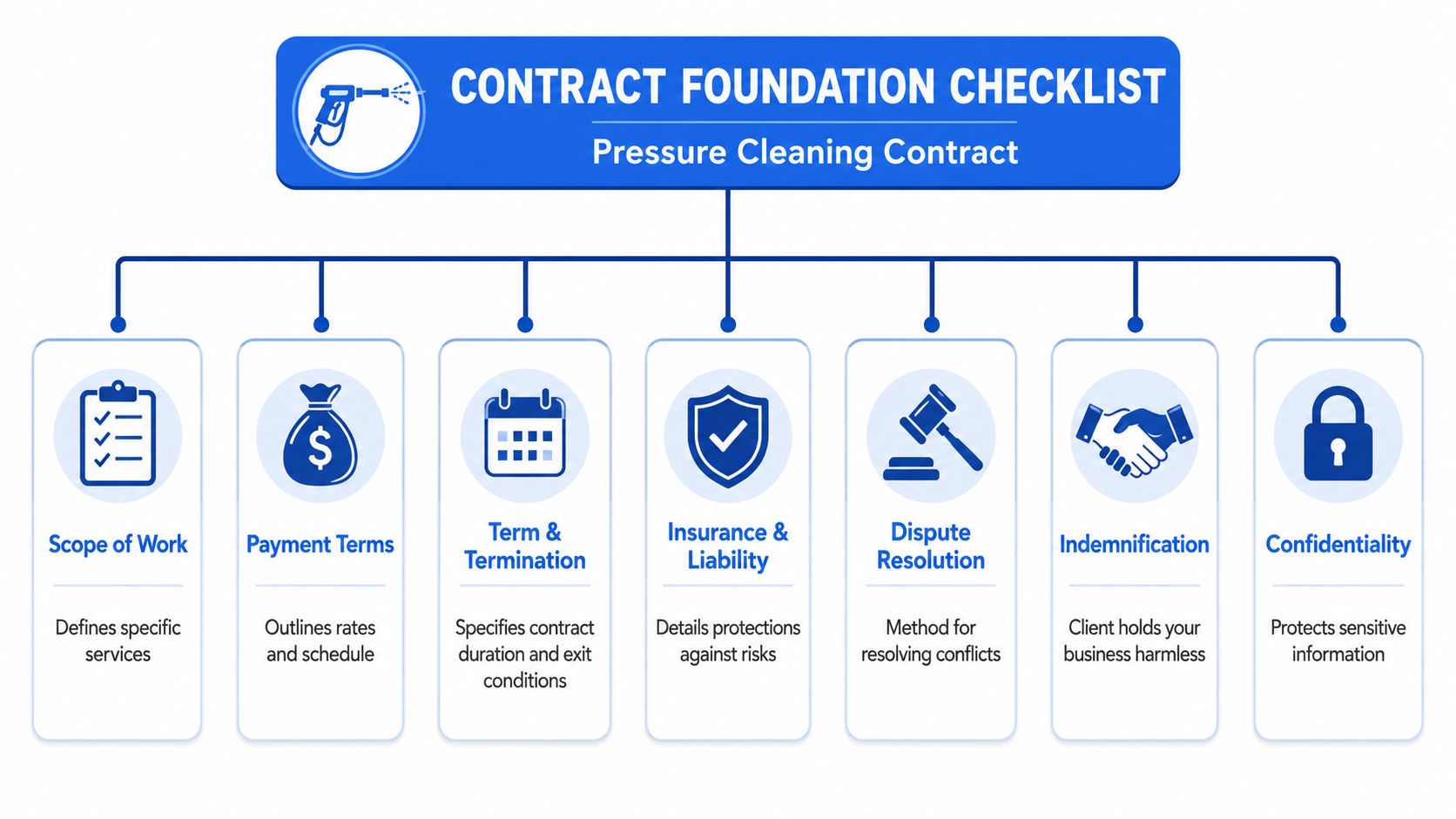
A workable foundation includes these sections:
A crew shows up to wash a tract home in Phoenix and finds two locked side gates, no working hose bib, brittle sun-cooked paint on the patio cover, and a client who assumed oil stains on the driveway would "probably come out." The same week, a retail center manager in Las Vegas wants overnight service, zero disruption to tenants, and emergency touch-ups after a storm. Those jobs should never run under the same contract language.
Job type changes the risk, the setup, and the margin. Analysts at 4M found in this cleaning contract pricing white paper that labor drives most cleaning costs. In pressure cleaning, profit usually disappears through bad assumptions about access, protection, water supply, drying time, and return visits that were never priced correctly.
Residential work creates small disputes that turn into expensive call-backs if the contract stays generic. Homeowners focus on the finished look, but exposure usually sits around the work area. Decorative light fixtures, door seals, painted trim, pool equipment, window screens, planters, and pets all affect how the crew can clean safely.
The contract should spell out who provides access, whether on-site water and power are available, and what happens if they are not. In Arizona and Nevada, water access is not a minor detail. If the hose bib is broken, locked behind a tenant gate, or delivers weak pressure, production slows down and the cleaning method may need to change.
Surface language matters just as much. Older stucco, painted block, oxidized coatings, wood trim, and patched masonry should never sit under a vague "pressure washing" description. The better approach is to identify the surface, the method, and the limitation. If a wall has failing paint or brittle patchwork, the contract should say cleaning may expose conditions that already existed. This article on using a pressure washer on stucco gives a good example of why method-specific wording protects both sides.
A solid residential scope usually covers:
Commercial clients are buying control as much as cleaning. They want the job done with the least disruption to customers, tenants, employees, and deliveries.
That changes the contract. A retail center, medical office, restaurant pad, warehouse, or HOA common area needs clear language on work hours, barricades, water runoff control, point-of-contact authority, and what happens if the site is not ready when the crew arrives. In Phoenix and across the desert Southwest, dust, hard water, grease, and monsoon runoff also affect how often service is needed. A one-time cleanup contract should not read like a recurring maintenance agreement, and a recurring agreement should define what is included in a standard visit versus a storm-response or spill-response callout.
I also like to separate cleaning frequency from cleaning standard. If the contract only says "monthly pressure cleaning," the client and contractor can end up with very different expectations. It is better to identify the areas serviced each visit, the level of buildup expected under normal conditions, and the approval process for extra work. For smaller operators trying to tighten up their paperwork before taking on larger accounts, practical guidance on insurance for self-employed cleaners helps frame the level of risk those commercial terms create.
High-rise work carries a different exposure profile from ground-level cleaning. Access approvals, restricted work windows, public safety controls, staging areas, and tenant coordination all need to be written down before the first hose is pulled.
In Las Vegas resort and mixed-use properties, that often means roof access rules, loading dock times, engineering approval, security coordination, and written limits on where water can and cannot go. In Colorado, freeze-thaw conditions can add another layer. Water intrusion around failed sealants or façade joints may not show up during service, but the cleaning contractor still gets blamed if the contract never addressed pre-existing conditions and water-management limits.
The contract should identify the access method, the approved service area by elevation or zone, and who has authority to stop work if conditions change. It should also separate façade cleaning from restoration. Pressure cleaning can remove soil. It does not fix failed coatings, leaking joints, or concrete spalling.
| Clause Focus | Residential | Commercial (e.g., Retail, Office) | High-Rise |
|---|---|---|---|
| Scope detail | Specific surfaces around the home, owner responsibilities, exclusions for permanent staining or restoration | Service zones, traffic areas, dumpster pads, frequency, and site-specific exclusions | Elevation-by-elevation scope, access method, restricted surfaces, and engineering limits |
| Scheduling | Arrival window, occupant access, pets, parked vehicles | After-hours service, tenant coordination, loading access, and disruption limits | Building access windows, security clearance, wind or weather restrictions, and staging times |
| Water and utilities | On-site hose bib and power availability, alternate charge if unavailable | Approved water source, runoff handling, shutoff coordination | Approved tie-in points, drainage controls, and limits near sensitive façade systems |
| Protection language | Landscaping, screens, patio items, painted finishes, door seals | Storefront glass, signage, slip hazards, pedestrian routing | Public protection, façade sensitivity, anchor points, and restricted zones |
| Approval process | Homeowner approval | Property manager, facility contact, or regional manager approval | Building management, engineering, security, and site supervisor sign-off |
| Return service terms | Weather-related touch-ups only if stated | Defined callout rates, emergency response terms, and recurring standards | Limited return scope unless separately authorized and re-access approved |
The contract should match the building, the surface, and the service tier. Generic templates miss the exact problems that turn profitable jobs into claims.
If your contract talks a lot about cleaning and barely talks about risk, it's unfinished.

Pressure cleaning creates exposure in three places. First, bodily injury, especially slip-and-fall risk in walkways, drive lanes, and entries. Second, property damage, such as etched glass, lifted paint, blown-out sealants, scarred wood, or water intrusion. Third, dispute exposure, where the surface was already failing but the cleaning crew gets blamed because the failure became visible during washing.
Most owners ask, “Are you insured?” That's too broad to be useful. The contract should identify the coverage you carry and what documents you can provide before service begins. It should also name the conditions that fall outside your responsibility, including pre-existing damage and latent defects.
For smaller operators and independent crews, practical reading on insurance for self-employed cleaners can help clarify what kinds of policies matter before you start signing bigger commercial agreements.
A solid liability section usually covers:
If clients confuse bonding and insurance, this explanation of bonded vs insured helps frame that conversation in plain English.
One of the biggest mistakes in pressure cleaning contracts is a vague warranty. “We guarantee our work” sounds good until the client calls two weeks later about a stain that was never fully removable.
Your warranty should cover workmanship, not miracle restoration. That means you stand behind the service being performed as agreed, with the method and care promised in the contract. It does not mean every stain disappears forever or that neglected surfaces become new.
Field rule: Warranty the quality of your process. Don't warranty outcomes controlled by weather, traffic, porous material, or pre-existing damage.
A clean acceptance process helps. Walk the site, document the result, and define when the client is expected to raise concerns. That prevents a normal service call from becoming an open-ended obligation.
A short visual primer can help teams explain why contract language around liability matters in the first place.
Include a right-to-stop-work clause.
If the crew encounters unsafe access, active electrical hazard, unreported surface instability, no drainage control where required, or conditions that materially increase risk, the contract should allow work to pause until the client corrects the issue or approves revised scope. That single clause has saved many contractors from turning a marginal job into a claim.
A property manager in Phoenix signs a low-bid recurring service agreement in April. By July, monsoon dust has doubled the buildup on walks and entries, one water source is locked behind a tenant gate, and the crew is waiting on site for someone with authority to approve extra work. The problem is not the signature. The problem is that the agreement never spelled out how the account would run once real conditions showed up.
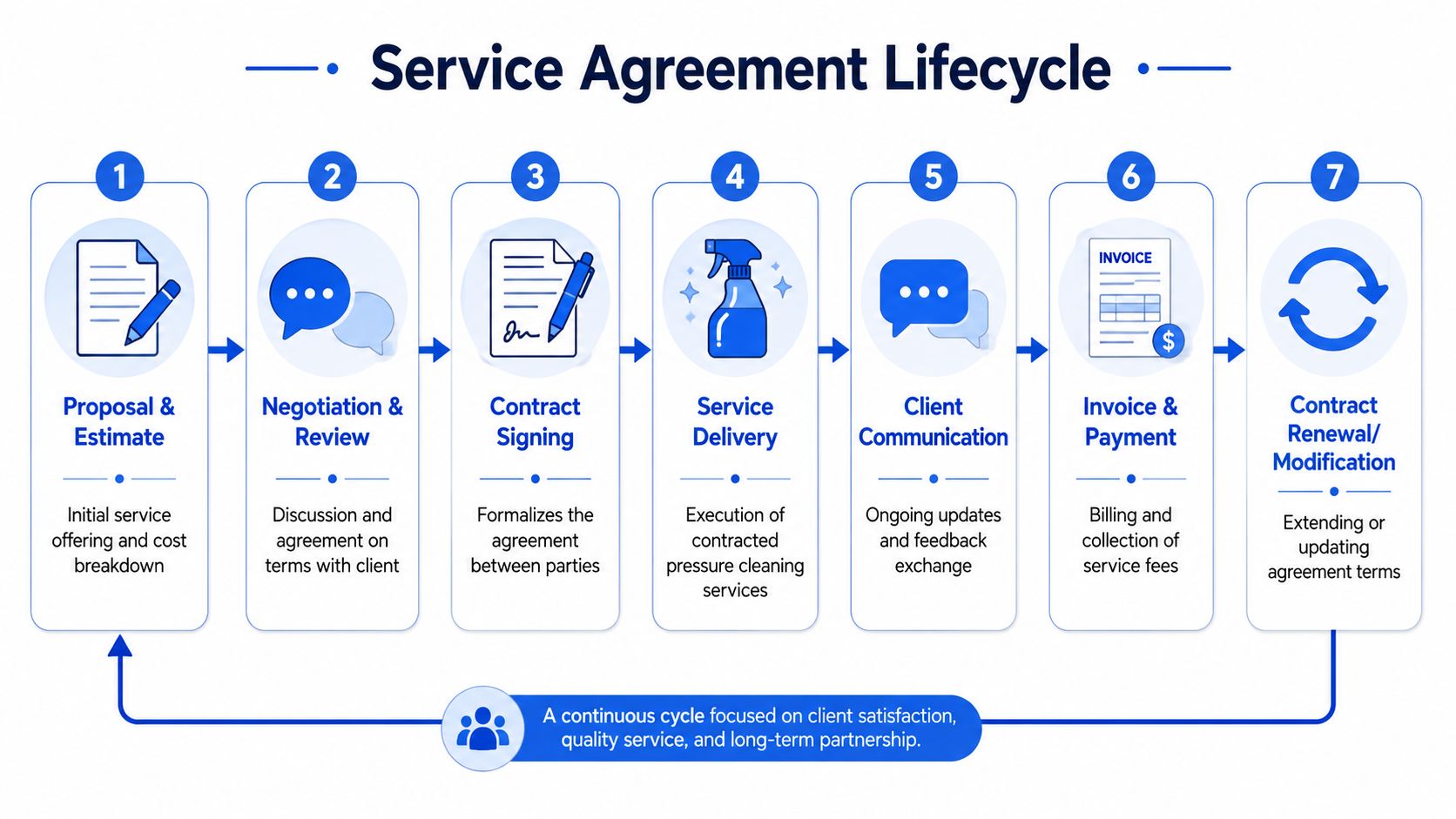
That is where service agreements either protect margin or drain it.
A signed contract only sets the starting point. Profit is made or lost in scheduling, access, change approvals, site conditions, and how fast both sides handle exceptions. Analysts cited by Pure Seal Services on pressure washing business failure rates point to weak execution, poor revenue planning, and lack of formal controls as common reasons cleaning businesses struggle. Pressure cleaning contracts break down the same way. They break down after the sale, during the routine work of keeping the account on track.
Price gets attention first. Operations decide whether the number works.
On residential jobs, that usually means confirming water access, gate codes, pet control, drainage paths, and whether the client understands what can and cannot be removed from concrete, pavers, stucco, or coated surfaces. On commercial work, the list gets longer. Access windows, loading zones, after-hours entry, tenant coordination, grease runoff controls, and who signs off on add-ons all need to be settled before the first service date. On high-rise and multi-level properties, the agreement also needs to address lift access, restricted zones, staging areas, and weather or wind holds that can shut down part of the scope without killing the whole day.
Good negotiation sounds plain:
Those details matter in Arizona, Nevada, and Colorado because conditions change fast. Dust, hard water, overspray, freeze-thaw cycles in some markets, event traffic, and seasonal occupancy all affect the scope even when the address stays the same.
Recurring service fails when the paperwork stays frozen and the property does not.
Set review points into the agreement. Quarterly works for many commercial accounts. High-traffic retail sites may need a monthly scope check. Large residential communities often need a seasonal review because irrigation patterns, dust load, and occupancy shift during the year. The purpose is simple. Compare the original scope to current site reality before missed expectations turn into a pricing fight.
A recurring agreement should define:
That protects both sides. The client gets a property that stays presentable. The contractor gets a written path to adjust labor, chemicals, equipment time, and visit frequency before the account starts losing money.
If change orders are slow, crews either wait around unpaid or do extra work that never gets billed.
The contract should say exactly how changes are approved. Email is fine for many commercial accounts. Text approval can work for smaller jobs if the agreement allows it and ties the approval to a dollar amount or added scope. For property managers, list primary and backup approvers. For HOAs and retail centers, define whether the onsite manager can approve spot work or only report it.
Keep the format simple. Date, added area, reason for change, price, and who approved it. No mystery. No debate a week later.
Every service agreement needs a clear exit process. That matters on recurring residential routes, commercial storefront work, and large annual contracts.
State the notice period. State what happens to work already scheduled. State when final invoices are due. State whether prepaid work is refundable, partially earned, or credited based on work already completed. If the account has recurring service at multiple properties, say whether termination applies to one site or the whole group.
Suspension language matters too. If payment is late, access is repeatedly unavailable, or site conditions make service materially different from what was sold, the agreement should allow the company to pause future visits until the issue is corrected. That is not aggressive. It is basic account control.
Mediation can also make sense on larger commercial agreements, especially where a dispute over scope, staining, or service frequency could drag on longer than the work itself. A short dispute process often saves both parties money.
The best-managed agreements remove guesswork. Everyone knows who opens the gate, who approves extras, when scope gets reviewed, and what happens if the property changes. That is how recurring work stays profitable in real markets, not just on paper.
The next version of pressure cleaning contracts won't be judged only by the legal language. It will be judged by the documentation attached to the work.

Commercial buyers increasingly expect the contractor to prove what happened on site. That means before-and-after photos, estimate photos, completion notes, service timestamps, and organized records that match the invoice. Creator guidance around pressure-washing marketing and local visibility also points to growing expectations for visible documentation and proof of work, especially for property managers and institutional buyers who want audit trails and presentation consistency. That's why modern contracts are becoming documentation-heavy operational products, not just simple service agreements.
Don't leave documentation as an informal habit. Put it in the contract.
State that the company may document site conditions before service, record completed work areas after service, and attach that documentation to completion records or invoices. For recurring accounts, define where those records go and who receives them. On commercial properties, also identify who can approve completion remotely if the client isn't on site during after-hours work.
A future-proof agreement also reflects where you work. In Arizona, Nevada, and Colorado, weather and surface conditions vary enough that generic language creates risk. A contract for a shaded Denver property with freeze-thaw wear shouldn't read like one for a sun-beaten Phoenix block wall or a Las Vegas storefront dealing with dust and irrigation spotting.
Keep the contract updated when your service model changes. If you add recurring maintenance tiers, digital reporting, site maps, or client portals, your agreement should reflect that. If your crews are expected to provide photos, note water-access issues, or log damage before starting, that belongs in writing too.
The companies that win better accounts usually don't have the fanciest templates. They have contracts that match the actual job, the actual site, and the actual client expectation. That's what protects margin, reduces conflict, and gives the customer confidence they hired a professional.
If you want exterior cleaning handled with the same clear standards that come from more than 26 years in the field, Professional Window Cleaning is a strong place to start. From residential properties to commercial and high-rise work, our team brings disciplined service methods, clear communication, and professional results across Arizona, Colorado, and Nevada.
Read our blog posts regularly and keep learning.