Care and Maintenance
How Much Can a Window Cleaning Business Make in 2026
Wondering how much can a window cleaning business make in 2026? See real revenue, profit margin, and owner income numbers for solo, crew, and high-rise


You're probably here because you asked for a quote, then got three different prices for what sounded like the same job. One company counted windows. Another talked about panes. A third asked about screens, tracks, ladders, and whether you wanted inside and outside done.
That doesn't mean somebody is making numbers up. It usually means they're pricing different scopes, different access conditions, or different cleaning methods. A good window cleaning price calculator isn't supposed to spit out one magic number. It's supposed to reflect how the job is done.
You call three window cleaners for the same house in Scottsdale or Las Vegas. One price comes back low, one is twice that, and one contractor starts asking questions you did not expect. How many panes? Are the screens removable? Do the upstairs windows open inward? Is this inside and outside, or exterior only? That is usually the moment the quote stops feeling random and starts making sense.
Window cleaning prices change because cleaners are often measuring different jobs. One company is pricing basic exterior glass. Another is pricing interior and exterior glass, screens, tracks, French panes, and ladder work. A third is assuming a pure-water exterior clean on accessible upper windows instead of hand-detailing every piece of glass. If the scope changes, the labor changes. If the labor changes, the price should change.
After 26 years in this trade, I can tell you where homeowners get tripped up. They ask for a price per window, but many jobs are not priced by a simple window count. They are priced by the amount of glass, the time it takes to clean that glass properly, and the access required to do it safely. A big fixed picture window and a multi-pane unit may each count as one window on a rough walkthrough, but they are not one unit of labor.
Every quote starts with the cleaning method, because the method tells you a lot about labor, setup, and pace. Professional window cleaners use two main systems. Traditional squeegee work for detail cleaning, and pure-water cleaning for exterior glass where pole access makes sense.
Squeegee work is slower and more hands-on. It is the standard choice for interiors, storefront glass, mirrors, doors, and divided-light windows where edges and detailing matter. Pure-water cleaning is often the better fit for upper exterior glass, larger homes, and commercial buildings with good ground access. If you do not know which method fits the property, you do not know the actual labor involved yet.
That is also why a useful guide to what window cleaners charge helps more than a generic online number. Good pricing starts with how the work will be done, not just how many openings the house has.
Local conditions also affect pricing, even when the house size looks similar on paper.
Desert markets teach this fast. In Scottsdale and Las Vegas, sun exposure, dust, hard water, and neglected screens can add labor that does not show up in a simple window count. Glass that has gone too long between cleanings often needs extra attention around edges, frames, and screens. Properties with tight side yards, pool equipment, steep landscaping, or limited ladder placement can also slow a crew down.
So the quote is not random. It is a formula, whether the company explains it well or not. The price moves based on glass count, pane style, access, method, service level, and condition. Once you understand those inputs, you can build an estimate that looks a lot closer to what an experienced pro would quote.
Most bad estimates fail before the math starts. They use the wrong inputs.
A large single-pane picture window and a French-style unit with multiple divided panes are not the same job. They may look similar from the street, but they don't clean the same way and they don't take the same amount of handwork.
That's why the first input should be an exact inventory of the glass units you're asking to be cleaned. If you want a reality check on what pros usually charge, this guide on how much window cleaners charge is useful as a companion to your estimate.
Professional window cleaning exclusively uses two distinct methodologies: the traditional squeegee technique for detailed interior work and the pure-water system, which is the standard for glass above one story or on large commercial properties, as explained in Orloff's comparison of water-fed pole and traditional squeegee methods.
That has direct pricing consequences:
Some windows are expensive because they're dirty. Others are expensive because they're awkward. Awkward usually wins.
The third input is access. Homeowners and property managers most often underestimate the job when considering this factor.
Use this checklist before you try to price anything:
A good calculator doesn't just ask “how many windows?” It asks what kind, where they are, and what's included.
A homeowner in Scottsdale calls after getting two quotes for the same house. One is $240. The other is $480. Same address, same glass, completely different numbers. That usually happens because one cleaner is guessing from the driveway, and the other is properly building the job.
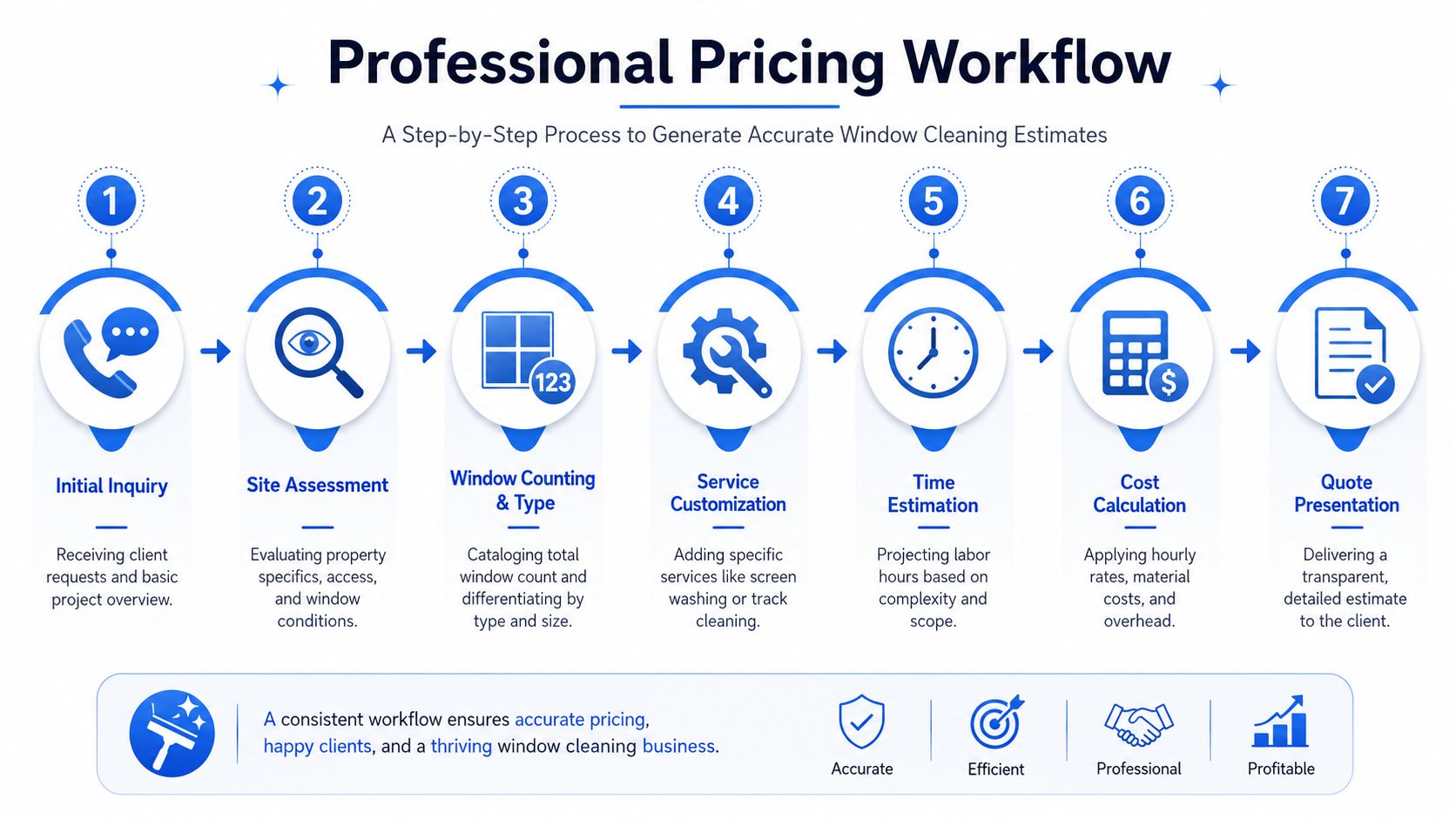
A professional quote starts with the company's cost to do the work, then adds the margin needed to stay profitable. After that, the cleaner chooses the right pricing unit, counts the glass accurately, adjusts for difficulty, adds any extra services, and checks the total against a minimum job charge.
That order matters. If the quote starts with a blanket “price per window” and everything else gets patched in later, the estimate usually drifts off course on French panes, skylights, cut-up glass, or second-story work.
Here is the practical version of the workflow I've seen hold up best in the field:
Start with job cost
Include labor time, travel, supplies, setup, insurance, and the overhead that keeps the truck rolling.
Add your margin
Profit is not the leftover. It has to be built in on purpose, or hard jobs start paying less than easy ones.
Pick the unit that fits the property
Simple residential work may price well by window. Divided-light glass usually needs pane counting. Some larger commercial jobs make more sense under the average window cleaning rate structures used for commercial and residential work.
Count the glass exactly
A slider, a double-hung, a transom, and a true divided-light unit do not take the same time. They should not carry the same price.
Adjust for labor drag
Ladder resets, tight side yards, furniture moves, hard water, and paint specks all add time. Time is cost.
Add line items clearly
Screens, tracks, sills, mirror work, chandeliers, and post-construction cleanup should be listed separately so the client can see what is included.
Apply a minimum charge
Small jobs still require drive time, unloading, setup, and paperwork. A minimum keeps a two-window stop from being priced like five minutes of labor.
Before going further, it helps to see the job flow in action:
The working formula is straightforward:
Total Price = Total Cost + (Profit Margin × Total Cost)
That formula explains why two properties with the same window count can price very differently. Twenty windows with open ground access in Las Vegas can be a fast morning job. Twenty windows on a custom home with divided panes, deep ledges, and interior furniture to work around can take far longer.
The count matters. The labor matters more.
Cheap calculators miss the job in predictable ways.
They count units too loosely
A “window” is often entered as one item when it may contain several panes or take specialty detailing.
They skip labor conditions
Access problems, heavy soil, ladder work, and setup time often decide whether the estimate is realistic.
They bury extras
Clients think they are comparing equal quotes, then find out one price excluded screens, tracks, or interior glass.
A low number built on bad counting is how cleaners lose money and customers get change orders after the work starts. A better calculator shows the logic up front, so the final price makes sense before anyone pulls a hose or sets a ladder.
A homeowner calls from Scottsdale after getting two quotes for the same house. One cleaner says $220. Another says $480. Both looked at the same windows. The difference usually comes from how each company counts the work, not from anyone pulling a number out of thin air.
That is why sample properties help. You can see which input changes the price, and why.
Start with a straightforward house. Say the home has standard double-hung windows, decent ground access, and a normal inside-and-outside clean. That is usually a pane-count job, with adjustments for how many pieces of glass you are really cleaning, how much ladder work is involved, and whether screens and tracks are included.
On paper, two Scottsdale homes can both have 22 windows and still price far apart. One might be a quick ranch with open walkways and simple frames. The other might have French panes, high foyer glass, tight side yards, and furniture that has to be worked around inside. The second house takes more labor, more setup, and more detail work. That is what the calculator needs to capture.
If you want a broader benchmark for how residential jobs are commonly structured, this guide to average window cleaning rates gives useful context. Use it as a reference point, then build from the actual glass, access, and scope in front of you.
A storefront should be priced from production, not from a house formula.
Large fixed panels often clean fast if the route is easy, the glass is maintained, and there is no obstacle like patio seating, signage, or heavy foot traffic. A small retail frontage with broad glass can make more sense as a square-foot or hourly job than a per-pane job, because the cleaner is really pricing time on site, setup, and frequency.
Frequency matters more on commercial work than many owners expect. A weekly or biweekly storefront usually stays easy. A neglected storefront with baked-on dust, sprinkler spotting, tape residue, or handprints at every panel slows down in a hurry. Same frontage. Different labor.
High-rise work follows a different math.
Once the job needs lift access, rope work, restricted scheduling, or a crew trained for suspended work, the glass itself stops being the main pricing driver. Safety planning, equipment, insurance requirements, and access coordination take over. Property managers sometimes focus on the window count and miss the main cost center. On these jobs, access decides the number first, and the glass count supports it.
That is why a condo balcony clean and an exterior high-rise drop should never sit in the same calculator without separate rules.
| Property Type | Primary Pricing Metric | Estimated Price Range |
|---|---|---|
| Single-family residential home | Per window or per pane | Price varies with count, layout, access, and scope |
| Typical home with standard double-hung windows | Calculated residential job price | Usually based on panes, interior/exterior scope, and labor time |
| Standard commercial property | Per square foot | Often priced from glass area, frequency, and access |
| Commercial hourly work | Hourly rate | Used when layout and production speed matter more than pane count |
| High-rise property | Specialized hourly rate | Usually based on access method, safety requirements, and crew time |
Two houses can have the same window count and land at very different totals once the adjustments start.

That is the part many homeowners and property managers in Scottsdale or Las Vegas miss. They build a rough number from panes or windows, then wonder why the quote shifts on site. The quote changes because base pricing only covers normal production. Once a crew has to slow down, protect landscaping, detail neglected glass, or work around difficult access, the formula changes.
The biggest price jumps usually come from first-time cleaning and access difficulty. Pine Country's commercial window cleaning cost calculator guide describes those as common labor multipliers, and that matches what happens in the field.
A first clean often takes far longer than maintenance work. Dust baked on by desert heat, mineral spotting from irrigation, paint specks, tape residue, bug debris, and dirty screen frames all add labor. That extra time has to show up somewhere in the estimate.
Access changes the number just as fast. Second-story glass over tile roofs, windows above stairwells, tight side yards, dense shrubs, pool equipment, or ledges that force repeated ladder resets all reduce production speed. On those jobs, the surcharge is not padding. It covers the slower and safer way the work has to be done.
Small add-ons can change the total more than people expect, especially on larger homes or buildings with a lot of openings. Screens, tracks, and sill detailing are the usual misses.
I tell customers to ask one plain question before comparing prices. “What exactly is included in each window?” That one question clears up a lot of bad quote comparisons.
Discounts make sense when the job gets easier to repeat. Recurring service is the best example. Clean glass stays easier to maintain, crews move faster, and there is less detailing on each visit. The same logic can apply when multiple services are scheduled together and setup time is shared.
Discounts do not make sense on labor-heavy work. If the glass has been ignored for years, if access is difficult, or if the scope keeps changing, a cheap price usually means something will be skipped. In practice, the fair estimate is the one that matches the actual labor. That is how you avoid surprise add-ons after the work starts.
If you want to build your own estimate before calling a pro, keep the worksheet simple and accurate.

Write down these five things:
A worksheet like that won't replace an on-site assessment for every property, but it will keep you from comparing mismatched quotes. It also helps homeowners, storefront owners, and property managers ask better questions before approving the work.
For service areas across Phoenix, Scottsdale, Las Vegas, and Denver, that clarity matters. Professional Window Cleaning has been cleaning windows for over 26 years, and the best quotes are always the ones that explain the why, not just the final total.
If you want a precise quote from a team that understands residential, commercial, and high-rise work, contact Professional Window Cleaning. A clear estimate starts with the right counting method, the right cleaning method, and an honest look at access, scope, and condition.
Read our blog posts regularly and keep learning.