
Care and Maintenance
Casement Window Cleaning the Right Way at Home
Learn safe, streak-free casement window cleaning techniques. Covers tools, prep, hardware care, frequency, and when to call a pro.


You're standing in the driveway watching a cleaner reach a second-story window from the ground. There's no ladder, no bucket of suds, and no squeegee sliding across the glass. The technician brushes, rinses, lowers the pole, and leaves the window to dry. A few minutes later, the pane looks clear.
That result can feel like a trick, but window cleaning with pure water follows a straightforward process. A purification system removes dissolved minerals, a pump sends the water through a telescoping pole, and a brush agitates the glass before the final rinse. The method is remarkably effective on the right soil, but it isn't a universal replacement for traditional hand cleaning.
Professional Window Cleaning has been cleaning windows for over 26 years, serving homeowners and property managers in Las Vegas, Phoenix, Denver, and Scottsdale. The most useful way to understand the method is to look at both sides, what makes it work and where it needs help.
The surprising part isn't the pole by itself. Telescoping poles have existed in professional window cleaning for decades, with early pole-based concepts traced to the 1950s in the United States, but modern pure-water systems made ground-based cleaning practical at a much broader scale. Industry history identifies 1997 as a modern breakthrough year, when U.K. cleaner Craig Mawlam launched a telescopic pole integrated with a water-purification system. Window-cleaning industry history describes how that combination changed access, safety, and drying.

At the top of the pole, a brush loosens dust and ordinary outdoor grime. Water flows through jets near the brush, carrying the loosened soil down the glass. The technician doesn't use the brush to dry the pane. Instead, the final rinse leaves behind water with very little dissolved material, allowing evaporation to finish the job without the mineral marks you'd see from ordinary tap water.
That distinction matters. A water-fed pole with untreated water would spread mineral-containing water over the window and could leave spotting. The system works because the pole delivers purified water, not just because it keeps the cleaner on the ground.
Practical rule: The pole provides reach and agitation. Water purity provides the spot-free finish.
Safety is another reason professionals use the method. Ground-based access removes many routine ladder tasks, and regulators such as the U.K. Health and Safety Executive treat work at height as a serious hazard requiring appropriate planning, training, and protective measures. Historical accounts also show why safer access became so important. One cited figure reports that in 1932 in New York, about 1 in 200 window cleaners were killed annually. That figure appears in a history of window washing and safety.
Pure water looks magical only until you separate the process into two jobs. The brush cleans the surface, while the mineral-free rinse lets the glass dry clear.
Think about the ring left inside a coffee cup after water dries. The water disappears, but whatever was dissolved in it remains on the ceramic. Tap water can behave the same way on glass. Calcium, magnesium, sodium, and silica travel with the water, then remain behind as the water evaporates.
Total dissolved solids, or TDS, gives a practical reading of that dissolved material. A mixed-bed deionization system, or a reverse-osmosis system followed by deionization, reduces the concentration of ions so the rinse water has very low conductivity. Field guidance commonly treats 0 to 10 parts per million, or ppm, TDS as the useful operating range for strong results, while water above roughly 20 ppm is often considered marginal for consistently spot-free drying. These thresholds vary with the water profile and the glass, so the meter is a control tool, not a guarantee by itself. Technical guidance on deionized water explains why dissolved minerals cause visible deposits as water evaporates.
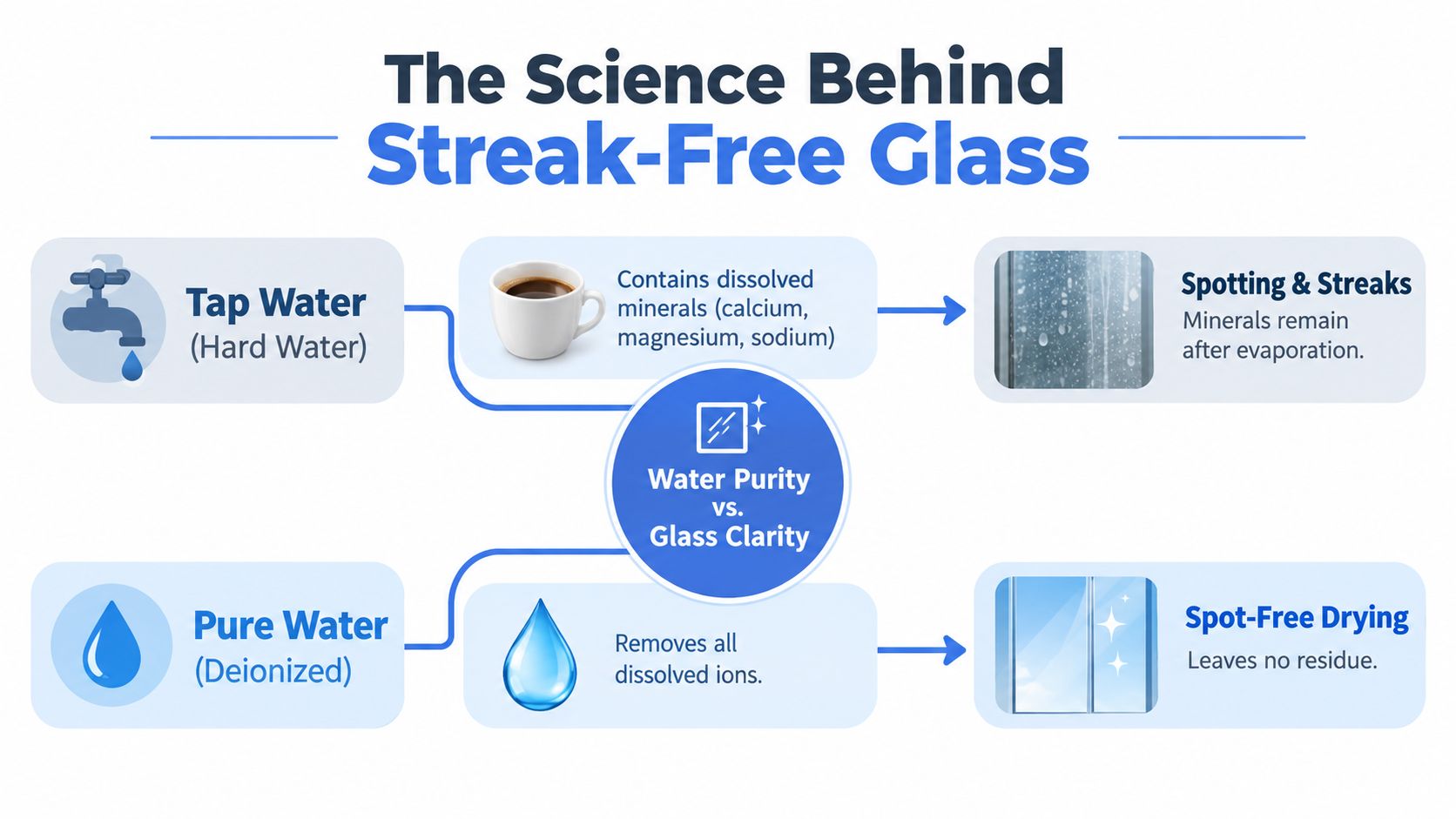
A purification system strips dissolved ions from the water. Reverse osmosis pushes water through a membrane that rejects much of the dissolved material, while deionization resin captures remaining charged particles. The final water isn't “stronger” because it contains a cleaning chemical. It's useful because it contains fewer minerals that can turn into residue.
The brush still matters. Agitation breaks the bond between ordinary dust and the glass, and the flowing water carries that soil away. Pure water can also interact favorably with particles on the surface because it lacks the mineral load found in untreated water, but it won't dissolve every contaminant. Oils, cured adhesive, and construction residue require a different kind of treatment.
For a homeowner, the practical test is simple. Ask the technician to show the TDS reading from the water being delivered to the pole, not only the reading from a storage tank or purification outlet. A reading near zero is ideal, and a reading in the 5 to 10 ppm range may still work on some glass and water profiles. The result also depends on brush technique, rinse quality, weather, and what was on the window before cleaning.
For a plain-language explanation of the difference between distilled water and professional purification, see cleaning windows with distilled water.
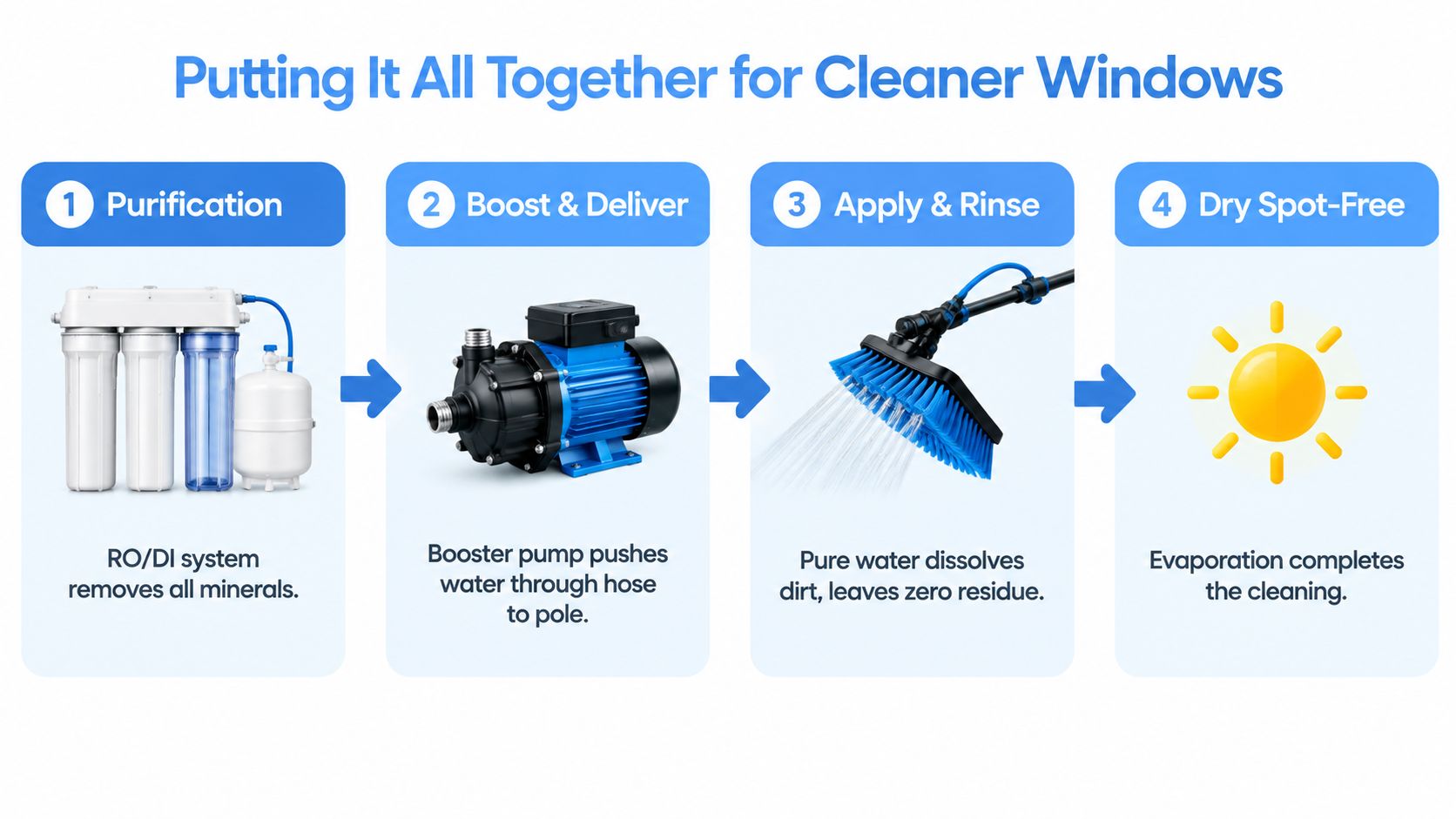
A professional system is a chain, and every link affects the finish. Purification removes minerals, a pump creates usable pressure, a hose carries water to the pole, and the brush distributes that water across the glass. If one part is undersized or poorly maintained, the technician may have clean water but still struggle to rinse efficiently.
A typical setup starts with water treatment. Sediment filtration protects later stages from particles, carbon filtration helps protect the membrane, reverse osmosis removes much of the dissolved load, and a DI vessel polishes the water to a very low TDS level. Readers who want a broader explanation of laboratory purification categories can review Type II and III water explained, although professional window cleaning applies those purification principles in a different operating environment.
A pump then moves water through the hose and up the telescoping pole. Commercial systems commonly operate around 8 to 10 bar, with pure-water flow around 3 to 8 litres per minute, and some equipment is rated for productivity up to about 200 square metres per hour with pole reach around 16 metres. These figures come from commercial pure-water equipment specifications. They're equipment ratings, not promises for every property, because pane size, soil, access, wind, and operator technique change the actual pace.
| Component | Typical Spec / Range | Why It Matters |
|---|---|---|
| Purification system | RO, DI, or RO plus DI | Removes dissolved minerals before water reaches the glass |
| TDS meter | Near 0 to 10 ppm target | Confirms whether the final water is suitable for spot-free drying |
| Pump | Around 8 to 10 bar in commercial systems | Maintains delivery pressure at the brush |
| Water flow | About 3 to 8 L/min | Flushes loosened dirt away instead of allowing redeposition |
| Water-fed pole | Telescoping carbon fiber or hybrid construction | Provides reach while keeping the operator on the ground |
| Brush head | Rinse jets with bristles suited to the surface | Combines agitation and rinsing |
| Hose and reel | Flexible, organized delivery line | Reduces tangles, trips, and interruptions |
Pole material also affects handling. Carbon fiber is light and rigid, while hybrid poles balance cost, weight, and stiffness. The correct length depends on the building, roofline, setbacks, and the technician's working position. A longer pole isn't automatically better if it flexes excessively or becomes difficult to control.
Professional Window Cleaning describes a pure-water window-washing process that uses filtration, deionization, a pump, and a water-fed pole. The important hiring question isn't whether a company owns a pole. It's whether the company can verify water quality and match the equipment to your windows.
The two methods professionals use are the squeegee method and the pure-water system. Neither one wins every job. Pure water is especially practical for exterior glass that can be reached from the ground, while a squeegee gives the cleaner close visual control needed for many interiors and difficult residues.
A squeegee job uses a washer or applicator, cleaning solution, rubber blade, and cloths. The cleaner wets the glass, loosens the soil, pulls the blade across the pane, and details the edges. Professional technique includes holding the blade at about a 45-degree angle, maintaining steady pressure, and overlapping strokes by about one inch. Professional squeegee technique guidance also emphasizes creating a dry edge and wiping the rubber blade between pulls.
| Factor | Pure Water Method | Traditional Squeegee |
|---|---|---|
| Exterior access | Often cleans from ground level with a water-fed pole | May require ladders or closer access |
| Drying | Dries naturally when water purity is suitable | Cleaner removes water manually |
| Ordinary outdoor soil | Brush agitation and rinsing work well | Washer and solution work well |
| Oily or bonded residue | Often needs pre-treatment or hand finishing | Stronger control over solvent and agitation |
| Interior glass | May smear oils if used without preparation | Usually gives better close-up control |
| Chemical use | Can operate without detergent | Typically uses a cleaning solution |
| Frames and corners | Brush can flush edges and vents | Cloths and detail tools provide precision |
| Safety at height | Keeps the operator on the ground for suitable work | Requires careful access planning when height is involved |
Pure water can reduce ladder setup and repositioning on exterior jobs, which makes it attractive for homes, storefronts, office buildings, and larger glass surfaces. It also avoids detergent runoff during the pure-water pass. That doesn't mean it uses no water. The brush needs enough flow to flush loosened soil, and the system's water demand depends on the equipment and operator.
Traditional squeegee work remains valuable for interior panes, post-construction detailing, painted or oily contamination, and situations where the cleaner needs to inspect and finish the glass at close range. A capable company may use pure water outside and a squeegee inside, rather than forcing one method onto every surface.
Pure water is still water. Removing minerals prevents mineral residue, but it doesn't give water the solvent power needed to break down every film on glass. That's the limitation many simple explanations skip.
Outdoor windows often carry water-soluble dust, pollen, and loose environmental soil. They may also carry cooking exhaust, road spray, tree sap, bird droppings, ivy marks, or residue from nearby construction. Inside the home, fingerprints and oily films are even more demanding. A wet brush can move that grease around and leave a haze instead of lifting it into a cloth.
A clean rinse can't repair a damaged surface or dissolve every contaminant.
Climate changes the likelihood of a good result, but it doesn't eliminate the method's boundaries. Exteriors in dry areas such as Phoenix, Las Vegas, and the Front Range around Denver may respond beautifully when the soil is loose and water-soluble. Interior glass, freshly renovated windows, and panes with oily buildup commonly need a hand-finish or pre-wipe.
Verification starts with TDS. Ask to see a reading at the pole tip before work begins. A target near 0 ppm is ideal, readings around 5 to 10 ppm may work depending on conditions, and water above roughly 20 ppm can be marginal for reliable drying. TDS doesn't identify oil or paint, so a good technician should inspect the soil as well as test the water.
The strongest fit is a property with substantial exterior glass, repeat maintenance needs, and windows that can be reached safely from the ground. One- and two-story suburban homes often benefit because the cleaner can work around landscaping without repeatedly setting up a ladder. The brush also reaches frames and corners that a quick glass-only wipe may miss.
Commercial properties can gain operational value from the same workflow. Storefronts, office parks, HOA communities, car dealerships, medical offices, schools, and stadiums may have many panes that reward consistent equipment and repeat scheduling. High-rise and mid-rise properties can also use purified water as part of a larger access plan involving rope access, platforms, or other specialized crews.
The cost depends on access, pane size, soil, frequency, building type, and whether interior detailing is included. Published market guidance for Arizona, Colorado, and Nevada commonly places residential exterior work around $4 to $8 per pane, high-volume commercial work around $1.50 to $4 per pane, and mid-rise or high-rise work around $0.10 to $0.25 per square foot. These figures are presented in the supplied market guidance at pure-water cleaning information, and they should be treated as broad pricing ranges rather than a quote.
Dusty desert properties may need more frequent attention than homes in milder foothill environments. A commercial manager should evaluate visibility, customer traffic, landscaping, access, and the cost of allowing soil to accumulate. A homeowner may prefer seasonal service, while a dealership or medical office may need a recurring exterior route.
Pure water can be cost-effective when the crew can clean many accessible panes efficiently. It becomes less decisive when every pane needs individual stain treatment, interior detailing, or labor-intensive restoration. Ask for the scope in writing, including exterior versus interior glass, frames, screens, hard-water treatment, and any post-construction work.
A professional-looking pole doesn't prove that the water is pure enough to dry clean. Before booking service in Arizona, Colorado, or Nevada, ask questions that connect the equipment to the result.
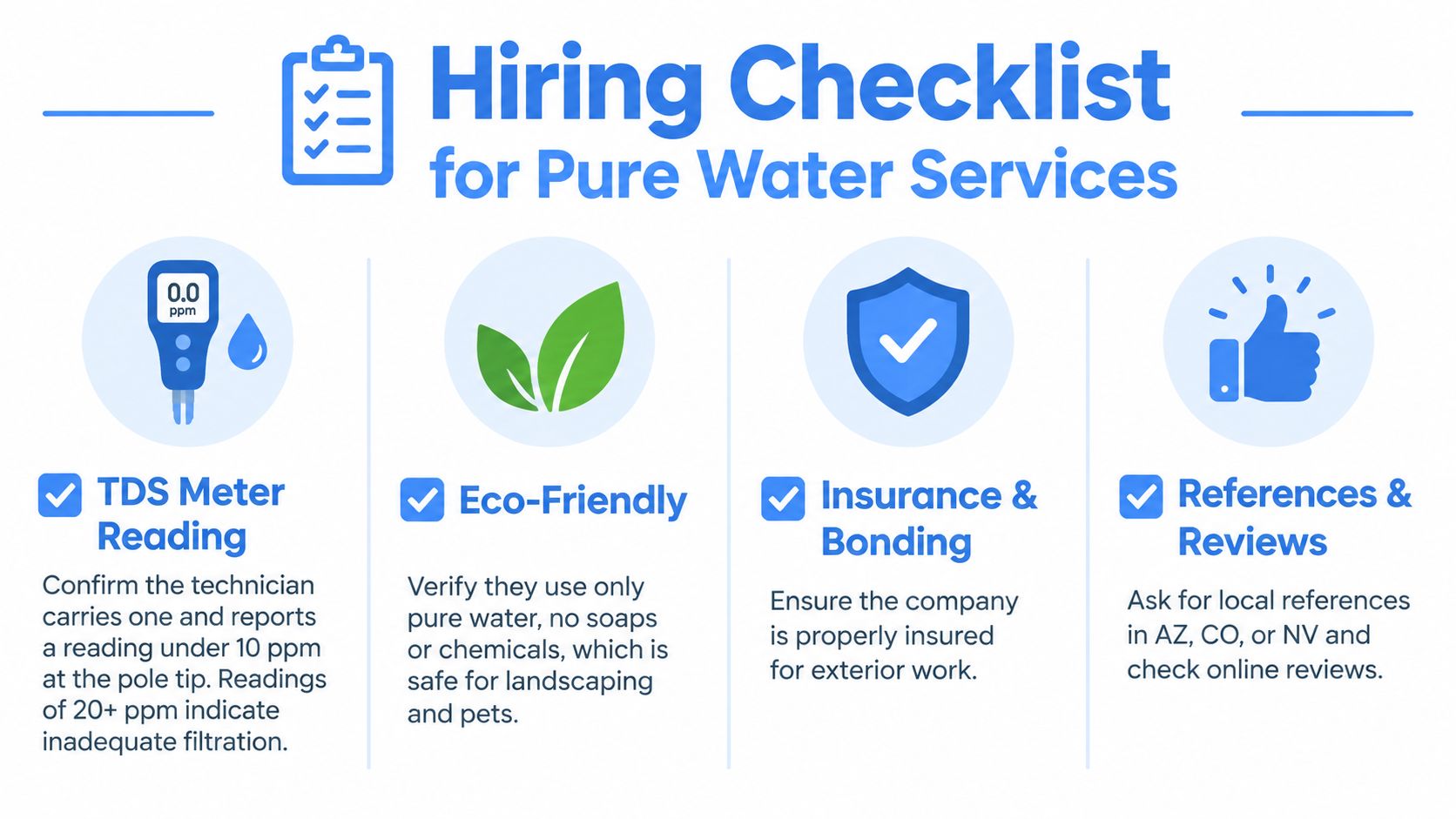
Ask for the TDS reading. The technician should carry a TDS meter and be able to report the reading at the pole tip. A target under 10 ppm is commonly used for strong results, while readings of 20 ppm or more may indicate that the water needs additional treatment or resin replacement. The exact reading should be interpreted alongside the glass and local water profile.
Confirm the access plan. Ask how the pole reaches your highest window without unsafe overextension. A technician should explain whether the property needs a shorter residential pole, a longer carbon fiber or hybrid pole, or another access method.
Clarify the cleaning method. Ask whether the company uses pure water only, traditional squeegee work, or a hybrid approach. Interior glass with fingerprints, kitchen film, or smoke residue may need a squeegee and hand-detailing process.
Discuss contamination before the appointment. Mention paint, plaster, stickers, sap, ivy, bird droppings, renovation dust, or hard-water stains. A company that knows the problem in advance can bring the right tools instead of treating every pane as ordinary dust.
Verify insurance and references. Request proof of appropriate general liability and workers' compensation coverage, then ask for references or photos from comparable properties in AZ, CO, or NV. Reviews are useful, but they shouldn't replace a clear scope of work.
Ask about runoff and scheduling. Pure water avoids detergent during the water-only pass, but the crew still uses water. Confirm how technicians manage runoff near drought-sensitive landscaping and whether recurring service can be scheduled around dust, pollen, and seasonal debris.
A good provider won't promise that pure water solves every stain. They'll explain which panes qualify for water-fed cleaning, which need traditional work, and how they'll verify the finish.
The method makes sense once you connect the steps. Purification removes dissolved minerals, the pump delivers the water, the brush agitates the glass, and the final rinse leaves little behind to form spots. The glass then dries naturally, provided the water quality and surface condition are suitable.
Pure-water systems are especially useful for exterior residential and commercial glass that can be reached from the ground. They reduce routine ladder work and can clean frames and panes in one connected process. They also avoid detergent during the pure-water pass, which may matter around landscaping, pets, and drainage areas.
They aren't the right answer for every pane. Oily films, paint, plaster dust, sticker adhesive, ivy marks, baked-on bird droppings, and etched mineral deposits may need manual scrubbing, scraping, pre-treatment, or solvent work. Interior glass often deserves a separate squeegee process because the cleaner can lift oily residue instead of spreading it with a wet brush.
For property owners in Arizona, Colorado, and Nevada, the next step is practical:
The method isn't magic, and it isn't a universal substitute for skilled squeegee work. It's a specialized system that performs exceptionally well when the water is properly purified, the equipment is correctly matched, and the glass carries the kind of soil the process can remove.
Professional Window Cleaning offers residential, commercial, and high-rise window washing with pure-water equipment for suitable exterior glass and traditional methods where close detailing is needed. Visit Professional Window Cleaning to discuss your windows, confirm the right cleaning approach, and request service in your area.
Read our blog posts regularly and keep learning.