Care and Maintenance
Hard Water Stain Remover Shower: What Actually Works
Find the right hard water stain remover shower fix for glass, tile, grout, and chrome. Safe DIY recipes, product picks, and prevention tips that work.


A solo window cleaning operator in markets like Phoenix, Las Vegas, or Denver typically produces $80,000–$150,000 in gross revenue with roughly a 30%–40% net margin after equipment, insurance, and supplies. A one-crew operation commonly runs $200,000–$400,000 in revenue with a thinner 25%–35% margin, because payroll becomes the dominant cost.
That answer sounds straightforward until you ask what “make” means. Gross revenue is the money customers pay. Owner draw is what the owner takes from the business. Operating profit is what remains after the company pays labor, vehicles, insurance, supplies, marketing, administration, taxes, and equipment replacement. Those figures can be dramatically different.
A window cleaning business can generate strong sales and still leave the owner with disappointing personal income. The reverse is also possible. A solo operator may report an attractive margin because the owner's own labor isn't recorded as a paid expense. The business looks highly profitable, but the owner has effectively bought that profit with time on ladders, driving between stops, quoting jobs, answering calls, and handling administration.
How much can a window cleaning business make? The answer depends on what the business model produces and what the owner's income includes. A solo operator with a dense residential and small-commercial route may generate $80,000–$150,000 in gross revenue. A one-crew company can commonly reach $200,000–$400,000, while technicians, payroll taxes, workers' compensation, vehicles, supervision, and scheduling take a larger share of each invoice.
A commercial-pricing benchmark places indicative solo-operator net margins at 30%–40%. An owner-operator working with a helper may run at 25%–35%. These are scenario ranges, not promises. Pricing, route density, job difficulty, customer acquisition, and unpaid owner labor can move the result substantially. The commercial window-cleaning pricing benchmark frames margin as an operating result rather than a sales target.

Insurance belongs in the operating model from the start. This guide to insurance for cleaners in Australia illustrates why coverage should not be treated as an afterthought. Policies and regulations vary, so operators in Arizona, Colorado, and Nevada need local advice.
The clearest test is practical: Could the business still produce its stated profit if the owner stopped cleaning windows for a month? If not, the reported figure may combine the owner's wages with profit. That distinction matters when judging whether the operation can support a crew, replace the owner's labor, and scale without hiding costs.
A broad industry benchmark provides useful context, but it shouldn't be mistaken for a window-cleaning average. The U.S. Census Bureau classifies window cleaning inside NAICS 561720, Janitorial Services, which also covers building-interior cleaning and related services. A 2017 industry dataset reported approximately 28,445 active companies, 1,103,369 employees, $22.49 billion in annual payroll, and $50.42 billion in total revenue. Dividing revenue by establishments implies roughly $1.77 million in average annual revenue per establishment. The NAICS 561720 industry dataset makes clear that these figures cover more than window cleaning.
That average is heavily influenced by larger commercial contractors. It isn't a realistic target for a small owner-operated route, and it doesn't tell you how much an owner personally takes home. Revenue must first pay for labor, vehicles, ladders or lifts, insurance, supplies, marketing, administration, taxes, and equipment replacement.
The U.S. Bureau of Labor Statistics reported median pay of $36,840 per year, or $17.71 per hour, for janitors and building cleaners in May 2025. A more specific BLS compilation for Building Cleaning Workers, All Other, which includes window-cleaning work alongside related occupations, reported a $44,040 national median, a $46,420 average, and $22.32 mean hourly pay for May 2025. BLS janitor and building-cleaner wage information provides employee-compensation benchmarks, not direct owner-profit figures.
Two full-time field employees paid at the broader annual median represent $73,680 in base wages before payroll taxes, workers' compensation, training, downtime, benefits, supervision, and other overhead. A company employing those workers must produce substantially more than that in sales before it has paid for vehicles, equipment, insurance, scheduling, marketing, and owner profit.
That's why an owner who performs field labor can show more operating cash than an owner focused on sales and management. The first owner is replacing a paid technician cost with personal labor. The second needs enough route productivity and pricing power to pay someone else to do the work.
The following scenarios are planning models, not guarantees. They separate sales from labor, overhead, and owner draw so you can see why two companies with similar invoices may produce very different personal incomes.
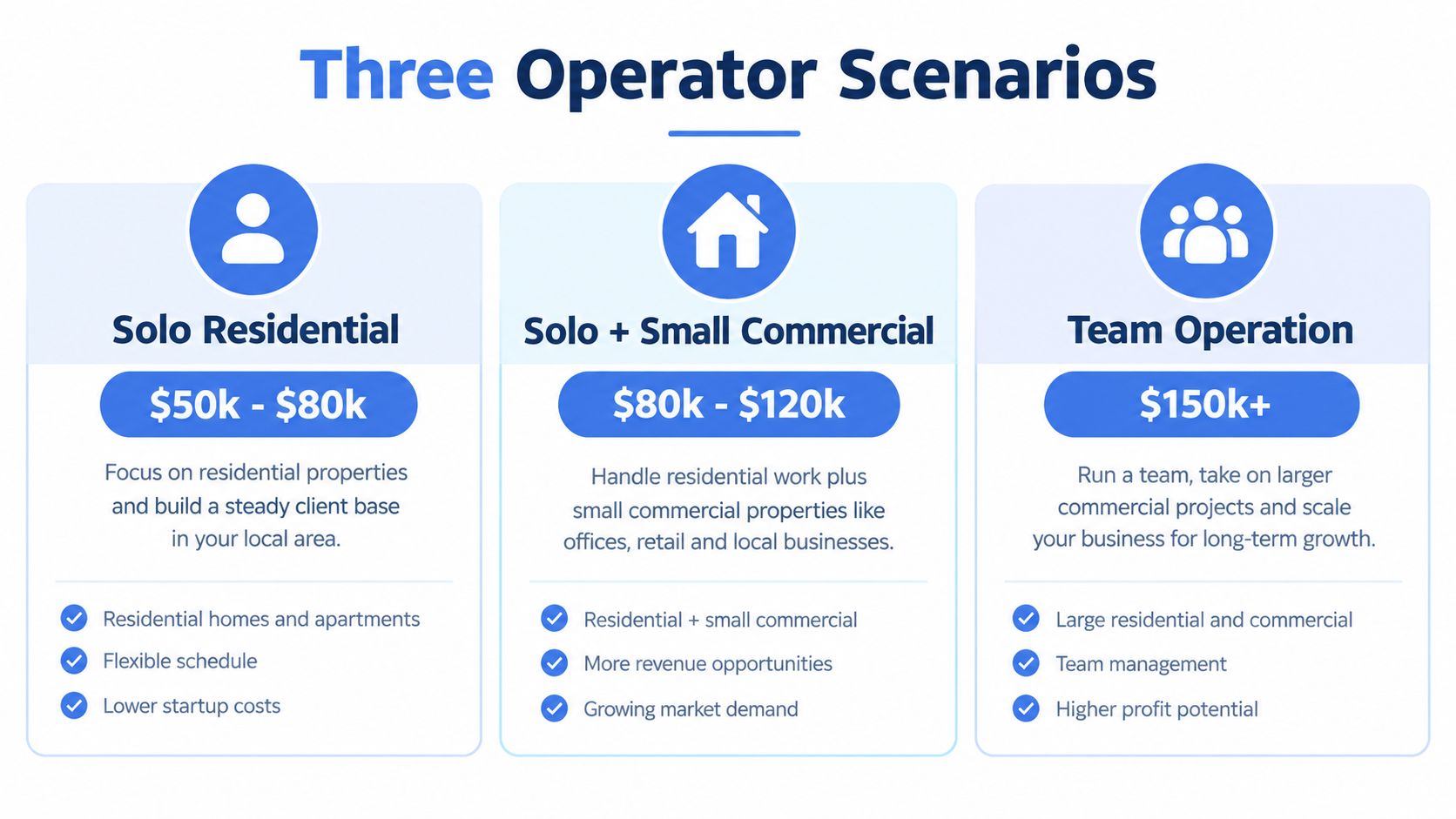
A solo cleaner serving residential customers and small storefronts might target $80,000–$150,000 in annual gross revenue. Paid labor is zero for technicians because the owner performs the work, but that doesn't mean labor is free. The owner should track a notional wage for field time if the goal is to measure business profit accurately.
A representative monthly picture might include customer billings, fuel and vehicle costs, insurance, replacement supplies, equipment maintenance, marketing, software, and administration. What remains can support owner compensation and profit, with the benchmark 30%–40% margin range providing a planning reference. A sample year should also include slow periods, unpaid estimates, cancellations, equipment purchases, and taxes rather than assuming every working day is billable.
A one-crew business may generate $200,000–$400,000 in annual revenue from mixed residential and commercial work. Paid labor becomes the largest line item, followed by vehicle costs, insurance, equipment, scheduling, sales, and quality control. The owner may still clean windows, but the business now needs enough margin to pay technicians even when the schedule has gaps.
A strong month isn't defined only by the number of jobs completed. It's defined by technician utilization, geographic concentration, rework levels, collection speed, and the revenue produced per route hour. Owner draw can rise when the crew is productive, but a fuller schedule with underpriced work can leave the owner working harder to manage a thinner result.
A multi-crew company serving dealerships, condominiums, medical offices, property managers, commercial buildings, and high-rise accounts can exceed the one-crew ceiling, but complexity rises with revenue. Paid labor includes field technicians and potentially supervisors. Overhead expands to additional vehicles, specialized equipment, insurance, training, dispatching, recruiting, sales, and administration.
| Operator Scenarios Side by Side | Gross Revenue | Paid Labor | Overhead | Owner Draw |
|---|---|---|---|---|
| Solo operator | $80,000–$150,000 | Owner performs field work | Lean vehicle, insurance, equipment, supplies, marketing, administration | Highest dependence on owner labor |
| One-crew operation | $200,000–$400,000 | Technician and helper payroll plus employer costs | Vehicles, insurance, equipment, scheduling, sales, quality control | Potentially higher, but more sensitive to utilization |
| Multi-crew company | Above one-crew capacity | Multiple technicians and supervision | Fleet, training, specialized access, management, sales, administration | Depends on systems, contract mix, and retained profit |
The cleanest monthly and annual reporting keeps owner wages separate from owner profit. If you don't make that distinction, you won't know whether scaling is increasing income or merely increasing responsibility.
Professional window cleaners rely on only two core methods, the squeegee method and the pure-water system. The method you choose affects speed, access, equipment, training, and which jobs you can quote confidently.
The squeegee method uses a cleaning solution, washer or cloth, rubber blade, and towels. The operator agitates soil, pulls the water from the glass, and details the edges. It remains valuable for interior glass, traditional residential work, storefronts, and jobs where close inspection and fine detailing matter.
The pure-water system filters minerals from water, sends it through a hose and water-fed pole, and delivers it to a brush. The brush loosens soil while the purified water carries away residue, allowing the glass to dry naturally without soap or squeegee work. This explanation of professional window-cleaning methods shows why the equipment changes the labor pattern.

A squeegee-heavy route can suit detailed residential and smaller commercial jobs, especially when interiors require hands-on finishing. A pure-water setup can improve access to exterior glass on taller residential properties and commercial routes, reducing ladder movement in suitable conditions.
Neither method automatically creates a higher income. Production depends on the glass, access, soil, setup time, travel, crew skill, and quality standard. A fast system that produces callbacks is not productive.
Height work also requires disciplined procedures, equipment checks, training, and a clear understanding of fall hazards. A guide on height safety for Australian crews offers useful general safety context, although operators must follow the regulations and requirements that apply in their own state.
Practical rule: Choose equipment because it improves safe production on the jobs you can consistently sell, not because it looks impressive in a supplier catalog.
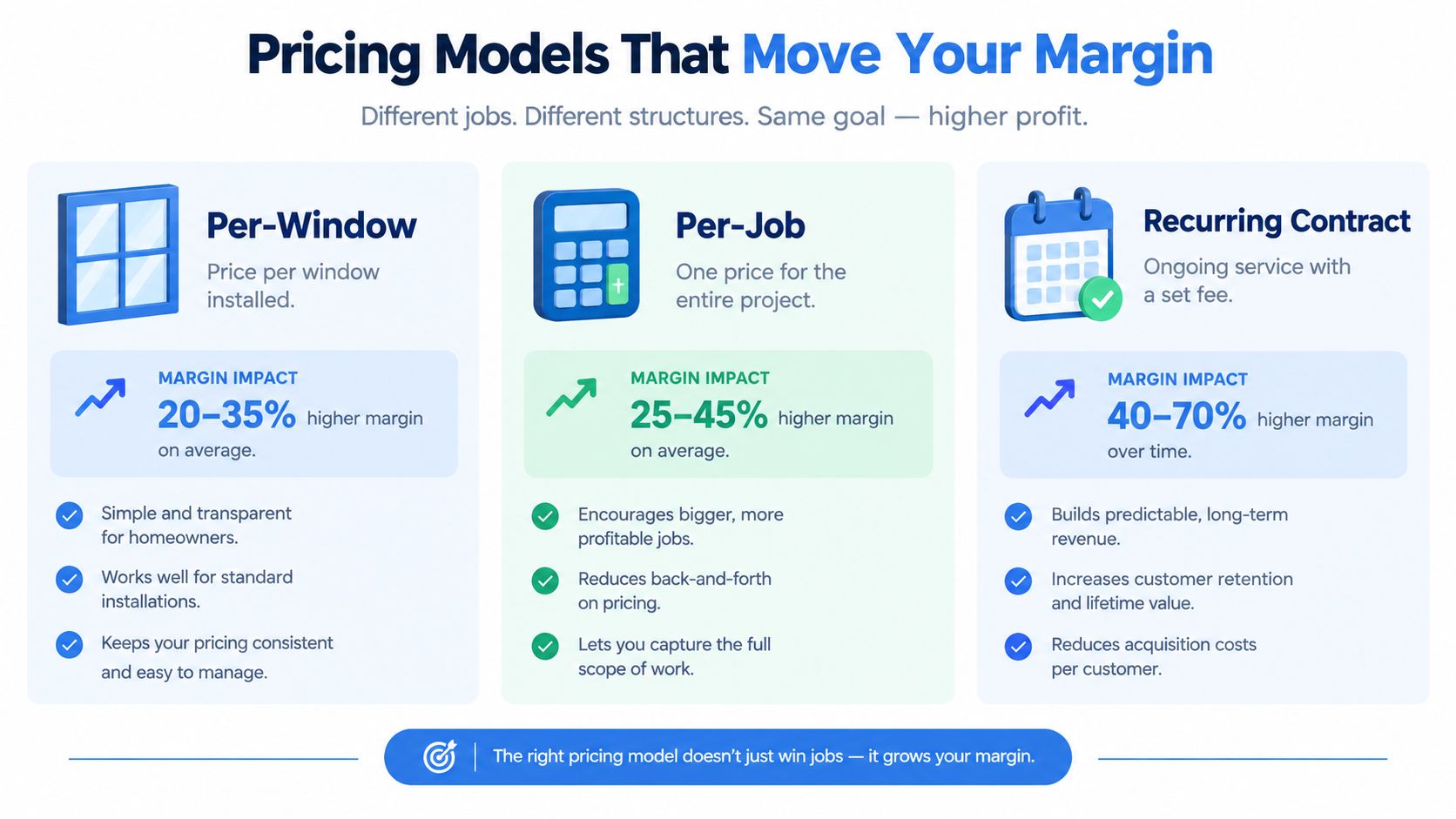
Pricing decides whether a full route creates owner income or only keeps vehicles and crews busy. Three practical models cover most window-cleaning work: per-window, per-job, and recurring contract pricing. Each shifts risk between the customer and operator.
Per-window pricing fits jobs with a clear glass count and predictable access. Commercial work is commonly priced at approximately $2–$3 per window. At an illustrative $2.50 per window, cleaning 400 windows in a productive day produces $1,000 in gross revenue, while 250 windows produces $625. Use the commercial pricing calculator to account for travel, ladder moves, water-fed-pole setup, equipment, and safety controls before judging the margin.
Per-job pricing suits homes, one-off cleanings, and specialty work where a window count hides the actual workload. Awkward access, heavy soil, interior detailing, and fragile finishes can turn a seemingly small job into a long visit. Set the invoice around setup, access, paid labor, and expected production time, not glass count alone.
Recurring contract pricing can strengthen route density. Storefronts, medical offices, dealerships, condominiums, and property-management accounts provide repeat work, but the agreement must state frequency, access requirements, and scope. Specialized or high-access work may be priced by the day at approximately $800–$2,000 plus equipment expenses. A large invoice can still produce a weak margin when utilization is low.
Compare average window cleaning rates with your actual production times before copying a competitor's price. A route with lower travel and repeat access may outperform a higher-priced job that consumes half a day. Marketing overhead belongs in the same calculation. Marketing subscriptions for law practices show how fixed monthly retainers can smooth acquisition costs. A window company can apply the same principle by paying for consistent local visibility rather than relying only on one-off ads.
A window cleaning route earns more when the schedule puts nearby jobs together. Geography affects drive time, customer density, property type, climate exposure, and the frequency at which owners request service.
In Arizona, operators serving Phoenix, Scottsdale, Tempe, and Chandler may find a strong mix of residential communities, storefronts, medical offices, dealerships, and property managers. Desert dust increases the importance of exterior maintenance and can create repeat demand, but the operator must price for heat exposure, water logistics, vehicle wear, and the time required to move between spread-out neighborhoods. Flagstaff brings a different property mix and climate profile, so the same production assumptions won't automatically transfer.
Colorado routes around Denver can combine dense commercial corridors, residential neighborhoods, condominiums, and higher-access properties. Seasonal weather can affect scheduling and access, while route planning needs to account for elevation, winter conditions, and the practical limits of exterior work. A commercial account close to several other stops may outperform a larger isolated property because less time disappears between appointments.
In Nevada, a Las Vegas route can include hospitality-adjacent commercial properties, dealerships, residential communities, and high-rise or condominium work. The market can support larger specialty opportunities, but specialized access, safety systems, insurance, training, and equipment can materially change the economics.
A small service area with repeat customers often outperforms a wide territory filled with one-off jobs. Use Las Vegas service coverage as an example of the local-market principle: the valuable question isn't just how many potential customers exist, but how many can be scheduled in useful geographic clusters.
Scottsdale, Denver, Phoenix, and Las Vegas each require their own pricing tests. Track revenue per stop, unpaid travel, callback frequency, access time, and repeat interval by area. Those figures will tell you more about earning capacity than a national average.
A full calendar can conceal a deteriorating business. If wages rise, travel expands, rework increases, or customers resist price changes, more appointments may produce less owner income.
In 2025, 70% of building-service contractors expected to increase team wages, 71% expected to pass some price increases on to customers, and typical staffing increases were reported in the 3.5%–3.9% range. The 2025 building-service contractor market study illustrates the pressure service companies face when labor costs move faster than old pricing.
Suppose a route produces a stable amount of billable work and payroll represents the largest variable cost. If wages rise by 4%, holding the invoice total unchanged reduces the contribution left after labor. To keep owner draw stable, the company needs a price adjustment based on the labor share of each service, not an arbitrary increase applied everywhere.
For example, if paid labor accounts for half of a job's revenue, a 4% wage increase raises total job cost by roughly 2% of revenue before other employer costs are considered. A price increase of about 2% would preserve the prior contribution in that simplified example. If labor accounts for a larger share, the required price adjustment is larger. This is a planning illustration, not a universal industry rate.
The right question isn't “Can we fill another day?” It's “Does the next day produce more contribution after paid labor, travel, callbacks, and acquisition cost?”
Door-to-door outreach can work for building a concentrated residential route, especially when one satisfied homeowner leads to nearby jobs. Its weakness is that the owner pays in time, walking, follow-up, and uneven conversion, so each job must be evaluated against the effort required to win it.
A well-maintained Google Business Profile supports local discovery and helps customers find a company when they already need service. It can produce stronger intent than broad awareness marketing, but reviews, accurate service areas, prompt responses, and clear photos matter more than just having a listing.
Property managers and homeowners associations can create recurring condominium and commercial opportunities. The sales cycle is slower, and proposals may require proof of insurance, safety procedures, crew details, and documented quality control. The account can be worth pursuing when multiple buildings or repeated service reduce travel and selling costs.
Dealerships and medical offices are attractive targets because clean glass supports presentation and customer experience. Outreach should focus on access, scheduling windows, interior disruption, and repeat service rather than a generic low-price offer. Referral systems can then convert satisfied commercial and residential customers into additional introductions.
Track every channel with a simple acquisition record:
A customer who pays a higher invoice but requires long travel and repeated rescheduling may be less valuable than a nearby recurring account with a smaller ticket. Owner income improves when the business raises prices where necessary, drops poor-fit work, and protects productive routes.
Scaling starts with route density, not hiring for its own sake. A solo operator should first document production times, quote accurately, schedule nearby jobs together, and build repeat residential or commercial work. Hiring before those basics are stable can turn a profitable owner job into an underpriced payroll obligation.
The first technician should create capacity for work the owner can't perform simultaneously, such as commercial proposals, property-manager relationships, estimates, collections, and quality control. The owner must decide whether to remain a productive field operator or gradually shift toward sales and management. Both models can work, but the financial statements must show owner labor separately from profit.
A practical progression looks like this:
Professional Window Cleaning was started by David Kaminski in 1999, giving the company more than 26 years of operating history as of 2026 across residential, commercial, and high-rise window cleaning in Arizona, Colorado, and Nevada. That history illustrates the difference between launching a route and building a durable service operation across markets and service categories. The relevant roadmap for any owner is documented in a disciplined window cleaning business plan, with assumptions tested against actual production and expenses.
The answer to how much can a window cleaning business make ultimately depends on the company you choose to build. A solo route can produce attractive owner income when the owner accepts the labor role. A one-crew operation can create more capacity, but only if pricing covers payroll and overhead. A multi-crew company has a higher revenue ceiling, yet it demands stronger systems, commercial discipline, and management beyond just booking more homes.
Professional Window Cleaning provides residential, commercial, and high-rise window cleaning across Arizona, Colorado, and Nevada, including services for homes, medical offices, dealerships, condominiums, and commercial properties. If you want to compare professional service options or discuss the access and scheduling requirements for your property, visit Professional Window Cleaning and request more information.
Read our blog posts regularly and keep learning.