Care and Maintenance
Hard Water Stain Remover Shower: What Actually Works
Find the right hard water stain remover shower fix for glass, tile, grout, and chrome. Safe DIY recipes, product picks, and prevention tips that work.


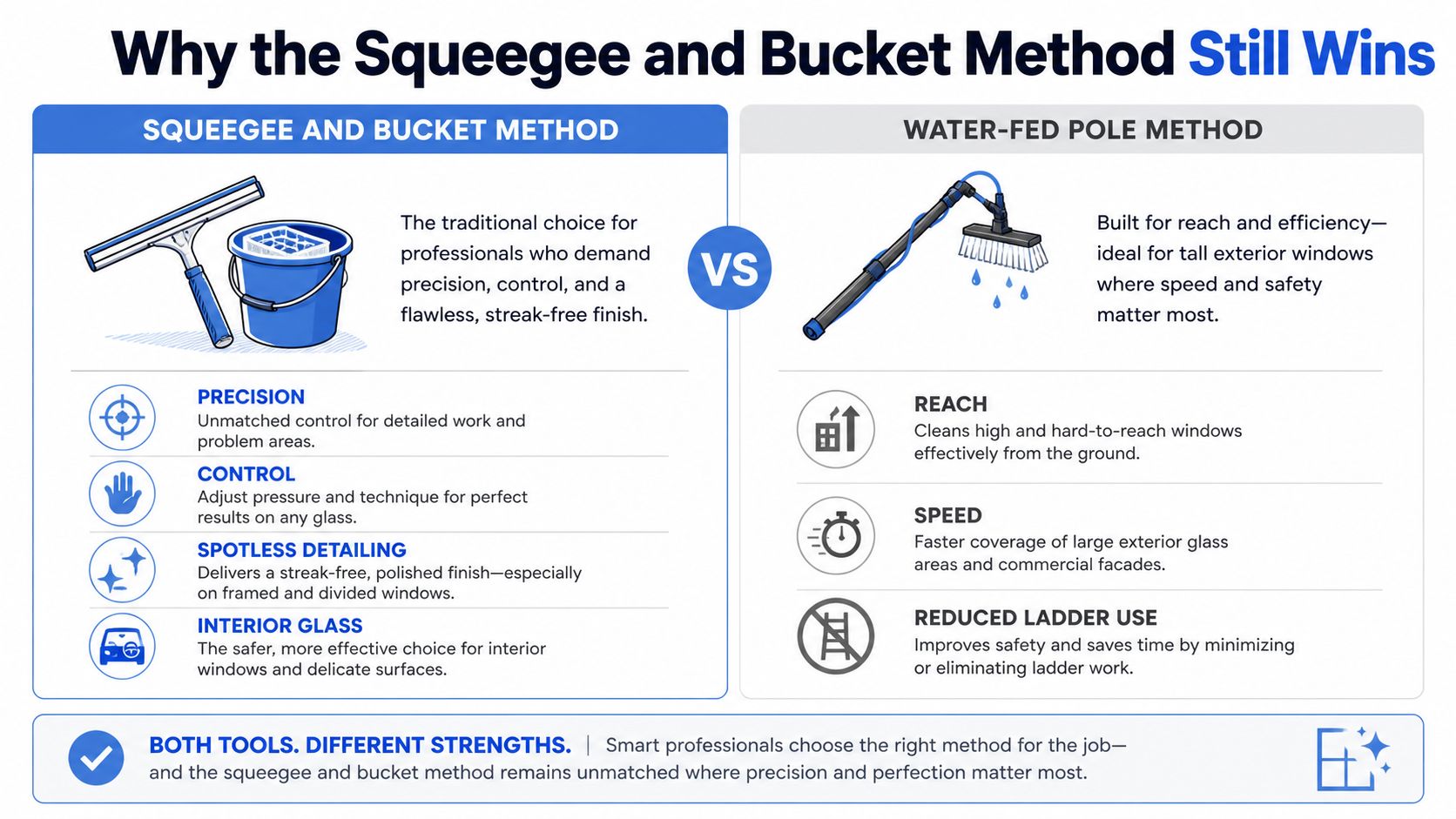
Many are told to use spray and a microfiber cloth because a squeegee and bucket sounds old-fashioned. On a professional job, that advice often breaks down as soon as exterior glass carries dust, grit, grease, mineral spotting, or construction residue. A controlled wet pass loosens the soil, lifts it away from the surface, and removes the solution without forcing a dirty cloth across the pane.
Professional window cleaning has two main methods: the traditional squeegee method and the pure-water system. The first uses a bucket, scrubber, and squeegee. The second uses purified water through a water-fed pole, with the water typically polished through deionization to about 0–5 ppm in the DI stage, according to the National Window Cleaning Authority's pure-water guidance. Neither method wins every job. The skilled crew chooses according to the glass, access, contamination, and physical demands.
Calling the squeegee and bucket outdated confuses age with usefulness. The modern window-cleaning squeegee has a documented milestone in 1936, when Italian immigrant and window washer Ettore Steccone patented a lightweight brass design with one flexible rubber blade. It replaced the bulky Chicago squeegee, which used two thick blades and required 12 screws to change them. Historical references also place the tool in civilian window cleaning by 1918, with one source identifying that as the earliest written reference cited by the Oxford English Dictionary, as detailed in this history of window cleaning.
That design turned a heavy deck-cleaning implement into a precise glass tool. Pair the squeegee with a bucket of solution and a scrubber, and the operator can repeat the same wetting, agitation, and wiping cycle across pane after pane. The setup gives direct control over blade pressure, overlap, edge work, and the amount of solution left on the glass.
A professional benchmark illustrates that repeatability. At the 2002 International Window Cleaning Association conference in Reno, Nevada, French cleaner Richard Moreau used a 12-inch squeegee to clean three 45-inch-square windows in 15.76 seconds in a speed-cleaning contest, according to This Old House's account of squeegee history. That result doesn't describe ordinary production work, but it shows how controlled the method can become in trained hands.
Practical rule: Use pure water for access and reach. Use a bucket and squeegee when soil removal and edge control matter more than avoiding a wet pass.
Water-fed poles earn their place on upper glass, difficult exterior access, and surfaces such as solar panels. Within arm's reach, however, a scrubber can work a dirty pane directly, while the rubber blade carries away the loosened contamination. For crews comparing chemistry, the discussion of ammonia versus ammonia-free glass cleaners is useful, especially where coatings, films, or sensitive finishes affect product selection.
Tool selection should follow the work, not a universal favorite. A small residential pane, a long storefront run, and a rope-access curtain wall panel place different demands on the channel, handle, rubber, and bucket.
For residential work, a 10- to 14-inch Ettore or Unger channel is versatile. Pair it with softer rubber, around 50–60 durometer, when the glass is cold or carries tinted film. A standard 5-gallon rectangular bucket with a scrubber screen insert gives the washer enough room to soak evenly while the screen helps wring out excess solution and trap grit.
Storefront crews usually benefit from an 18-inch stainless-steel channel and a pivot handle. The wider channel covers long panes efficiently, while the pivot helps the operator maintain contact across changing hand positions. A 6-gallon bucket reduces refill interruptions across extended window lines, though it also adds weight, so keep it close to the working area.
High-rise and rope-access work demands lighter equipment. Aluminum or carbon-fiber handles reduce carried weight, while 6- or 8-inch channels are easier to control when rope tension, wind, and limited body position make a long stroke awkward. A reinforced bucket needs a secure carabiner tie-off, and every item should remain controlled throughout the descent.
| Setting | Channel Width | Rubber Durometer | Handle Material | Bucket Size |
|---|---|---|---|---|
| Residential | 10–14 inches | 50–60 | Standard or ergonomic grip | 5 gallons |
| Commercial storefront | 18 inches | Medium to firm | Pivot handle | 6 gallons |
| High-rise or rope access | 6–8 inches | Selected for conditions | Aluminum or carbon fiber | Reinforced, tied off |
Harder rubber can hold a clean line on hot glass and heavier soil, while softer rubber conforms better in colder conditions and around certain films. Inspect the edge constantly. Daily professional use commonly calls for replacement every two to four weeks, and a nick is a reason to replace it sooner, not a defect to work around.
A comfortable grip matters on long routes. Ergonomic handles can reduce forearm fatigue when a crew works across many panes, and the professional window squeegee guide provides additional equipment context. Professional Window Cleaning has used this type of field knowledge in residential, commercial, and high-rise work for over 26 years.
A south-facing storefront covered in construction dust exposes weak technique quickly. If the solution dries before the blade reaches it, the glass shows drag marks and residue. If the scrubber only moves surface water around, grit remains under the rubber and creates chatter.
Start with a restrained mix. A common professional benchmark is about 2 tablespoons of concentrated window solution per gallon of water, with enough detergent to keep the pane wet but not so much that the glass becomes greasy or difficult to detail, as described in the KSS window-cleaning guide. Over-soaping increases drag and leaves residue. Follow the product label when its concentration differs.
Pre-wet the scrubber in the bucket, wring it until it's loaded but not streaming, and agitate the glass in overlapping S-patterns. Work the corners and edges before the squeegee touches the pane. The scrubber's job is to suspend grit in solution, not to polish a dry surface.
Place the bucket on the dry side of the work area, outside walk paths and away from runoff. Keep the solution cool enough to stay workable, especially on sunlit storefronts.
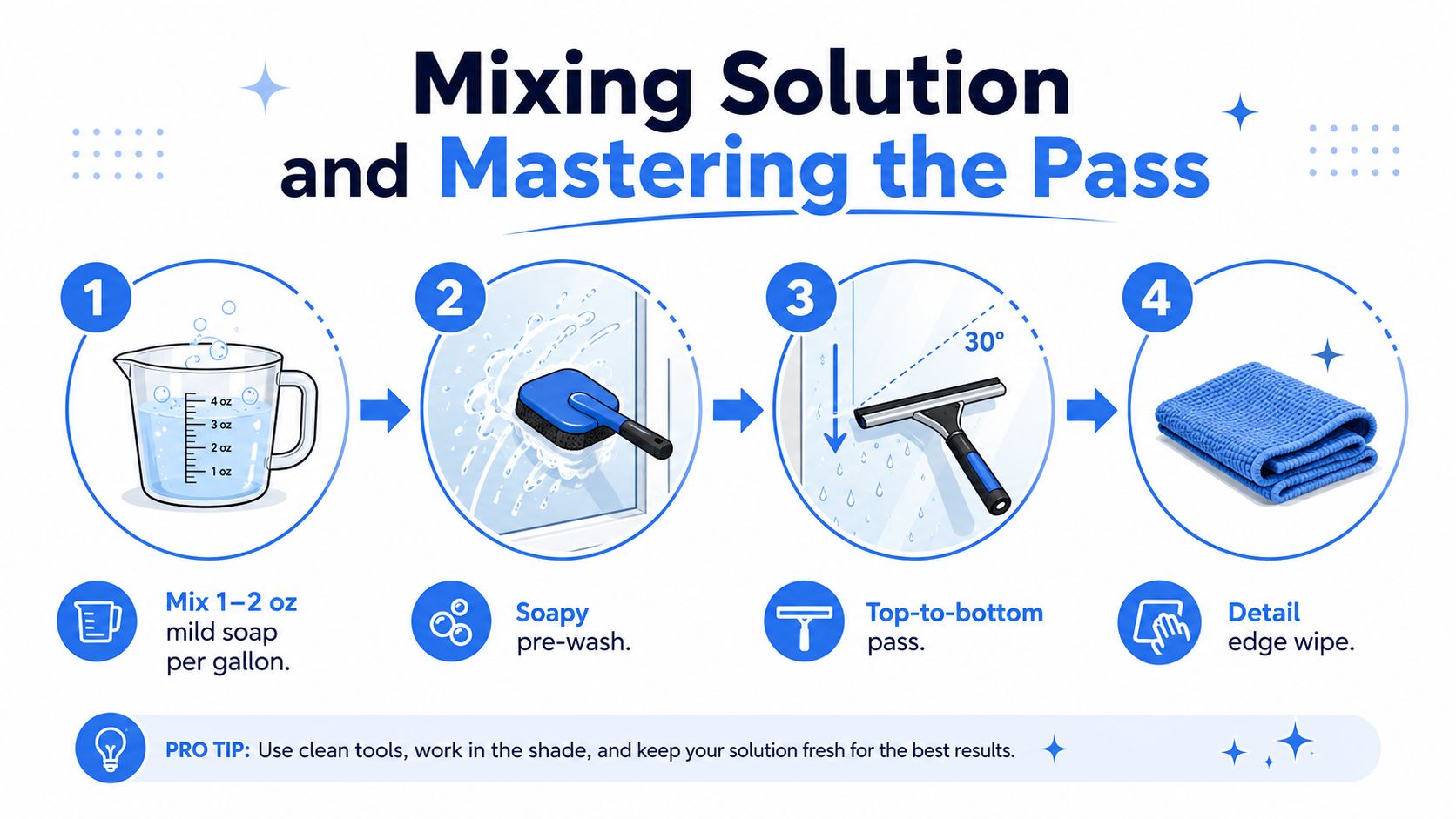
Start near the top corner with the channel held at roughly a 45-degree angle to the glass. Maintain steady pressure, keep the rubber in continuous contact, and overlap each stroke. A fan or S-pattern works well on large panes because it limits unnecessary re-wetting and keeps the operator moving through one connected path. The squeegee technique guidance from J. Racenstein reinforces the importance of angle, pressure, and controlled overlap.
Wipe the rubber edge after every stroke. That small habit removes suspended grit before it returns to the glass and prevents dirty water from collecting at the channel ends.
After the main pass, chamois the sill and use a lint-free microfiber to finish corners, frames, and seals. The center pane may be clean while the perimeter still carries a visible line. For an outside-window chemistry reference, see this guide to cleaning solution for outside windows.
The working rhythm is simple: two wipes, one squeegee pass, one detail. Adjust it for pane size and soil, but don't sacrifice edge work to chase speed.
Efficiency is not just the time spent on glass. A method that leaves a clean pane while forcing overreaching, twisting, or repeated wrist flexion can reduce production quality over a full shift. The squeegee and bucket remain a precision system for reachable, dirty exterior glass because agitation and blade control reduce repeat work.
A product-use manual measured that a 14-inch microfiber washer, 14-inch squeegee, and bucket were 48% faster than a trigger sprayer and rag in its testing, as noted in the professional window-cleaning ergonomics discussion. That result supports the setup for the conditions tested. Soil load, pane size, access, and operator skill still determine the actual job time.
Set the bucket close to the working side, where the hand drops naturally. Keep the channel in a relaxed grip with the wrist near neutral, and guide longer movements from the shoulder instead of repeatedly flexing the wrist. The goal is controlled reach, not maximum reach. Equipment placed behind the body creates unnecessary rotation every time the worker reloads.
| Method | Avg. Time per Pane | Shoulder Load | Lower-Back Strain Risk | Best Use Case |
|---|---|---|---|---|
| Squeegee and bucket | Depends on soil and pane size | Moderate, controlled with correct reach | Lower when bucket stays close | Dirty exterior glass and reachable panes |
| Spray and wipe | Can increase with heavy soil | Repeated wiping can accumulate fatigue | Reaching and bending during detailing | Small interior panes and light touch-ups |
| Pure-water pole | Depends on access and rinse needs | Pole handling can load shoulders | Less bending at ground level | Upper exterior glass and difficult access |
The ergonomics analysis cited in the professional window-cleaning material found that ergonomic tool designs can virtually eliminate major injurious upper-arm postures associated with window cleaning. Handle weight, reach, grip, and posture therefore deserve the same attention as blade condition and edge detail. A lighter tool does not correct a bucket placed too far away, and a good squeegee does not justify a strained shoulder position.
Spray and wipe suits a small interior pane when bucket setup would waste time. Pure water suits high exterior glass, third-story conservatories, and access points where ground-based work avoids ladders. The squeegee and bucket earns its place on reachable, heavily soiled glass, where direct agitation followed by a controlled blade clears contamination with fewer repeated passes. That trade-off is why the setup remains practical rather than old-fashioned.
Commercial glass requires a work plan before the first wet pass. In a medical office or multi-tenant building, coordinate with tenants about appointment periods, blocked walkways, noise, and access to occupied rooms. Set a route that keeps wet equipment within the assigned work area and prevents dirty solution from moving between tenant spaces.
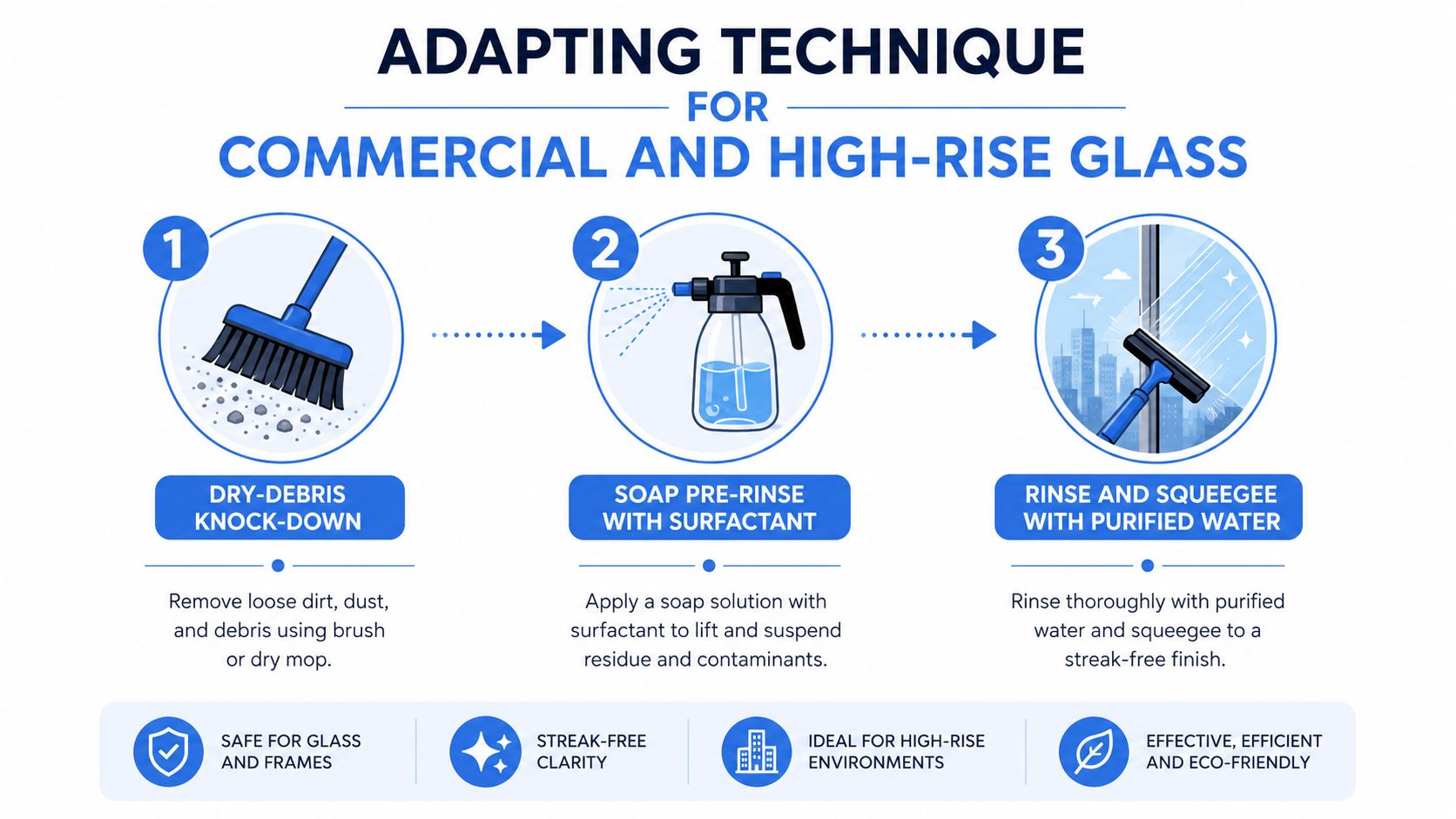
Start by removing dry debris with a brush. A controlled soap pre-rinse should follow, with enough surfactant to suspend remaining soil before the squeegee touches the pane. This sequence reduces abrasive drag, protects the rubber, and limits repeated passes on heavily contaminated exterior glass.
Schedule constraints change the setup. Large curtain-wall elevations may justify a longer channel, provided the operator can control it across the panel without overreaching. Smaller channels suit interrupted sections, silicone-sealed frames, and tight access points. Keep the belt holster on the working-hand side, and secure the T-bar sleeve so it stays fixed during agitation.
Commercial work also demands material control. Use separate cloths for frames, sills, and final glass work. Rinse or replace the scrubber when it carries visible grit, and replace cloudy solution before suspended soil returns to the glass. In healthcare or high-traffic settings, rotate clean cloths between areas and keep buckets assigned to the work zone. A fast cleaning method can still spread residue or contamination when dirty materials travel from one tenant area to another.
Curtain-wall access needs its own plan. Confirm whether panels are reachable from the ground, require a water-fed pole, or need approved elevated access. Account for façade sections, anchor points, pedestrian protection, and the order of work before equipment arrives. On high-rise jobs, fall protection and access planning govern the method more than tool preference.
Pure water may suit the final rinse where the system and access support it. The industry overview of professional window-cleaning systems describes traditional squeegee work and pure-water systems as core professional approaches. Choose between them according to soil, access, tenant conditions, and the required schedule.
Streaks rarely come from the glass itself. They usually point to a missed edge, contaminated water, damaged rubber, or an inconsistent pass.
Safety errors deserve the same attention as finish quality. Slips, trips, and falls accounted for nearly 16.5% of workplace fatalities, 6,680 of 40,531, from 2014–2021, according to the KSS window-cleaning safety guide. The bucket position, floor condition, and hose route directly affect that risk.
Use a slip mat on tile when runoff is likely. Keep ladder feet stable, maintain a clear base, and remove solution from areas used by occupants or crew members. For work above six feet, follow applicable site rules, use suitable eye and hand protection, and meet the relevant ANSI Z133 requirements for the operation. A clear pane is never worth an uncontrolled fall.
Keep the bucket close enough for efficient work, but outside the path of anyone moving through the area.
A squeegee performs only as well as its rubber and channel. At the end of each route, inspect the blade for nicks, rinse grit from the channel, and let the components dry rather than storing them wet. Rotate or replace rubber when the edge rounds over, and store it straight so heat, pressure, or a cramped toolbox doesn't warp the wiping edge.
Sanitize buckets and scrubbers between interior jobs, especially in medical offices and multi-tenant properties. Residue and bacterial film can build inside equipment that looks clean from the outside. Keep separate cloths for glass and frames, and replace channels when they bend, corrode, or no longer hold the rubber evenly.
The squeegee and bucket isn't a relic. It's a precision system that remains especially effective when exterior glass is dirty, reachable, and judged at the edges as carefully as in the center. For properties requiring specialist access, consistent commercial scheduling, or high-rise planning, Professional Window Cleaning serves customers across Las Vegas, Phoenix, Denver, and Scottsdale.
If your residential, commercial, medical-office, or high-rise glass needs more than a quick spray and wipe, contact Professional Window Cleaning for a service built around the right method, controlled edge detailing, and safe equipment handling. Ask the team to assess whether a squeegee and bucket or pure-water system fits your property before work begins.
Read our blog posts regularly and keep learning.