Care and Maintenance
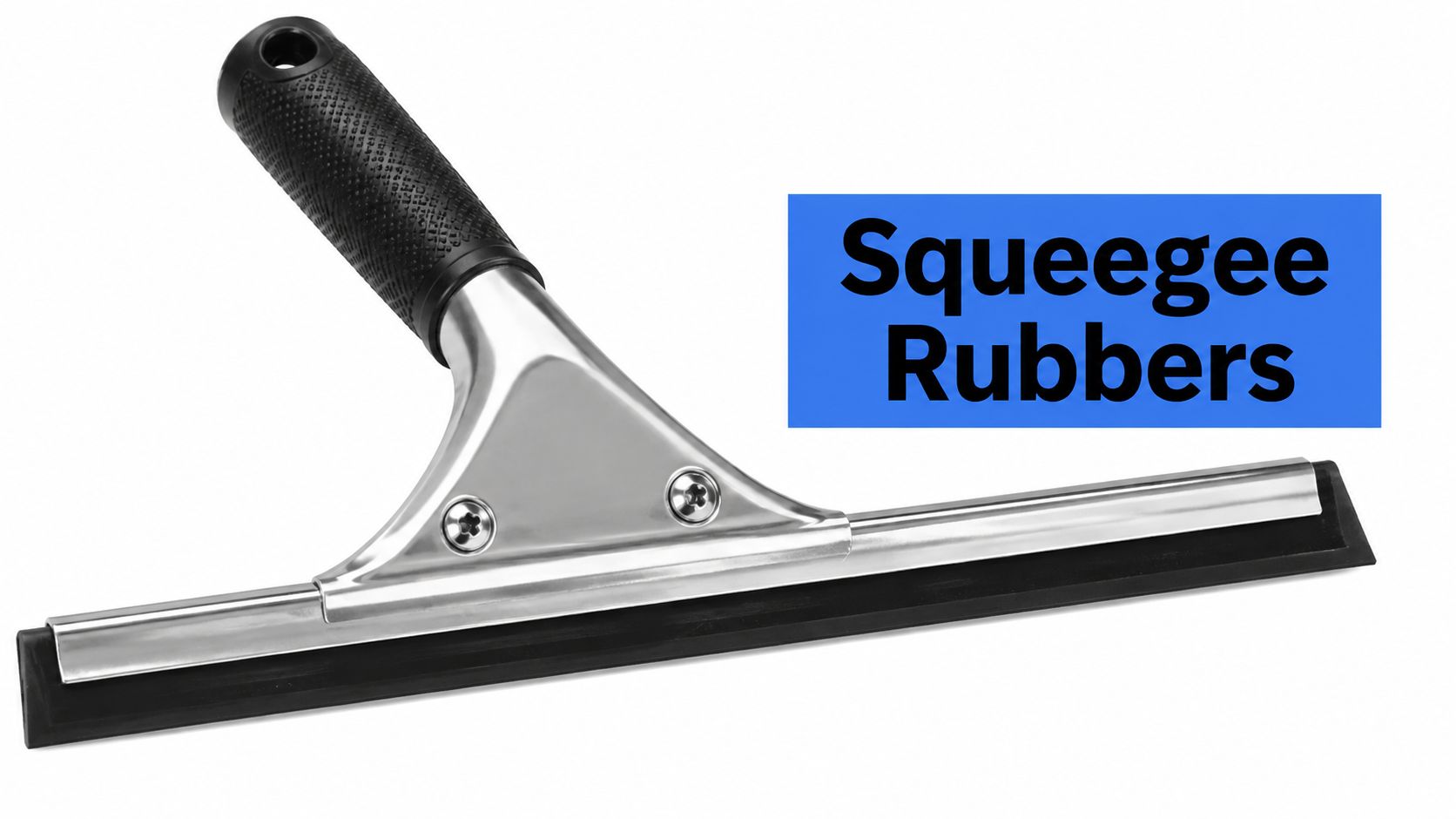
Window Squeegee Rubbers: A Complete Reference Guide
Window squeegee rubbers explained — types, sizes, materials, how to measure, replace, and pick the right rubber for clean, streak-free glass every time.


You're probably looking at glass that should be clear, but isn't. The windows may not look filthy from across the room, yet every streak lights up the moment the sun hits it. That's where many consumers get pulled into the wrong solutions. They buy sprays, magnetic gadgets, extension tools, and whatever new “easy” cleaner is trending, then wonder why the glass still looks bad.
After 26 years in professional window cleaning, the answer is simpler than the market makes it seem. There are only two professional window washing system methods that matter. The traditional squeegee method and the pure-water system. That's it. Everything else is either a variation, a shortcut, or a consumer tool trying to imitate one of those two.
You see it all the time. A homeowner buys a new spray, a magnetic cleaner, or some telescoping gadget, spends an hour on the glass, and the streaks show up as soon as the sun hits the window. The problem is not effort. The problem is using the wrong system.
In professional window cleaning, two methods produce reliable results. A traditional squeegee system with cleaning solution or a pure-water system using filtered water with no soap. As Orloff's explains in its breakdown of water-fed pole vs. traditional squeegee work, those methods solve the job in two different ways, and both are standard in the trade.
This distinction is important because a lot of bad advice starts with the liquid, not the method. Glass does not come out clean because a bottle promises shine. It comes out clean because the cleaner controls soil, water, edges, and drying. The system does the work.
After more than 26 years in the field, Professional Window Cleaning has seen plenty of tools come and go. The equipment has improved, especially for exterior and upper-story glass, but the professional choices are still narrow for a reason. These two systems keep producing clean glass without haze, drag marks, and leftover residue.
Consumer tools usually miss the mark for three practical reasons:
Practical rule: If a tool does not fit a squeegee workflow or a pure-water workflow, it usually has no place in professional window cleaning.
Technique separates professional results from amateur results. A squeegee needs clean rubber, proper angle, and controlled overlap. A pure-water setup needs correct filtration, proper brush work, and enough rinse time to let the glass dry spot-free. If you want to understand the hand-work side of that process, this guide on how to squeegee a window properly covers the basics well.
Any window washing system has to do four things well:
That is why professionals keep coming back to the same two options. The squeegee gives precise control on detail work, interior glass, and route jobs where edges and finish matter most. The pure-water system covers exterior and upper glass efficiently, especially where ladders, reach, and repeatability are part of the job.
Those are the only two that deliver professional results.
The squeegee method is still the standard for detail work because it gives the cleaner direct control over the glass. You scrub the dirt loose, suspend it in solution, then remove the water cleanly with rubber before it dries. When it's done correctly, the pane is clear, sharp, and free of drag marks.
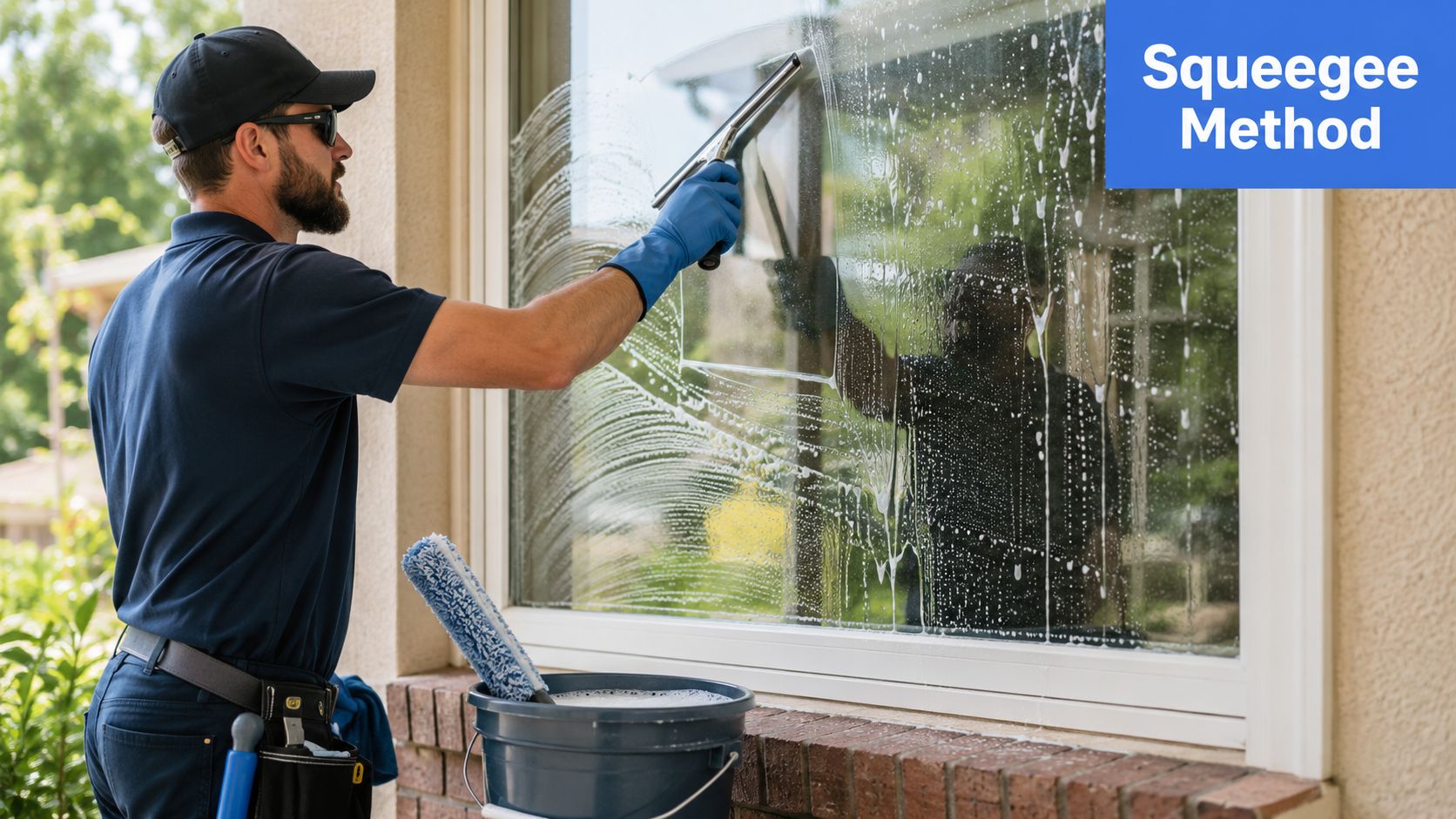
A real squeegee setup is simple, but every piece matters:
Most streaks come from poor rubber, bad angle, dirty edges, or trying to wipe the glass instead of pulling the water off cleanly.
The motion matters as much as the tool. Professionals don't just drag the blade down and hope for the best. We overlap the passes so no thin lines of water are left behind. On many panes, that means controlled fanning or an S-pattern. On others, it means straight pulls, especially when layout and edge detail call for a cleaner finish.
If you want to see the mechanics broken down, this guide on how to squeegee a window covers the process in more practical detail.
A squeegee doesn't forgive sloppy work. It rewards clean rubber, good hand position, and disciplined edge control.
The traditional method is the right call when the glass needs precision more than reach.
| Best use | Why it works |
|---|---|
| Interior glass | Floors and furnishings stay protected with controlled water use |
| French panes and grids | Tight sections need exact blade placement |
| Mirrors and glass doors | Detail work shows every miss |
| First-floor specialty windows | Curves, cutups, and odd shapes favor hand work |
The squeegee has limits, and most of them show up when height and scale enter the job.
That last point matters. Anyone can buy a squeegee. Very few people can use one well across an entire property. The method still earns its place because nothing beats it for close-in accuracy.
The pure-water method changed exterior window cleaning because it removes the biggest problem in traditional washing. Tap water leaves minerals behind when it dries. Pure water doesn't. When the filtration is correct, the water dries clear and spot-free without soap.
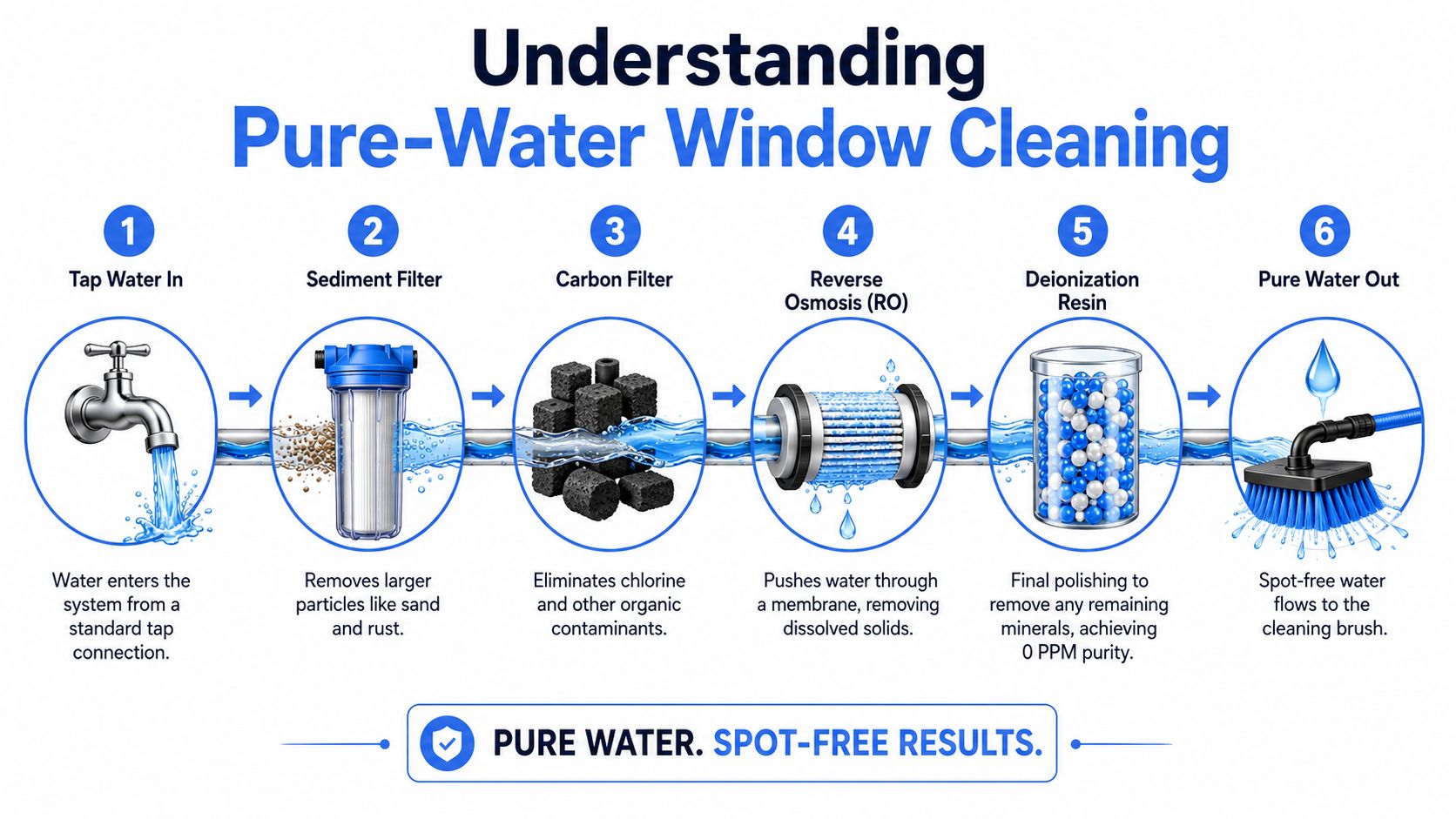
A pure-water window washing system starts with filtration. Water moves through stages that remove sediment, chlorine, dissolved solids, and remaining minerals. What comes out is water that can be pumped through a hose and water-fed pole to a brush at the glass.
The brush agitates the dirt. The flowing pure water rinses it off. Then the window is left to dry naturally.
That only works if the water is pure enough. In water-fed window cleaning systems, the key specification for avoiding spots is a TDS reading between 0 and 20 PPM, and if the reading rises above 20 PPM, mineral deposits can dry onto the glass and leave visible spotting, as explained in this technical discussion of TDS management in water-fed systems.
A proper pure-water setup usually includes:
For a fuller look at that setup, this article on pure-water window washing is a useful reference.
A short visual helps more than a long explanation here:
This system earns its keep on exterior work, especially where height and access matter more than hand detailing.
One practical example is the water-fed pole service used by Professional Window Cleaning, which is suited to exterior glass where crews need safe ground-based access on taller structures.
Pure water isn't foolproof. If the brushes are dirty, the rinse is weak, the seals are shedding oxidation, or the TDS reading has drifted too high, the result can go wrong fast. The method works because the water chemistry is controlled. Ignore that, and you're back to spots.
Professional window cleaning comes down to choosing the right system for the glass in front of you. The trade does not run on gimmicks, spray-on gadgets, or whatever new tool gets pushed at homeowners this season. It runs on two proven methods. A squeegee for controlled hand work, and pure water for efficient exterior production.
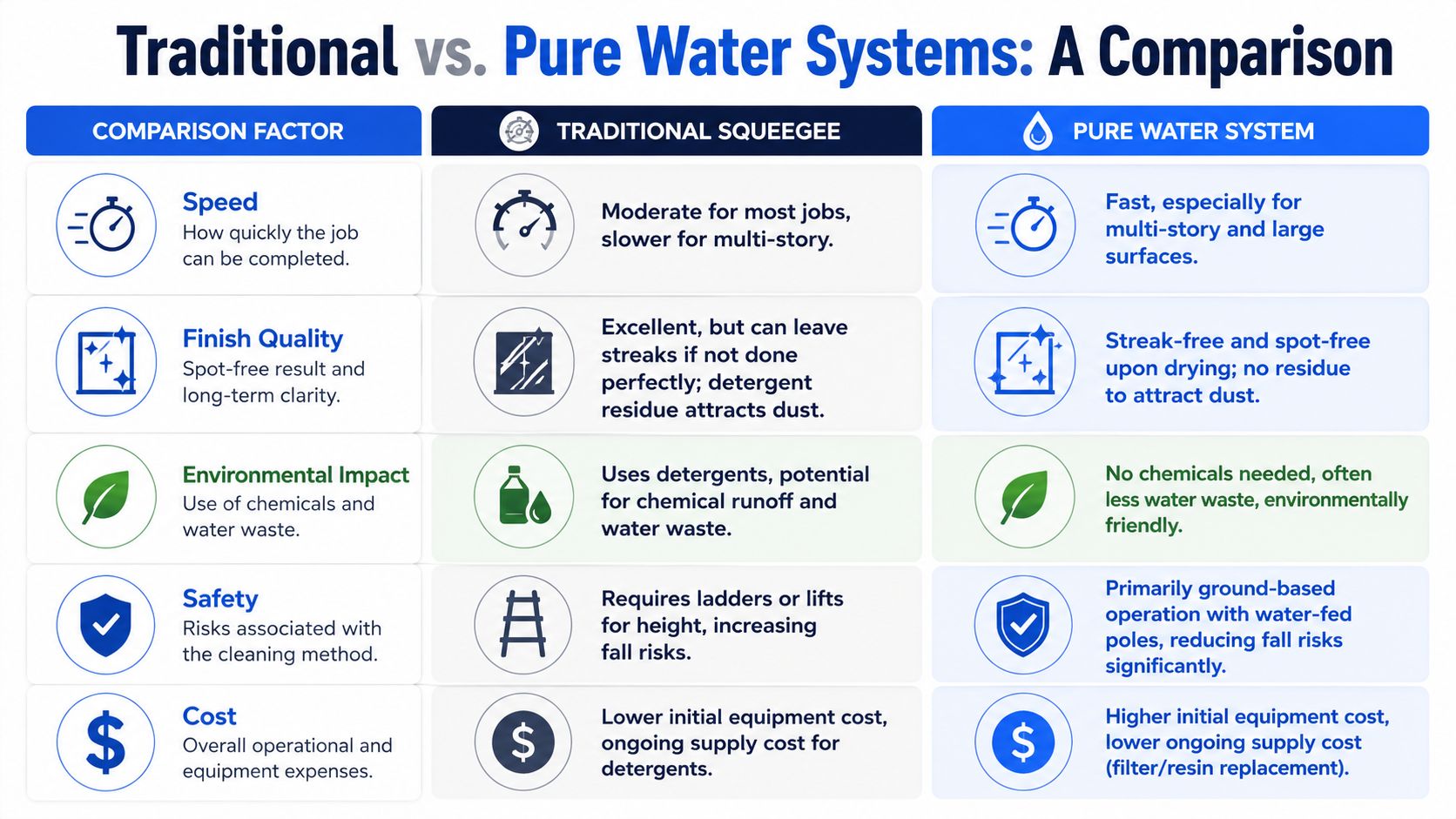
| Factor | Traditional squeegee | Pure-water system |
|---|---|---|
| Speed | Moderate on standard work | Fast on large exterior and upper glass |
| Finish style | Excellent when hand technique is strong | Spot-free drying when water purity is maintained |
| Best fit | Interiors, doors, mirrors, cutups, grids | Exterior glass above one story with clear access |
| Safety profile | Often requires ladders or lifts at height | Ground-based pole work reduces height exposure |
| Ongoing supplies | Rubber, towels, solution | Filters, resin, brush maintenance |
The split is practical. As discussed in this video analysis of traditional versus pure-water efficiency, squeegee work stays ahead on detailed route work, while pure water pulls ahead on larger exterior runs where speed and reach matter.
Use a squeegee when the glass needs precision.
A ground-floor boutique with divided-light panes is a good example. The owner wants sharp edges, dry frames, and clean corners around every small pane. A skilled cleaner can control all of that by hand. The same goes for interior office glass, restaurant entry doors, mirrors, partition glass, and decorative residential windows with cutups.
That level of control is the reason the traditional method still holds its place after all these years.
Pure water takes over when the job gets bigger, taller, or less forgiving on labor time. Multi-story office exteriors, large custom homes with hard-to-reach upper glass, and dealership storefronts all fit that profile.
Regional conditions can push the decision further. Desert markets often bring dust, mineral buildup, and broad sun-exposed glass. On exterior routes in places like Las Vegas or Phoenix, crews often get better production with pure water, then switch to a squeegee for interior detail work and any pane that needs hand correction.
Good window cleaners do not argue about methods. They match the method to the glass.
Many property owners assume there has to be one best window washing system for the whole building. In practice, the cleanest result usually comes from combining both.
A typical job might look like this:
That is how professionals work. One system handles production. The other handles precision. Use both where they belong, and the result is faster work, fewer callbacks, and glass that looks professionally cleaned.
High-rise window cleaning is a different trade from routine residential work. Once a building exceeds ordinary ladder and pole reach, cleaning stops being a simple access problem and becomes a rigging and safety problem.

For buildings over 3 stories, industry-standard design calls for roof-based suspension systems rather than relying on ground lifts or telescoping poles, because roof-rigged access provides the vertical reach and safety compliance that ground equipment can't achieve beyond about 30 to 40 feet according to Archtoolbox's overview of window washing equipment design.
Ground equipment has practical and legal limits. At enough height, stability, reach, and working angle all become problems. Roof-based systems solve that by transferring the working load through the building's anchorage and supporting controlled descent.
That usually involves equipment such as:
A cleaner on a high-rise isn't just washing glass. The crew is operating inside a life-safety system.
Property managers and owners need more than a vendor who says they “do high-rise.”
Ask direct questions:
Safety equipment is part of the window washing system on high-rise work. It isn't separate from the job.
The biggest mistake is assuming a crew can “figure it out” with longer poles, a lift in the parking lot, or improvised tie-offs. That approach may work on low buildings in limited situations, but it doesn't belong on true high-rise access. The farther the glass is from safe ground access, the less room there is for shortcuts.
On commercial and high-rise work, clean windows only count if the method is safe, planned, and appropriate to the structure.
You can spot the wrong hire before the work starts. The quote is vague, the method is fuzzy, and every answer sounds like they plan to use the same tools on every piece of glass.
That is how property owners end up paying for windows that still spot, edges that still drip, or upper panes that never come fully clean.
A professional window cleaner should be able to walk the property, identify the glass, and tell you exactly which of the two systems applies. Traditional squeegee work fits interior glass, divided panes, mirrors, and detail-heavy windows. Pure water fits many exterior windows where pole access, rinse quality, and safe ground-based cleaning make sense. If a company cannot explain that clearly, keep looking.
Price still matters. Method matters first.
Ask direct questions like these:
Experienced crews answer those questions without stumbling. They can explain the trade-offs, where pure water saves time, where a squeegee gives a tighter finish, and where access changes the plan. Someone with a ladder, a bucket, and no real system usually cannot.
Local knowledge is a more significant factor than many property owners realize.
Climate, dust load, hard water, pollen, and heat all change how a job should be scheduled and how the glass should be finished. Marvin's window washing tips cover sound basics, but field conditions still vary by region. A crew working in desert conditions needs to account for mineral residue and fast drying. A crew working in a cooler, less dusty market deals with a different set of problems. The two professional systems stay the same. The way they are applied does not.
That is the difference between a company that cleans windows for a living and one that treats window cleaning like a side service.
A polished truck and a clean website do not prove technical skill. Clear communication still counts, because organized companies usually estimate better, schedule better, and explain the work better. If you are comparing home service companies in general, these Silva Marketing home service tips give a useful outside view of what professional communication looks like.
Hire the company that can explain access, method, finish quality, and limits in plain language. If they cannot tell you when a squeegee is the right tool and when a pure-water system is the right tool, they do not understand the work well enough.
It depends on the property, the location, and what lands on the glass. A home in a dusty area usually needs more frequent exterior service than a shaded property with less exposure. Storefronts and commercial entry glass also show fingerprints and traffic film faster than residential windows.
The system itself isn't designed to damage seals because it uses purified water and a brush, not blasting pressure. Problems usually come from the condition of the window, not the purity of the water. If seals, frames, or oxidation are already failing, a professional should identify that before cleaning.
Pressure washers are built for force, and windows are not. You can force water past seals, damage frame finishes, crack weak glass, or drive contamination into edges and tracks. They solve the wrong problem with the wrong kind of power.
For a few reachable panes, sure. For upper exterior windows, divided lights, or anything where finish quality matters, DIY usually costs more in time and frustration than people expect. Most of the “easy” tools sold to homeowners still don't match the two systems professionals rely on.
If your glass needs a method that fits the building, not a gadget that overpromises, Professional Window Cleaning handles residential, commercial, and high-rise window cleaning using the systems professionals trust.
Read our blog posts regularly and keep learning.