Care and Maintenance
How to Restore Window Glass and Frames the Right Way
Learn how to restore window glass, frames, and seals with pro methods, real tools, and honest trade-offs. A practical guide


Getting that professional, streak-free shine on your windows isn’t about some secret formula—it’s about having the right window cleaning supplies for the job. Professionals use only two methods for window cleaning: the classic, hands-on squeegee technique and the more modern, high-reach pure water system. Figuring out which approach fits your needs is the first step to choosing the right gear for a flawless finish.
At Professional Window Cleaning, we've spent over 26 years perfecting our craft, and one thing has never changed: it always comes down to the tools. Whether we're tackling a home in Scottsdale or a commercial high-rise in Las Vegas, the supplies we use dictate the quality of the finish.
Think of it like a chef's kitchen; having the right knives and pans is just as critical as the recipe itself. The same principle applies when you're aiming for crystal-clear glass. The world of window cleaning supplies can be broken down into two main kits, each designed for different situations. This guide will demystify the exact tools our experts use every single day, helping you understand what you need for your project.

Before you start building your toolkit, you need to understand the two main ways the pros get the job done. Each method calls for a unique set of supplies designed for maximum efficiency and effectiveness.
To get a closer look at the specific gear we use for each method, you can learn more about professional window cleaning equipment in our detailed article.
And while your main focus is probably the glass itself, don't forget about the screens. Clean screens are crucial for the overall look and function of your windows. For great tips on cleaning the mesh without causing rips or tears, this guide on how to clean lanai screens without damaging them is a fantastic resource.
The right tools don't just make the job easier; they make a professional result possible. The difference between a streaky, frustrating mess and a perfectly clear pane often comes down to the quality of your squeegee or the purity of your water.
Once you understand these two foundational approaches, you'll be in a much better position to pick out the window cleaning supplies that actually match your needs, ensuring the job gets done safely and correctly.
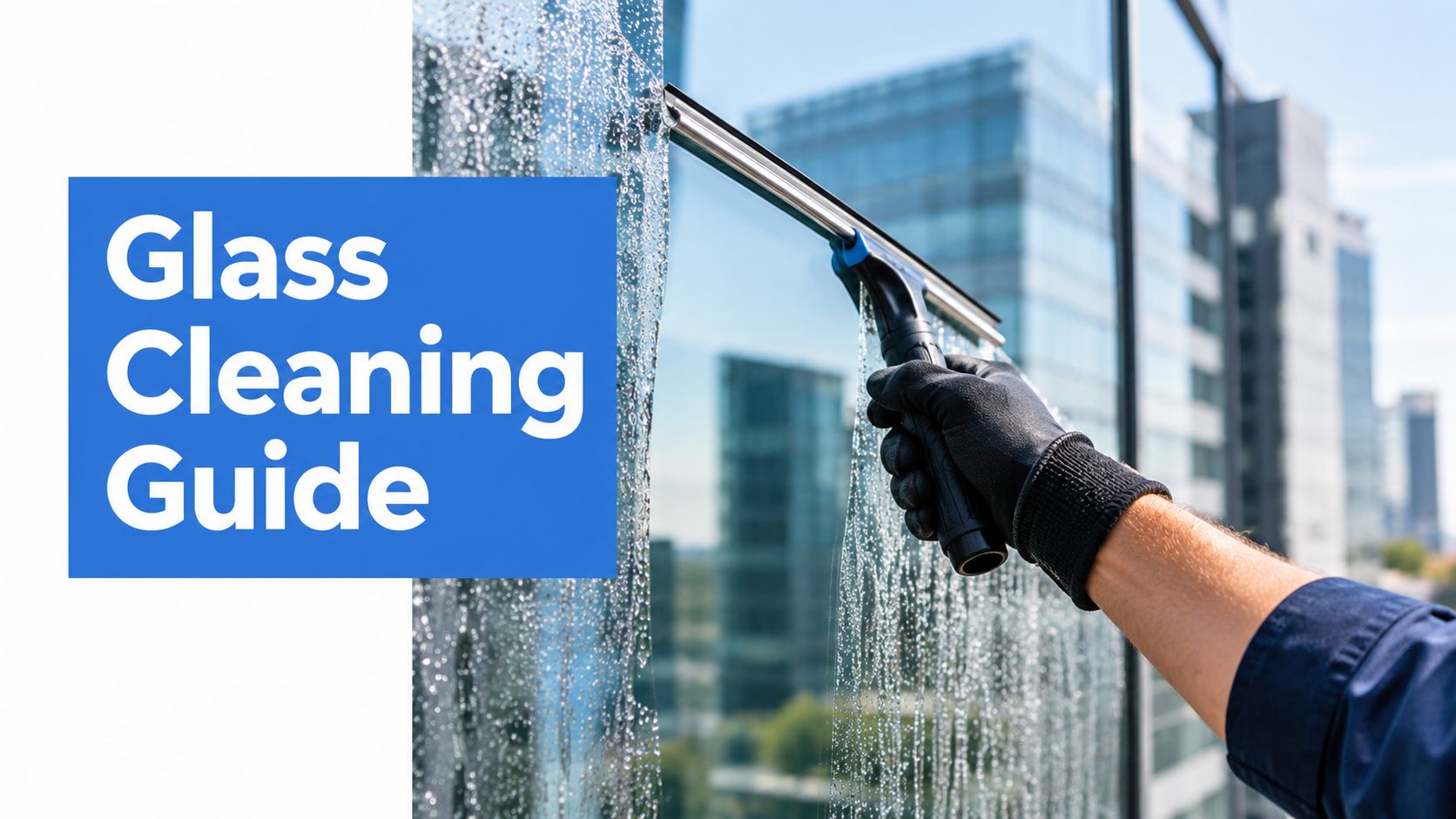
The squeegee is so much more than a rubber blade on a handle. It's the heart of a time-honored craft that runs on skill, technique, and the right blend of window cleaning supplies. Think of it like a painter's brush—in the right hands, it creates a flawless, streak-free masterpiece. This traditional method is still the absolute best choice for ground-floor residential and commercial windows.
For over 26 years, our team at Professional Window Cleaning has relied on this classic technique, especially for properties in cities like Denver and Phoenix. Getting that signature clarity isn't about scrubbing harder; it's about making each tool work in perfect harmony. From the applicator laying down the cleaning solution to the final, careful wipe with a microfiber cloth, every step is deliberate and essential.

A professional-grade squeegee is a modular tool, built to be customized for different window sizes and types. Getting to know its components is the first step toward mastering it.
The goal is to use a channel that’s just a little shorter than the window pane you're cleaning. This gives you enough room to maneuver and detail the edges without bumping the frame, which prevents those annoying drips and smudges.
A squeegee can't do the job alone. It needs a solid support team of tools to prep the window, apply the solution, and perfect the finish. Each piece of gear has a specific role to play.
The Applicator (or Scrubber)
Before you even think about putting a squeegee to glass, you need to apply your cleaning solution and scrub away the dirt. An applicator, often called a T-bar with a microfiber or abrasive sleeve, is perfect for this. It holds a ton of cleaning solution and provides just enough gentle abrasion to lift grime, dust, and pollen without scratching the surface.
The Cleaning Solution
A professional cleaning solution is surprisingly simple. The real secret is creating "slip," which lets the squeegee's rubber blade glide effortlessly across the glass. Believe it or not, a few drops of a high-quality, biodegradable dish soap in a bucket of water is often all you need.
Pro Tip: Don't go overboard with the soap! Too many suds will leave behind a sticky film that actually attracts more dirt. The perfect ratio is just enough to feel slick between your fingers but not so much that you're creating a mountain of foam.
Microfiber Towels
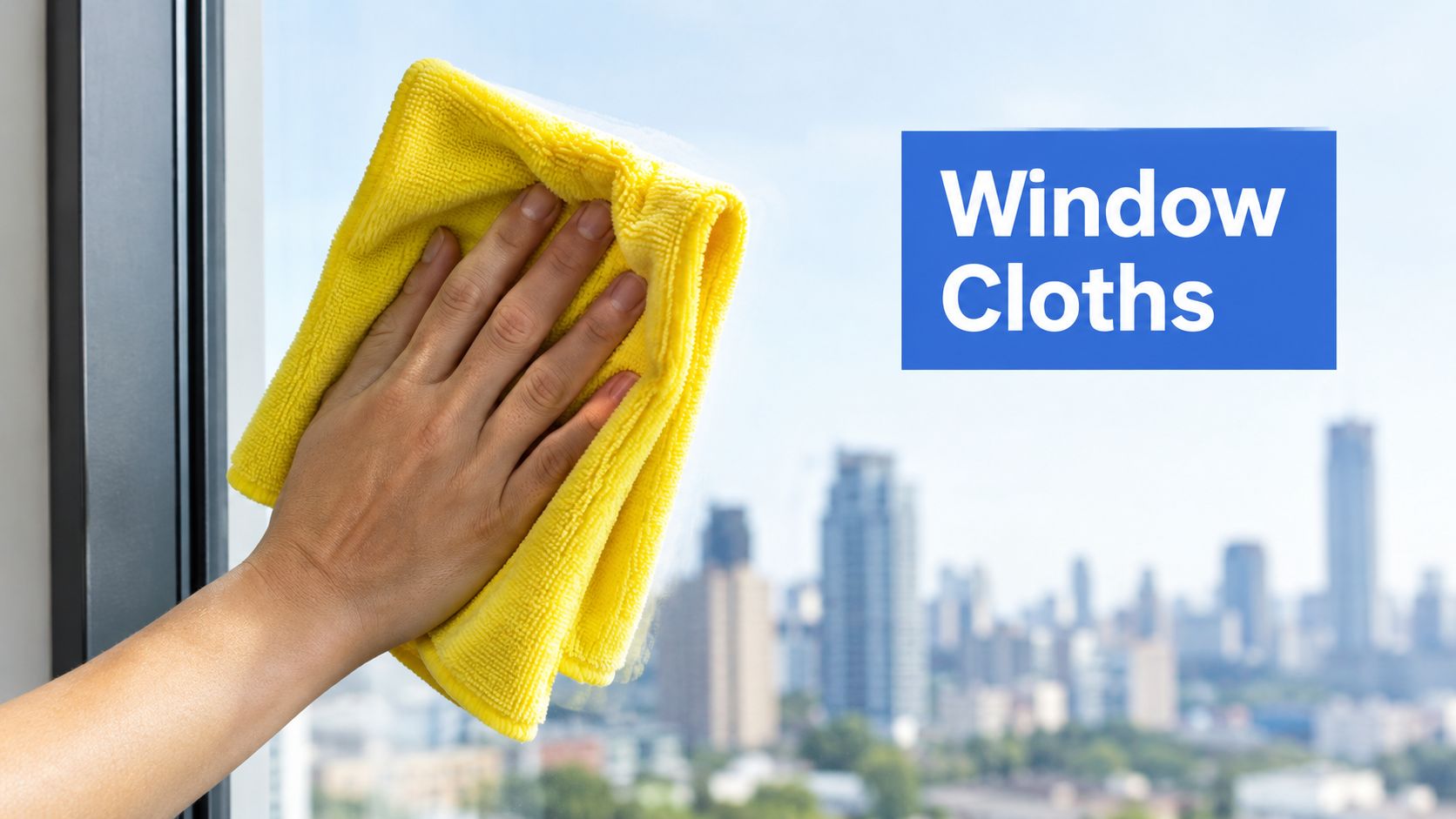
For professional results, microfiber cloths are non-negotiable. Their unique fiber structure traps dirt and soaks up water way more effectively than cotton rags or paper towels, which tend to just push dirt around and leave lint behind. You’ll want at least two: one for wiping your squeegee blade between passes and another, completely dry one for detailing the edges and sill.
The Bucket
A wide, rectangular bucket is another key piece of equipment. Unlike a standard round bucket, a rectangular one is perfectly shaped to fit a wide applicator and squeegee, making it easy to dip your tools without making a mess. For pros working on larger properties in places like Las Vegas or Scottsdale, these specialized buckets are a must-have for pure efficiency.
While the good old-fashioned squeegee is still the king for ground-level work, the game changes completely when you start looking up. For multi-story buildings, sprawling commercial properties, and high-rises, you need a different set of window cleaning supplies. This is where the pure water system comes in—a modern approach that has totally transformed how pros tackle jobs at height, safely and efficiently.
At Professional Window Cleaning, we were early adopters of this technology to serve our clients in busy urban centers like Phoenix and Las Vegas. It lets us deliver a flawless, spot-free finish on windows several stories high, all while our team stays safely on the ground. This method isn't just about reaching new heights; it's about a fundamentally different way of cleaning that relies on pure science instead of soap.

The term "pure water" sounds simple enough, but in our world, it means water that's been meticulously stripped of all its dissolved mineral content. Think of your tap water as a liquid full of invisible stowaways—minerals like calcium, magnesium, and sodium. When that water evaporates on a window, it leaves those stowaways behind as ugly spots and streaks.
Pure water, on the other hand, is completely empty. It’s gone through a rigorous purification process, usually one of two ways:
The result is water in its most aggressive, natural state. Because it contains zero minerals, it actively wants to bond with and dissolve dirt, grime, and other gunk on the glass, making it a powerful cleaning agent all on its own. To get a deeper look at the science, check out our guide on pure water window cleaning.
Unlike the traditional bucket-and-squeegee method, a pure water system is an integrated kit where every component works together. The three core pieces are the purification unit, the pole, and the brush.
This is the heart of the whole operation. These systems can be anything from portable, cart-based units for residential jobs to larger, truck-mounted setups for big commercial projects. They house the DI resin tanks or RO membranes that turn regular tap water into a spot-free cleaning machine.
Instead of a ladder, we use a lightweight, telescopic pole made from materials like carbon fiber or fiberglass. These poles can extend up to 60 feet or more, letting our technicians safely reach windows up to five or six stories high. The purified water is pumped from the system up through a thin tube running inside the pole.
The real game-changer with the water-fed pole is safety. By eliminating the need for ladders on most mid-rise buildings, it dramatically reduces the risk of falls—a critical concern for any professional service.
Attached to the end of the pole is a specially designed brush with soft bristles. This brush does two things: first, it gently agitates and scrubs the dirt loose from the glass. Second, jets built into the brush head spray a constant stream of pure water, rinsing all that loosened grime away.
Because the water is completely pure, there's no need to squeegee the window dry. The glass is simply left to air dry on its own, resulting in a perfectly clear, streak-free finish every single time. This level of efficiency is a huge reason this system has become the go-to for large-scale jobs in cities like Denver.
The growing demand for this kind of professional maintenance reflects a larger trend. The broader cleaning services market is projected to expand significantly, with North America leading the charge. This growth is driven by businesses outsourcing maintenance and adhering to strict hygiene standards, especially for high-rises and commercial properties where advanced systems are a necessity. You can discover more insights about this expanding market on market.us.
You can have the best squeegee in the world, but a truly professional, streak-free shine comes down to the supporting cast of tools. The right window cleaning supplies—accessories and safety gear—are what separate a weekend DIY attempt from a genuine pro job. These are the items that guarantee the work gets done safely, efficiently, and to a standard that really stands out.
After 26 years in this business, we at Professional Window Cleaning know that skipping these details just isn't an option. It’s like a surgeon’s operating room; the scalpels are critical, but the procedure is impossible without the trays, lights, and protective equipment. That same logic holds true whether we're working on a home in Scottsdale or a commercial building in Las Vegas.
To work like a pro, you need to think like one. That means being organized and ready for whatever the glass throws at you. The right accessories keep your most important tools right where you need them and help you defeat stubborn grime that a simple wash won’t touch.
These accessories are the unsung heroes of a well-stocked kit, turning a frustrating task into a smooth, methodical process. They’re a must-have for delivering top-tier service in every city we cover.
Let's be clear: window cleaning, especially at any kind of height, has real risks. That’s why safety equipment isn’t just another accessory; it's a non-negotiable part of any professional's kit. Cutting corners on safety is a gamble no one should ever take.
The most important tool in any window cleaner's bag is a deep commitment to safety. A perfect window is worthless if getting it clean leads to an accident. It’s why we invest just as much in our safety protocols as we do in our cleaning gear.
Creating a safe work environment means having the right gear on hand. When working with cleaning solutions or at heights where debris might fall, it's critical to have the proper essential eye protection.
A complete safety setup is vital for protecting yourself and the property you're on. For homeowners and property managers in places like Phoenix or Denver, seeing a professional team that follows these standards provides incredible peace of mind.
Let's be clear: the right window cleaning supplies are never a one-size-fits-all deal. A homeowner in a quiet Scottsdale suburb has a completely different toolkit than a facilities manager overseeing a sprawling commercial complex in Denver. Matching the tools to the job is the single most important step in getting a professional result and making sure you're not wasting money on gear you don't need.
Think of it like choosing a vehicle. You wouldn't buy a semi-truck to run to the grocery store, and you wouldn't try to haul construction materials in a compact car. The same logic applies here. For most homes, the classic squeegee method is the perfect fit—it's effective, precise, and gets the job done without a huge investment. But for large commercial buildings with multiple stories, a pure water system is almost always the smarter long-term play.
This breakdown will help you figure out your situation, weigh the pros and cons, and choose the right tools with confidence.
If you're a homeowner, your goal is simple: get sparkling clean windows without having to buy out a supply warehouse. For that, the traditional squeegee method is your best friend. It delivers professional-grade results with a minimal and affordable set of tools.
Your shopping list should focus on quality basics that are built to last. Forget about those gimmicky all-in-one kits you see on TV.
This simple but mighty kit lets you tackle your own windows using the same fundamental tools our experts at Professional Window Cleaning have trusted for over 26 years.
It's no surprise that the demand for clean windows at home is on the rise. The residential window cleaning market is booming, expected to hit around USD 15.2 billion by 2025. This growth is fueled by homeowners with more disposable income—like busy families in the Denver suburbs—who'd rather outsource the chore than risk a fall from a ladder. You can get more details on the residential window cleaning market on marketreportanalytics.com.
This flowchart helps visualize the fundamental safety decision when you're deciding between ground-level work and anything that requires a ladder.

The key takeaway is simple: the moment you leave the ground, the safety game changes completely, and equipment like a harness becomes non-negotiable.
As a commercial property manager, your mindset shifts from just getting things clean to focusing on efficiency, safety, and return on investment (ROI). While a pure water system has a higher upfront cost, it almost always pays for itself over time, especially for buildings with two or more stories in cities like Phoenix or Las Vegas.
For commercial properties, window cleaning isn't just a chore; it's an operational expense. The right equipment minimizes labor costs, reduces liability, and protects the building's aesthetic value, making it a critical business decision.
When you're looking into a pure water system, here's what you need to consider:
After diving into the world of window cleaning supplies—from squeegees and pure water systems to all the essential safety gear—one thing becomes perfectly clear: this job is a lot more involved than it looks. While tackling it yourself is an option, hiring a professional is almost always the smartest, safest, and most efficient route.
Professional Window Cleaning has been cleaning windows for over 26 years! We don’t just show up with a bucket and a squeegee. We arrive with decades of experience, a deep understanding of technique, and the right professional-grade tools for any situation, whether it’s a home in Phoenix or a high-rise in Las Vegas.
Let's be honest, your time is your most valuable asset. The hours you'd spend researching tools, buying supplies, wrestling with ladders, and doing the actual cleaning can easily eat up an entire weekend. A professional crew can get the same job done in just a few hours.
Even more importantly, the quality of the finish is something you can see. Our technicians use techniques that take years to master, like the classic fanning motion with a squeegee or a precise rinse with pure water. This expertise guarantees a streak-free, long-lasting clean that DIY efforts just can't match, instantly boosting your property’s curb appeal.
Working at heights is inherently dangerous. In fact, falls from ladders are one of the leading causes of serious injuries around the home. Professionals come prepared with the right safety gear, from heavy-duty ladders with stabilizers to full harnesses for high-rise work, and they have the training to use it all correctly.
Hiring a professional service isn't just about paying for clean windows; it's about investing in peace of mind. You completely avoid the personal risk of injury and the potential liability of an accident on your property.
By entrusting the job to a team like ours, which serves communities from Scottsdale to Denver, you can forget about the safety concerns. We handle the heights so you don’t have to.
Professionals show up with an entire arsenal of tools designed for every possible scenario. They’ve got the right squeegee sizes for every window pane, specialized scrapers for stubborn gunk, and advanced pure water systems for multi-story buildings. This means you get a perfect result without having to buy, store, and maintain a garage full of specialized gear.
The industry is always evolving, too. The global window cleaning robot market is expected to hit an impressive USD 1,592.8 million by 2025, a trend fueled by the growing number of high-rise buildings and busy lifestyles that make manual cleaning a challenge. For a company like Professional Window Cleaning, with over two decades of experience, it just highlights how important it is to integrate technology for complex jobs on modern buildings. You can learn more about this evolving tech by exploring the market research on cognitivemarketresearch.com.
At the end of the day, choosing a professional service guarantees a flawless, efficient, and safe outcome every single time.
When you're diving into the world of window cleaning supplies, a few questions always seem to pop up. It makes sense—especially when trying to understand the two main methods the pros rely on. Here are some of the most common things people ask us.
You might be surprised to hear that the best and safest cleaning solution is also the simplest. For the classic squeegee method, all you really need is a bucket of clean water with just a few drops of a good, biodegradable dish soap. That little bit of soap is the secret ingredient; it gives you the "slip" needed for the squeegee to glide perfectly across the glass, wiping everything away without leaving streaks or a sticky film.
A sharp, perfect rubber blade is non-negotiable for a streak-free shine. For our teams at Professional Window Cleaning, who are out there cleaning windows every single day in places like Phoenix and Denver, a blade might only be good for a day or two of heavy use.
If you're a homeowner using it once in a while, the rule of thumb is to replace it the moment you see any streaks or tiny imperfections in the finish. This usually happens after a few big cleaning days.
That’s a definite no. Pure water systems are built specifically for exterior window cleaning. The whole system is designed to work by rinsing the glass with a constant flow of purified water, which would obviously make a huge mess inside your home or office. When it comes to interior windows, the only professional technique is the tried-and-true squeegee and applicator method.
The core idea is simple: the squeegee is your go-to tool for all interior work and ground-level exterior windows. The pure water system is a specialized piece of equipment designed to safely and efficiently clean exterior windows at height.
This is exactly why our crews come equipped for both situations. It allows us to pick the right tool for the job, whether we’re working on a single-story home in Scottsdale or tackling a high-rise in Las Vegas.
Ready to see what a difference 26 years of experience and the right professional tools can make? Get in touch with Professional Window Cleaning for a free estimate and let us give your property a flawless shine. Head over to https://www.professionalwindowcleaning.com to get started.
Read our blog posts regularly and keep learning.