
Care and Maintenance
Cloth for Window Cleaning Choices That Deliver Results
Choose the best cloth for window cleaning by comparing microfiber, cotton, lint-free, and chamois options, plus care and selection tips.


You step outside after a windy night and find a gray film across the windows. Yesterday's clear view looks dull again, and the sprinkler spots along the bottom panes haven't gone anywhere. Reaching for the hose is tempting, but on Maricopa glass, more rinsing doesn't necessarily mean a cleaner result.
Good window cleaning in Maricopa, AZ, starts with identifying what's on the glass, then choosing the right method, timing, and water control. Loose desert dust and stubborn mineral deposits need different treatment. A careful crew makes that distinction before putting a washer or brush against your windows.
The morning after a wind event, look beyond the middle of the pane. Dust collects along the lower frame, across the sill, and behind the screen. A quick wipe might clear a viewing patch while leaving enough grit around the edges to dirty the glass during the next wash.
That familiar dusty appearance is only part of the problem.
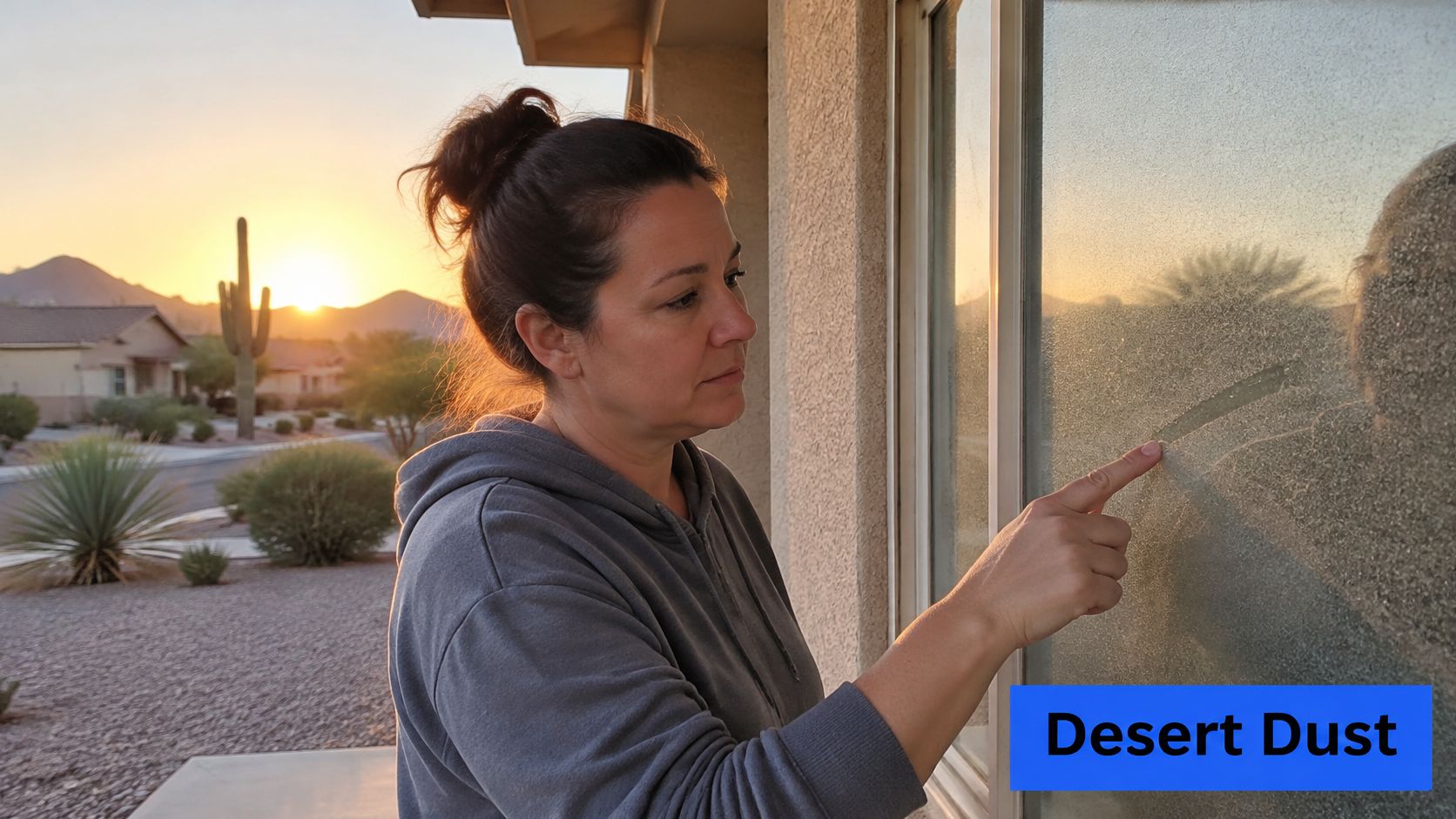
Maricopa County's air-quality monitoring guidance notes that dust storms can produce very high concentrations of coarse airborne particles. On windows, the practical concern is loose abrasive material. Rubbing that material across dry glass, coated surfaces, or painted frames risks turning a cleaning attempt into surface damage.
Loosen and flush grit before mechanical wiping. Keep microfiber cloths and washing tools clean, and change dirty solution rather than carrying suspended soil from pane to pane.
Hard water creates a different challenge. The municipal report for Phoenix lists total hardness of 158–344 ppm, approximately 9.2–20.1 grains per gallon, which can leave calcium- and magnesium-rich residue when rinse water evaporates on hot glass, according to the municipal water-quality report. That's regional context, not a measurement of every Maricopa home's supply.
Practical rule: Treat dust as material to remove gently and mineral spotting as a condition to assess, not something to scrub harder by default.
Heat makes both jobs less forgiving because cleaning liquid can dry before the technician finishes working it. Cooler glass, controlled wetting, and prompt removal matter more than adding extra detergent.
For recurring sprinkler marks, prevention belongs in the maintenance plan. Adjusting the source of repeated wetting is more useful than endlessly rewashing the same pane. This guide to hard-water stain prevention explains what to address between professional visits.
Professional window cleaners use two methods: a washer and squeegee, or a pure-water system. Different handles, brushes, poles, and access equipment support those methods. They don't create separate cleaning methods.
The mechanical distinction is straightforward: a squeegee removes the cleaning liquid, while a pure-water system removes dissolved impurities before the final rinse reaches the glass. The professional window-cleaning methods guide describes both approaches and explains why properly purified water leaves little or no dissolved material behind as it dries.

| Factor | Squeegee & Washer | Pure-Water System |
|---|---|---|
| Cleaning action | Washer loosens soil; rubber blade removes liquid | Water-fed brush agitates soil; purified water rinses it away |
| Interior glass | Controlled application and immediate removal | Generally unsuitable where rinse water can't be contained |
| Exterior access | Requires safe access for close hand work | Useful where a pole can reach glass safely from the ground |
| Dust removal | Needs clean solution and careful tool handling | Needs adequate agitation and a thorough final rinse |
| Mineral spotting | Removes wash liquid before it dries | Avoids adding dissolved minerals during the final rinse |
| Detailed work | Useful for edges, small panes, and close inspection | Efficient for suitable exterior panes |
| Existing mineral deposits | May need separate restoration treatment | Purified rinsing alone isn't mineral restoration |
With the traditional method, the technician wets and agitates the glass, draws the squeegee across it, and details the edges. The finish depends on clean rubber, controlled strokes, and keeping dirty frame water off the cleaned surface.
With pure water, the technician brushes the glass and rinses away loosened contamination. A conductivity or TDS meter helps verify filtration output. The equipment's presence alone doesn't prove the rinse water is ready to use.
Neither method excuses incomplete preparation. A water-fed brush can leave dirty corners if the operator rushes, and a squeegee can leave drag marks if the rubber or solution is contaminated. The better method is the one that suits the window and can be executed properly.
A well-organized visit should feel predictable. Before arrival, ask the crew to confirm the service window, access arrangements, pets, and whether anyone needs to be home for interior work. Mention damaged screens, stubborn spotting, or rooms that need special handling.
The service-day sequence should be easy to follow.
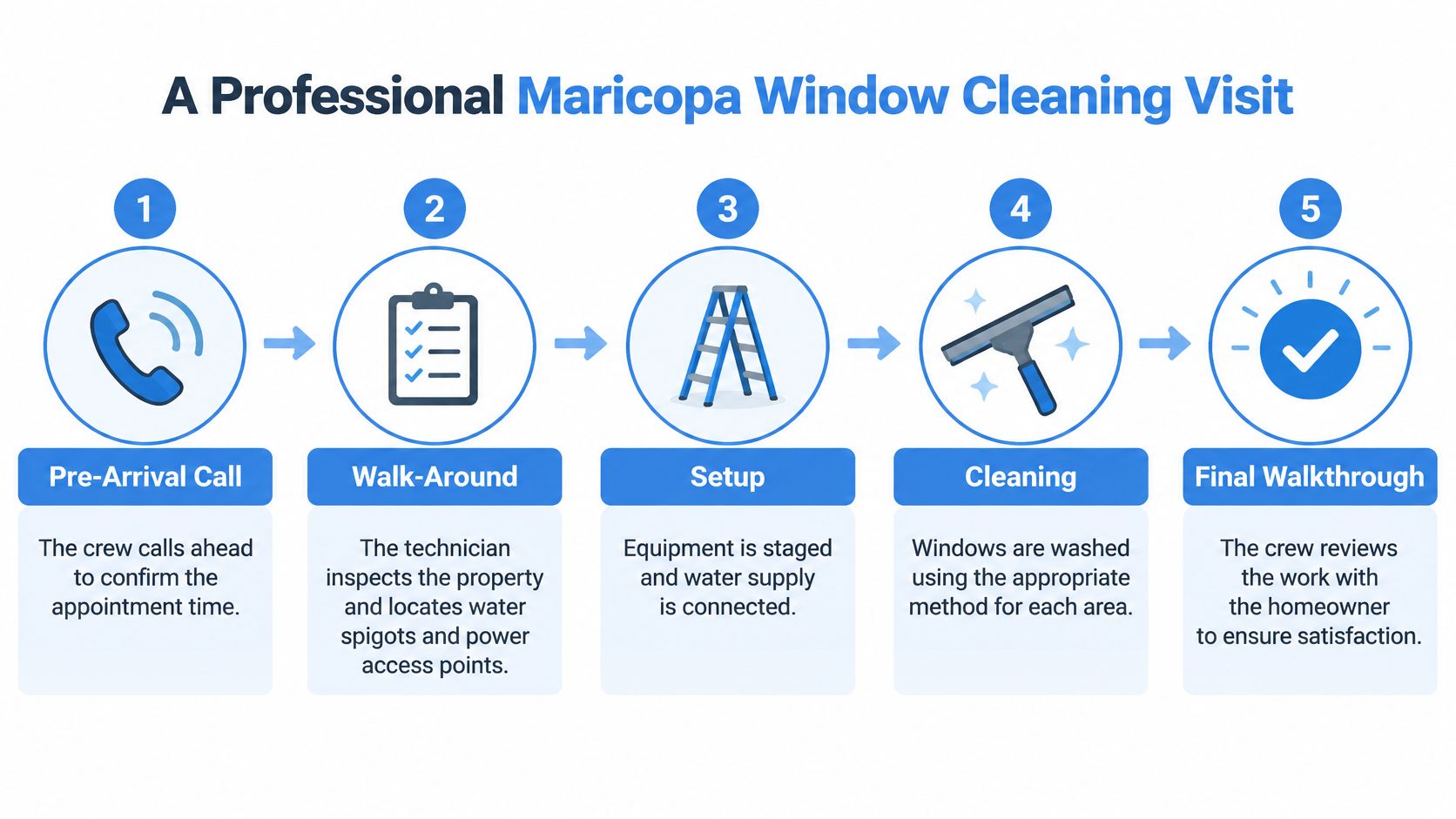
Before unloading everything, the technician should inspect glass condition, locate water spigots, identify power access if equipment requires it, and agree on hose routes. Delicate landscaping, loose pavers, narrow gates, and furniture beneath windows deserve attention before work begins.
Ask the crew to confirm:
The crew should then plan around actual sun exposure. East-facing glass may need early attention before it heats further, while shaded north-facing windows can offer a more forgiving work area. A rigid compass-order rule is less useful than checking which panes are already hot.
Screens should be identified by location and handled according to their condition. Cleaning a pane and reinstalling a dirty screen undermines the finish, but washing a brittle screen without discussing its condition isn't good practice either.
This video offers another way to become familiar with the service before booking.
The final walkthrough should compare the result with the agreed scope. Check accessible panes together, identify any remaining deposits, and resolve missed areas while the equipment is still available. Don't leave the distinction between unfinished cleaning and pre-existing damage for a later phone call.
A useful quote prices the work required, not the size of the house. Pane count, access, condition, and finish requirements explain more than a broad description such as "standard residential cleaning."
Property type matters too. The 2020 Census housing summary counted 1,812,827 housing units in Maricopa County, including 169,248 vacant units, illustrating the range of occupied-home, turnover, and pre-listing work across the wider county. Those county figures aren't a count of homes in the City of Maricopa.
A large, accessible pane may take less handling than a group of small divided windows. Height adds complexity when the technician needs additional access equipment or must work around landscaping, rooflines, and limited setup space.
| Quote factor | What to clarify |
|---|---|
| Pane count and size | How the company counts divided glass, doors, and specialty panes |
| Access | Whether difficult windows require a separate access plan |
| Condition | Whether the price covers routine soil or restoration |
| Screens and tracks | Whether cleaning, removal, and replacement are included |
| Service frequency | What preparation differs between initial and maintenance visits |
| Portfolio work | Whether coordinated access changes scheduling or scope |
An initial deep clean can require more preparation than a recurring maintenance visit. That can justify a higher per-visit price, but a discount isn't automatic. Ask what work the recurring arrangement removes or simplifies.
Hard-water restoration should be clearly separated from ordinary washing. Repeated passes with a washer don't necessarily remove an established mineral film. If treatment is needed, request an explanation of the surface assessment, proposed process, and limitations before approving it.
A lower quote isn't better value if it excludes the screens, difficult panes, or finish you expected.
Bundled screen, sill, and track work adds value when those areas need attention. It adds little value when the description is vague. Compare written scope against written scope, including exclusions and the process for reporting missed work.
Start with what needs cleaning, not with a preference for a particular tool. An exterior-only job with accessible panes and ordinary surface dirt is a different assignment from interior glass with small divided sections and visible mineral deposits.
For a single-story home with suitable exterior access and no established staining, pure water can be a sensible fit. Interior panes and windows needing close edge work generally favor the washer and squeegee. A mixed-method visit is often the practical choice rather than a compromise.

The infographic offers a starting point, but building height alone doesn't decide the method. Upper exterior panes may suit a water-fed pole if the operator can reach and rinse them properly from a safe position. Conversely, an awkward ground-level window may need careful hand work.
Use these decision points:
A squeegee isn't itself a mineral-removal tool. Likewise, purified water isn't a treatment for every white mark. The condition assessment remains separate from the choice of washing method.
For scheduling, biannual service can be a starting recommendation, not a universal requirement. Quarterly visits may be worth considering near active construction or unpaved lots if the glass repeatedly becomes objectionably dirty between appointments.
After a major dust event, inspect before booking an extra full-house clean. The exposed side may need attention while sheltered panes remain acceptable. A condition-based plan keeps the service focused on what your home needs.
A spotless upper window isn't a good result if the crew reached it by taking an avoidable risk. Before comparing prices, ask how the company intends to reach high glass and keep people away from the work area.
Ladders, rooftops, and high-access equipment require more than confidence. A credible contractor should explain the access plan, equipment selection, and site precautions without dismissing your questions.
“Licensed, bonded, and insured” combines different subjects. Ask what licensing applies to the proposed work, what a bond covers, and whether insurance matches the services being performed. None of those terms should be treated as interchangeable or as a guarantee that every possible claim is covered.
The distinction between bonded and insured contractors is useful when reviewing a proposal.
Insurance can help address covered losses. It doesn't eliminate every homeowner liability question, replace safe work practices, or guarantee payment for an excluded claim.
Professional Window Cleaning has been cleaning windows for over 26 years, with its public company profile documenting a 1999 start. That history is a useful example of a checkable track record, although a business-directory profile isn't an audited record of every job or safety outcome.
Longevity deserves consideration alongside current credentials, not instead of them. Ask who supervises the crew and how technicians handle a window they can't safely reach.
Hiring standard: A trustworthy contractor can say that a particular pane needs a different access plan or should remain untouched.
That willingness to stop matters. Good judgment includes recognizing when conditions, equipment, or access don't support the promised work.
Walk past a freshly cleaned window and look from an angle. Then check it from inside against the light. A pane can appear clear straight on while revealing a squeegee line, edge drip, or missed corner from another position.
For routine soil, the expected finish is straightforward: clear viewing areas, clean corners, and no avoidable streaks or rinse residue. Frames and sills included in the scope should look wiped and finished, not merely splashed.
A remaining white ring deserves inspection, but it doesn't automatically prove the technician skipped the pane. Mineral buildup, damaged coatings, scratches, and defects within the glazing need different explanations.
Ask the technician to identify the mark and explain what was included in the service.
| What you notice | What to ask |
|---|---|
| A fresh drip from the upper edge | Can the edge be checked and detailed? |
| Dirt remaining in a corner | Can the corner be reworked? |
| A persistent pale deposit | Is this mineral buildup outside the routine scope? |
| A mark that appears within the glazing | Can the technician confirm which surface is affected? |
Homeowner priorities are usually practical: an unobstructed view, tidy edges, careful treatment of the house, and no mess left behind. Those are useful acceptance criteria without relying on invented testimonials or promises that every window can look new.
Judge the finish against the agreed scope, but expect a clear explanation for anything that remains.
Aftercare matters as well. Don't dry-buff a newly dusty pane just because you notice a small mark later. Describe the location and appearance to the company, and use a photo if it helps identify the issue.
The best before-and-after difference comes from disciplined preparation and inspection. Extra effort with a dirty cloth won't substitute for either.
Before confirming an appointment, get the scope and access arrangements in writing. A short exchange beforehand is easier than discovering exclusions while the crew is already working.
For water use, ask for a job-specific estimate rather than accepting a universal consumption claim. Maricopa County's drought guidance emphasizes reducing outdoor water use and choosing cooler hours for water-intensive tasks.
Runoff deserves its own question. City of Maricopa Ordinance 25-15 prohibits water use that causes flooding, obstructs traffic, creates hazardous traffic conditions, or damages public property.
How long will the visit take?
Ask for an estimate based on photos, scope, and access. A useful answer distinguishes routine cleaning from additional detailing or restoration.
Will crews work during a haboob warning?
Ask about the company's weather policy before booking. Active blowing dust is a reason to postpone, not rush to finish.
How should I prepare?
Clear window access, secure pets, move fragile items, and identify alarms or restricted rooms. Confirm who removes screens and moves heavier furniture.
How should recurring service be arranged?
Agree on a provisional schedule, then adjust it using the condition of your glass. Clarify whether storm-related visits are separate appointments.
Professional Window Cleaning offers residential, commercial, and high-rise window washing, with the method and scope matched to the property. Visit Professional Window Cleaning to request a Maricopa quote, describe your dust and hard-water concerns, and confirm what's included before scheduling.
Read our blog posts regularly and keep learning.