Care and Maintenance
Casement Window Cleaning the Right Way at Home
Learn safe, streak-free casement window cleaning techniques. Covers tools, prep, hardware care, frequency, and when to call a pro.


You're standing in front of glass that looked fine from across the parking lot, then the sun shifted and every streak, spot, and baked-on film showed up at once. That's the moment most property owners realize window cleaning isn't about wiping panes, it's about restoring clarity, protecting the glass, and keeping the building looking cared for.
Professional window washing is a trade with real method behind it. In markets like Phoenix, Scottsdale, Tempe, Chandler, Gilbert, Flagstaff, Las Vegas, and Denver, the difference between a quick wipe-down and a true professional result often comes down to access, weather, glass type, and the cleaning system used. A seasoned crew knows when a simple storefront clean is enough, when a route-based service makes sense, and when a high-rise job needs rope work, lifts, or a suspended scaffold.
There's a reason local reputation matters so much in a fragmented industry. IBISWorld estimates 35,344 businesses in the U.S. window washing industry in 2024, with revenue at $2.9 billion in 2024 and projected at $3.2 billion by 2029 on the window cleaning industry statistics page. That kind of market tells you a lot, there are plenty of operators, but not many shortcuts.
I've also seen how maintenance in one area connects to another. If you keep up with exterior care around the property, resources like Prescott artificial grass maintenance can help owners consider the full picture of curb appeal, not just glass. Clean windows and a clean property work together, and when both are neglected, the whole property looks tired.
A homeowner notices the problem first in the morning. The light comes through at an angle, and what looked like “a little dust” yesterday now reads as haze, mineral spotting, and streaks that make the whole façade feel dull. On commercial properties, the same issue hits harder, because a dirty first impression tells visitors the building isn't being watched closely.
Professional window washing changes that fast because it's not just surface cleaning. The work is about restoring transparency, removing residue without leaving residue behind, and using the right method for the right glass. That matters whether the building is a single-family home, a medical office, a car dealership, or a tall condo in Denver or Las Vegas.
The visible gain is obvious, but the practical gain is just as important. Routine care helps keep grime, dust, and hard-water deposits from sitting on the glass and frame longer than they should. When contaminants stay on the surface, they're harder to remove later, and the job gets slower, messier, and less predictable.
Practical rule: the longer buildup sits on exterior glass, the more likely it is to require careful correction instead of a simple wash.
That's why experienced cleaners look at the whole job, not just the pane in front of them. Access, weather, glass type, and safety setup all shape the result. A good provider also understands how a property in Phoenix behaves differently from one in Denver, especially when sun, dust, and seasonal debris change the cleaning window.
There's also the time factor. Property owners can spend half a day chasing streaks with paper towels and still end up with smears that show up in direct light. A professional crew brings a system, the right cloths, the right solution, and the muscle memory to finish cleanly and move on.
For owners comparing service options, the main value isn't mystery, it's consistency. That's what separates a real trade from casual cleaning. In a mature market with many small operators, experience and repeatable process matter more than flashy promises.
In the field, professional window cleaning comes down to two methods that hold up under real use. The first is the squeegee method, the hand-cleaning process pictured when one thinks of a cleaned pane. The second is the pure-water system, also called a water-fed pole setup, which lets a cleaner work from the ground with purified water sent through a pole and brush head.
The old idea that the work is just soap and a quick wipe falls apart once you watch a trained crew on site. Good results come from sequence and control. Training materials for the trade generally describe the same workflow, scrub the glass first, pull the squeegee in overlapping passes, wipe the blade after each stroke, then detail the edges with microfiber cloths. That order matters because leftover water on the frame or edge line can mark the pane after the main pass is finished.
The squeegee method is still the standard for many residential interiors, storefronts, and close-detail exterior work. The cleaner wets the glass, loosens the film, then pulls the solution off in controlled strokes. If the blade is dirty, nicked, or not cleared between passes, streaks show up fast, especially on dark-tinted glass or when direct light hits the surface.
Good field work is repetitive on purpose. The cleaner resets the blade, checks the edge, and finishes the corners by hand.
That extra handwork is where many DIY jobs fall short. People often clean the center of the pane and leave the perimeter behind, but the edge line is where drips, residue, and missed spots tend to collect. A real professional finish depends on that last detail pass, not just the broad wipe across the middle.
The method also gives the cleaner more control on mixed glass conditions. Some panes need lighter pressure, some carry a film that needs a second pass, and some frames shed water back onto the glass if the angle is wrong. That is why experienced cleaners adjust stroke length, drying method, and edge detailing instead of using one fixed routine on every opening.
The other core method is the pure-water system, and it changed the trade in the 1990s according to industry history sources. Instead of detergent and hand tools on the glass, the cleaner uses purified water and a brush on a pole to break up dirt, then lets the pane dry without soap film. That approach works well on many exterior jobs where the glass can be reached safely from the ground and where access is more limited.
This method does not replace every hand-cleaning situation. Interiors, heavy detailing, and some specialty glass still call for the squeegee approach. It also depends on water quality, brush choice, and how dirty the glass is at the start. On lightly soiled exteriors, it can move quickly. On neglected glass with baked-on grime or mineral buildup, it may need more time or a different method to get the result the owner expects.
The trade-off is access versus finish style. A water-fed pole reduces the need to work directly on the glass line, which helps on taller or harder-to-reach exteriors. The squeegee method gives tighter control and a more hands-on finish, which is why crews still rely on it for interiors, detailed edges, and glass that needs close inspection.
If you want to see how a full system is described in practice, the process overview on the professional window washing system page is a useful reference point for how crews organize the work.
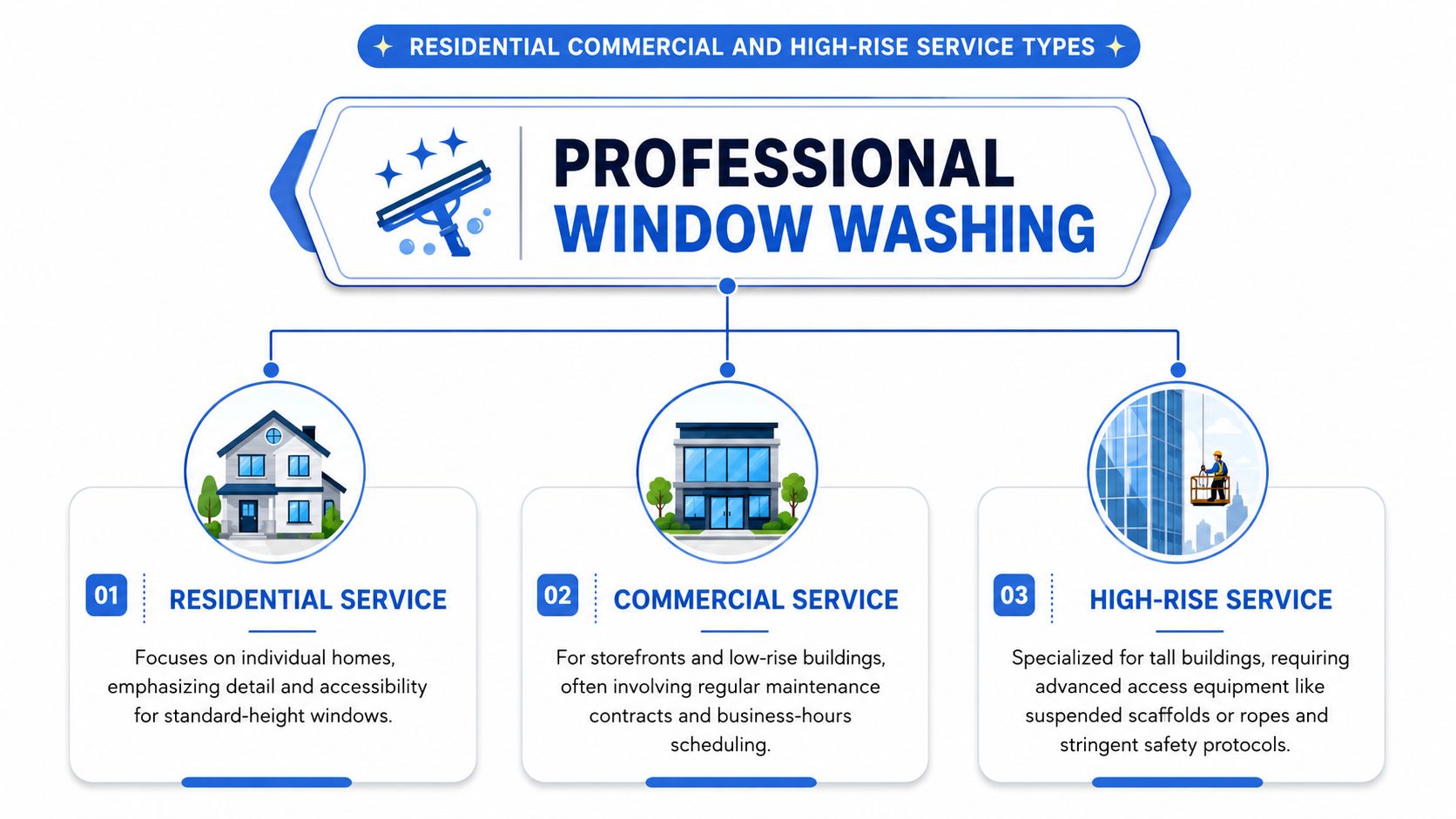
A homeowner, a property manager, and a high-rise board member are usually buying three different services, even if they all use the same phrase. Residential service is about homes and condos, where access is usually simpler and attention to detail matters on interior glass, mirrors, and standard-height windows. Commercial service covers storefronts, offices, dealerships, medical buildings, and similar properties where presentation and repeat scheduling matter. High-rise service is specialized work for tall façades that need ropes, suspended scaffolds, aerial lifts, or other controlled access methods.
The job changes with the building, not just the client. A single-story house in Scottsdale may need careful interior and exterior cleaning around landscaping and screens. A dealership in Chandler needs glass that looks clean all day because customers judge the showroom before they ever talk to sales staff. A tower in Denver needs more planning before a crew ever touches the façade.
Residential work usually focuses on windows the owner sees every day. The pace is slower, and the cleaner often has to move through living spaces, protect flooring, and work around pets, furniture, and window treatments. Commercial service tends to be more about repeat routes, exterior glass visibility, and scheduling around business hours.
High-rise work is the most technical category because the access method is part of the job itself. The standard used in the trade, ANSI/IWCA I-14.1, applies to operations performed at least three stories above grade, while OSHA generally requires fall protection at 4 feet or more in general-industry settings and uses 5,000 pounds per worker as a strength criterion for personal fall-arrest anchorage, according to this safety overview. That means the equipment plan isn't optional, it's built into the work.
The best providers explain the scope before they start. They identify whether the work includes interior glass, exterior glass, screens, tracks, or specialty panes. They also tell you when access will limit what can be cleaned in one visit.
That honesty matters more than a low quote. A clean storefront is one thing. A tower with awkward setbacks and weather exposure is another entirely.
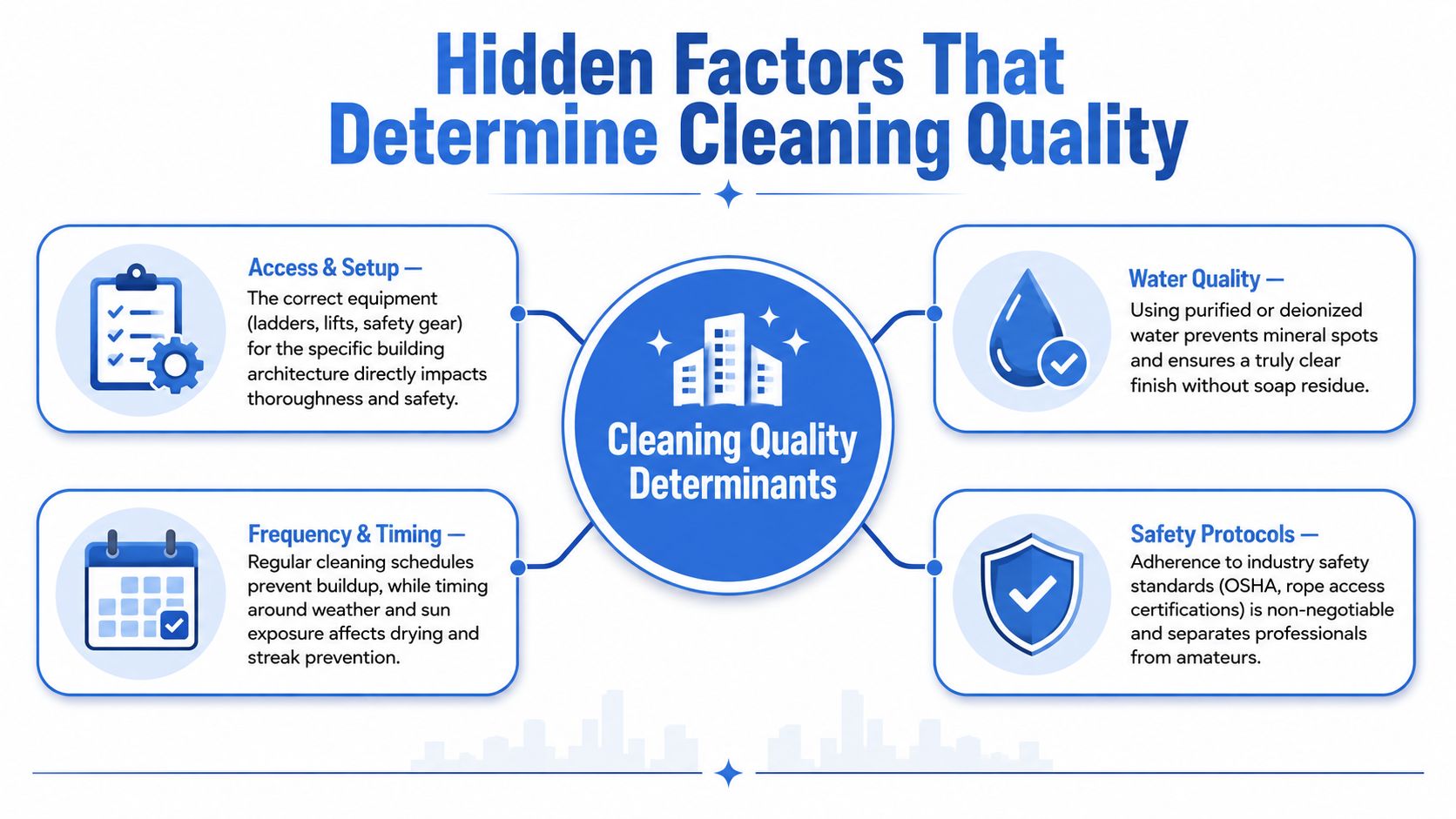
Most bad window jobs don't fail because someone forgot how to wipe glass. They fail because the crew misunderstood the site. Access, glass specification, and weather all shape the final result, and those are the details that separate a careful job from a frustrating one.
A lot of windows are not hard to clean, they're hard to reach. Setbacks, adjacent structures, patio roofs, sloped landscaping, and awkward angles can turn a simple pane into a planning problem. One industry FAQ says access is generally the number one reason a window can't be reached, and that rings true in the field.
That's especially important for commercial and high-rise properties. A cleaner may have the right technique but still need lifts, ropes, or partial service because the building geometry blocks direct access. People often assume a longer pole solves everything, but poles don't fix every angle, and they don't make an unsafe setup safe.
Not all glass behaves the same. The standards used by the International Window Cleaning Association distinguish flat glass under ASTM C1036, heat-strengthened or fully tempered glass under ASTM C1048, and laminated architectural flat glass under ASTM C1172. Those categories matter because they differ in surface behavior, edge conditions, and failure modes, which affects how hard a cleaner can work the glass.
A careful cleaner identifies the glass before choosing the tool. That reduces the risk of scratches, edge damage, and seal interference.
A pane that looks ordinary from the sidewalk may need gentler handling than the owner expects. That's why experienced crews look at the assembly, not just the dirt.
Sun, heat, and wind can ruin a good cleaning day. General window-cleaning guidance warns against washing in direct sunlight because solution can dry too quickly and leave streaks, and that matters even more in hot markets like Arizona and Nevada. What looks like a technique problem is sometimes just a timing problem.
I've seen spotless glass turn streaky because the solution flashed off before the blade finished its pass. I've also seen crews do everything right and still reschedule because the conditions were wrong. Good scheduling is part of professional work, not an excuse.
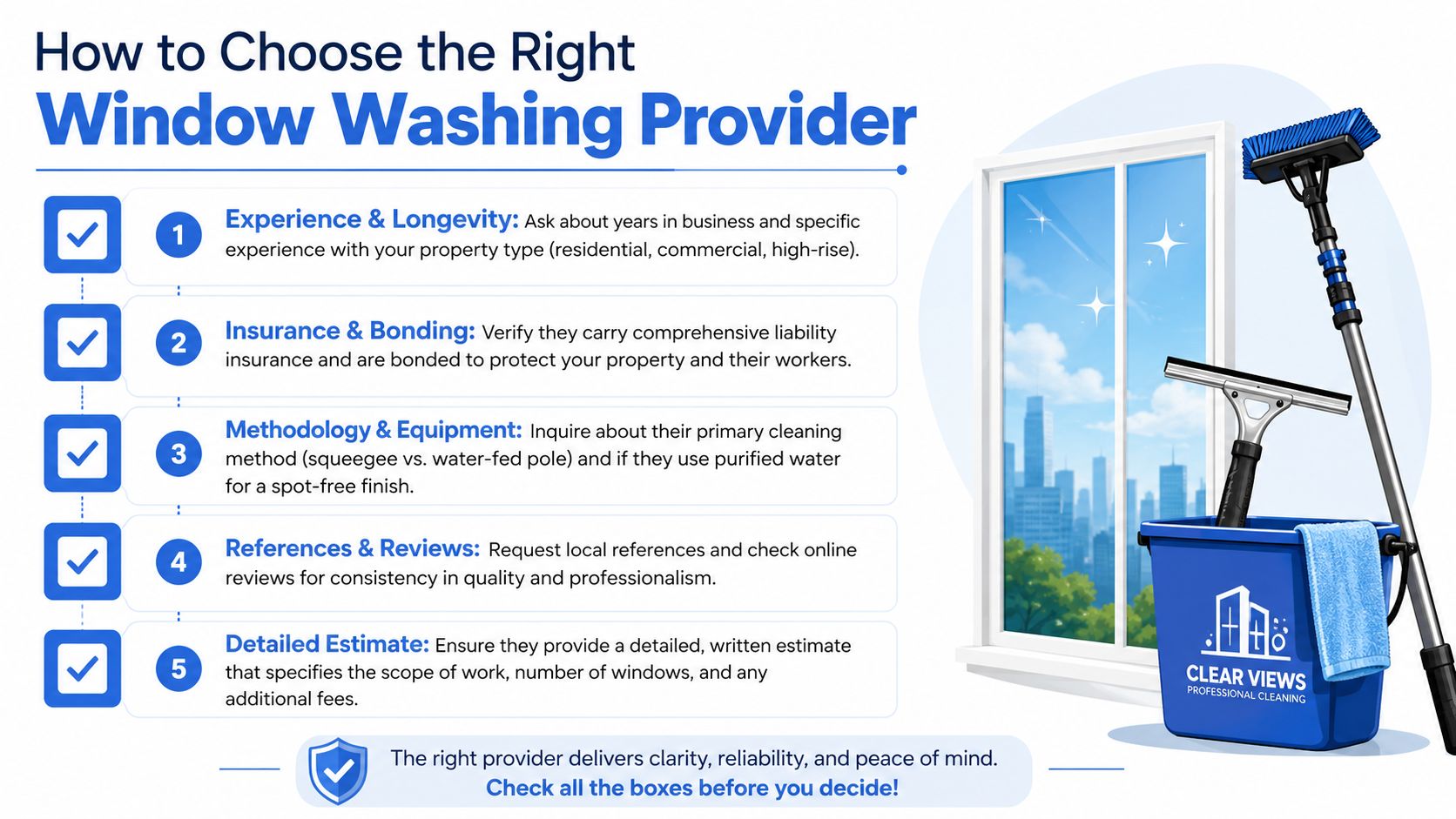
Picking a provider should feel like checking a professional résumé, not taking a gamble. In a fragmented market with thousands of operators, the safest choice is usually the one that can explain how they work, what they can reach, and what they won't promise. Experience matters, but so does the way that experience shows up on the estimate and on-site.
A serious company should answer the same questions every time without getting defensive:
If you want a practical lens on whether to hire help or keep trying to do it yourself, The Green Advantage's advice on pest control is a useful reminder that the better question is often not “can I do it?” but “what does the job require?”
A crew that works the same routes every week understands how dust, heat, sun, and building design affect the schedule. That's valuable in Phoenix, Scottsdale, Tempe, Chandler, Gilbert, Flagstaff, Las Vegas, and Denver, because each area brings its own mix of weather and architecture. Local knowledge also helps with route density, which matters in a business where recurring commercial contracts are often more efficient than one-off visits.
Don't hire on price alone if the provider can't explain access or safety. The cheapest estimate can become the most expensive mistake.
The right provider should sound calm, specific, and familiar with the property type you own. If they're vague about equipment or timing, keep looking.
Price starts with the size of the job, but it doesn't end there. Window count, glass type, accessibility, interior versus exterior scope, and whether the work is recurring all influence the estimate. A storefront with easy ground-level access is a different job from a multi-story office with awkward angles and limited staging room.
Commercial contracts often work differently from one-time residential cleaning. Repeat service can be built around a route, while a home clean may require more setup and more time spent moving through living spaces. If windows are hard to reach or need special equipment, that can change both the labor plan and the scheduling.
| Property Type | Recommended Frequency | Key Factors |
|---|---|---|
| Single-family home | Twice a year | Dust, pollen, sun exposure, and general curb appeal |
| Condominium | Twice a year or more often if the view matters | Shared access, exterior visibility, and building rules |
| Storefront or retail | Monthly to quarterly | Customer-facing glass and street grime |
| Office or medical building | Quarterly | Professional appearance and regular maintenance |
| High-rise property | Scheduled as part of a building plan | Access planning, safety setup, and façade exposure |
That table is a practical starting point, not a rigid rule. Properties in dusty or sun-heavy areas often need adjustments, especially when weather and water quality leave residue faster than owners expect.
Maintenance works best when it's consistent. Letting glass sit too long usually makes the next cleaning slower and less predictable.
For owners in Arizona, Colorado, and Nevada, the best schedule depends on what the building faces and how much grime collects between visits. The cleaner's job is easier when buildup never gets a chance to harden.
Arizona and Nevada are hard on glass in ways that don't show up in milder climates. Heat, dust, wind, and hard water mineral deposits can change how often a property needs service and how the crew should schedule the work. In Colorado, the issues shift toward pollen, seasonal grime, snow-related residue, and stronger sun at altitude.
The practical answer is to plan around the environment instead of fighting it. In Phoenix, Scottsdale, Tempe, Chandler, and Gilbert, exterior work usually goes better when crews avoid the hottest part of the day and watch for conditions that dry solution too fast. In Flagstaff, cooler conditions and seasonal changes can alter timing, while Las Vegas often brings bright sun, dust, and mineral spotting that needs a careful approach. In Denver, weather swings and seasonal buildup make consistency more valuable than occasional deep cleans.
For Arizona property owners, the regional cleaning approach on window cleaning in Arizona is especially relevant because it reflects how local conditions affect scheduling and finish quality. The main lesson is simple, local climate changes the method, not just the date on the calendar.
Professional Window Cleaning has been in business since 1999, which means over 26 years of field experience across Arizona, Colorado, and Nevada. That kind of longevity matters because it comes from handling the same real-world problems property owners face every season.
If your windows are streaking, hard to reach, or just overdue for a proper clean, contact Professional Window Cleaning and ask for a service plan that fits your property. We'll help you match the right method to your glass, your access, and your schedule so the result looks right the first time.
Read our blog posts regularly and keep learning.