Care and Maintenance
Window Cleaning Service Near Me: A 2026 Guide
Find a window cleaning service near me with 2026 price bands, two pro methods, safety questions, and booking tips for AZ, CO, and Las Vegas.


Steel wool is only acceptable on bare, uncoated glass, using 0000 grade, with mineral grit removed first. Even then, it's a conditional detailing tool, not a guarantee against scratches.
The popular advice that “fine steel wool can't scratch glass” leaves out the most important part: what's touching the pad. A vulnerable coating or a grain of construction dust can turn a household cleaning trick into permanent damage. Before trying steel wool glass cleaning, identify the exposed surface, not just the pane.
Bare glass is the starting requirement, not automatic permission. Low-E coatings, hydrophilic self-cleaning layers, aftermarket tint, decorative films and digital prints need a different approach from untreated glass.
An insulated window can have a coating sealed between its panes, where your cleaning tool won't touch it. An exposed coating is different. Check the glazing documentation or manufacturer's care instructions rather than assuming every energy-efficient window has the same cleaning restrictions.
| Glass or surface | 0000 steel wool | Use instead |
|---|---|---|
| Bare uncoated annealed glass, including windows and mirrors | Acceptable after grit removal and a successful spot test | Squeegee or glass cleaner with microfiber |
| Tempered shower glass | Avoid | Squeegee and glass cleaner, then rinse |
| Low-E coated glass | Avoid | Microfiber and nonabrasive cleaner |
| Hydrophilic self-cleaning glass | Avoid unless the manufacturer permits | Manufacturer-approved cleaner |
| Window tint or film | Avoid, fibers can shred the film | Soft microfiber and film-safe cleaner |
| Decorative, frosted or digitally printed glass | Avoid unless confirmed suitable | Soft cloth after a spot test |
| Vehicle windshield glass | Permitted by some manufacturers after a grit wash | Follow the manufacturer bulletin |
| Unknown surface | Do not use | Identify the coating first |
Manufacturer permission applies to the specified surface and procedure. An Infiniti technical bulletin hosted by NHTSA permits new #0000 steel wool on windshield glass after abrasive grit has been washed away. That isn't blanket approval for every windshield, side window or aftermarket treatment.
The 2024 Nissan service bulletin allows #0000 steel wool for foreign material on automotive window glass, used manually without power tools, after washing and drying with soap and water. It specifies fresh wool from an unopened package and advises against applying cleaners with the wool.
Ask these questions before opening the packet:
A spot test checks how a known, suitable surface responds. It doesn't replace identifying an unknown coating.
| Grade | Fineness | Typical use | Suitable for glass |
|---|---|---|---|
| 0000 | Super fine | Light rust removal, finished-wood buffing, glass cleaning | Yes, on bare glass after grit removal |
| 000 | Very fine | Cleaning, polishing and smoothing glass, metal, enamel and ceramics | Sold for bare glass; test first and don't treat that as coating approval |
| 00 | Fine | Metal finishing and polishing | Not recommended |
| 0 | Medium fine | Rust and paint removal on metal | Not recommended |
| 1 | Medium | Heavier metal cleaning | Not recommended |
| 2 | Medium coarse | Stripping and heavy metal work | Not recommended |
| 3 | Coarse | Glass block, stone and hard metal | No for finished window glass; scratching risk |
| 4 | Extra coarse | Heavy-duty abrasive work | No for finished window glass; scratching risk |
Read the grade, not just the product name. Grainger's steel-wool specifications identify 0000 as the finest grade, suitable for glass cleaning, light rust removal and buffing finished wood. That's the conservative choice for the limited bare-glass procedure described here.
Grade 000 also appears in glass-industry product ranges. Bohle's grade-000 steel wool is sold for cleaning, polishing and smoothing glass, metal, enamel and ceramics, with wet or dry use determined by the surface. That product description doesn't make it interchangeable with a manufacturer procedure specifying super-fine wool.
The middle grades belong to progressively heavier finishing and cleaning work. Don't interpret “fine” on its own as suitable for a window, and don't substitute a kitchen scouring pad because it looks similar.
At the coarse end, glass block is not the same cleaning application as a clear finished pane. A product intended for stone, hard metal or glass block is a poor choice for a window where even a faint line will show against daylight.
Steel wool consists of flexible, unbacked strands. It compresses into small spaces and follows beveled edges, which makes it useful for detailing but also makes accidental contact with frames, seals and adjacent finishes easy.
Buying rule: If the packaging doesn't state the grade, don't use the product on glass.
Brand familiarity doesn't compensate for the wrong abrasive. Keep glass-detailing wool separate from pads used on metal, masonry or painted surfaces.
Iron is softer than common glass: J. Racenstein's fine-surface guidance puts iron at approximately 4 on the Mohs scale, compared with about 5.5 to 7 for common glass. That explains why clean, ultra-fine fibers can work on some uncoated panes, but it doesn't prove the whole cleaning operation is scratch-proof.
The visible result can look like this:
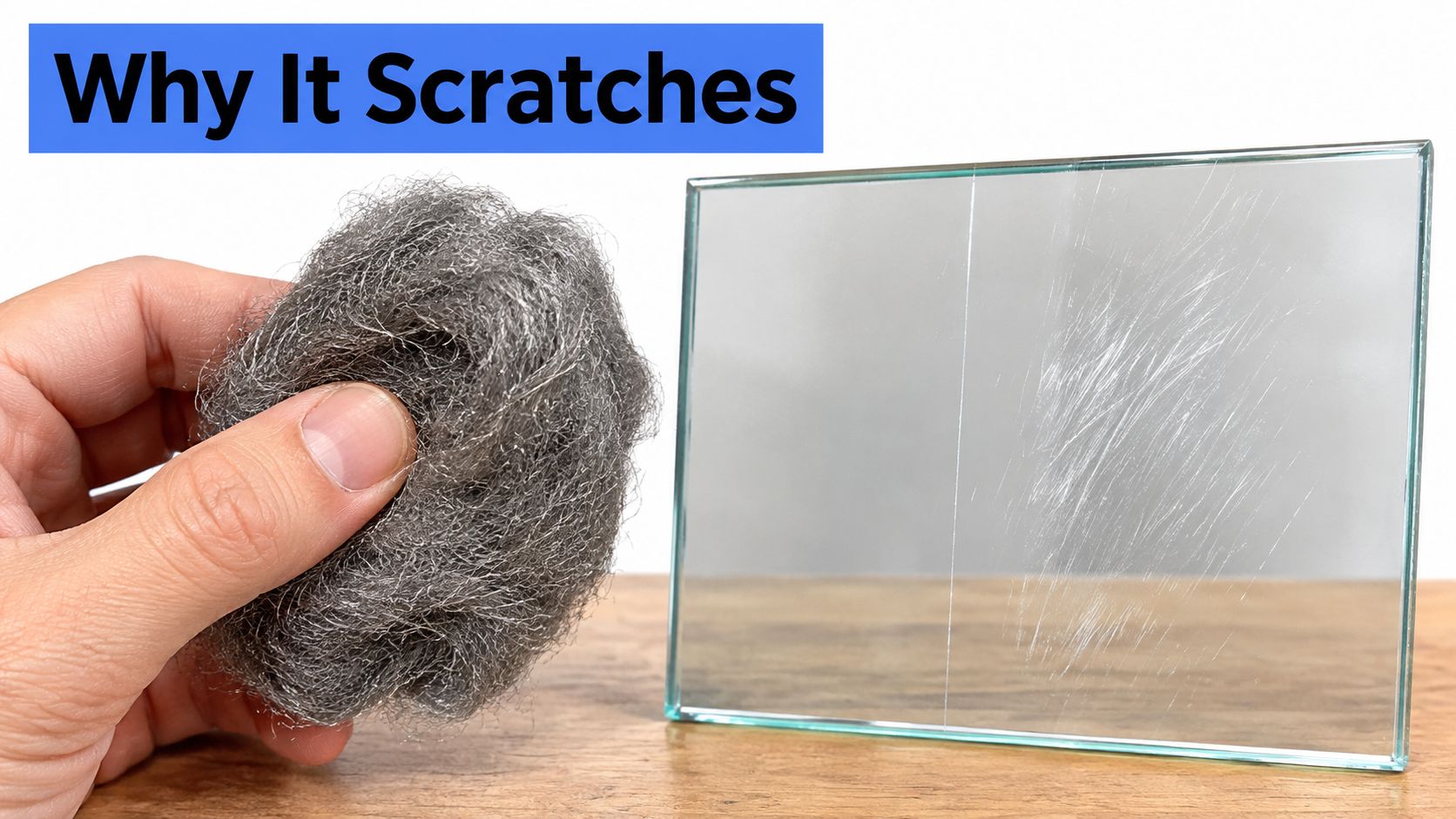
Sand, concrete dust and construction debris can contain mineral particles harder than the pane. When a fiber traps one and you push the pad across the window, that particle can score a permanent line. It's like dragging a pebble underneath a sponge: the softness of the sponge doesn't protect the surface.
Heavy pressure presses trapped debris against the glass. Dry rubbing and inadequate lubrication make drag harder to control, while a pad previously used near masonry can carry contamination that you won't see.
The same caution applies to other household abrasives. Our explanation of whether a Magic Eraser can be used on glass helps distinguish ordinary cleaning from abrasive contact.
Watch any demonstration with surface identification and contamination control in mind:
Fine steel fibers have a high surface-area-to-volume ratio and can ignite readily. Keep wool away from sparks, batteries, electrical contacts and open flames.
Store unused material dry in its packaging. Collect used fibers and keep discarded pads contained away from ignition sources rather than leaving them loose on a workbench or in a pocket with batteries.
Use this procedure only for confirmed suitable bare glass. If a vehicle or glazing manufacturer gives a specific procedure, follow that procedure instead, including its directions about dry use, cleaners and surface preparation.
The preparation matters more than how hard you rub:
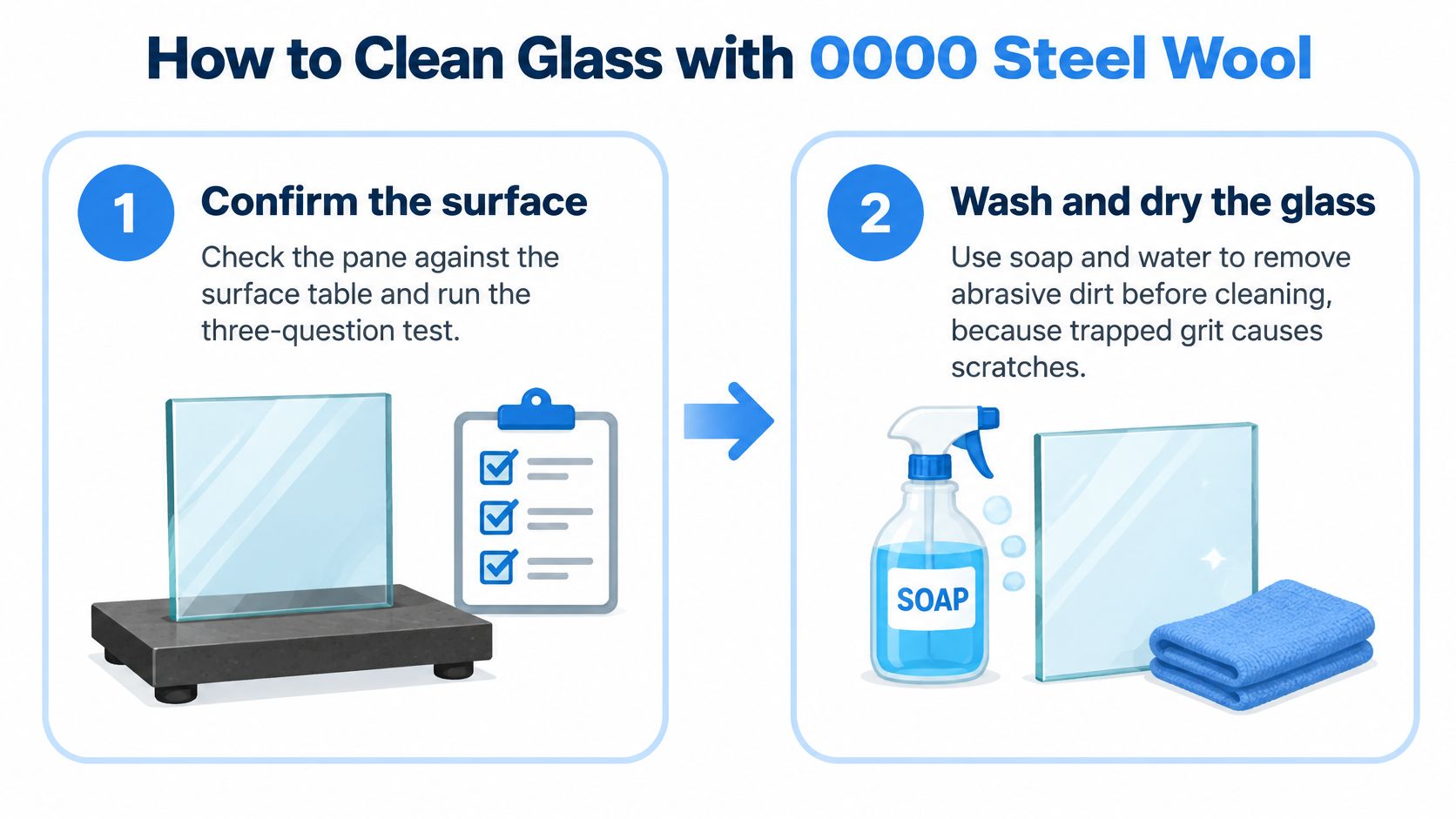
Confirm the exposed surface. Check the pane against the surface table and identification questions, then select an inconspicuous test area. Don't assume that a clear-looking pane is untreated, because transparent films and coatings can be difficult to identify visually.
Wash and dry the glass. Use soap and water, rinse thoroughly and dry with a clean microfiber cloth so you can inspect what remains. The common mistake is wiping a dusty pane and calling it clean, leaving abrasive particles at the edges or beneath the residue.
Open fresh super-fine wool. Take the pad from an unopened package and keep it off the sill, ground and surrounding masonry. Discard dropped or contaminated wool rather than trying to shake it clean, since particles can remain inside the compressed strands.
Wet the test area for this bare-glass method. Dampen the glass with clean water and maintain a wet surface while working. Don't transfer this wet procedure to automotive glass when its manufacturer specifies a different approach.
Keep cleaning products off the wool itself. Don't load the fibers with cleaner, polish or a homemade mixture, and don't combine products to make the pad more aggressive. If the residue needs a chemical treatment, select one approved for that surface and use it as a separate cleaning operation.
Use light pressure and short, straight strokes. Work the test patch gently, rinse the pad frequently and replace it if contamination is suspected. Straight strokes make your contact path easier to inspect and avoid spreading circular abrasion patterns, but they don't make a dirty pad safe.
Stop at drag, haze or a visible line. Rinse and dry the test patch, then examine it from different angles in daylight before treating more glass. Photograph the test area if you're responsible for a tenant's, customer's or building owner's property; don't keep rubbing to see whether a mark disappears.
Rinse, dry and inspect the finished area. Remove loosened material and fibers, then dry with a separate clean microfiber cloth. Check the pane, seals and frame edges rather than judging the result only while the glass is wet.
Success means a clean, even surface with no new marking and no steel fibers left behind. If achieving that requires harder pressure, stop and change the approach.
A fine swirl or straight line appearing after rubbing is a warning, not leftover dirt to scrub away. Trapped grit, excessive pressure or an unsuitable surface may be responsible. A scratch that remains after gentle washing needs assessment rather than another abrasive pass.
Bohle's glass-care product guidance recommends testing unfamiliar surfaces to prevent scratching. The practical lesson is that a product's glass-cleaning label doesn't override the condition of the pane, coating or pad.
Cloudiness that existed before cleaning isn't necessarily a new scratch. For residue that remains after routine washing, Aloha Window Bros.’ guide to tackle stubborn window mineral deposits offers useful context for evaluating a deposit-removal approach.
Don't use stronger abrasion as a diagnostic test. A removable film, mineral buildup and altered glass can look similar when viewed straight on.
Damage control: A replacement pad can fix contamination. It can't reverse a scratch already cut into the pane.
On coated or uncertain glass, switch to a manufacturer-approved nonabrasive method. If haze or lines remain after cleaning, leave polishing decisions to someone who can assess the surface and the likely result.
Professional window cleaners use two window-cleaning methods: a squeegee or a pure-water system. Steel wool isn't a third method. It's a separate, conditional residue-removal tool, and neither routine cleaning method depends on it.
| Method | Best for | Risk to glass | Professional use |
|---|---|---|---|
| Squeegee with cleaning solution | Standard panes and storefronts | Low when the blade and surface are clean | Yes, one of two methods |
| Pure-water system | High windows, residential and commercial maintenance, preventing mineral spotting | Very low on suitable surfaces; no drying wipe needed | Yes, one of two methods |
| 0000 steel wool | Stubborn deposits on bare, uncoated glass | Moderate and grit-dependent | No, not a professional window-cleaning method |
A suitable cleaning solution loosens ordinary grime, and a clean rubber blade removes the water. Use controlled, overlapping strokes with a clean blade edge rather than repeatedly dragging dirty water across drying glass.
This approach suits accessible windows and storefronts because the cleaner can inspect the pane closely. For routine household maintenance, Fillaree's guide to how to make eco-friendly glass cleaner provides an alternative to buying another spray, provided the ingredients suit your glass and surrounding finishes.
According to Waterpoint's pure-water system explanation, reverse osmosis can remove up to 99% of dissolved substances, while deionization captures remaining trace ions. A telescoping brush loosens dirt, and flowing treated water carries it away.
With very few dissolved minerals remaining, the rinse can air-dry without mineral spotting or a final towel wipe. That prevents rinse-water deposits; it doesn't mean pure water alone will remove established hard-water stains.
For Low-E, tinted and shower glass, choose a soft microfiber cloth and an approved nonabrasive cleaner for local hand cleaning. Persistent surface damage may warrant glass-polishing assessment, not harder scrubbing.
Choose the cleaning method around the glass, access height and level of soiling, then address exceptional deposits separately.
A careful DIY pass is reasonable only when the glass is confirmed bare, the wool is super fine, the pane is clean and the dried spot test shows no marking. Choose professional assessment for tempered shower glass, coatings, tint, decorative surfaces, dealership vehicles or high-rise windows where access or damage would be costly.
Professional Window Cleaning's business profile records a 1999 start, giving the company over 26 years of experience, with listed work spanning homes, high-rise buildings and condominiums, international airports, government buildings, sports arenas, football stadiums and construction sites.
Our service areas include Denver and Las Vegas. Our cleaning process uses:
For broader household cleaning information, Simply Maid is a separate resource, but specialist glazing still needs surface-specific care.
Confirm the surface before testing anything abrasive. Run a spot test only when the glass is suitable, and request a quote if the coating, residue or risk remains uncertain.
Professional Window Cleaning offers residential, commercial and high-rise window cleaning, with methods suited to the glass and access conditions. If you're considering steel wool because ordinary cleaning hasn't worked, visit Professional Window Cleaning to request a quote and describe the deposits, coatings or marks before risking another abrasive pass.
Read our blog posts regularly and keep learning.