Care and Maintenance
Window Cleaning Service Near Me: A 2026 Guide
Find a window cleaning service near me with 2026 price bands, two pro methods, safety questions, and booking tips for AZ, CO, and Las Vegas.


The doors are covered in fingerprints again, the afternoon sun is showing a film across the display glass, and your next customer is stepping around a wet patch at the entrance. You need clean windows, but you also need the work done without disrupting the business. A useful storefront window cleaning plan accounts for all of that: what gets dirty first, how crews reach it, and where customers walk while the work happens.
The right service isn't just a promise of streak-free glass. It's a workable schedule, a suitable cleaning method, and a controlled job site.
| Glass type | Typical interval | Why it sets the pace |
|---|---|---|
| Entrance doors and lobby glass | Every 2–4 weeks as a starting recommendation for busy sites | Heaviest hand contact and the first thing customers see |
| Street-facing display glass | Monthly as a starting recommendation | Road spray, dust and daily sun exposure show quickly |
| Dusty or desert-market storefronts | Move each row up one tier when visible buildup warrants it | Wind-blown sand adds grit that can scratch glass during careless cleaning |
| Upper-floor and office windows | Quarterly as a commercial-property baseline | Less public contact, with service frequency tailored to the building |
These are starting intervals, not fixed requirements. Before setting the schedule, stand where customers approach and check for fingerprints, dust film and haze. If these are already obvious, shorten the interval for that glass area instead of increasing service across the whole property. Foot traffic and pedestrian routing matter too: entrance glass gets handled repeatedly, while upper panes face different exposure and access conditions.
The distinction between entrances and upper windows matters. Bloomberg's account of commercial window washing describes building windows being washed approximately twice per year. That is an example of a building-wide cycle, not the standard for office glass. Commercial properties are generally recommended for quarterly cleaning, with the schedule adjusted to the specific building. Ground-level retail windows and lobby entrances usually need more frequent attention because customers touch and inspect them at close range.
In dust-prone markets such as Phoenix and Las Vegas, shorten entrance intervals when wind-blown grit keeps returning between visits. Move up one tier to the next more frequent interval; don't automatically double every service visit. Grit also makes careful cleaning important, since wiping it across the pane can scratch the glass.
Kitchen exhaust and road spray call for a different adjustment. They can leave stubborn film on display glass even when the doors still look acceptable. Increase service on the affected frontage and address the source where possible, especially if an exhaust outlet or irrigation pattern keeps contaminating the same panes.
South- and west-facing glass deserves an afternoon inspection. Sun-warmed surfaces can make residue harder to remove, and strong light exposes marks that are less visible during a shaded morning check. That makes sun angle and the time customers approach part of the schedule, not just appearance after cleaning.
Scheduling rule: Pay for the frequency each glass area needs, not one blanket interval for the whole building.
Use this guide to how often commercial windows should be cleaned when organizing a mixed property. For a new storefront, start display glass on a monthly schedule, review its condition before each visit over two service cycles, then adjust the interval to match visible buildup and customer-facing conditions.
| Method | Best for | Reach and access | Finish and main risk | Core equipment |
|---|---|---|---|---|
| Squeegee and detergent | Low storefronts with accessible glass | Hand tools or an extension pole; a ladder may be needed where safe ground access won't work | Streaks if detergent dries on hot glass | Bucket, scrubber, squeegee, microfiber cloths |
| Pure-water system | Tall frontages, hard-to-reach frames and sites with mineral-rich supply water | Ground-based water-fed pole, subject to equipment and site limits | Detergent-free rinse; contaminated water or incomplete rinsing can leave spots | Filtration stack, TDS meter, telescoping pole, brush |
Professionals use two methods: a squeegee or a pure-water system. Ladders, lifts and suspended platforms provide access. They aren't separate cleaning methods.
The comparison below shows the basic equipment and applications.

A squeegee gives the technician direct control over solution removal and edge detailing. It's a practical choice for accessible doors, display panes and glass beneath reachable awnings, particularly where runoff must be kept away from the entrance.
Pure-water equipment filters ordinary supply water before delivering it through a hose to the pole-mounted brush. The window-cleaning equipment overview describes carbon filtration combined with reverse osmosis and/or deionization, targeting approximately 0 parts per million of total dissolved solids. Brush agitation loosens dirt, then purified water rinses it away without a detergent finish.
That helps prevent new mineral deposits from the rinse water. It doesn't mean existing hard-water stains will disappear. Bonded deposits may need separate treatment before routine maintenance can produce an even result.
For taller frontages, WAXIE's pure-water cleaning guide describes lightweight pole systems reaching up to 55 feet, roughly five stories, allowing workers to remain on the ground where ladder placement would be dangerous. That capability isn't a guarantee that every frontage is suitable: setbacks, overhead obstructions and pedestrian access still govern the decision.
The UK Health and Safety Executive's window-cleaner guidance recommends pre-use equipment checks and regular pole inspections, and warns against work in high winds, thunderstorms or near overhead power lines.
For a building with both low and high glass, assign the method by area. Use the squeegee where close detailing and runoff control matter; use pure water where safe pole access makes high cleaning practical. Don't force one method across the entire façade just because that equipment is already unloaded.
A reliable squeegee workflow starts before the scrubber touches the pane. The technician needs to identify loose contamination, vulnerable surfaces and marks that won't respond to ordinary washing.
This process illustration summarizes the sequence.
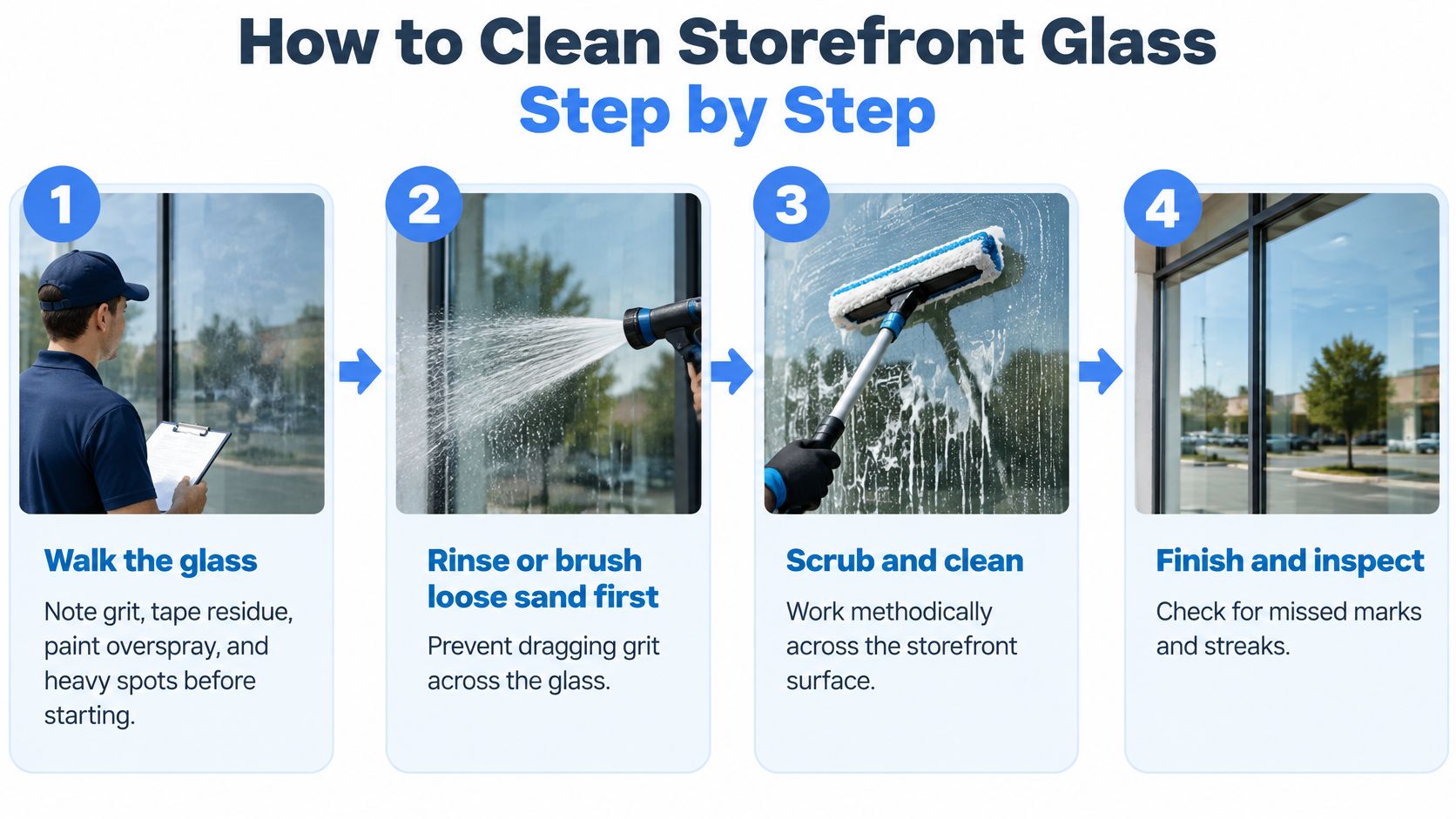
Walk the glass. Note grit, tape residue, paint overspray, heavy deposits and visible scratches before starting. The usual mistake is treating every mark as removable dirt, then using more pressure when ordinary washing doesn't work.
Rinse or brush away loose sand first. Remove loose material gently rather than dragging it across the surface with a loaded scrubber. Don't transfer a brush used on a gritty sill straight onto coated glass without cleaning it.
Soak with clean water and a mild, non-abrasive solution. Wet the working area thoroughly so the scrubber can loosen soil without dry rubbing. Avoid flooding frame joints or starting more glass than you can finish before the solution dries.
Remove the solution immediately with a clean squeegee. Work from top to bottom, controlling overlapping strokes and wiping the blade between passes. A nicked or contaminated rubber edge leaves lines, so inspect it instead of repeatedly chasing the same streak.
Dry the perimeter and joints. Use a clean microfiber cloth on corners, gaskets and mullion joints, where retained water can escape after the pane looks finished. Keep a separate cloth for dirty sills so you don't smear that contamination back onto the glass.
Inspect at an angle in changing light. Step away, view the pane obliquely and check both sides where accessible. Straight-on inspection can miss haze, edge residue and marks hidden by reflections.
The Aloha Window Bros storefront-cleaning guide summarizes Glass Association of North America advice to avoid routine razor-blade or metal-scraper contact with architectural glass and specifies wash and rinse water at 20 ppm total dissolved solids or less to limit spotting and streaking. Coatings and unknown construction debris make casual scraping an especially poor shortcut.
Check purified-water output with a TDS meter before water-fed work. Don't assume the filtration equipment is still producing acceptable water because it did on the previous job.
This video provides an additional view of storefront cleaning technique.
A clean-looking pane isn't finished if water is still sitting in the joints above it.
The common failures are avoidable: rubbing embedded grit into a coating, letting detergent dry on hot glass, reusing a contaminated blade and leaving wet edges that later produce tracks. Correct the cause rather than polishing the same defect repeatedly.
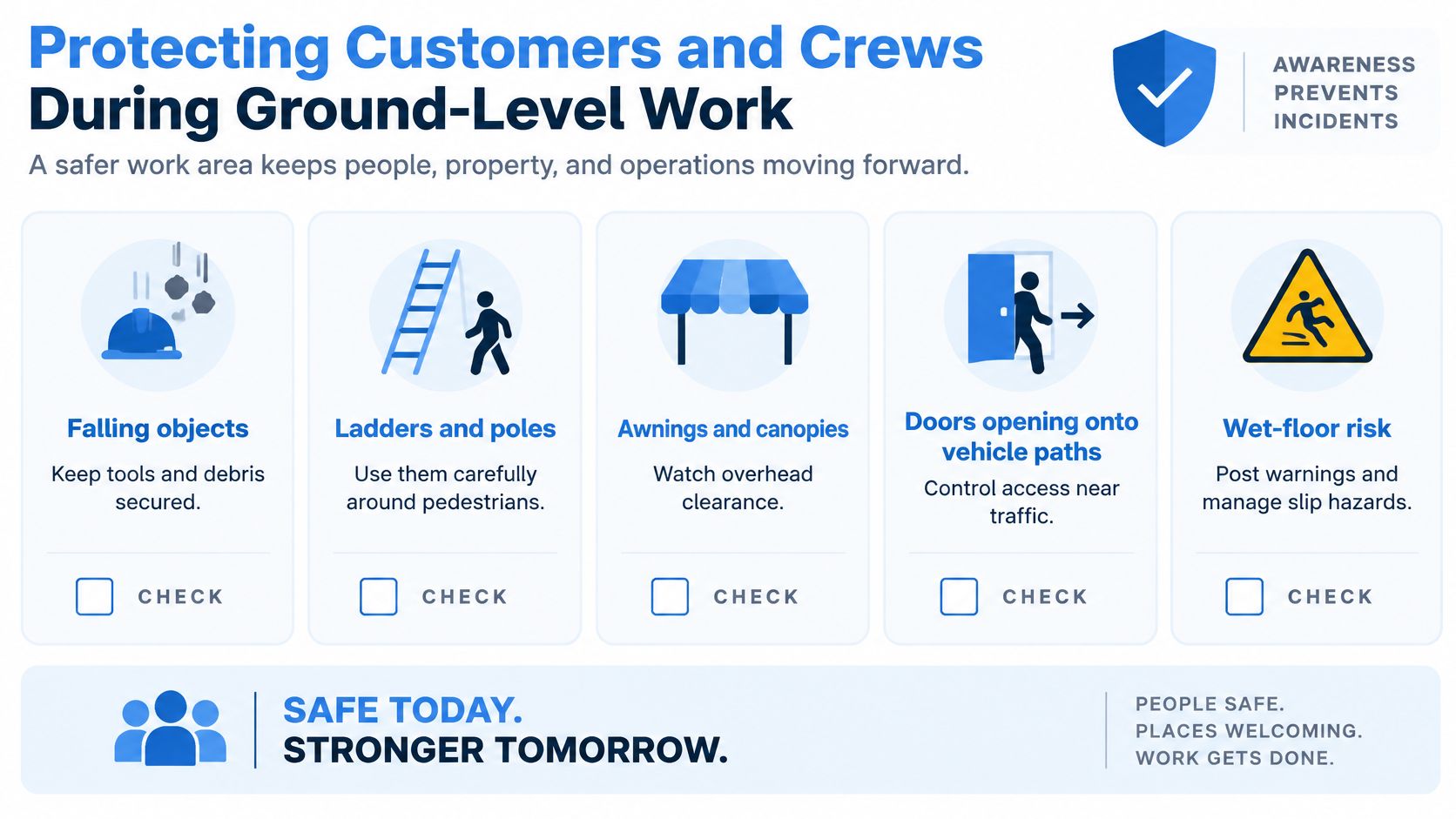
A storefront job can put customers at risk before the glass is touched. A dropped tool, a pole crossing a walking route or wet flooring near an entrance can turn routine cleaning into a safety problem. Plan the work around both the crew and the people using the storefront.
The OSHA small-business safety handbook covers workplace hazards such as falling objects and heat exposure. Keep people out of areas where tools or materials could fall. A shouted warning after an object drops is too late.
These are the hazards to identify during the site walk.
Outdoor work in Las Vegas, NV calls for a heat plan: drinking water, recovery breaks, shade and a response if a worker feels unwell. Set weather-related stop conditions before starting, not while someone is trying to finish the last pane.
Before work begins, confirm the safe-access, equipment, training and supervision requirements that apply in the city and state where the job takes place. Requirements and site conditions can affect how crews access a window, so resolve those details before setting up.
For solo assignments, include missed check-ins and medical emergencies in the communication plan. Resources on emergency escalation for lone workers can help managers establish who receives an alert and what happens next.
Use this window-cleaning safety equipment guide to support equipment planning. At closeout, document the cleared work area, the completion time and confirmation that the customer was notified.
On the sales floor, dirty haze and bright reflections can both obscure merchandise. They may look similar from the counter, but they need different fixes. Washing removes contamination; it doesn't change the direction of sunlight.
A retail-center daylighting project report estimated a 79% reduction in lighting load compared with a base-case model, while also identifying the need to control direct sunlight to reduce glare on merchandise and employee work surfaces. That result belongs to a daylighting design project, not a window-cleaning service, and shouldn't be presented as a promised cleaning-related energy saving.
Say a dealership's west-facing showroom becomes difficult to view late in the day. If the discomfort returns on freshly cleaned glass at the same hour, another wash won't solve the underlying problem.
Use a short observation log before changing the cleaning contract:
Car dealerships need customers to see vehicles clearly through the frontage. Medical offices need comfortable waiting and reception areas. Retailers need displays that remain legible from the sidewalk, not just attractive under interior lighting.
Schedule a full clean before a high-visibility sales period, then check the displays during the hours customers will see them. Keep cleaning separate from any decision to alter films or coatings, and confirm surface compatibility before using products near those treatments.
Clean glass can improve daylight transmission. It can't correct a solar-control problem.
Treat storefront window cleaning as one part of the façade and lighting plan. It supports visibility, but it isn't a guaranteed energy-saving intervention.
A useful quote starts with a glass inventory, not just a photograph of the front door. Separate entrances, display panes, upper glass and interior partitions so each area has a clear scope.
Professional Window Cleaning has been cleaning windows for over 26 years; its ProMatcher business profile records service beginning in 1999. We offer commercial window cleaning for storefronts and offices, with a free estimate and monthly or quarterly service commonly appropriate for storefronts and commercial buildings.
Per-visit service suits a single cleanup. A recurring monthly or quarterly plan gives each glass area a defined maintenance rhythm, while post-construction or sales-event work should have a separate rate and scope. Construction debris isn't ordinary maintenance soil.
Check the quote against frontage height, the method needed, frequency tier, number of entrances and restrictions around peak customer hours. Specify whether frames, sills and both sides of the glass are included so competing totals describe comparable work.
Reliable administration matters too. For small contractors coordinating site contacts and schedule changes, Mercateer's front-office support for small contractors is a relevant resource for organizing incoming calls and customer communication.
For the first visit, put a walk-through, a written work-zone plan and a post-cleaning inspection on the agreed checklist. Identify existing damage before cleaning, confirm who can authorize additional work and make sure the final inspection happens before the crew leaves.
Professional Window Cleaning offers storefront and office window cleaning, free estimates and a satisfaction guarantee. Visit Professional Window Cleaning to request an itemized estimate and discuss a recurring schedule that fits your glass, customer traffic and business hours.
Read our blog posts regularly and keep learning.