Care and Maintenance
How a Window Cleaner with Extension Reaches High Glass
Learn how a window cleaner with extension works, when a pole is safe, how to choose one and where ladders or professionals are the better call.


The lobby glass looks fine until the afternoon sun hits it. Then the haze shows, the night crew is gone, and you're standing there with two spray bottles. One says low odor. The other says it kills germs. Neither label tells you whether that bottle belongs on a clinic partition, a storefront, or a dealership frontage.
That choice is a buying specification. Commercial glass cleaners should be chosen from the safety data sheet, the ingredient disclosure, and the certification status, then matched to the soil, the glass, and the people nearby. Words on the front of the bottle don't replace the sheet in the binder.
The category is big enough that a bad pick gets repeated across a whole portfolio. Grand View Research estimated the global glass-cleaner market at approximately USD 3.29 billion in 2024 and projected USD 6.14 billion by 2033. Liquid glass cleaners were the largest product category in 2024, at about USD 1.20 billion. Scale doesn't pick your bottle. The sheet does.
Five product types cover most commercial glass work. The right pick depends on the soil, the surface, and who is breathing nearby. Use the table as a lookup: find the setting, match the type, then read the label and the safety data sheet before you buy.
| Type | Typical Composition | Best Fit | Main Watch-Out |
|---|---|---|---|
| Ready-to-use alkaline spray | Water, ammonia, glycol ether solvents, surfactants | Storefronts, office and interior glass with oily film | Haze from residue; never mix with bleach |
| Alcohol-based spray | Isopropyl alcohol 1–5%, 2-butoxyethanol 1–5%, ammonium hydroxide 0.1–1% | Quick touch-ups on mirrors and glass partitions | Strong vapor; ventilate and spray onto the cloth |
| Concentrate for dilution | Surfactants such as caprylyl/capryl glucoside at 1–5% | High-volume janitorial programs | Serious eye irritation (Category 2A); dilute exactly per SDS |
| Safer Choice certified | Every ingredient screened by EPA; PFAS-free primary packaging | Schools, medical offices, high-occupancy buildings | Certification is voluntary; still verify streak-free performance |
| Antimicrobial, DfE-registered | Registered disinfectant active ingredients | Touch-prone interior glass in healthcare or food service | Follow label dwell time; pesticide rules apply |
Ready-to-use alkaline spray is the workhorse for storefronts and office glass. Water carries the mix, ammonia keeps it alkaline so acidic film lifts, glycol ether solvents cut grease, and surfactants carry the loosened soil off the pane. It's fast on fingerprints. Leave too much product on the glass and the residue hazes in sunlight, and never put it in a bottle or on a cloth that has held bleach.
Alcohol-based spray suits quick touch-ups on mirrors and partitions because it flashes off before it can streak. A government-published safety data sheet lists isopropyl alcohol and 2-butoxyethanol at 1–5% each, with ammonium hydroxide at 0.1–1%. That finished product isn't considered hazardous under the 2012 OSHA Hazard Communication Standard, and it still tells you to rinse exposed eyes thoroughly with water. The vapor is the practical limit. Ventilate, and spray the cloth rather than the pane.
Concentrate drops the cost per use on a large janitorial route, and it punishes a sloppy mix. A California procurement safety data sheet lists caprylyl/capryl glucoside and lauryl glucoside at 1–5% and classifies the product as causing serious eye irritation, Category 2A. Dilute exactly as that sheet says, keep OSHA-compliant eye protection on the cart, and don't inhale the mist.
Safer Choice fits schools, medical offices, and other high-occupancy buildings when you want a documented screen rather than a plant graphic. The EPA Safer Choice program evaluates every ingredient, not only the actives, and it reviews performance, pH, packaging, and VOC limits. The 2024 update bans intentionally added PFAS in primary packaging. Certification is voluntary, so an uncertified product isn't automatically unsafe. I would still ask for a side-by-side on your own glass before you switch the whole building.
Antimicrobial, DfE-registered products belong only on touch-prone interior glass in healthcare or food service. EPA's greener-products guidance keeps the Safer Choice label for general cleaners and the Design for the Environment logo for antimicrobials such as disinfectants and sanitizers. A DfE product has to meet pesticide registration plus strict health and environmental criteria. "Kills germs" doesn't make a better window cleaner. It adds dwell time, residue, odor, and worker-exposure rules to a job that only needs soil and mineral-film control.
Low-odor, plant-based, and recyclable packaging are marketing until a sheet or a certification backs them. Safer ingredient criteria and demonstrated performance sit on the same EPA review, so "green" and "effective" aren't opposing goals. Neither is proven by the front label.
Foam and spray aren't the same job either. Foam clings on a vertical pane where a thin spray runs off, and a practical way to sort that choice is to compare foam versus spray glass cleaners against the soil you see, not against the scent.
Buying rule: If the safety data sheet, the ingredient list, and a streak test on your glass don't agree with the front label, buy from the sheet.
First action: list every glass surface and note which setting it belongs to. Storefront, mirror, school corridor, exam room, or food-service pass-through. The setting picks the row. The row picks the bottle.
Professional window cleaners use only two methods. One is the squeegee. The other is the pure-water system. Spray-and-wipe with a household bottle is a touch-up, not a third professional method.
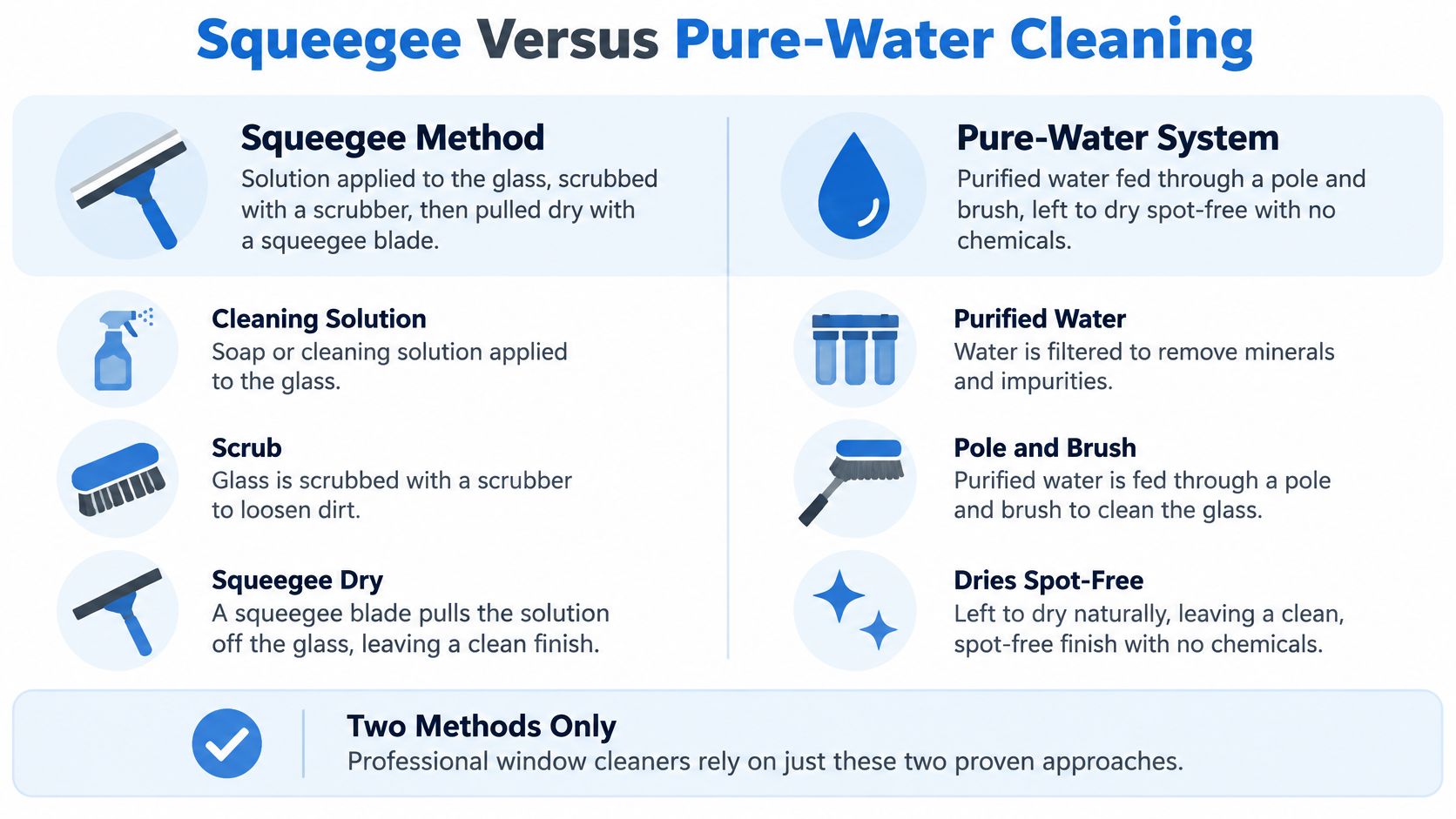
| Method | How It Works | Reach | Drying | Best For |
|---|---|---|---|---|
| Squeegee and solution | Solution applied, scrubbed, then pulled off with a squeegee | Ground level, or ladder and lift access | Edges need manual wiping | Storefronts, interiors, detailed frames |
| Pure-water system | Purified water pumped through a telescopic pole to a brush or squeegee head | Up to about six stories from the ground | Dries naturally without chemical film | Tall exteriors, high-rise and dealership frontage |
Solution goes on the glass. A scrubber or brush breaks the film. The squeegee pulls the dirty water off in overlapping strokes. A clean low-lint microfiber wipes the edges and the frame so drips don't crawl back onto the pane. You see every corner, every mullion, and every sticker edge.
The limit is access and labor. Someone has to reach that pane with a ladder, a lift, or a stable interior stance. Every pane is worked by hand. That's the right trade when frames are detailed, when you're inside an occupied office, or when a single storefront door has to look perfect before opening.
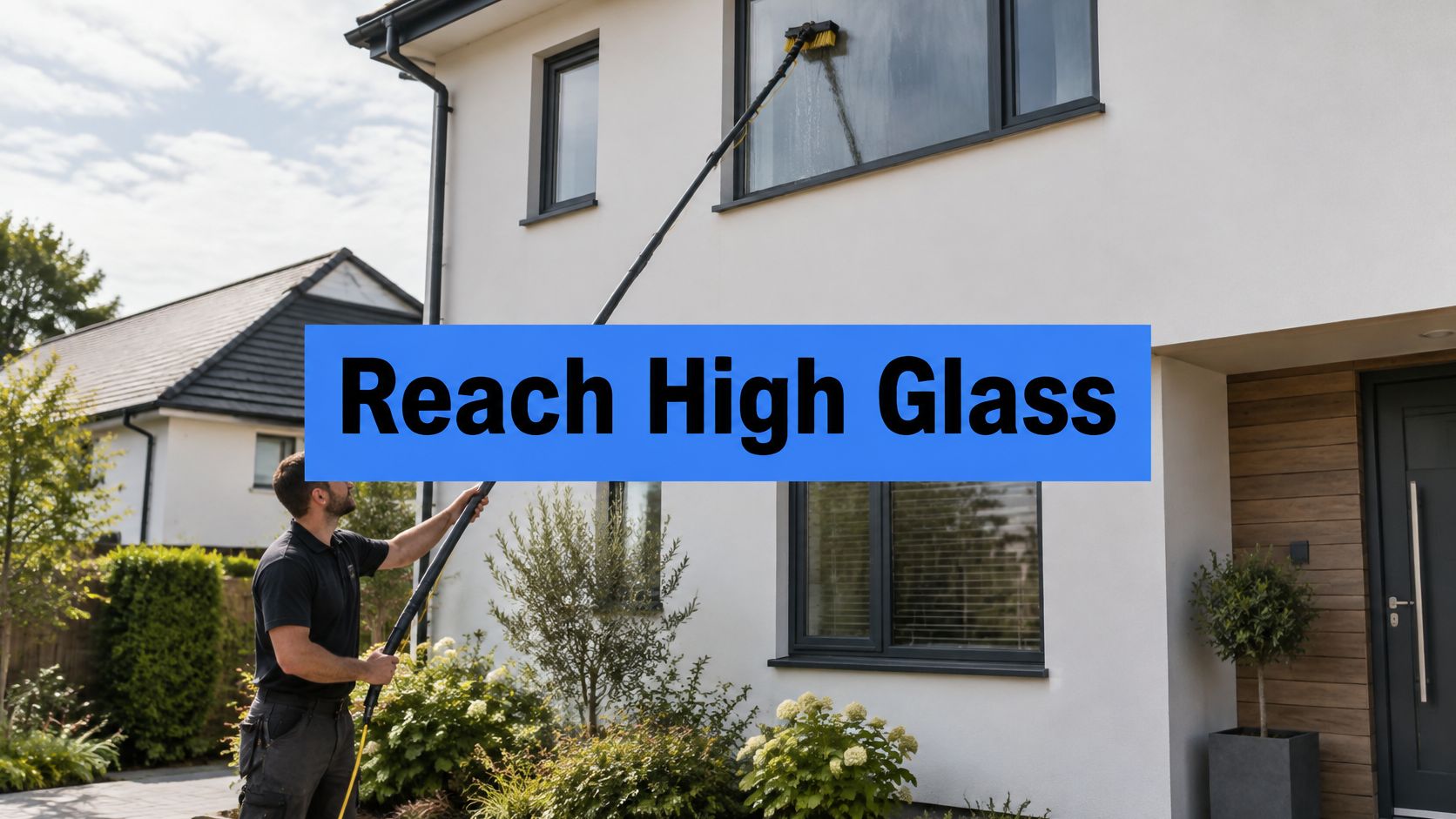
A pure-water system sends purified water up a telescopic pole to a brush or squeegee head. The brush agitates. The rinse carries soil away. The glass dries on its own, with no detergent film left behind. CleanLink reports that water-fed pole systems can let cleaners work from the ground at heights of up to approximately six stories. That reach is why crews rely less on ladders for tall exterior runs and long dealership frontage.
It isn't a casual pole. The UK Health and Safety Executive window-cleaning guide treats water-fed poles as a way to avoid work at height under the Work at Height Regulations 2005, and it still requires pre-use checks, competent training, and controls for hoses, wet walkways, wind, overhead power lines, and public access. Workers should gain experience on short poles before using poles extending above 10 metres. Work stops when the operator can't safely control the pole.
Squeegee for detailed frames and interiors. Pure water for tall exteriors and dealership frontage, where access is the bottleneck.
Think of dish soap on a dinner plate. A little lifts the grease. Whatever you leave behind dries cloudy, and the plate looks dirty even though you washed it. Glass does the same thing, only the cloud shows up as a streak the moment the light changes.
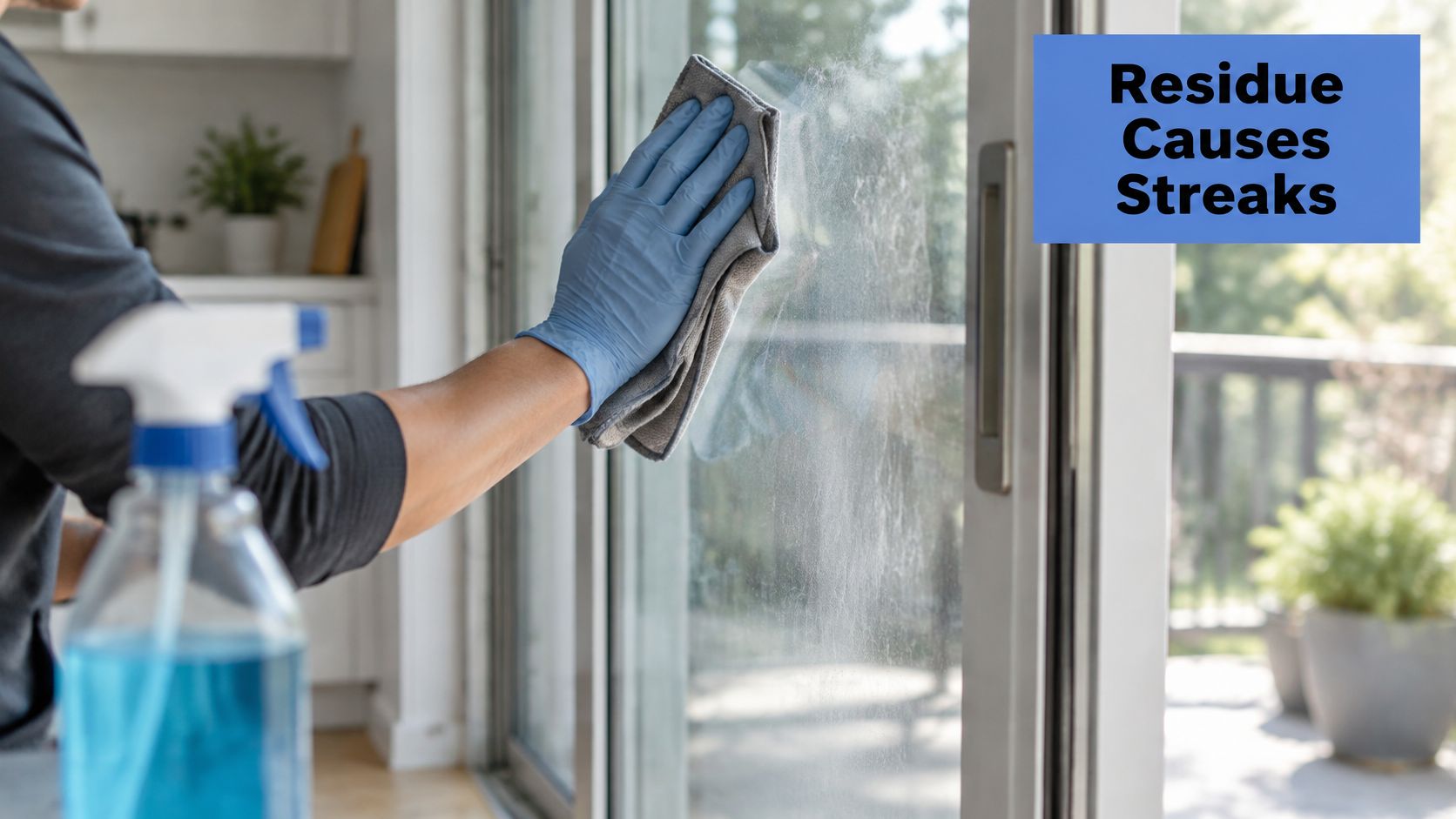
A typical commercial formula is water plus alkaline ammonia, alcohol or glycol-ether solvents, and surfactants. Water is the carrier. Ammonia holds the mix alkaline and helps lift acidic contamination. Solvents dissolve oily film and fingerprints. Surfactants lower the tension at the glass so loosened soil rides off instead of sitting there.
One commercial-industrial safety data sheet from Solenis lists the ranges in plain percentages:
Those ranges are for that formulation, not for every bottle on a janitorial shelf. A lighter retail-style spray can sit far below them and still streak if you flood the glass. Where ammonia odor is a problem for patients or staff, look at a non-ammonia glass cleaner and read that sheet the same way. Don't assume "no ammonia" means "no residue."
Excess surfactant, or a poor rinse, changes how water spreads and drains. Residual surfactant slows the flow, so liquid hangs on the pane and dries in arcs. Sun-heated glass makes it worse. The water flashes off, and the nonvolatile ingredients concentrate into a visible film. That's the plate again. You used soap, and you didn't get it off.
The same failure shows up when a cloth is already loaded. A dirty microfiber puts surfactant back onto glass you just cleared.
Three rules fix most of it. Apply the minimum product that wets the soil. Use a clean low-lint microfiber, and retire it when it feels slick. Remove the solution before it dries, especially on glass in direct sun.
A short walk-through of that wipe-before-it-dries habit is easier to coach than a chemistry lecture. This clip shows the motion crews should copy on interior panes.
This is not optional. Never mix an ammonia-based glass cleaner with bleach or any chlorinated product. Hazardous gases can form.
The failure usually isn't a dramatic pour in the janitor closet. It's residue. Acidic bathroom cleaner or a chlorine disinfectant left in a bucket, a spray bottle, or a cloth can meet the ammonia glass cleaner on the next pass. Some formulas also warn that acids can react vigorously, throwing heat and spatter. A military facility safety data sheet for a common glass cleaner is explicit about keeping ammonia away from bleach and chlorinated compounds.
Ventilation is part of the job, not a paperwork line. Avoid vapor and mist, and keep air moving in small rooms. In occupied medical offices, dealership showrooms, and high-rise lobbies, spray onto the cloth instead of toward the pane. You still wet the glass. You put less mist into the breathing zone and less overspray onto stone, wood, and displays.
Some glass-cleaner safety data sheets list eye irritation and respiratory irritation even when the bottle looks ordinary. Classification changes with the formula. A finished spray and a concentrate don't share handling rules just because both say "glass" on the front. The safety data sheet, not the product name, sets the eye protection, the ventilation, and the first aid.
If two products can share a cloth, they can share a reaction. Separate the tools before you separate the shelves.
Book the provider who can answer the chemistry and access questions before they quote a price. A polished brochure tells you nothing about which method reaches the sixth story or which bottle stays off the bleach cart.
Those three answers show whether the provider manages hazards or hopes the label is enough. Vague storage talk is a risk signal. A named method for each height is the opposite.
Training and a stop rule matter more than a long pole. A crew that keeps working in wind they can't handle drops a brush into a walkway or a lot.
Ask which products they specify for each setting. One house brand for every pane means they haven't read your building. Occupied rooms should mean cloth application, scheduled access, and no surprise disinfectant on ordinary glass.
Then check how the provider runs their own office. A contractor who misses your call during the bid will miss it during the job. Plenty of trade contractors cover their lines the way HVAC shops do when they browse HVAC call answering services; staffed or outsourced, the standard is the same. You get an answer, a date, and a written scope.
A written quote should name the method, the product type for each area, the frequency, and the access plan. Push for line items: interior and exterior glass, screens, sill and frame detail, hard water or mineral deposit treatment where it applies, and a post-cleaning inspection so streaks and missed edges get caught while the crew is still on site. If you want a model for how that scope reads on offices and storefronts, review a commercial window cleaning service breakdown before you compare bids.
Three buildings, three different bottles, and no building should copy the cart of the other two.

A medical office uses a Safer Choice cleaner on reception glass and exam-room partitions. The crew sprays the cloth, not the pane, and bleach never rides on that cart. Touch-prone interior glass gets a separate, label-directed step only if infection control calls for it.
A dealership cleans showroom glass and the street frontage on a set schedule. Tall panels go to pure water so ladders aren't blocking the lot while sales staff walk customers through. Interior displays and door pulls stay on the squeegee, where frames and edges need a hand wipe.
A downtown high-rise runs a water-fed pole on exterior glass, a standard cleaner on lobby panes, and an antimicrobial only on touch-prone interior glass. Wind, the sidewalk, and the pole-control stop rule decide whether that exterior run happens today. The pattern holds across all three: surface first, method second, product third, and the safety data sheet settles the product question before anything is sprayed.
A professional crew should describe its work the same way that checklist does. We use environmentally friendly, effective, and safe cleaning products on office glass, at any window height. Soft brushes and microfiber cloths clean every inch of sills and frames without damaging the glass or surrounding areas, and we finish with high-quality sealants and protective treatments that resist later dirt buildup, water damage, and wear.
Professional Window Cleaning has been in business since 1999, with over 26 years of window cleaning across Arizona, Colorado, and Nevada. Office and storefront glass gets professional-grade squeegees and brushes matched to each pane. If you want the checklist walked on your own glass, request a site assessment and bring the surface list with you.
Professional Window Cleaning cleans commercial glass with professional squeegees, brushes, and specialized equipment matched to each pane, with products chosen from the safety data sheet. If your offices, storefronts, or tall exterior runs need a clear product and access plan, visit Professional Window Cleaning and ask for a site assessment.
Read our blog posts regularly and keep learning.