Care and Maintenance
How to Prevent Hard Water Stains on Windows
Learn how to prevent hard water stains on windows with proven tips for homeowners and property managers in Las Vegas, Phoenix, Denver, and beyond.


What if the question isn't whether glass cleaner works, but whether it works on your glass, in your climate, and around the people who use the building every day? That's where non ammonia glass cleaner stops being a buzzword and starts being a practical choice. In homes and commercial properties across Arizona, Nevada, and Colorado, the decision usually comes down to fumes, tint safety, residue, and how fast a cleaner dries in hot sun.
The category is no longer a small niche. A recent market report says ammonia-free formulations held about 48.00% of revenue in 2025, while the broader glass cleaner market reached USD 3.85 billion in 2025 and is projected to reach USD 7.38 billion by 2035 at a 6.75% CAGR (SNS Insider glass cleaner market report). That growth reflects a simple reality, people want cleaner glass without harsh fumes, surface risk, or the lingering smell that can hang in kitchens, lobbies, and enclosed offices.
Why are so many people moving away from ammonia-based glass cleaners? The answer is practical. Glass now appears in more places, including tinted home windows, showroom walls, acrylic partitions, office conference rooms, and coated surfaces that do not all tolerate the same chemistry.
A market report estimated the global glass cleaner category at USD 3.29 billion in 2024, with North America accounting for over 35% of that total and the residential segment exceeding 60% of market share (Grand View Research glass cleaner market report). That matters because the largest user base is still homes and mixed-use buildings, where comfort and surface compatibility matter just as much as cleaning strength. A separate industry analysis of the household cleaning products market also points to steady demand for formulas that fit modern home care routines and indoor-air concerns, which helps explain why ammonia-free options keep getting attention.
For a homeowner, the reason can be simple. The cleaner works, but the smell lingers. For a facility manager, the issue might be haze on tinted film or irritation for staff who use the product repeatedly. For a parent or pet owner, the concern is what happens when a stronger-fuming product is sprayed in a closed room or a carport with little airflow.

Practical rule: if the glass is tinted, coated, acrylic, or cleaned in an enclosed space, the standard cannot just be “good enough.” Compatibility and air quality are part of the job.
The shift away from ammonia is about matching the cleaner to the surface, the room, and the person doing the work. In hot, dry places like Arizona, Nevada, and Colorado, that choice matters even more. A formula that flashes off too fast can streak before the towel finishes the pass, while a better-balanced non ammonia glass cleaner gives you more control when sunlight, heat, and mineral-heavy water all press against the result.
A good non ammonia glass cleaner is a small chemistry system built to loosen dirt, lift it off the surface, and dry cleanly. One technical sheet describes a concentrate with pH 10.3–10.8, specific gravity 0.940–0.970, complete rinsing, and hard-water stability up to 250 ppm (GCI technical sheet). That kind of formula is designed for more than a quick wipe. It has to break grime, hold it in suspension, and leave as little behind as possible.
A kitchen sponge with soap in it does a similar kind of work. The surfactants loosen oily fingerprints and atmospheric film, the water carries the loosened soil, and the wipe removes it before it dries back onto the glass. The alkaline side of the formula helps with stubborn grime, while the surfactants stop the dirt from settling back down. For a plain-English explanation of that balance in real cleaning products, see this overview of ammonia window cleaner, which helps show why ingredient behavior matters more than the label alone.
Hard-water tolerance matters in the Southwest because mineral content can turn a decent wash into a hazy finish. If the formula cannot handle dissolved calcium and magnesium, the cleaner can dry in patches or leave a film on large panes. On big storefronts, the mistake is not always technique. Sometimes the solution and the water supply are working against each other.
The same spec sheet notes the cleaner is biodegradable (GCI technical sheet). That does not make the glass cleaner magical, but it does matter for repeated use on commercial routes where runoff and volume add up over time.
A cleaner that rinses clean is doing two jobs at once. It removes the soil, then gets out of the way before it can show up as haze.
Ammonia-free formulas can look simple on the shelf, but the difference is in how the ingredients behave as the water evaporates. In Arizona, Nevada, and Colorado, that matters because hot glass changes the clock. A formula that flashes off too fast can streak before the towel finishes the pass, while a better-balanced non ammonia glass cleaner gives you more control when sunlight, heat, and mineral-heavy water all press against the result. The chemistry helps, but the finish still depends on the person holding the towel.

Which cleaner makes more sense for the glass in front of you, the one without ammonia or the one with it? The answer depends on the surface, the people using it, and the heat on the glass. A product that works well in a shaded office can behave differently on a sun-baked pane in Arizona, Nevada, or Colorado.
The easiest way to compare them is by the job you need them to do. Ammonia-free and ammonia-based cleaners can both leave glass looking clean, but they do not act the same around people, coatings, and hot weather.
| Criterion | Non Ammonia | Ammonia |
|---|---|---|
| Safety around people | Better fit for enclosed rooms, routine staff use, and homes where odor matters | Stronger fumes can be more irritating during long cleaning sessions |
| Tint and film compatibility | Often preferred for tinted glass, reflective coatings, plexiglass, and acrylic | Can be risky on films, plastics, optical coatings, and tinted windows |
| Odor | Usually lower odor and easier to use indoors | Sharper smell that can linger in tight spaces |
| Streaking in hot sun | Can perform well, but formula volatility and technique matter a lot | Can still streak if it flashes too fast or leaves residue |
| Surface versatility | Better fit for glass plus more delicate adjacent materials | More limited when the surface mix includes specialty coatings |
A ready-to-use non-ammoniated product sheet lists pH 8.5–9.5, specific gravity 1.0, viscosity <100 cps**, and **flash point >210°F (3M Glass and Surface Cleaner ready-to-use PDF). That profile points to fast spreading and quick drying with lower flammability risk than solvent-heavy options. The same sheet also classifies the liquid as a moderate eye irritant, moderate skin irritant, and upper respiratory irritant, which is a reminder that “ammonia-free” still does not mean “no precautions needed” (3M Glass and Surface Cleaner ready-to-use PDF).
For many properties, the choice is straightforward. If you are cleaning tinted glass, acrylic panels, or a lobby with limited airflow, non ammonia glass cleaner is usually the safer fit. If you are working on a surface that can handle stronger chemistry and the space has good ventilation, traditional ammonia-based products can still make sense.
A separate safety guide warns against mixing ammonia with bleach because it creates chloramine gases that are extremely toxic, and it notes risks for acrylic, plastic, optical coatings, and tinted windows or car windows (Saniwash safety guidance). That matters in janitor closets where different bottles get stored together and labels can be overlooked.
For a closer look at why some crews still choose ammonia on certain jobs, see this comparison with ammonia-based products and ammonia window cleaner. The trade-off is simple, ammonia can help on some soils, but it raises the risk of odor, compatibility issues, and user error on delicate surfaces.
If you are comparing product families for a property plan, green cleaning chemical options can help you sort cleaner chemistry from marketing claims. On hot glass, the finish still comes down to what evaporates, what gets wiped away, and how fast the surface dries. The absence of ammonia helps, but it does not replace good technique.
Professional window cleaning really comes down to two methods, the squeegee and the pure-water system. The cleaner you choose sits inside that method. It doesn't replace it.
With the squeegee method, an ammonia-free solution is usually applied to interior glass, storefronts, mirrors, and other surfaces where control matters. The solution loosens the soil, the scrubber lifts it, and the squeegee removes the water before it can dry into a film. That's why this method still dominates for detail work, especially when the glass is close to people, furniture, or finished floors.
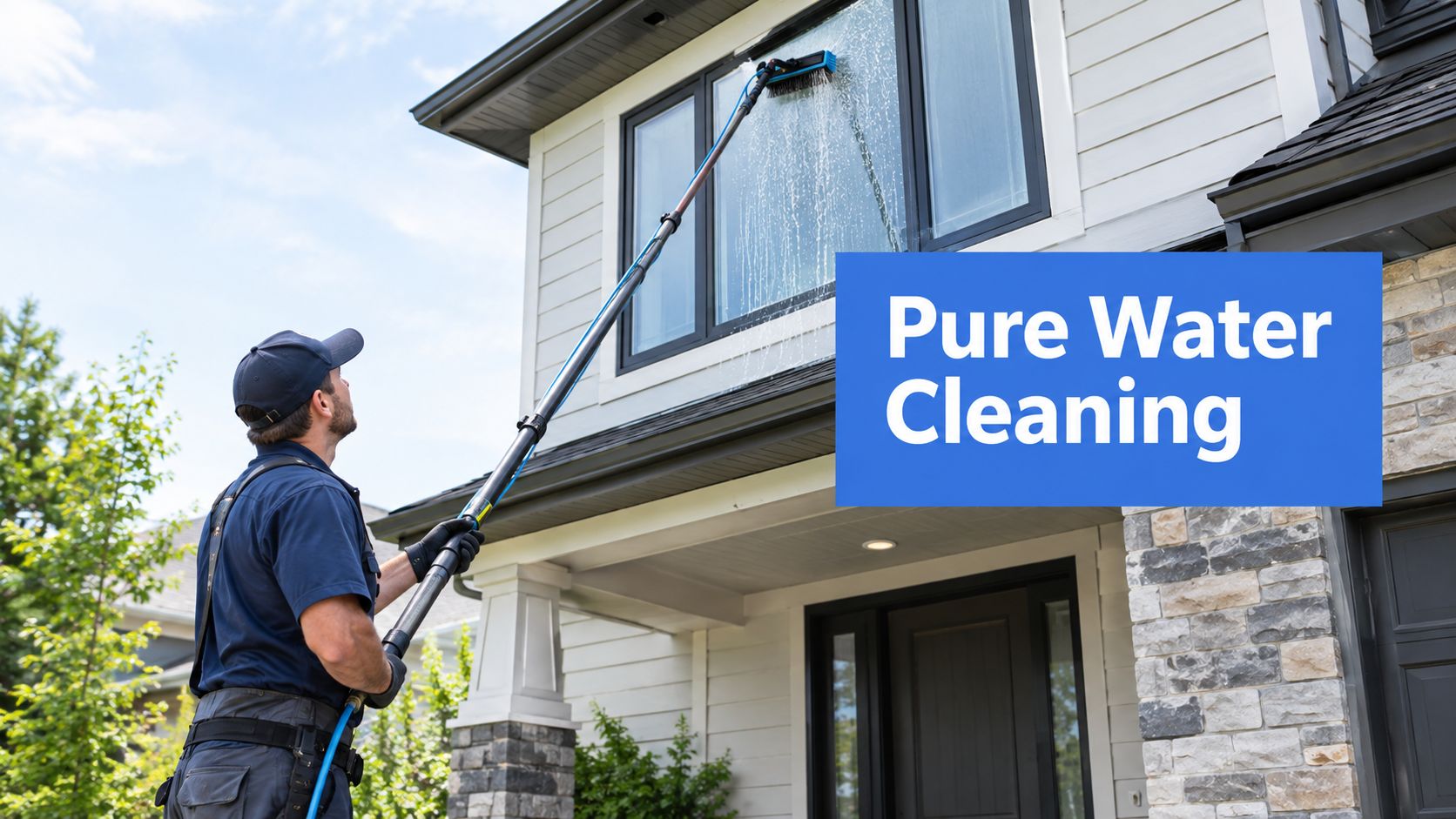
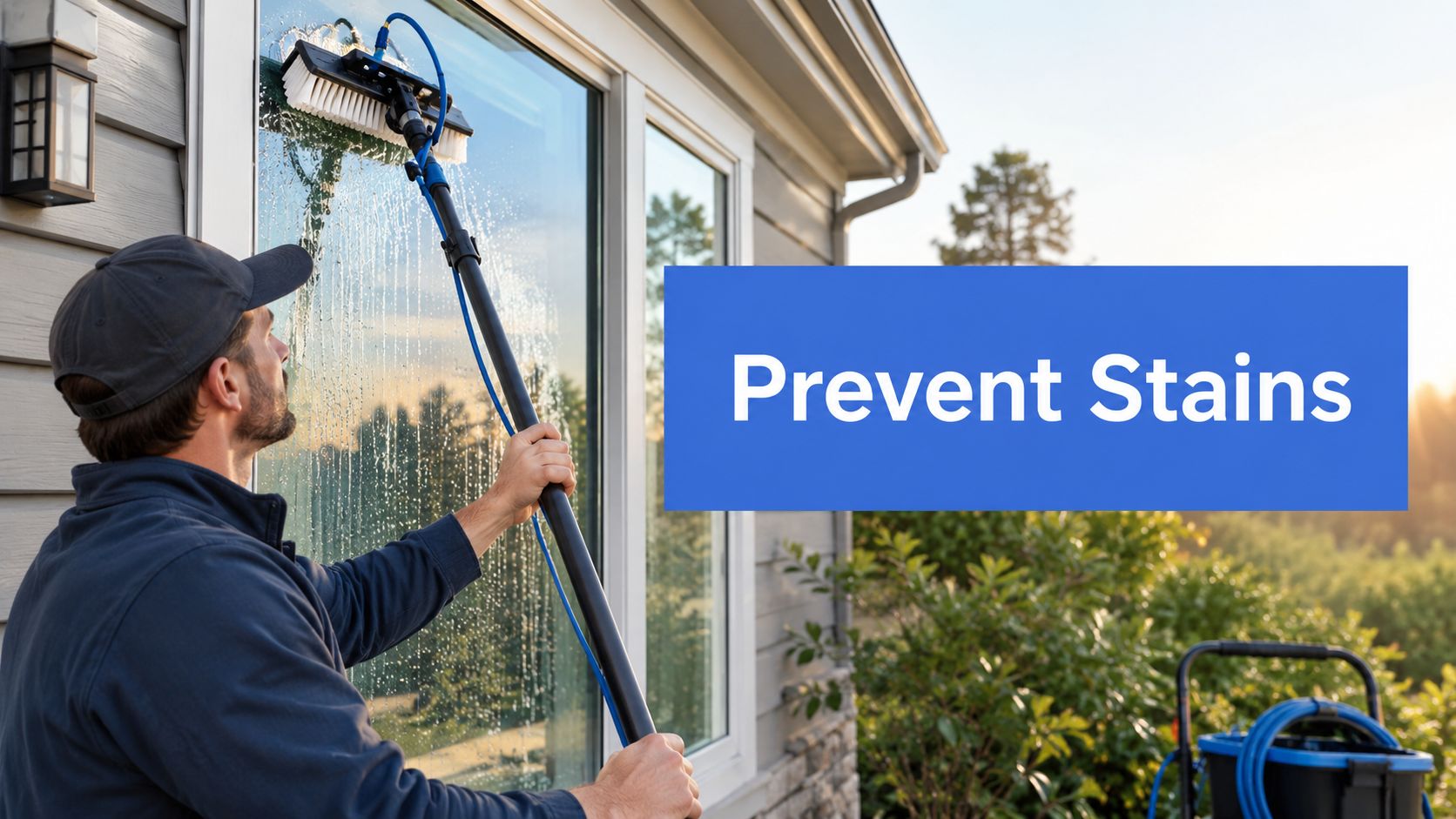
A pure-water system works differently. It filters dissolved solids out of the water so the rinse dries without spots, which makes it useful on exterior glass where ladders and lifts would slow the job down. In that method, chemical use can drop sharply or disappear entirely, because the water itself is doing the final cleaning and rinse.
For crews choosing between tools and products, the cleaner should match the method, not the other way around. An ammonia-free formula fits especially well when the job calls for a controlled interior clean or a surface that needs extra compatibility. A pure-water setup makes more sense when the goal is reach, speed, and low-residue exterior work.
If you want a broader look at product categories that support safer cleaning routines, green cleaning chemical options is a useful reference point. It's not about replacing trade skill. It's about understanding what kind of chemistry sits behind a given result.
The workflow matters too. Apply too much solution, and even a good formula can leave drag marks. Apply too little, and dirt moves around instead of coming off. The glass doesn't care what the label says. It only responds to chemistry, water, and the tool in the hand.
A quick demonstration can help make the method feel concrete.
In the Southwest, sun and surface type change everything. A formula that looks perfect in a cool kitchen can behave differently on a west-facing storefront at noon in Phoenix, a dealership in Las Vegas, or a reflective tower in Denver.
A Scottsdale homeowner with tinted windows usually cares about two things, glare and film safety. Ammonia-free cleaner is often the better call there because the glass may already have a tint layer, and the house may be closed up with the air conditioning running. Less odor and less coating risk make the job easier to live with. A bright, direct-sun exposure can still punish the wrong formula, though, so timing and wipe quality matter as much as the label.
A Las Vegas dealership faces a different problem. Floor-to-ceiling glass gives you a huge cleaning area, but heat can flash-dry product before it's fully wiped away. That's where residue becomes obvious. If the formula leaves behind non-volatile ingredients, the haze shows up fast on showroom glass. That's why direct sun and large panes expose the weakness of cheap cleaners more quickly than a small bathroom mirror ever will.
A Denver high-rise adds another layer. Reflective curtain wall panels and coated glazing demand careful chemistry. The cleaner has to behave well on specialty surfaces, and it has to do it while crews are moving fast and weather can shift. Ammonia-free chemistry usually fits that better than a more aggressive all-purpose solvent blend.
The underside of the issue is streaking under real-world heat. Many people blame technique first, but in Arizona, Nevada, and Colorado, fast evaporation can turn a decent wipe into a streak if the product isn't volatile enough to clear cleanly. That's why the same cleaner can look perfect indoors and disappointing on a sunlit exterior.
In hot sun, a cleaner that dries too fast can leave you with less time to correct the pass. The glass tells the truth immediately.
DIY can be a smart option for light interior glass, especially when you already have the ingredients in the kitchen or laundry room. The key is to keep the mix simple and to treat technique like part of the formula.
A basic distilled water plus white vinegar mix works well for fingerprints, light film, and mirrors. A small amount of rubbing alcohol can help the surface dry faster, which is useful in drier climates. A tiny amount of plant-based dish soap can help on greasy smudges, but too much soap is one of the fastest ways to create streaks.
Technique matters more than many expect. Use a clean microfiber cloth, not a worn towel. Work in shade when you can. A two-cloth method, one for wiping, one for drying, is often the difference between a clear pane and a cloudy one. Paper towels can leave lint, and in bright Southwest light, that lint reads like residue.
For more guidance on safer product choices, non-toxic window cleaner is a helpful companion topic if you're comparing DIY mixes with store-bought products.
DIY is great for small jobs and inside surfaces. Once you're dealing with large exterior panes, specialty coatings, or repeated commercial cleaning, a professional-grade non ammonia glass cleaner usually gives you more consistent results.
“Ammonia-free” is a useful label, but it's not a universal safety badge. The rest of the formula still matters. Alcohols, solvents, surfactants, and other additives can still irritate sensitive eyes, skin, or breathing passages, even when ammonia is absent.
A product can be ammonia-free and still be the wrong fit for a delicate surface. That's why the earlier section on compatibility matters. Tinted film, acrylic, anti-glare layers, and specialty coatings can all react differently to ingredients that are perfectly fine on plain glass. The safest decision is based on the full ingredient system, not one removed ingredient.
CloroxPro says EPA Safer Choice certification requires products to meet human-health and environmental standards under which ammonia is not an acceptable ingredient (CloroxPro on safer-choice glass cleaners). That helps explain why many buyers see ammonia-free products as the more responsible default. It still doesn't erase the need for ventilation and PPE when you're cleaning in tight interiors or around sensitive occupants.
Independent consumer testing reported that ammonia-free glass cleaners cleaned "just as well" as comparably rated cleaners, and the top-performing ammonia-free product in that test, Sprayway Foaming Glass Cleaner, removed the tested messes and left surfaces dry after a single wipe (6abc consumer test coverage). That's encouraging, but it also reinforces the core point. Good results come from a solid formula matched to the right surface and used correctly.
Three questions usually settle the decision fast. First, what kind of glass is it, plain, tinted, coated, acrylic, or mixed with other finishes? Second, what's the exposure like, shaded interior, hot direct sun, or a windy exterior? Third, how often does it need cleaning, once in a while at home or on a regular commercial schedule?
If the glass is simple and the cleaning is light, a DIY ammonia-free mix can be enough. If the property has tinted windows, reflective film, or sensitive surfaces, a store-bought non ammonia glass cleaner is usually the safer move. If the panes are large, high, or exposed to intense sun, professional service starts to make more sense because technique and equipment become part of the chemistry.
For building managers comparing product classes, commercial cleaning chemicals guide is useful background on how professional cleaning chemistry gets chosen for real-world jobs. The same principle applies here. The best cleaner is the one that fits the surface, the environment, and the crew using it.
If you're in Phoenix, Scottsdale, Las Vegas, or Denver and you want glass that's cleaned with the right method for the right surface, the safest choice is to bring in a team that handles this work every day.
Professional Window Cleaning has spent years working on residential, commercial, and high-rise glass across Arizona, Nevada, and Colorado, and we know how much streak-free results depend on the right chemistry and the right method. If you want expert help for tinted windows, storefront glass, or large exterior panes, visit Professional Window Cleaning and book the team that treats glass care like a craft.
Read our blog posts regularly and keep learning.