Care and Maintenance
Moss Growing in Window Tracks: How to Remove It for Good
Moss growing in window tracks usually means trapped moisture. Learn how to clean it out, fix the drainage cause and stop it from coming back.


The usual advice is to buy a longer pole and leave the ladder in the garage. That skips the most important question: can you control the cleaning head safely against the whole pane? A window cleaner with extension can reach above your head without giving you the pressure, visibility, or access needed to finish the job.
A longer pole isn't automatically safer or easier. Choose the cleaning method first, then judge the glass, the ground beneath it, and the work your shoulders will have to do.
A window cleaner with extension is an access setup, not a separate cleaning chemistry. Professionals use only two window-cleaning methods: squeegee cleaning and pure-water cleaning. A pole can support either method, but extending the handle doesn't change what must happen on the glass.
Extension setups and when to stop
| Setup | What happens on the glass | Sensible ground use | Stop when |
|---|---|---|---|
| Squeegee on an extension pole | Solution on, rubber blade off, detail the edges | First-floor glass and some calm second-story panes | The blade cannot hold a straight edge or the operator must leave stable ground |
| Pure-water pole | Soft brush scrub, then a rinse at or below the specified TDS limit and air dry | Exterior glass a technician can control from the ground, including some multi-story faces | Wind, poor access, or heavy mineral staining keeps the rinse from drying clean |
| Neither ground method | Needs close work, lift access, or interior access | Not a pole-from-the-sidewalk job | Overhead lines, a fourth-floor-scale drop, ledges, or glass the tip cannot see and control |
The National Glass Association's architectural-glass cleaning guidance describes applying cleaning solution and immediately removing it with a squeegee, and also recognizes specialized pure-water pole cleaning with a non-abrasive brush and final rinse containing no more than 20 parts per million of total dissolved solids. TDS describes dissolved material in the water, including minerals that can remain on glass after drying.
A washer sleeve and rubber blade are still squeegee equipment, even when attached to an extension pole. A hose, soft brush, and deionization or reverse-osmosis supply form a pure-water system; our explanation of how water-fed pole window cleaning works shows how those components work together.
With a squeegee, the operator must maintain blade contact through the stroke and manage the water left at the edges. A pole that reaches the upper frame but twists whenever the blade changes direction won't produce a controlled finish.
Pure-water work removes the blade stroke, but it doesn't remove the need for careful cleaning. The brush must loosen the dirt, and the rinse must carry that dirt away rather than leave it pooled along a frame.
For a homeowner choosing equipment, the practical distinction is simple: will you remove the water mechanically, or rinse with purified water and let the pane dry? A garden hose and brush don't become a pure-water system merely because they attach to a telescopic handle.
Screens, frames, tracks, and most interior glass still need close attention. Don't buy a fully extended pole expecting it to replace screen removal, careful sill wiping, or the small tools needed inside a window track.
A pole that reaches the glass may still be difficult to control. Treat it as a cantilever, a long member supported at one end, rather than as a longer mop handle. The head hangs at the far end while you steer from below. When a wet brush presses sideways against the glass, the pole must resist bending and twisting at the same time.
Advanced Composites' comparison of carbon fiber and aluminum explains why fibers running lengthwise resist bending, while ±45-degree layers improve torsional stability. Carbon fiber generally offers less weight and greater stiffness per unit weight than aluminum. The result still depends on fiber orientation, tube diameter, joints, and locking hardware.
As you extend the pole, its weight and the head's sideways pressure can make the tip move more. That movement shows up as skipped corners, uneven brush pressure, or a squeegee blade that drifts out of line with the frame. A longer pole is not automatically easier to use.
Telescopic-tube engineering guidance from Yongxian gives approximate overlap benchmarks of 80 mm for light-duty sections and 120–150 mm for poles exceeding roughly 3 m of reach. These figures are engineering guidance, not a substitute for following a specific pole's extension marks and instructions.
More sections make a pole easier to carry, but every joint adds another place for wear, dirt, or a loose lock to cause side-to-side play. A compact pole that rattles at its joints can be harder to position than a less compact pole with secure connections.
For a familiar size reference, Window Cleaning Supply lists a Garelick telescopic pole adjustable from 2 feet to 24 feet. Short telescopic poles sit toward the lower end of that range. At the longer end, Splash Window Cleaning's equipment guide describes water-fed poles reaching up to 60 feet. Those figures describe equipment reach, not a guarantee that every pane at that height can be cleaned from the ground. Building shape, access, wind, and glass condition all affect what is usable.
Reach bands for extension window cleaning
| Glass situation | Usual tool | Height band | Ground work still realistic |
|---|---|---|---|
| First-floor exterior | Handheld squeegee or short pole | Short telescopic poles, toward the low end of the 2 feet to 24 feet range | Yes, on firm footing |
| Second-story house glass | Telescopic squeegee pole or modest water-fed pole | Within the 2 feet to 24 feet telescopic range, depending on the setup | Often, if the path is clear and conditions suit the work |
| Multi-story face with a clear view | Water-fed pure-water pole | Water-fed poles reach up to 60 feet | Only when access, wind, and glass condition allow |
| Fourth-floor scale or blocked glass | Lift, controlled access, or interior clean | Beyond a dependable ground-pole setup, or obstructed | Usually not a homeowner ground-pole job |
These are tool-selection bands, not guaranteed building heights. Standing farther away to clear a hedge changes the angle and uses up working reach. A deep sill can also keep the brush off the glass even when the upper frame appears reachable.
Buying test: Extend the pole with the actual brush, washer, or squeegee attached. An unloaded reach claim does not show how much bend you will have to manage against wet glass.
Check whether you can place the head, maintain steady contact, and bring it back without a sudden swing. If the tip needs constant correction before cleaning begins, more length will not fix the control problem.
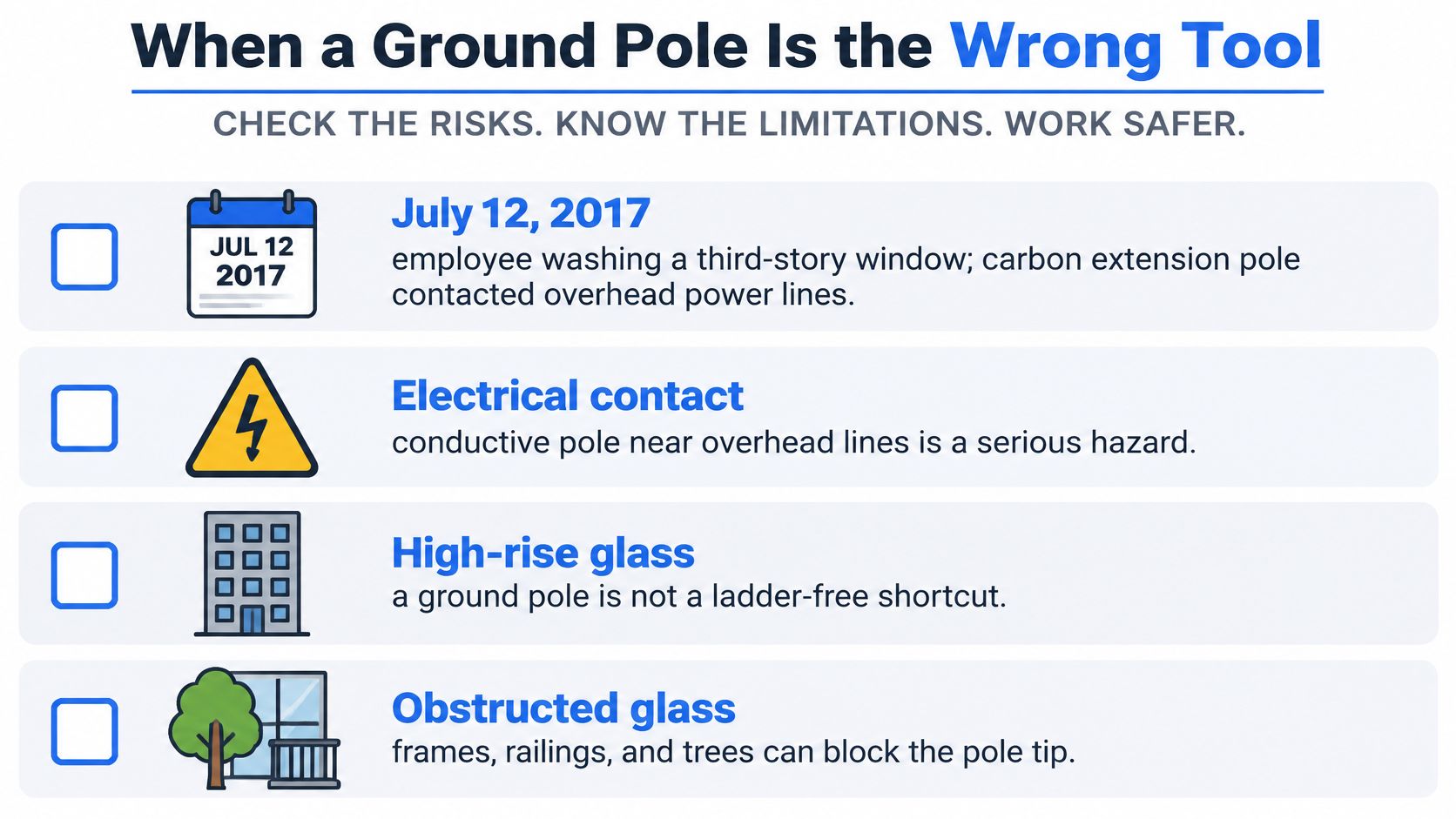
A ground pole removes the need to climb for some jobs, but it does not make every window safe or practical to clean. The pole can still reach overhead power lines, catch on obstacles, or pull you off balance. Its length also increases the force on your shoulders, so steering a brush or squeegee can cause strain and make steady contact difficult.
The risk is documented: an OSHA accident record documents that on July 12, 2017, an employee washing a third-story window contacted overhead power lines with a carbon extension pole and suffered electrical burns and fatal shock. Carbon fiber can conduct electricity. A lightweight pole is not an insulated tool, and keeping your feet on the ground does not remove electrical danger.
The Health and Safety Executive's window-cleaning best-practice guide highlights risks such as overhead lines, trailing hoses, slippery surfaces, wind, and losing balance while looking upward. Check the whole work area, not just the distance to the glass.
If powered access is being considered, training needs to suit the equipment and jurisdiction. Readers arranging work in New South Wales can use this resource to compare EWP licence options in NSW, then check the requirements for the planned task.
A single-story stucco house with open side yards may suit a short squeegee pole, provided the glass is visible and the ground is stable. Remove accessible screens for separate washing at a bench. Do not scrub through them or try to pry them loose with the pole head.
A sidewalk storefront with a clear face and modest transom may suit pure-water work if the hose can stay against the wall and pedestrian access can be protected. Shade may make the work easier to manage, but a convenient time does not make poor wind conditions safe.
A high pane near utility lines or behind a deep setback calls for a different access plan. A longer pole cannot make an obstructed view clear, and holding it farther sideways can reduce control. Do not walk into an area you have not assessed to compensate for blocked access.
A vaulted indoor window above furniture may appear reachable from the room while remaining difficult to clean safely. Move furniture and arrange close access rather than standing on cushions or steering the pole blindly around a light fitting.
Keep the pole for work where you can see the whole pane, maintain firm footing, and control the cleaning head. If any of those conditions fail, choose a suitable access method or call a crew.
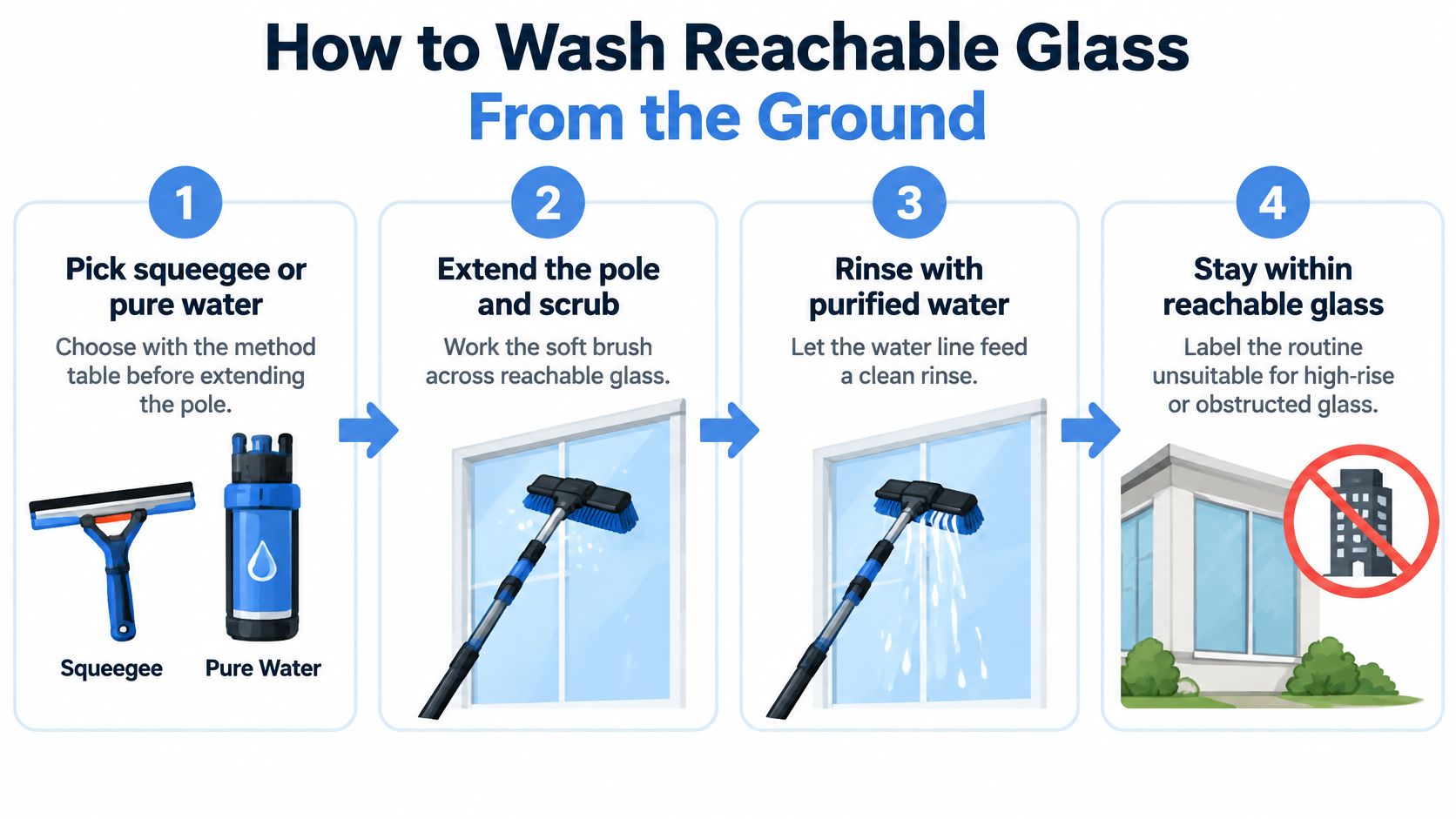
This routine is for visible, accessible exterior glass, not high-rise windows or panes hidden behind obstacles. Begin with a small, straightforward pane so you can judge the setup before committing to the rest of the elevation.

Choose squeegee or pure water before extending, because the method determines the head, water supply, and finishing technique. Use a washer and blade for squeegee work, or a soft brush connected to a proper purified-water supply for pure-water work.
Inspect the locks, head connection, blade or brush, and hose, because loose hardware becomes harder to manage at full reach. Check for cracks, damaged bristles, nicked rubber, hose kinks, and sections that slide after locking, then extend only as far as the pane requires.
Clear furniture, toys, and other obstacles, because you need a predictable place to stand and lower the tool. Lay a water-fed hose along the building rather than across the walk, and keep your lowering area clear of people.
Plant both feet on firm ground and choose a controllable pole angle, because working directly overhead makes it harder to see the head and manage pressure. Reposition deliberately with the pole lowered instead of shuffling backward while watching the brush.
For squeegee work, wet the pane and pull overlapping strokes from top to bottom, because gaps between passes leave strips of dirty water. Lower the tool to wipe the blade as needed, and detail safely accessible edges with a clean cloth rather than leaving water to dry in the corners.
For pure-water work, scrub with the soft brush and rinse thoroughly with purified water, because loosened dirt must leave the pane before it dries. Give upper corners and frame-adjacent areas deliberate attention, then let the glass air-dry without polishing it with a household towel.
Detail accessible frames and sills at arm's length after the pole work, because a long tool isn't suited to precise track cleaning. Don't jab the brush connector into corners or force the head behind seals; inaccessible details need a different access arrangement.
Stop if the head chatters, wind takes control, footing becomes slippery, or looking up makes you step without checking, because those are signs that the setup is no longer controlled. Lower the pole before reassessing, rather than trying to finish the last corner while fighting the equipment.
Check the result from an angle once the pane has dried. Look for even edges, clean corners, and no dried fan of runoff above the sill.
Reaching the top rail isn't the finish standard. The job is complete only when the whole accessible pane is clean without having pushed the operator beyond safe control.
Ground-level work can still be strenuous. A 2025 occupational-workload study presented at PREMUS found that telescopic washing poles remove ladder-fall exposure while loading the neck, shoulders, and back; in its testing, prism glasses or a harness-pulley system reduced workload, while some other aids offered limited benefit.
The important distinction is between avoiding a fall and avoiding physical strain. You can remain on the ground throughout a job and still hold your head back, lift your shoulders, and repeat forceful movements for too long.
End the session if your shoulder hikes, your neck locks, or you start changing your stance to dodge the ache. Unfinished glass isn't a reason to keep working through pain.
Alternate hands and sides across small groups of panes, and take a real break before starting another elevation. Lowering the tool while you inspect the finish gives your arms a different task, but it doesn't replace rest when you're already uncomfortable.
For general habits around repetitive work, the SunnyBay tips on preventing RSI provide supplementary guidance. Persistent pain, weakness, or numbness deserves medical attention rather than another equipment adjustment.
A brief residential touch-up allows you to stop after a small amount of glass. A commercial route can require the same upward gaze and brush movement across an entire frontage, followed by another building.
For that longer workload, consider:
Building owners should judge equipment by time spent working overhead as well as reach. If most of the glass would require sustained work above shoulder height, arrange a professional crew and consider whether an aerial platform would provide a better working position.
A lighter pole may help, but it doesn't turn an all-day overhead assignment into a short household chore.
Keep the pole for exterior glass you can see and control from firm ground, after the site assessment passes. Call a crew for utility conflicts, uncontrolled weather, elevated setbacks, stubborn mineral scale, or more overhead work than you can comfortably manage.
Professional Window Cleaning has been cleaning windows for over 26 years, with its operating history documented on the company's about page. We offer residential, commercial, and high-rise window cleaning, including window washing and specialized facility glass.
Our window washing comes with a streak-free guarantee, using professional-grade squeegees and brushes. A free estimate gives you a practical next step when the building needs more than a homeowner's extension setup.
Service includes Las Vegas, Phoenix, Denver, and Scottsdale.
If a stop condition in the setup comparison matches your building, request an estimate instead of buying more pole length. Keep DIY work limited to the panes that passed the site check, and identify inaccessible glass, screens, and mineral staining when discussing the remaining work.
Professional Window Cleaning offers a free estimate for residential, commercial, and high-rise window cleaning, so you don't have to guess whether an extension pole is the right approach. Visit Professional Window Cleaning to request an estimate and describe the height, access obstacles, and glass conditions that made you stop.
Read our blog posts regularly and keep learning.