Care and Maintenance
Commercial Glass Cleaners Explained for Business Owners in 2026
Learn how commercial glass cleaners work, which types suit your building, and how pros apply them safely for streak-free office and storefront glass.


You've washed the patio glass, dried it, and stepped back to find the same chalky sprinkler rings. Or your shower door looks clear while it's wet, then turns cloudy again as it dries. Before buying a stronger water stain remover from glass, check whether you're dealing with removable mineral deposits or damaged glass. A controlled vinegar patch test can guide that decision without turning a cleaning problem into a scratching problem.
Fresh hard water spots usually need a mild acid and controlled contact time, not aggressive scrubbing. Start on plain, uncoated glass, out of direct sunlight. If you don't know whether the surface has a film or protective coating, confirm compatibility before applying vinegar.
Gather ordinary white vinegar, clean microfiber cloths, a glass-safe non-scratch pad, rinse water, and a dry towel. Keep separate cloths for washing and drying so you don't drag loosened grit back across the pane.
Rinse away loose grit. Flush the pane with clean water before touching the stain. Dust and mineral particles trapped beneath a cloth can scratch glass when you press or rub.
Test a hidden corner. Apply white vinegar to a small, inconspicuous patch with a damp microfiber cloth. Give it a brief initial check, then rinse and dry the patch to look for discoloration, new haze, or changes in the surface finish. Don't continue if the glass or coating reacts badly.
Hold vinegar against the stain. Soak a clean microfiber cloth in white vinegar and wring it until it's damp rather than dripping. Lay or hold it against the affected area. This keeps the cleaner where it's needed instead of sending acidic runoff over the frame and sill.
Allow contact time, then wipe gently. Keep the deposit wet for approximately 5–15 minutes, following the controlled treatment approach described in Ventura County Roof Cleaning's hard water stain guide. Use a glass-safe non-scratch pad in small circles with light pressure. If the cloth begins drying, rewet it rather than pressing harder.
Rinse thoroughly and dry. Remove the loosened residue and all remaining vinegar with clean water. If your tap water is hard, use purified or low-mineral water for the final rinse, then dry with a clean towel.
Use this visual checklist to keep the sequence straightforward while you work.

Inspect the glass after rinsing and drying, not just while it's wet. The ring should look lighter, and the treated patch should wipe clear without requiring heavy pressure. If nothing changes after a complete cycle, diagnose the mark before treating the whole pane.
Don't let vinegar dry in direct sun. You can end up with cleaner residue and redeposited minerals that make the haze harder to judge. Ordinary soap is useful for greasy fingerprints and loose dirt, but it generally does little to dissolve established calcium deposits.
Practical rule: Let the cleaner do the dissolving. More pressure isn't a substitute for the right chemistry.
If similar chalky residue also collects around your well-water-fed fixtures, Water Filter Advisor's well water mineral deposit removal guide offers useful context for tackling those deposits. Keep fixture-cleaning advice separate from glass compatibility, especially around coated panes.
The vinegar patch test is a decision aid, not a definitive laboratory test. Improvement suggests that at least part of the mark is removable mineral buildup. An unchanged patch means you need to reconsider the diagnosis, not automatically reach for stronger acid.
Start with clean, rinsed glass so soap residue and dirt don't obscure the result. Compare the treated patch with an adjacent untreated area under angled light. Look for a broken ring, a thinner deposit, or a clearer edge rather than expecting the entire mark to disappear immediately.
The Glass Restore's explanation of acid cleaning and etching distinguishes removable deposits from permanent surface changes and identifies unchanged, smooth haze as a reason to suspect etching or coating damage. That distinction matters because cleaning removes material sitting on the glass; it can't wash away damage to the glass itself.
| Symptom | Likely cause | Vinegar test result | Next step |
|---|---|---|---|
| Chalky white ring after drying | Calcium carbonate deposit | Lightens during the controlled wet treatment | Repeat the five-step routine |
| Cloudy film that wipes off with a damp cloth | Soap or dust residue | Clears with rinsing | Clean with mild detergent, then rinse |
| Rough, milky texture that resists wiping | Bonded mineral scale | Partial lightening only | Ask a professional about controlled wet polishing |
| Smooth, dull haze that does not change | Etching or coating damage | No change | Stop using acid; assess restoration or replacement |
| Haze on low-E, tinted or decorative glass | Possible coating sensitivity | Unknown, risk of damage | Skip acid and consult a glass specialist |
These are working clues, not guarantees. Roughness alone doesn't establish how deep a defect goes, and a smooth surface doesn't prove that every cloudy mark is permanent. The useful question is whether a compatible treatment produces a visible improvement without changing the surrounding finish.
Say the outside edge of a sprinkler ring clears but its center stays milky. That's evidence of partial removal, not permission to scrub the center harder. Rinse, dry, and inspect before choosing another treatment.
Shower doors may have factory-applied protective treatments. Low-E glass, tinted windows, decorative glass, and applied window films also need a compatibility check. Don't assume that a product labeled for glass is suitable for every coating or exposed surface.
Protect natural stone, metal, grout, silicone, and painted trim from runoff. Mask vulnerable areas where practical, control the cleaner with a damp cloth, and promptly rinse accidental splashes where the surrounding material permits it. A dry towel beneath the working area can catch drips, but replace it before it becomes saturated.
Don't confuse an improvement in the deposit with approval for unrestricted use. A cleaner can dissolve scale while also affecting a nearby finish. Check both the stain and its surroundings.
An unchanged mark is a reason to stop and reassess, not a challenge to press harder.
A stubborn deposit can include silica-rich material that doesn't respond like fresh carbonate scale. After a mild-acid test, examine the dry pane under angled light. If it remains uniformly cloudy, stop chemical treatment until someone can assess whether the remaining problem is bonded scale, etching, or coating damage.
SD Glass Restoration's hard water removal guidance describes controlled wet abrasive polishing, often using silicon-carbide abrasives followed by cerium oxide, for difficult bonded deposits. Trained personnel keep polishing wet to limit heat and surface damage. This is restoration work, not another version of routine wiping.
Don't improvise that process with coarse abrasive pads, steel wool, or concentrated pressure on a stubborn spot. A small scratched patch can be more noticeable than the original haze, especially when sunlight strikes it.
Hydrofluoric-acid products are not a household remedy. They can attack silica and carry severe contact hazards. Their ability to affect glass is precisely why they don't belong in an improvised DIY escalation.
The stop rule is straightforward: if repeated gentle, compatible treatments produce no change, stop scrubbing. Etched glass needs an assessment for restoration or replacement, not stronger acid. A responding deposit may justify another controlled application; an unresponsive surface needs a different decision.
Hardness describes the mineral content of water, commonly expressed as milligrams per liter as calcium carbonate. The USGS classification reproduced in Aloha Window Bros' explanation of water spots defines soft water as 0–60 mg/L, moderately hard as 61–120 mg/L, hard as 121–180 mg/L, and very hard as above 180 mg/L.
The treatment descriptions below are practical expectations, not guaranteed cleaning schedules.
| Hardness class | mg/L as CaCO3 | Effect on glass | Expected treatment load |
|---|---|---|---|
| Soft | Within the soft band above | Minimal mineral load | Rarely needs mineral treatment under light exposure |
| Moderately hard | Within the moderately hard band above | Light film after repeated drying | Occasional spot treatment |
| Hard | Within the hard band above | Visible rings on sprinkled or splashed glass | Regular attention; allow controlled dwell time |
| Very hard | Above the hard band | Heavy buildup under repeated drying | Repeat treatments may be needed; check for bonded scale |
When a droplet evaporates, calcium and magnesium remain behind. That's why a mineral ring isn't ordinary dirt, and why a pane can look freshly washed yet still show white outlines.
Exposure matters alongside hardness. A window that catches sprinkler overspray repeatedly can accumulate more material than a sheltered pane supplied with the same water. Rain runoff and frequent washing can also repeatedly wet the surface, while rapid evaporation in arid conditions makes spotting conspicuous.
Use hardness to plan maintenance, not to justify stronger cleaner. The patch-test result and surface compatibility still determine treatment.
Check your utility's annual water quality report for hardness, or use a hardness test strip. Well owners should test their own supply rather than assuming a nearby municipal result applies.
Match the result to the table, then adjust your expectations about maintenance and repeat applications. Don't extend acid contact indefinitely because your water is very hard. Deposit age, glass temperature, droplet volume, and exposure frequency all affect how stubborn a particular mark becomes.
Professional window cleaners use two methods of window cleaning: a squeegee or a pure-water system. As explained in The Total Wash Co's comparison, squeegee cleaning removes the wetted soil with a rubber blade before the technician dries the edges. Pure-water cleaning uses a telescoping pole and soft brush to rinse exterior glass with purified water that can air-dry without mineral spotting.
Squeegees suit reachable interior and ground-floor panes. Pure-water poles suit exterior or upper-level glass cleaned from the ground. Mineral treatment is a preparatory task, not a separate window-cleaning method.
Use this checklist to control both the liquid and the tools.
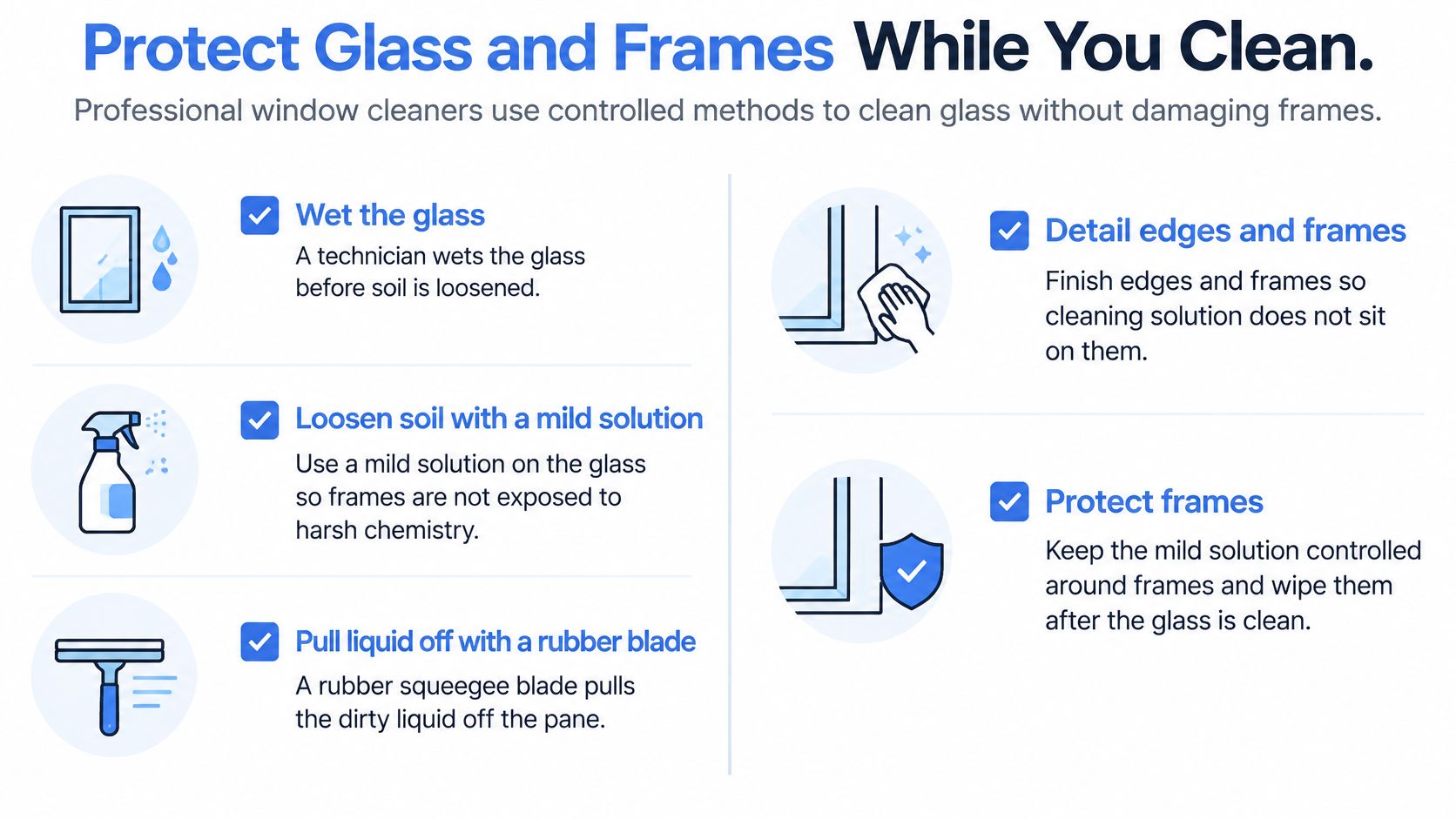
The cost of careless technique isn't just streaking. It can include grit scratches, lost coatings, and chemically etched frame finishes.
Watch the cleaning technique with particular attention to liquid control and edge detailing.
Prevention means controlling where water lands, what it contains, and whether it dries on the glass. Removing the source of repeated spotting saves more effort than repeatedly treating the same patch.
In arid parts of Arizona, Nevada, and Colorado, quick evaporation leaves little working time. Keep a squeegee near the shower and check irrigation whenever you notice a new pattern of exterior spots.
Use our hard water stain prevention guidance to organize those habits around your property's exposure. Don't automatically lengthen treatment time when spots return; first check whether you've corrected the water source.
Each untreated drying cycle can leave more residue for the next cleaning to remove. Catching a light film early is more manageable than allowing it to become a stubborn, bonded deposit.
DIY makes sense when the stain is fresh, the glass is plain, and a gentle repeat treatment clears it. Bring in trained help when haze survives that repeat, the surface is coated, decorative or tinted, or the affected area is too large to treat safely.
Professional Window Cleaning has been cleaning windows for over 26 years, as documented in our company history. We serve Phoenix, Las Vegas, Denver, and Scottsdale. Our office cleaning includes specialized mineral-deposit treatments, and our HOA service includes hard water stain removal using specialized techniques and solutions.
For persistent haze, review our glass restoration services. We offer a satisfaction guarantee and address customer concerns promptly.
Test one compatible patch this week, photograph it after drying, and record whether it improved. Use that result to decide whether to repeat the gentle routine or arrange an assessment.
Professional Window Cleaning offers residential and commercial window cleaning, including specialized treatment for hard water spots and mineral deposits. Visit Professional Window Cleaning to request a free estimate and discuss whether your cloudy glass needs cleaning or a restoration assessment.
Read our blog posts regularly and keep learning.