Care and Maintenance
Window Washing Cloths: The Professional Guide
Discover the best window washing cloths for streak-free glass. Compare microfiber, chamois, and cotton, plus expert care tips for homes and high-rises.


USD 3.59 billion is the estimated global glass cleaner market in 2025, with commercial use representing approximately 55% of demand, but the best commercial glass cleaner isn't automatically a spray bottle. Professional window cleaning relies on only two methods, a squeegee or a pure-water system, and the right choice depends on your building type, contamination, and access constraints.
That distinction challenges the most popular advice about commercial glass. Buying a stronger formula won't solve poor access, mineral deposits, dirty tools, or a method that leaves residue across a large facade. A property manager should choose the cleaning method first, then select compatible chemistry only where the job actually needs it.
Professional Window Cleaning has been cleaning windows for over 26 years. That experience points to a practical rule: product selection follows method selection. A low-rise medical office, a high-rise curtain wall, a car dealership, and a busy storefront may all need clear glass, but they don't present the same safety, soil, or surface-compatibility problem.
| Cleaning approach | Best fit | Main advantage | Main limitation |
|---|---|---|---|
| Traditional squeegee | Interior glass, storefronts, heavy soil, detailed work | Strong control over solution and agitation | Requires trained technique and safe access |
| Pure-water system | Large exterior facades and hard-to-reach glass | Dries without chemical residue | Requires purified-water equipment and disciplined operation |
| Targeted chemical treatment | Grease, adhesive, mineral deposits, or construction residue | Addresses contamination a routine wash may leave behind | Must match the glass, frame, and indoor environment |
Buyers comparing labels and scent claims often overlook the tool, technique, and drying conditions that determine whether glass stays streak-free. A suitable chemical can still produce poor results when the operator uses the wrong tool, works in direct heat, or treats mineral deposits like ordinary dust.
Professional window cleaning depends on two methods: traditional squeegee work and pure-water cleaning. A bottle can support squeegee work, but it cannot replace the method, the operator's technique, or the conditions on site.
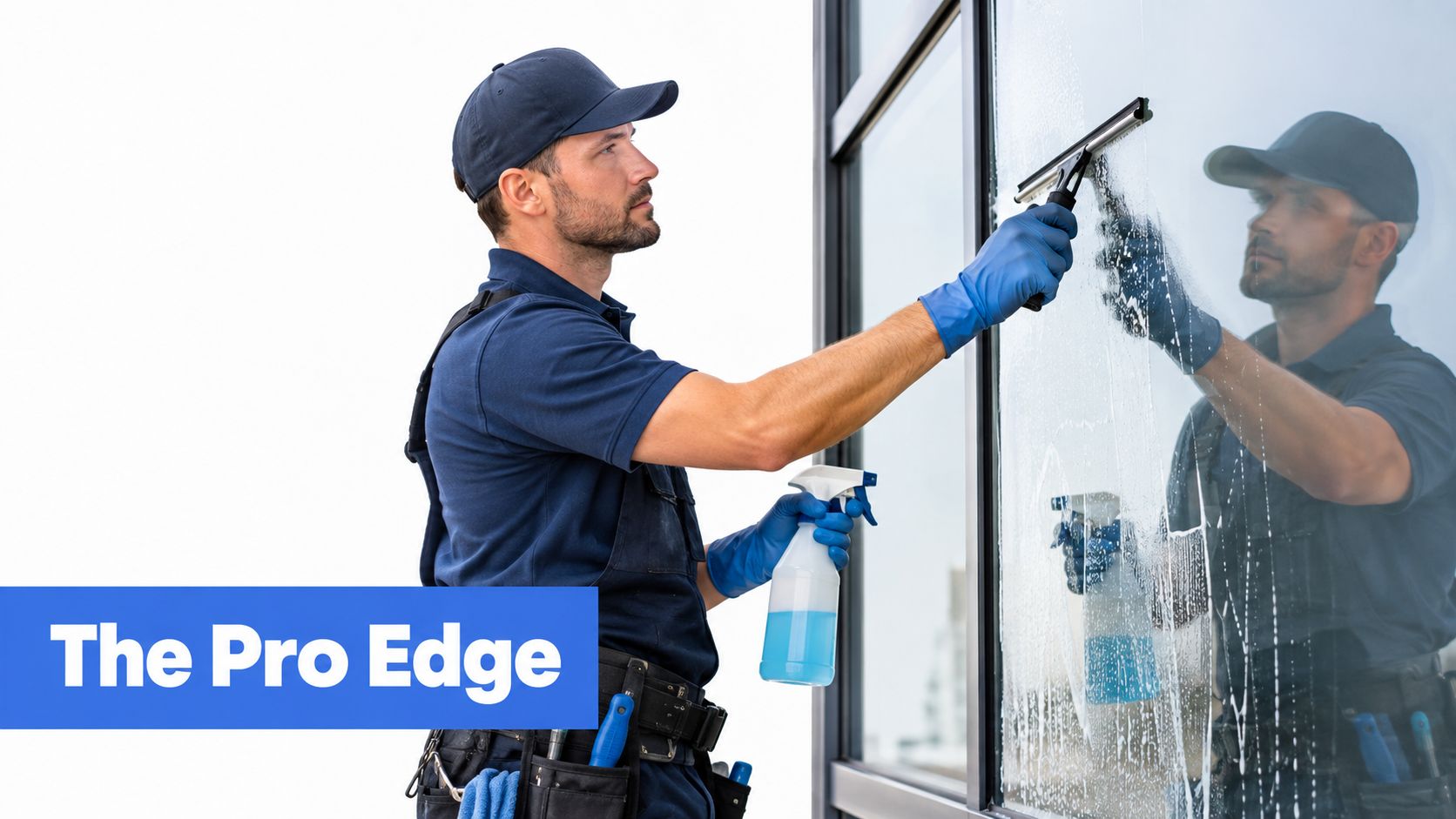
Traditional squeegee work gives the operator direct control. The cleaner wets the glass, loosens soil, and removes the solution with a maintained rubber blade. This method suits surfaces that need deliberate agitation, indoor glass, and detailed work around edges, seals, mullions, and tight corners.
Pure-water cleaning addresses a different need. Reverse osmosis and deionization remove minerals and impurities from tap water, allowing purified water to dry without spots from soap or chemical additives. It works particularly well on exterior glass where a crew needs consistent coverage and wants to limit chemical residue.
The first questions should be: How will the crew reach the glass? What is on the glass? Where will the runoff go? Their answers usually identify the appropriate method more reliably than a spray-product ranking.
Practical rule: If the method cannot control access, contamination, and drying conditions, a more expensive cleaner will not rescue the job.
A car dealership may require careful interior work around tinted glass, fingerprints, and bright showroom lighting. A medical office may place greater emphasis on low odor and compatibility with coated surfaces. A large exterior facade may suit purified water because crews can clean glass and frames without leaving a traditional detergent film.
Professional Window Cleaning has been cleaning windows for over 26 years. That experience supports a practical rule: product selection follows method selection. The right chemical depends on the work being performed, not just on a label claim.
Commercial glass also exposes weak technique quickly. On one small pane, an extra wipe may have little effect on labor. Across a large property, repeated passes, rewetting, and callbacks create operational problems. Independent testing examines speed, streaking or filminess, and wipe passes, as well as effectiveness, formulation, packaging, ease of use, and clarity of directions, according to independent glass-cleaner testing criteria.
The strongest choice is the method that removes the building's specific soil with fewer unnecessary passes, while protecting the glass and keeping the work safe. Chemical cleaner matters when the job requires it, but method, access, and drying conditions determine the result.
Commercial glass cleaning isn't a minor janitorial add-on. One market estimate places the global glass cleaner market at USD 3.59 billion in 2025, with commercial use accounting for approximately 55% of total demand, according to Fortune Business Insights' glass cleaner market analysis.

The same market report distributes regional share across Asia-Pacific at 37%, North America at 34%, Europe at 29%, and the rest of the world at 10%. Those figures describe a broad, geographically distributed category, not a niche purchase made only by specialist contractors.
U.S. window-washing services offer useful context because they operate in the same building-maintenance ecosystem. Industry revenue is projected at USD 2.9 billion in 2024 and USD 3.2 billion by 2029, while the number of businesses is listed at 35,344 in 2024, according to window-cleaning industry data from Jobber.
The sector's estimated profit before interest and taxes is 6.7% of revenue, and its projected annual growth from 2024 to 2029 is 1.7%, according to the same source. For operators working within a mature market, those economics make labor efficiency and consistency more important than a small difference in bottle price.
A property manager buying glass-cleaning supplies is really buying a workflow. The choice affects chemical storage, dilution, equipment, training, drying time, rework, and the risk of a visible callback. A low-cost product that forces extra passes may cost more in labor than a concentrated or better-matched system.
Commercial buildings also need predictable results. Retail entries, office lobbies, dealerships, and medical facilities are judged under changing light, frequent touch, and public scrutiny. A system that produces a clean result across repeated visits has more operational value than a formula that performs well only under ideal conditions.
That is the central market insight. Commercial buyers don't need the most aggressive chemical. They need a method that manages surface area, access, contamination, and risk without creating unnecessary work. The large market exists because those decisions repeat across thousands of buildings and service routes.
Professional window cleaning centers on two methods, traditional squeegee work and pure-water cleaning. Both can deliver clear glass, but they don't solve the same operational problem.
Traditional squeegee work uses a wetting tool, cleaning solution, and rubber blade. The operator loosens soil, pulls the solution away in controlled strokes, and details the edges with a clean cloth. It remains the practical choice for interior glass, storefront touch-ups, heavily soiled panes, and jobs where the operator needs close visual control.
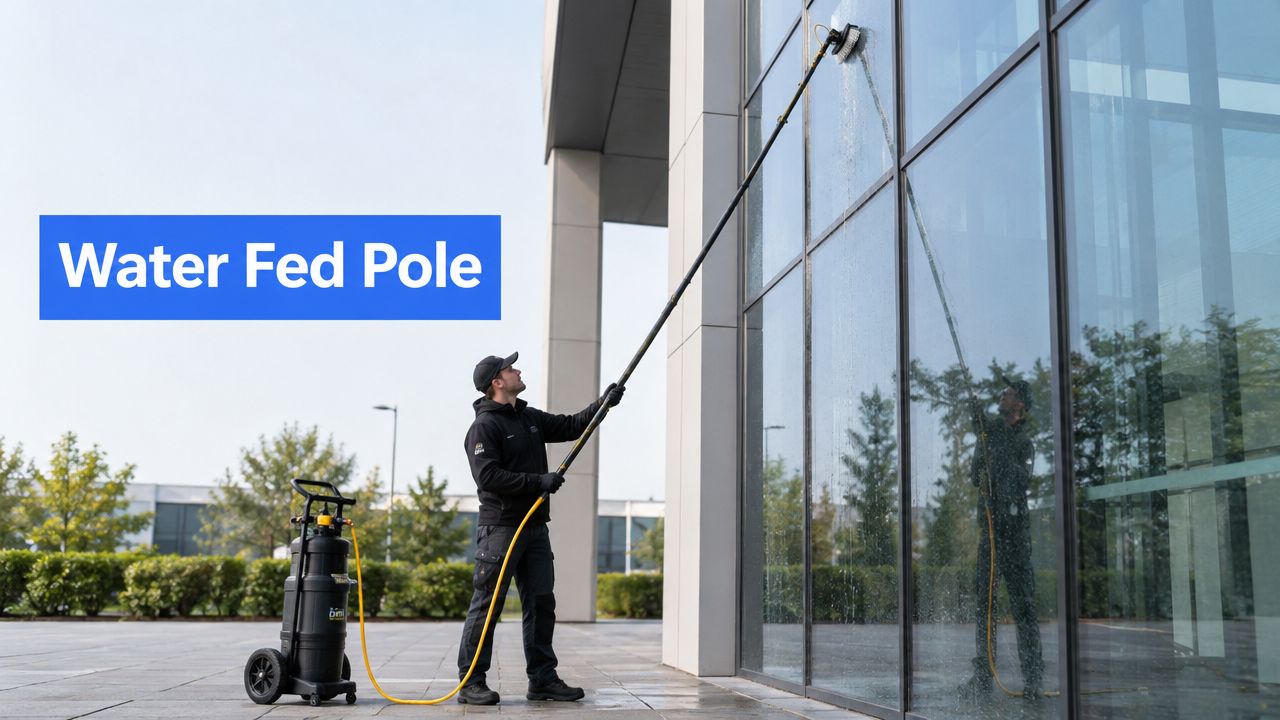
Pure-water systems use reverse osmosis and/or deionization to remove minerals from tap water. The purified water lifts soluble contamination, and the remaining rinse water can dry spot-free without detergent or chemical additives. Professional systems are designed for large or difficult exterior glass, where carrying chemicals and repeatedly wiping broad panes can slow the route.
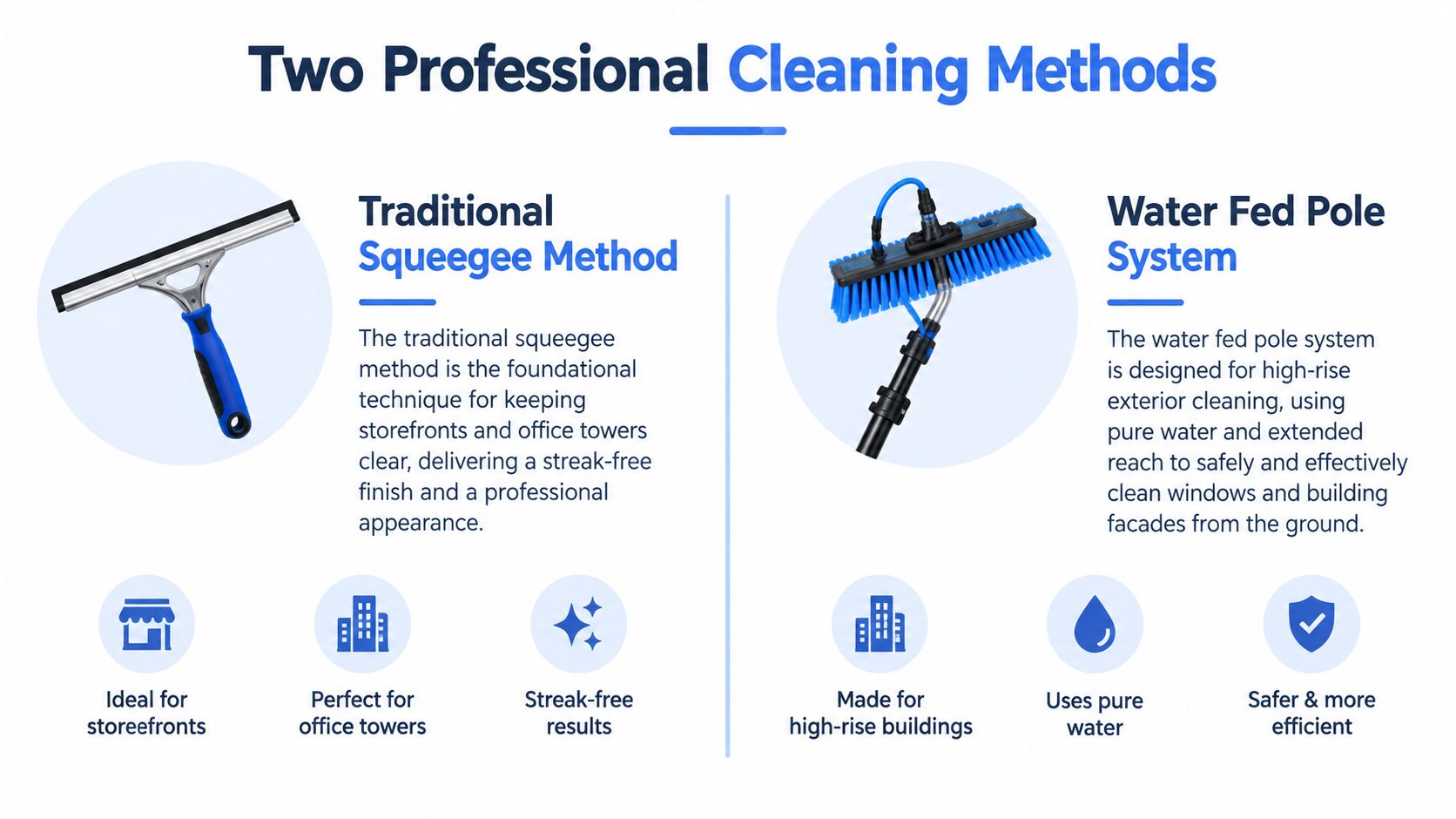
Squeegee work is strongest when contamination needs attention rather than simple rinsing. Greasy fingerprints, indoor film, construction residue, and stubborn edge buildup often need a cleaning solution and controlled agitation. The trade-off is that the operator must manage ladders, lifts, or other access equipment where the building requires it.
Pure-water cleaning is strongest on exterior routes with many panes, large elevations, or difficult reach. Water-fed poles can reach up to about 55 feet, roughly five stories, while keeping workers on the ground, and industry materials state that these systems may reduce job time by about 60% compared with traditional methods, as described in pure-water cleaning guidance from WAXIE.
The method still requires skill. Poorly purified water, contaminated brushes, or careless work around incompatible surfaces can undermine the result. Pure water isn't a universal substitute for spot treatment, abrasion control, or interior detailing.
The right question isn't which method looks more modern. It's which method removes this building's soil with the least risk and rework.
For a deeper explanation of exterior applications, pure-water window washing provides useful context on equipment and workflow. Homeowners and facility teams comparing maintenance practices can also consult these exterior home renovation window tips, particularly when access, frame condition, and long-term glass care overlap.
The practical split is straightforward. Use a squeegee when the job benefits from chemical cleaning and precise control. Use pure water when the exterior glass is broad, reachable from the ground, and better served by a residue-free rinse.
Chemical cleaners still have an important place in commercial glass work. They make sense when the glass carries grease, fingerprints, indoor film, adhesive residue, or contamination that purified water alone won't remove. The mistake is treating chemistry as the entire cleaning system.
Ammonia-based formulas can cut greasy soil quickly, but they bring odor, handling, and compatibility concerns. Professional guidance favors ammonia-free or low-VOC options for many commercial settings, especially where tinted or coated glass, enclosed spaces, or frequent occupant exposure make fumes and material compatibility important. One analyzed glass-cleaner product was reported at approximately 26 g/L VOC with no signal word or hazard codes, as discussed in glass-cleaner safety analysis.
| Cleaner Type | Best For | Key Limitation |
|---|---|---|
| Ammonia-based cleaner | Grease and fast interior touch-ups | Odor and compatibility concerns on some tinted or coated glass |
| Ammonia-free formula | Medical offices, hospitality, tinted glass, occupied interiors | May need more deliberate dwell time or agitation on heavy soil |
| Low-VOC formulation | Enclosed workplaces and odor-sensitive environments | The VOC profile still needs review rather than assumption |
| Concentrate or refill format | High-volume routes with trained staff | Incorrect dilution can create residue or weak cleaning |
| Targeted treatment | Mineral, adhesive, paint, or construction residue | Must be selected for the contaminant and substrate |
Independent evaluations make procurement easier when they focus on speed, streaking, filminess, and wipe passes instead of vague shine claims. Those measures connect directly to labor: a cleaner that needs fewer passes can support a faster, more consistent route.
A useful formulation reference is the discussion of commercial glass cleaner formula. It reinforces the point that chemistry should be matched to the job, not selected by brand recognition alone.
Standard glass cleaner isn't the right answer for every mark. Hard-water deposits may require a purpose-made mineral treatment, while adhesive or paint may need careful mechanical or chemical removal that won't damage the glass, coating, or frame. Professional guidance recommends checking for mineral deposits, paint, adhesive, and other buildup before routine cleaning, then choosing products for the specific glass and frame material, as outlined in commercial window-cleaning guidance from Absolute Hygiene.
The safest commercial formulation is the one that removes the target soil without leaving a film, damaging a coating, or creating an indoor-air-quality problem. Often, that means a modest ammonia-free solution used with a good squeegee, not a stronger product applied more heavily.
Start with the building, not the bottle. A useful decision process identifies the contamination, maps access, checks the glass and frame materials, and then decides whether the job calls for squeegee work, pure water, or a targeted treatment before the routine method.
Loose dust, fingerprints, grease, mineral spotting, adhesive, and construction residue behave differently. A pure-water system may handle ordinary soluble exterior dirt efficiently, while grease on interior glass may need a compatible detergent and squeegee. Mineral deposits can require a separate treatment rather than repeated applications of ordinary cleaner.
Ground-access exterior glass is a natural candidate for water-fed poles. Interior glass, narrow panes, detailed frames, and surfaces near occupants usually benefit from close squeegee control. If access requires ladders, lifts, roof work, or unusual positioning, safety and site planning become part of the method decision.
| Condition | Recommended Method | Chemical Needs |
|---|---|---|
| Low-rise storefront with fingerprints | Squeegee work | Ammonia-free cleaner may be appropriate |
| Large exterior facade with soluble dirt | Pure-water system | Usually no traditional chemical additive |
| Interior medical or office glass | Squeegee work | Low-odor, compatible formulation |
| Hard-water deposits | Targeted treatment followed by the suitable routine method | Mineral-specific product may be required |
| Construction dust with adhesive or paint | Controlled squeegee cleaning after inspection | Surface-specific treatment, used cautiously |
| High or difficult exterior access | Pure-water system where reach and surface conditions allow | Usually minimal chemical use |
A car dealership needs clarity under bright showroom lighting, so residue and edge detailing matter. A high-rise facade needs a system that addresses height, worker exposure, equipment logistics, and runoff. A medical office needs a clean finish without unnecessary odor in occupied areas.
Commercial guidance from Kärcher on window-cleaning methods emphasizes purified water for standard professional cleaning and highlights the operational question many product lists omit, whether chemicals are necessary for the routine job at all.
Choose the least complicated method that can remove the contamination safely and leave the glass clear.
Before approving a recurring schedule, test a representative pane. Inspect it in direct and reflected light, check the frame and coating, and confirm that the method doesn't create runoff or odor problems. A short field test is more useful than assuming a product will behave the same way across every building.
In-house cleaning can work for accessible, low-risk glass with a trained operator and a controlled routine. It becomes less sensible when the property includes high elevations, steep facades, complex curtain walls, heavy contamination, public foot traffic, or surfaces that require specialty treatment.
Professional Window Cleaning has operated since 1999, making the company more than 26 years old as of September 27, 2026. The business serves Las Vegas, Phoenix, Denver, Scottsdale, Tempe, Chandler, Gilbert, and Flagstaff, with services relevant to residential properties, commercial buildings, high-rise condominiums, car dealerships, stadiums, medical offices, and property management portfolios.
A stronger spray can't compensate for unsafe access. Professional crews bring trained operators, appropriate equipment, and experience choosing between squeegee work and pure-water systems. They can also recognize when ordinary cleaning should stop because the glass has mineral damage, adhesive, paint, a coating, or a frame-material compatibility issue.
Property managers overseeing curtain walls may find a curtain wall details guide from Facility Management Insights useful when evaluating the relationship between glazing, frames, seals, and maintenance access. Understanding the assembly helps the cleaning provider plan the work without treating every pane as an isolated surface.
Routine interior touch-ups may stay in-house if staff can work safely, use clean tools, follow product instructions, and inspect the result. Larger exterior routes, high-access glass, recurring mineral deposits, and public-facing properties usually justify a specialist because the service must manage both appearance and risk.
Professional Window Cleaning offers commercial and high-rise window cleaning using squeegee work and pure-water systems. Visit Professional Window Cleaning to discuss your building type, glass condition, access requirements, and the method that fits the job.
Read our blog posts regularly and keep learning.