Care and Maintenance
Best Commercial Window Cleaning: Top Providers for 2026
Compare the best commercial window cleaning providers across AZ, CO, and NV, with criteria for high-rise access, pricing factors, and how to choose a vendor.


When it comes to getting your windows truly clean, there are really only two ways the pros do it: the classic squeegee method and the more modern pure-water system. Forget the paper towels and spray bottles. If you want a streak-free shine that actually lasts, these are the only techniques that deliver every single time. Professional Window Cleaning has been cleaning windows for over 26 years, and these are the only two methods we use.
When we started Professional Window Cleaning over 26 years ago, our mission was simple: leave every window with a perfect, streak-free shine. In all that time, we've seen countless cleaning "hacks" come and go, but only two methods consistently give us professional-grade results.
Whether our team is working on homes in Las Vegas or high-rise commercial buildings in Phoenix, our entire process is built around these two foundational techniques. This guide will walk you through exactly why they're so much better, breaking down the tools, the techniques, and the science behind that crystal-clear finish.
Here's something most homeowners don't realize: professional window cleaning isn't what it used to be. It's evolved from a simple chore into a full-blown craft. Globally, window cleaning services were valued at a staggering USD 141 billion in 2024, with projections hitting USD 257.27 billion by 2032.
North America alone accounts for roughly 37.75% of this market. Think about that for a second. Facility managers now treat regular window cleaning as a standard operating expense, not an afterthought. For homeowners in sun-drenched areas like Scottsdale and Denver, this trend confirms what we've known for years: professional methods are a proven best practice. You can learn more about these window cleaning services market trends and insights.
The biggest takeaway here is that professional methods aren't just better—they are fundamentally different. They control water flow, get rid of the static charge that attracts dust, and remove microscopic minerals that cause spots and streaks.
Before diving into the professional techniques, it helps to understand why the common DIY approach just doesn't cut it. The table below offers a quick side-by-side look.
As you can see, the difference is night and day. It's not just about effort; it's about the science behind the clean.
Ever wonder why that spray bottle and paper towel combo leaves you with a streaky mess? It's simple, really. You're mostly just smearing the dirt around. The cleaning solutions often dry too fast, leaving behind a hazy film, and paper towels just add lint to the problem.
Professional techniques are designed to do one thing perfectly: remove all the dirt and all the cleaning solution from the glass. Nothing gets left behind to mess up your view. It's the difference between just moving dirt around and actually removing it for good.
The humble squeegee is more than just a tool; it's the cornerstone of traditional, professional window cleaning. While it might look simple, mastering its use is the real secret to achieving that flawless, streak-free finish we all want. After more than 26 years in the business, our teams at Professional Window Cleaning have perfected these techniques on countless homes and businesses in Las Vegas and Phoenix.
The first thing a pro does is "wet out" the glass. This isn't just a quick spray—it's about generously applying a cleaning solution to the entire window surface using a T-bar scrubber. The goal is to loosen every bit of dirt and create a lubricated surface for the squeegee to glide across without a hitch.
This is where the difference between professional work and a typical DIY attempt really starts to show.
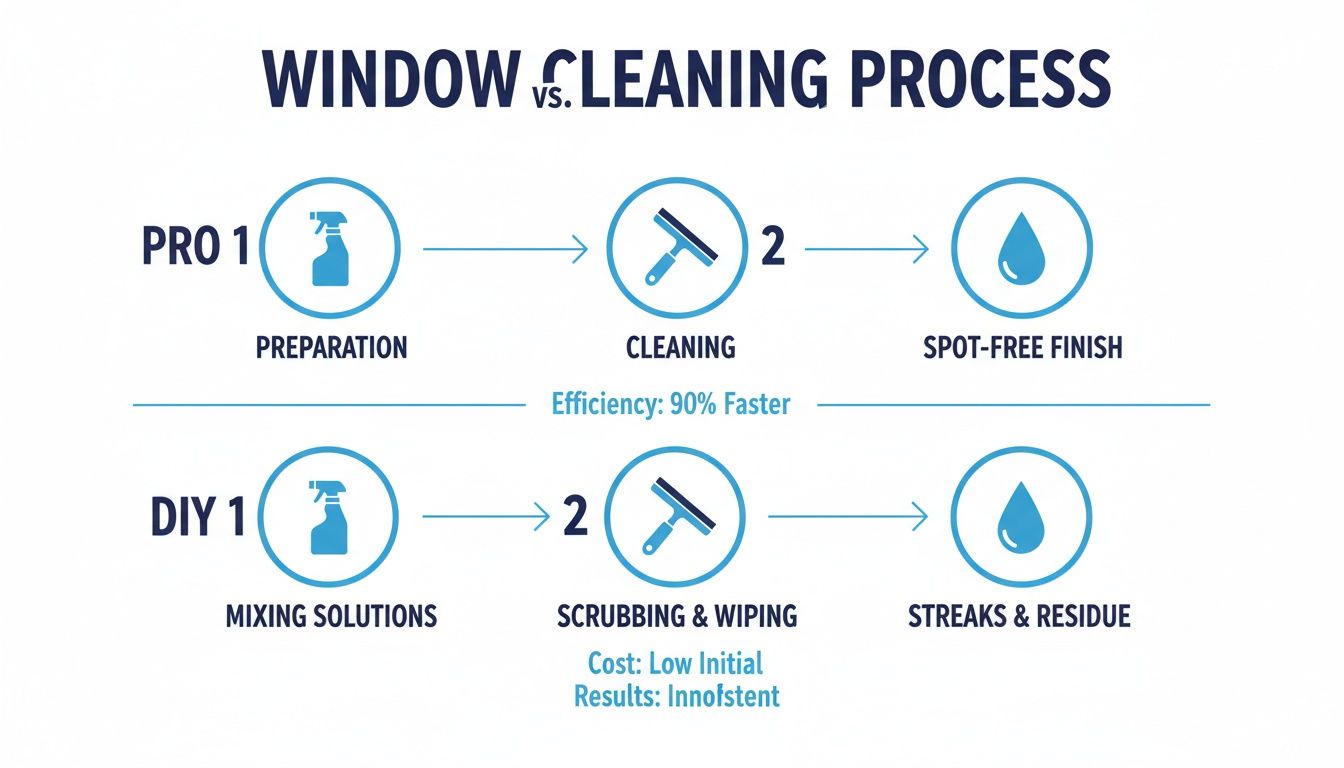
As you can see, the professional process is designed to lift and remove dirt completely. This prevents the smearing and static buildup that often happens when you just use paper towels and a spray bottle.
Once the window is thoroughly wet, it's squeegee time. Pros generally rely on two primary techniques: the "straight pull" and "fanning." For most residential windows, the straight pull is the easiest and most effective method, especially if you're just starting out.
For larger panes of glass, you’ll often see pros using the fanning method—a more advanced S-shaped motion that keeps the leading edge of the water moving continuously across the glass. It takes some practice, but you can get a better handle on the technique with our in-depth guide on how to properly squeegee a window.
Pro Tip: Maintaining the correct angle is everything. Your squeegee should be held at approximately a 45-degree angle to the glass. Too steep, and it will chatter and skip across the surface; too shallow, and it will just leave water behind.
Even with perfect technique, a small amount of water will inevitably pool along the edges of the frame and at the bottom sill. This is where detailing, or "touching up," comes in. The final step is to grab a separate, clean microfiber cloth and carefully wipe away any remaining drips from the edges and the sill.
This small step prevents dirty water from running down and ruining your hard work or damaging your window frames and floors. It’s this attention to detail that separates a good result from a truly professional one. By following these steps, you’re not just wiping a window; you're using a proven system for perfect clarity.
While the squeegee is the classic tool of the trade, modern window cleaning has embraced a powerful, science-backed alternative: the pure-water system. This method is a huge leap forward, especially for exterior and hard-to-reach windows. It’s actually one of the two core techniques our team at Professional Window Cleaning has relied on for over 26 years to get those flawless results.
At its heart, the system works by stripping tap water of all its natural minerals and impurities. If you've ever tried cleaning your windows with a garden hose, you know the frustration. Normal water is full of dissolved solids like calcium and magnesium. When that water dries on glass, the minerals get left behind, creating those annoying spots and streaks.
A professional system uses a multi-stage filtration process—usually involving reverse osmosis and deionization—to produce 100% pure H₂O. This purified water is an incredible cleaning agent for one simple reason: it’s unstable and wants to return to its natural, impure state.
Think of pure water as a magnet for dirt. When we pump it through a water-fed pole and spray it onto a window, it aggressively attracts and dissolves grime, pollen, and other gunk. A specialized brush on the end of the pole helps agitate and lift all that debris from the glass.
The best part? Because the water is completely free of minerals, we can just let it air-dry. No squeegeeing needed. It dries to a perfect, spot-free finish every single time. This is a complete game-changer for efficiency and, more importantly, safety. If you want to get into the nitty-gritty, you can explore our full guide on how pure water window washing works.
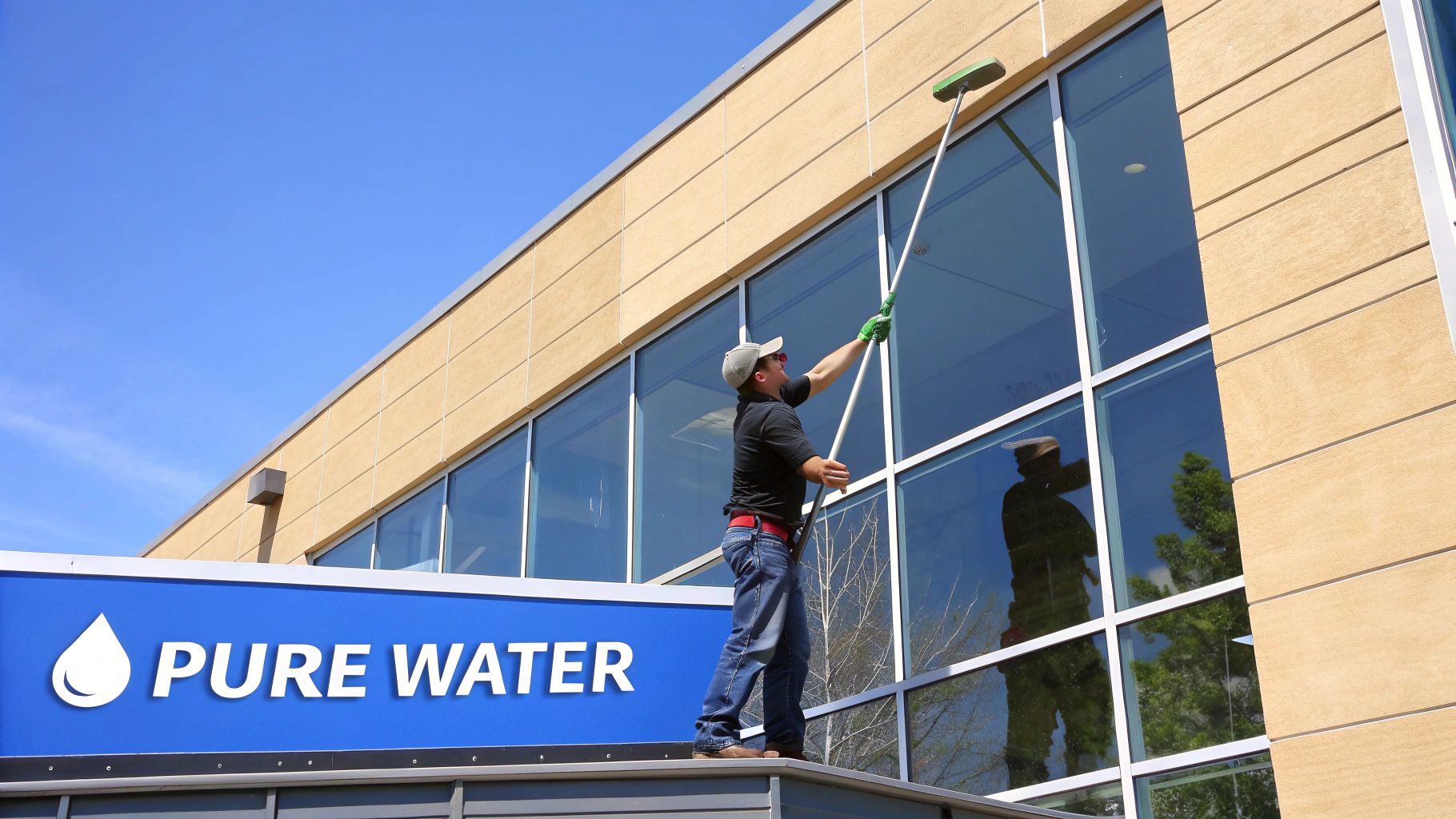
This method is a lifesaver for commercial properties and multi-story homes in cities like Scottsdale and Denver. Imagine trying to clean the third-story windows of a large office building. Instead of messing with risky ladders or bringing in expensive lifts, our technicians can work safely from the ground, reaching heights of up to 60 feet with a lightweight carbon fiber pole.
The real magic of a pure-water system is its simplicity and effectiveness. It scrubs, rinses, and dries in a single step, leaving behind nothing but crystal-clear glass. It’s the ultimate expression of working smarter, not harder.
The best way to clean windows on large commercial buildings is shaped as much by safety as it is by technology. The global market for window cleaning products, including these pure-water systems, was valued at USD 2.68 billion in 2023 and is projected to hit USD 5.34 billion by 2031.
That growth is directly tied to urbanization and the rise of tall buildings where water-fed pole technology has become the standard for safe, ground-based cleaning. North America leads this market with a nearly 38% share, reflecting the high demand for keeping commercial properties looking sharp.
Ultimately, the pure-water system provides a superior, longer-lasting clean because it leaves no sticky soap residue behind to attract more dirt. This makes it an incredibly efficient and effective solution for modern window maintenance.
You can't get that professional, streak-free shine without the right gear. After more than 26 years in this business, we've learned that quality tools are absolutely non-negotiable. This is your definitive shopping list for putting together a toolkit that delivers incredible results every single time, whether you're working on windows in sunny Scottsdale or urban Denver.
And forget that aisle of flashy, specialized cleaners at the hardware store. The single best cleaning solution is one you can make right at home.
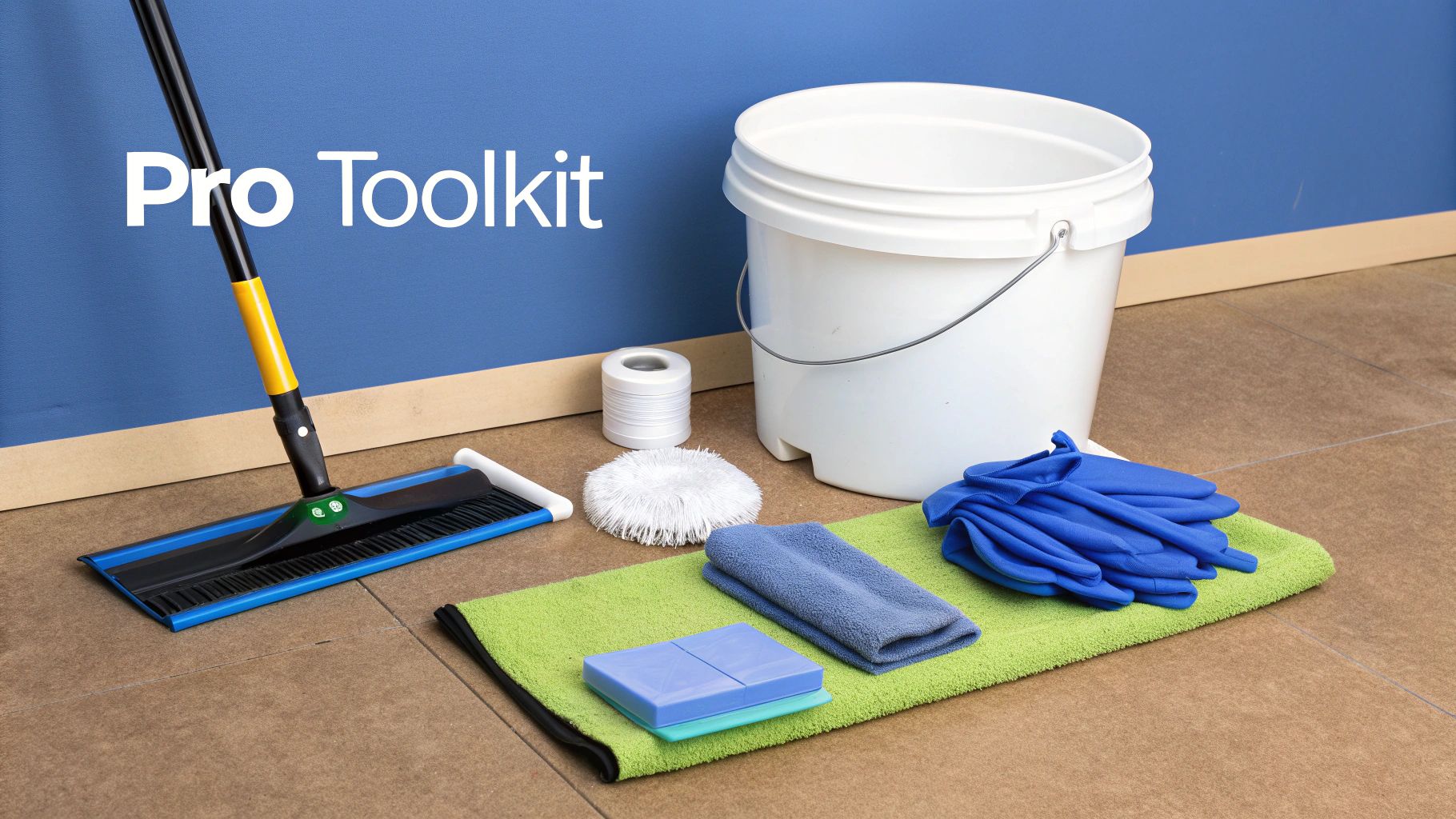
Whether you’re just starting out or looking to upgrade your current setup, having the right equipment makes all the difference. Below is a checklist of the essential tools and solutions we rely on for both traditional squeegee work and modern pure-water systems.
Getting these basics right is the first step toward achieving a truly professional result on every window you touch.
For the traditional squeegee technique, your success really boils down to a few key items. Spend a little more on quality from the start—it'll save you a ton of time, frustration, and money down the road. The best way to clean windows always starts with professional-grade equipment, which is why Professional Window Cleaning has perfected this toolkit over 26 years.
Here's what you need:
The most common mistake we see is using way too much soap. You only need a few drops. This creates a solution that cuts through grime without leaving behind a sticky film that just attracts more dust.
If you’re tackling second-story exteriors or just want to embrace a more modern approach, a pure-water system is the way to go. It’s a bigger investment upfront, but the payoff in efficiency and safety is huge.
A basic setup has three main components:
Building the right toolkit from the start is the first, and most important, step toward achieving that flawless, professional finish.
Mastering the squeegee or even setting up a basic pure-water system brings a ton of satisfaction, but some jobs are just better left to the experts. Knowing the best way to clean windows is also about knowing when the safest, most efficient move is to pick up the phone and call a pro. At Professional Window Cleaning, we've spent over 26 years handling the complex, dangerous, and large-scale jobs that are way beyond a typical weekend DIY project.
Certain situations really demand an expert’s touch, not just for quality but for safety. If you’re looking at a multi-story building, windows perched precariously over delicate landscaping, or glass that requires specialized ladder work, the risk of injury is just not worth the potential savings. Professionals come fully insured and equipped with the right safety gear, turning a hazardous task into just another day at the office.
Post-construction cleanup is another area where a pro is absolutely invaluable. You need specific tools and techniques to remove stubborn stuff like paint overspray, silicone, or sticker residue without permanently scratching the glass. We once handled a huge new car dealership in Las Vegas where every single pane was covered in construction dust and adhesive. Our specialized equipment and experience were the only way to reveal that pristine showroom glass without a single scratch.
It’s a similar story for properties in cities like Phoenix and Denver, where homes and businesses often feature expansive or hard-to-reach glass. In those cases, our efficiency and guaranteed perfect finish make all the difference.
The decision to hire a pro often comes down to a simple calculation: time, risk, and the value of a guaranteed result. For complex jobs, the professional approach isn't just an alternative; it's the correct solution.
Behind every "best way to clean windows" tip is a bit of simple economics. In the U.S., professional window cleaners earn an average of about USD 18 per hour. It's also telling that commercial cleaning services hold around 27.51% of the overall cleaning market—a clear sign of how much property managers rely on professionals. For a homeowner in Scottsdale, this shows that paying a trained team is right in line with how major markets achieve consistent clarity and safety. You can find more insights about the future of the commercial cleaning industry here.
When you’re ready to bring in an expert, a little research goes a long way. A company’s online presence can tell you a lot about its professionalism and customer service. In fact, understanding the importance of effective website design for home service contractors can help you spot the pros from the amateurs. Look for clear service descriptions, photos of their actual work, and contact information that’s easy to find.
Ultimately, calling a professional is the smart choice when a job involves:
In these cases, trusting a professional team ensures the job gets done safely, correctly, and to the highest standard. It’s about protecting both you and your property.
Even with the best tools and techniques, you're bound to have questions. After 26 years in the business, we've heard just about everything from our clients in places like Las Vegas and Phoenix.
Here are our answers to the questions that pop up most often, packed with advice you can use right away to get that perfect, professional shine.
It’s always tempting to clean windows on a beautiful, sunny day, but this is hands-down one of the biggest mistakes you can make. The heat from direct sun causes your cleaning solution to evaporate almost instantly.
What’s left behind? All the soap and mineral deposits from the water, which are the very things that cause stubborn streaks and spots. You simply can't move your squeegee fast enough to beat the sun. For a flawless finish, always work on an overcast day or when your windows are completely in the shade. If you have no other choice, work in very small, manageable sections so you can wet, scrub, and dry the glass before the solution vanishes.
You might be surprised to learn that the secret weapon for most pros is incredibly simple. You can forget all those expensive, store-bought sprays.
The best solution is just a bucket of cool water with a few drops of a quality liquid dish soap, like Dawn. That's it. This simple mix is perfect for two reasons:
Pro Tip: Steer clear of vinegar or ammonia-based cleaners. They can damage window tints, degrade rubber seals over time, and evaporate too quickly, which ironically leads to more streaking. For the pure-water method, you don't need any solution at all—just 100% purified water.
Streaks are the ultimate frustration, but they almost always come down to a few small, fixable mistakes with your gear or your technique. If you're still seeing lines after you're done, run through this quick mental checklist.
First, check your squeegee blade. Is it old, nicked, or dirty? A damaged blade will never leave a clean finish. Second, make sure you’re using enough cleaning solution. If the glass starts to dry out, your squeegee will chatter and skip across the surface.
Finally, focus on your form. Are you holding the squeegee at a consistent 45-degree angle and applying even, light pressure? Are you overlapping each stroke by about an inch? And this one is crucial: are you wiping the blade clean with a dry microfiber cloth after every single pass? Getting these little details right is what separates an amateur from a pro.
The perfect cleaning schedule really depends on where you live and your specific environment. For most homes in areas like Scottsdale, a thorough exterior cleaning twice a year is plenty to keep them looking fantastic.
Commercial properties are a different story. For a business in a busy city like Denver, we usually recommend a monthly or quarterly cleaning schedule. This helps maintain a sharp, professional image and prevents buildup from traffic, pollution, and pollen. If your building is near a construction site or a high-traffic road, you’ll likely need more frequent cleanings.
For a guaranteed streak-free shine without lifting a finger, trust the experts. Professional Window Cleaning has been delivering crystal-clear results since 1999. Schedule your free estimate today!
Read our blog posts regularly and keep learning.