Care and Maintenance
Water Stain Remover from Glass: Fix Hard Water Spots Safely
Need a water stain remover from glass that works? Follow five safe steps with mild acid, test for etching first, and protect frames and coatings.


You're sitting in a quarterly board meeting or walking the porte-cochere of a 30-story Strip property, looking up at four hundred vertical feet of hazy glass. Desert dust has settled into every horizontal mullion. Residents are asking why the west-facing views look smeared after a windy weekend, while your facilities team is trying to figure out how to wash recessed balcony panels without shutting down the main valet lane.
Exterior glass washing gets treated as a routine janitorial line item until you manage or buy into a multi-story tower. Up on a high-rise facade, cleaning the glass is the final step in a much bigger operational equation. Before a single squeegee blade or water-fed brush touches a pane, someone has to engineer how a crew gets there safely, verify what the building's coatings can tolerate in desert heat, and confirm who carries the liability if wind gusts pick up mid-drop.
Treated properly, exterior glazing care is both a recurring ownership cost and a documented safety obligation. Whether you manage a resort tower, sit on a condominium board, or are reviewing resale documents before making an offer, understanding how access, cleaning methods, desert temperatures, and building rules fit together keeps you from signing a bad contract or damaging six-figure curtain-wall glass.
Nearly the entire Las Vegas skyline went up within a single generation of construction. New York-New York Hotel & Casino, completed in 1997, was the first Las Vegas high-rise hotel and casino resort to exceed 492 feet (150 meters), topping out at 529 feet (161 meters), and 39 of the city's 40 tallest skyscrapers were completed after 1997, according to the Wikipedia list of tallest buildings in Las Vegas. The resort and residential boom that followed produced towers like The Palazzo (642 feet, 53 floors, completed in 2007), Encore (631 feet, 48 floors, 2008) and Aria Resort & Casino (600 feet, 60 floors, 2009), per archived Emporis Las Vegas building statistics.
That building wave left the valley with an enormous inventory of vertical glass, much of it aging under the same desert conditions on the same timeline. Fine alkaline dust bonds to sun-baked panes, wind tunnels between neighboring towers narrow the rigging windows, and recessed balcony panels sit beyond the reach of a straight drop. Treating that facade as a routine janitorial line item underestimates it. Exterior glass on a tower is a recurring ownership cost and a documented safety duty: someone carries responsibility for the anchors, the drop zone below, and the liability if a gust picks up mid-descent.
A Las Vegas hi rise also operates differently from any low-rise property. Glazing sits hundreds of feet up, wrapped around mechanical penthouses, architectural fins, cantilevered balconies and sealed curtain walls that never open from the inside. Crews cannot lean an extension ladder against the fortieth floor, so rigging plans, anchor certification and pedestrian controls shape the contract as much as the washing itself.
Across the valley, homes usually need residential window cleaning, storefronts and offices need commercial window cleaning, and multi-story towers need high-rise window cleaning. For facility leaders sorting routine interior contracts from specialized facade scopes, an overview of commercial cleaning services by Solomon's Facilities Management shows how standard janitorial programs diverge from exterior technical trades. On tall desert buildings, three property types drive that specialized demand:
The stakes are the same across all three. A missed mullion is cosmetic; a failed anchor or an unmanaged drop zone is a liability event. Owners and boards that budget facade care as a fixed operating line, with access engineering and weather limits priced into the schedule, protect both the glass and the people below it.
On any tall building, the building architecture and glass profile dictate the access system long before anyone selects a cleaning method. You can have the sharpest technicians in the trade, and they still can't clean a 40th-floor recessed loggia if the bid only priced a straight-drop platform. Every Las Vegas hi rise combines distinct zones, from street-level lobbies and podium roofs to sheer vertical glass and setback terraces, so choosing the right access method starts with mapping the facade.
| Access method | Where it is used | Main strength | Main limit |
|---|---|---|---|
| Roof-mounted building maintenance unit | Full-height towers with a permanent roof track | Covers curtain walls systematically | Requires an installed track and a stowage zone |
| Suspended swing stage | Mid and upper floors of towers without a permanent system | Flexible positioning across a facade | Needs anchor points and wind limits |
| Rope access | Balconies, recesses and irregular elevations | Reaches areas a platform cannot | Limited load and needs trained technicians |
| Boom or lift | Podium levels and low-rise sections | Fast setup at ground level | Limited reach and clearance around the building |
| Ground-level pole system | Entrances and lower-floor windows | Low equipment cost | Cannot reach upper glass |
Reading that matrix is straightforward once you walk the roof and the perimeter of your building. If a tower was engineered with a permanent building maintenance unit (BMU) riding on a roof track, that integrated machine is almost always the primary tool for the main curtain wall. It lets crews move across flat, continuous glazing in predictable vertical drops without rigging temporary outriggers for every elevation.
Towers built without a permanent roof track depend on suspended swing stages (modular two-point scaffolds rigged from roof davits, parapets, or outrigger beams) or industrial rope access (bosun's chairs and dual-rope descent systems). Both methods require certified, inspected roof anchor points and clearly enforced wind shutoff limits. Swing stages carry two technicians along with buckets, extra towels, and replacement rubber blades, making them efficient on broad vertical runs. Rope access shines where architectural fins, angled glass walls, or stacked balconies block a rigid platform from sitting flush against the panes.
Field rule: Most complex towers don't rely on a single access method. A practical bid often pairs a BMU or swing stage for the main shaft with rope access for recessed terraces, an articulating boom lift for the podium level, and poles around street-level entrances.
Lower sections bring their own constraints. A boom or aerial lift sets up quickly on paved drives or wide walkways to reach second- through fourth-story podium glass, porte-cocheres, and atrium roofs, provided the ground can handle the machine's weight and overhead clearance is open. Where drive lanes are tight or entrances stay busy, a ground-level pole system handles lobby doors and lower-story panes cleanly without blocking vehicle traffic or requiring heavy equipment permits.
Your written cleaning plan must explicitly name the access system assigned to each elevation of the building. Never accept a proposal that says "standard high-rise access." A property's own HOA bylaws, roof-membrane warranties, or engineering rules for suspended platforms, aerial lifts, and rope work can override a contractor's preferred setup.
Say a condominium association prohibits rolling heavy scissor lifts across travertine pool decks, or restricts roof-anchor tiebacks near newly installed solar arrays. If a contractor didn't verify those building rules during the site walk, the crew shows up on Monday morning with equipment security won't let onto the property. Checking roof tieback certifications, load ratings on podium slabs, and HOA equipment rules before awarding the job prevents costly mobilization delays.
Strip away all the marketing jargon in the window-cleaning trade, and professional window cleaners use only two methods: the squeegee method and the pure-water system. Every legitimate tower maintenance program relies on one of those two techniques, or a deliberate combination of both across different elevations of the same building. Knowing how each works helps you evaluate whether a contractor's bid matches the dirt and glass on your property.
The squeegee method is the traditional hands-on process. A technician wets the pane with a mild cleaning solution using a sleeve scrubber, agitates stuck-on desert dust, insect residue, or greasy fingerprints, and pulls the dirty water cleanly off the glass in overlapping strokes with a sharp rubber squeegee blade before detailing the edges with a dry, lint-free towel. When the soap concentration, rubber blade edge, and hand technique are right, the glass finishes crystal clear. If the solution is too soapy, the blade is nicked, or the water flashes dry in direct sun before the blade passes, streaks and edge lines show up immediately.
The pure-water system takes a different mechanical approach. Instead of soap and a squeegee, water passes through multi-stage filtration (typically sediment, carbon, reverse osmosis, and deionization resin tanks) to strip out dissolved minerals, then flows up a lightweight pole to a soft-bristle brush that scrubs and rinses the pane before it air-dries spot-free. Water quality is measurable, not guesswork: according to Professional Window Cleaning's water-filtration guidance, a pure-water system must reduce total dissolved solids (TDS) to below 10 parts per million (ppm), with below 5 ppm preferable for optimal results, whereas untreated tap water at roughly 300 ppm TDS leaves chalky mineral residue behind as it evaporates.
Here is a side-by-side visual breakdown of how those two professional methods operate on the job.

Comparing both techniques side by side makes the operational trade-offs clear for property managers reviewing bids.
| Factor | Squeegee method | Pure-water system |
|---|---|---|
| Water used | Water with cleaning solution | Purified water below 10 ppm TDS, ideally below 5 ppm |
| Residue risk | Streaks if solution or technique is off | Spot-free drying when TDS is controlled |
| Equipment | Squeegee, scrubber and bucket | Pole, filter tanks and pure-water supply |
| Best fit | Coated glass and hand-reachable panels | Tall glass reached from the ground and hard-water exposure |
I'd match the method to the exact elevation and glass condition rather than forcing one technique onto the entire property. For tall lobby facades, podium glass reached from ground level, and areas constantly hit by hard-water sprinkler overspray, a pure-water system excels because it rinses frames and sills thoroughly while keeping technicians safely planted on the ground. It also avoids soap film that can attract blowing sand back onto lower-level storefronts.
For delicate architectural coatings, stubborn baked-on grime, balcony interiors, and upper-story panes serviced directly from a swing stage, BMU, or rope-access seat, the squeegee method gives technicians direct tactile control over every square inch. Technicians can feel grit before it drags across a coated pane and inspect seals up close. One constraint never changes, though: once glass rises above the first few floors, neither the squeegee method nor a pure-water rinse replaces the engineered access system required to put the crew in front of the pane safely.
A safety plan for high-rise glass work is a written agreement, not a verbal promise tossed off during a lobby walkthrough. If a contractor tells you, "Don't worry, our guys are experienced and we're fully insured," without handing over a building-specific work plan, stop the conversation right there. Commercial window-cleaning guidance from Professional Window Cleaning specifically calls for explaining the proposed cleaning method, identifying the access system matched to the building and glass profile, naming the person responsible for site safety, and describing how occupants and the public will be protected during the work.
This checklist summarizes the core four-stage verification flow every owner or property manager should follow before authorizing a drop.

Beyond confirming crew certifications and liability insurance, property managers should also verify the condition and rating of the crew's window cleaning safety equipment, from harnesses and independent lifelines to rope grabs and tool lanyards. Walking through seven concrete checks turns a generic bid into an auditable site protocol.
If a contractor resists putting their safety supervisor's name, wind limits, and drop-zone map on paper before starting, they're asking your building to absorb the risk they won't document.
A desert summer turns exterior glass into a building's most abused surface. On a typical Las Vegas hi rise, extreme solar gain, strict municipal glazing rules, and sudden canyon winds combine to limit when crews can work and what tools can safely touch the panes. Owners who treat a Mojave tower like a coastal office building end up paying for it in cracked glass, clouded coatings, and blown schedules.
A clear afternoon across the valley shows how much glass sits exposed to direct sun across neighboring elevations.
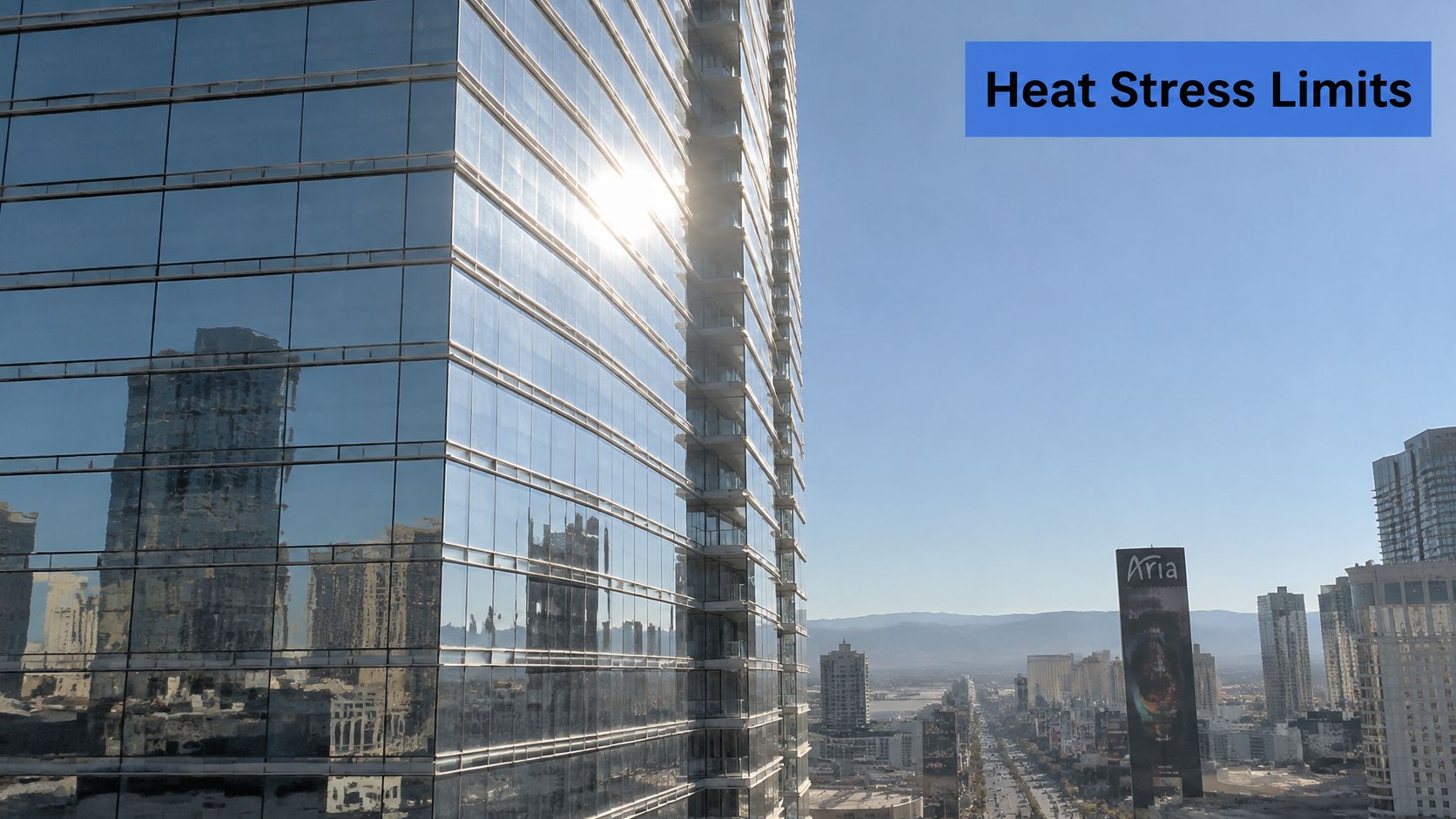
Thermal stress starts with surface temperature, not air temperature. South and west facing facades on Las Vegas towers run far hotter than the surrounding air through the summer months, the kind of sustained solar loading that ABE Designs' Nevada building-envelope practice accounts for in desert construction. That daily heat cycle forces curtain-wall frames, perimeter sealants, rubber gaskets, and insulated-glass units to expand and contract repeatedly while blowing dust and hard-water minerals bake directly onto exterior panes.
Cold rinse water on sun-baked glass is more than a streaking headache. The solution can flash dry in seconds, and rapid localized cooling can trigger thermal shock in panes that already carry edge stress, micro-chips, or frame pressure, turning an invisible flaw into a full-pane fracture. Crews counter this by working shaded elevations first, scheduling summer drops in the cooler early-morning hours, using temperature-compatible cleaning solutions, and checking surface temperature before wetting stressed glass.
Glazing rules shape the cleaning bucket as much as the thermometer does. The City of Las Vegas Title 19 Development Standards restrict how reflective tower glass can be, to keep reflected light and solar heat off neighboring buildings, streets, and sidewalks. To stay within those limits while keeping interior cooling loads manageable, architects rely on specialized reflective and low-emissivity (low-E) coatings built into the glazing system.
Those coatings change the care plan entirely. Abrasive scrub pads, aggressive razor scraping, or incompatible solvents can scratch or chemically cloud a coating even when the glass underneath stays sound. Because coating wear alters visible reflectance and solar performance across large elevations, bad technique produces uneven patches and localized glare that an owner cannot unsee from across the street. Before any crew loads the rigging, the specifications should confirm glass type, coating orientation (a sealed interior face versus an exposed exterior one), the manufacturer's approved chemical range, and allowable hand tools.
| Condition | Why it matters | Adjustment before cleaning |
|---|---|---|
| Sun-exposed glass at peak summer temperature | Thermal stress and fast drying | Work in cooler hours and avoid cold water on hot glass |
| Reflectivity-limited or coated glazing | Coatings can be damaged by abrasives or solvents | Confirm coating type and approved chemicals first |
| Damaged or stressed panes | Risk of thermal shock | Inspect glass and flag cracks before cleaning |
| Wind and wind-driven rain | Pushes platforms and rinse water off line | Postpone drops during gusty periods |
| Negative roof uplift and building movement | Stresses seals and waterproofing | Inspect anchors, tiebacks, and gaskets after storms |
Weather risk on tall desert buildings does not stop at summer heat. Wind-driven monsoon rain, negative roof uplift, and differential building movement put heavy mechanical loads on window seals, gaskets, and waterproofing interfaces. A sudden afternoon gust can swing a suspended platform against aluminum mullions or push rinse water sideways across a freshly finished elevation.
After severe wind or monsoon events, property managers should not send a crew back over the parapet on autopilot. Review the access plan, inspect roof anchors and parapet tiebacks, and walk the exterior glass for loosened gaskets or cracked panes before regular drops resume. A crack caught during a pre-drop check is a maintenance ticket; the same crack found after water reaches a resident's unit is a liability conversation.
For a closer look at how crews manage height, equipment, and exterior conditions on tall buildings, watch this short field overview.
A buyer touring a Las Vegas hi rise sees the lobby stone, the resort pool, and the view from the thirty-second floor. What the tour never shows is how the building maintains forty stories of exterior glass in the Mojave Desert, or what happens when a balcony rail collects two years of hard-water spots. Treating a condo purchase as purely an interior decision is one of the fastest ways to inherit special assessments and permanently hazy views, because exterior glass on a tower is an ownership cost and a safety obligation, not a cosmetic line item.
High-rise condominium sales totaled 604 in 2024, down 18% from 736 sales in 2023, according to Applied Analysis as reported by the Las Vegas Review-Journal. A cooler market works in a buyer's favor. Without weekend bidding wars, there is time to read the reserve study, check for deferred facade maintenance, and verify vendor access policies instead of assuming a polished valet stand means the building envelope is well managed.
Most homes in Las Vegas benefit from window cleaning every three to six months because desert dust, monsoon storms, and sprinkler hard water build up quickly. Towers follow the same physics on a larger scale. Skipping exterior cycles to trim an annual HOA budget does not save money for long: baked-on mineral deposits and neglected gaskets eventually demand restoration work that pushes high-rise window cleaning cost well beyond routine maintenance pricing.
Before signing a purchase contract or approving a new annual HOA budget, walk through these five questions in order.
Due-diligence takeaway: Look past the lobby marble and ask for the last two years of exterior glass invoices and reserve line items. A tower's window-cleaning schedule tells you a great deal about how disciplined its board is with envelope upkeep.
Before any owner or board signs a service contract, pull the building's written policies governing suspended platforms, aerial lifts, and rope access. Those internal rules determine which vendors are even allowed on site. If a building bans rope access off the roof parapet, any contractor quoting rope work is disqualified on day one. If the HOA mandates specific insurance endorsements, roof-protection mats, and weekday-only drop hours, bid comparisons only make sense when every vendor prices the exact same constraints.
Ask the property manager for the access policy in writing before collecting quotes. A vendor who has already worked the building will know its anchor layout, permitted drop zones, and staging hours, and that familiarity usually shows up as a tighter, more accurate bid.
Once you know your building's access constraints and understand the trade-offs between squeegee and pure-water work, the next step is turning that information into an accurate site walk and written safety plan. Professional Window Cleaning was founded in 1999 and has served residential, commercial, and high-rise customers for more than 26 years across Arizona, Colorado, and Nevada. We offer high-rise window cleaning for towers, hotels, and casinos, and property managers or owners in Las Vegas can call us directly at (702) 800-4994. If your building's city isn't listed on our service area pages, call the nearest office to confirm coverage for residential, commercial, and high-rise projects.
Walking into that initial conversation prepared saves days of back-and-forth emails and keeps estimates grounded in your tower's actual architecture rather than rough guesses.
Keep the end goal clear on that first phone call: you're working toward a site walk that produces a written access and safety plan, not a rough verbal promise over the phone.
Protecting a tower's glass in desert heat starts with matching the right access system, cleaning method, and documented safety protocol to your building's exact facade. Whether you manage a resort hotel, oversee a condominium association, or need scheduled exterior glass care for a multi-story commercial property, we bring over 26 years of residential, commercial, and high-rise experience to every drop. Visit Professional Window Cleaning to schedule an estimate and put a written high-rise access and safety plan in place for your building.
Read our blog posts regularly and keep learning.