Care and Maintenance
Medium Bristle Brush Guide for Window Cleaning
Discover why a medium bristle brush is the ultimate tool for window cleaning. Learn about materials, pure-water systems, and expert selection tips.


A realistic 2026 high-rise window cleaning cost runs from a few thousand dollars for mid-rise work to $10,000 to $50,000+ per cleaning for taller or access-heavy towers, using one of the two professional methods, a squeegee or a pure-water system. The final price depends on how the crew reaches the glass, how much glass there is, its condition, and how often the building needs service.
A property manager can discover that quickly by placing two quotes side by side. One proposal may show a single project total, while another lists panes, mobilization, rope access, safety planning, and equipment as separate line items. Both can be legitimate, but only one may describe the complete scope clearly.
High-rise work isn't priced like storefront cleaning. A crew isn't charging only for soap, water, and labor at the glass. The estimate also covers access systems, trained technicians, roof setup, fall protection, weather delays, public-area controls, and the time required to move safely across the facade.
A Phoenix manager may receive a low-thousands proposal for a repetitive mid-rise facade, while a Denver tower with exposed elevations and difficult roof access can move into five-figure territory. A Las Vegas building with similar glass area may price differently if balconies, setbacks, or public walkways slow the crew. The building's location matters, but the quote is built from physical conditions, not a city average.
A commercial pricing guide lists standard commercial cleaning at about $40 to $60 per hour, compared with roughly $170 per hour for high-rise work. It also places high-rise or specialty windows at $15 to $40 per window, versus $2 to $8 per pane for low-rise commercial glass. Whole-building high-rise jobs commonly reach $1,000 to $5,000+ per cleaning. (commercial window cleaning pricing guidance)
Use those figures to set a starting range, not to approve a bid. Height increases exposure, setup time, and safety planning. Glass count increases production time. Access conditions determine how much labor and equipment the crew needs. A tower with certified roof anchors and a repetitive facade may cost less than a shorter building surrounded by landscaping, balconies, and active walkways.
Practical rule: A quote that gives you a total without explaining the access method isn't complete enough to compare.
One pricing calculator models a 5% exterior premium for every 10 floors, plus a 10% surcharge above the 20th floor. Under that model, a 36-story building reaches $12,967 per cleaning and $38,901 annually, while a 90-story building reaches $31,381 per cleaning and $94,143 annually. (high-rise pricing calculator)
Those totals show how height can change the dollar impact. They do not account for every site condition, including wind exposure, facade shape, glass condition, or installed equipment.
For replacement planning, see how much do new windows cost in Boise. Replacement budgeting covers construction, while recurring cleaning covers facade maintenance.
Professional high-rise cleaning has two main cleaning methods:
The access system is separate from the cleaning method. A technician may use a squeegee while working from rope access, a suspended platform, or a building-mounted unit. A pure-water system may be used from a lower elevation with a telescopic pole, or in suitable areas as part of a larger access plan.
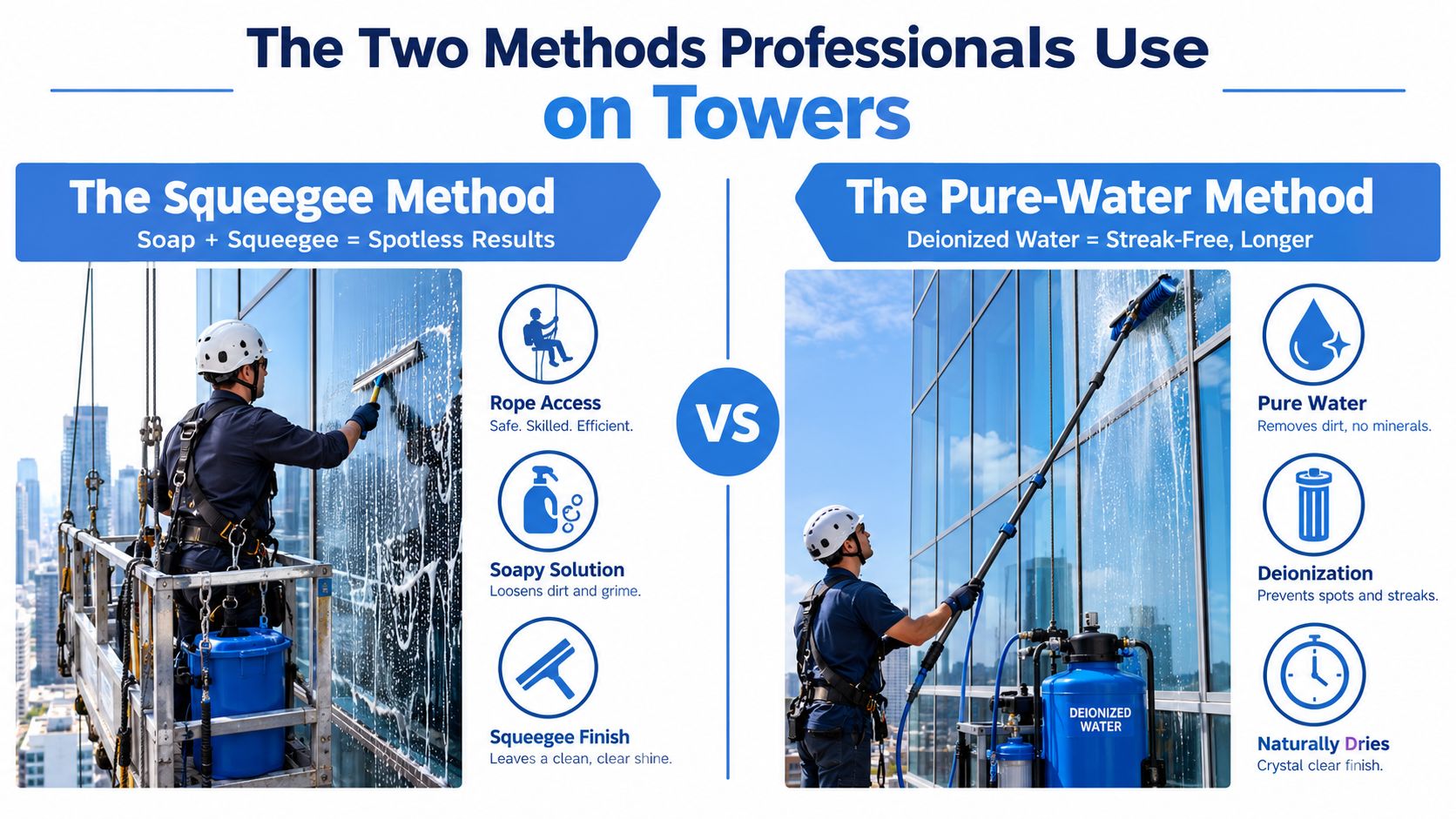
Squeegee cleaning gives the technician direct control over the glass. The worker wets the pane, loosens soil, pulls the squeegee across the surface, and details the edges. It works well when the glass has mineral deposits, construction residue, heavy grime, or edge buildup that needs physical agitation and inspection.
The method can be performed from a rope-access position, a swing stage, or a building maintenance unit. Rope access often keeps equipment relatively light when the facade and anchor arrangement are suitable. Suspended platforms can provide a stable work area for broad elevations, but mobilization, rigging, and platform operation add cost.
Pure-water systems remove minerals from the water before delivery. The technician uses a brush to loosen surface soil, then allows the purified water to dry on the glass without the spotting associated with ordinary water.
Pure water can be efficient on accessible elevations and routine maintenance glass. It isn't a substitute for every restoration task. Heavy mineral deposits, paint, adhesive, and neglected buildup may require more direct squeegee work or a separate restoration process.
Rope-access systems use two independent lines, a working line and a separate safety line anchored at the roofline. That redundancy is a defining safety feature of the system, as described in guidance on professional window cleaning methods. The rope system gets the technician to the glass. The squeegee or pure-water system determines how the glass is cleaned once the technician arrives.
A contractor's proposal should identify both parts. “Rope access cleaning” describes the route, not whether the crew will use a squeegee, pure water, or both. The same distinction applies to a building-mounted platform.
For a practical explanation of the planning and execution involved, see this guide to high-rise window washing. It helps property teams recognize whether a quote describes a genuine access plan or names a piece of equipment.
The method choice affects production speed and price. Pure-water work can be efficient on suitable lower elevations, while rope access lets crews reach taller sections without positioning large ground equipment. Suspended platforms may be the right answer for certain facades, but the platform, rigging, setup, and operating constraints become part of the budget.
A tower can look straightforward from the street and still produce a complicated bid. On an actual estimate, the price starts with how the crew will reach each elevation, then accounts for glass quantity, production time, safety controls, and the number of visits required. Two buildings with similar floor counts can carry very different totals if one has clear roof access and the other has setbacks, balconies, or public areas below.
Height affects rope length, descent planning, wind exposure, fall protection, and the number of times technicians must reposition. It also determines how long lifts, platforms, barricades, and other equipment remain on site. A pricing model may apply premiums as elevation increases, but those percentages are reference points, not universal contractor rates. The estimator still has to confirm usable anchors, roof layout, facade interruptions, and weather exposure.
More glass generally means more labor, but pane count by itself does not establish the price. Large uninterrupted panes can be faster to clean than small divided lights. Repetitive elevations are easier to sequence than facades interrupted by balconies, fins, deep reveals, or architectural screens. The scope should also state whether crews will clean frames, sills, tracks, screens, doors, and interior glass.
Published commercial benchmarks place rope-access work around $3 to $8 per square foot, high-rise work at about $8 to $15 per pane, and suspended-platform work around $10 to $25 per pane. (commercial high-rise washing benchmarks) These figures are not interchangeable. A per-pane rate that excludes mobilization, difficult access, or stain removal cannot be compared directly with an all-in project price.
Courtyards, landscaping, parking patterns, setbacks, overhangs, sloped ground, and busy sidewalks can prevent a simple descent or lift placement. The crew may need barricades, pedestrian control, escorts, special staging, or a different cleaning method for individual elevations.
A shorter building with poor access can cost more than a taller building with a clear roofline and usable anchors. Before setting the final number, the estimator should document the roof, ground staging areas, facade interruptions, loading routes, and public exposure. Those details show where labor hours and equipment costs enter the quote.
Rope access and suspended systems require specialized equipment, trained technicians, written procedures, insurance, and rescue planning. Weather conditions, crew size, labor hours, lift or scaffold requirements, and hard-water buildup can also raise the total. (high-rise safety and pricing factors)
Ask the contractor to identify those items in the proposal. A low number may leave access preparation, equipment, rescue coverage, or compliance work outside the stated scope.
A recurring contract can reduce repeated mobilization and keep the glass closer to routine-maintenance condition. Industry outlook material describes increased interest in recurring maintenance contracts and bundled facility services, along with rope access, pure water, and early-stage robotic cleaning. (window cleaning services outlook)
Compare more than the cost of one visit. Review annual cost, disruption to occupants, equipment setup, risk exposure, and whether delayed cleaning could require restoration before routine service resumes.
Arizona dust and mineral deposits may increase cleaning effort. Colorado weather can affect scheduling and access planning. A Nevada hospitality property may require tighter coordination around guests, deliveries, and pedestrian traffic. The quote should show those conditions through its production plan and scope, rather than hiding them in an unexplained percentage.
A tower's location sets the operating conditions, but the building itself sets most of the price. The examples below show how height, access method, glass quantity, surface condition, and scheduling can move a quote. They are sample benchmarks, not bids for a specific property. Published guidance places many whole-building high-rise jobs between $1,000 and $5,000+, with access-heavy contracts reaching five-figure totals. (high-rise cost factors and ranges)
| City | Sample building | Main cost assumptions | Approx. cost per cleaning | Annual planning benchmark |
|---|---|---|---|---|
| Phoenix | 12-story office tower | Pure-water poles on reachable elevations, squeegee work for mineral deposits, moderate roof access | $1,000-$2,000 | Budget one comparable service visit, then add restoration or extra access work if required |
| Denver | 20-story mixed-use building | Rope access or suspended equipment, weather contingency, resident and retail coordination | $2,000-$5,000+ | Carry a higher allowance for rescheduling, rigging, and restricted work windows |
| Las Vegas | Resort property | Squeegee and pure water by elevation, guest-area controls, staged work around events and deliveries | $2,000-$5,000+ | Price the planned service cycle by building zone, with separate allowances for traffic controls |
These figures help an owner compare the shape of a quote. A larger glass count raises production hours, while difficult access raises setup and safety costs even when the number of panes is modest. Use published average window cleaning rates for ordinary commercial context only. Low-rise pricing should not be applied directly to a tower.
A Phoenix estimate starts with dust, sprinkler overspray, mineral spotting, roof access, and the amount of glass exposed to open staging areas. Pure water can handle routine soil efficiently where poles or another access system can reach. Hard-water buildup may require hand work, treatment, and slower inspection.
The first service often costs more than later maintenance because the contractor must determine whether the glass needs restoration. Ask for hard-water treatment as a separate line item. That makes the recurring cleaning rate easier to evaluate and prevents a low per-pane figure from concealing corrective work.
Denver bids must account for wind, freeze-thaw conditions, weather delays, and building operations. A mixed-use property may require separate coordination with residents, retail tenants, loading areas, and property management. Rope access can reduce some equipment needs, but anchor checks, technician qualifications, rescue planning, and weather limits affect the production plan.
Compare the access route and contingency terms, not just the labor rate. A quote that includes a realistic rescheduling process may cost more upfront while avoiding an incomplete elevation or an unexpected return-visit charge.
A Las Vegas resort adds operational controls to the cleaning plan. Guest traffic, event schedules, public walkways, delivery zones, reflective or coated glass, and staging restrictions can slow production even when the facade looks straightforward.
Request the method and work sequence by elevation or building zone. One side may suit a suspended platform, while another needs rope access or a different shift. The final price should show those differences and identify pedestrian controls rather than averaging them into an unexplained total.
A proper quote starts before anyone cleans a pane. The estimator walks the property, counts or samples the glass, notes frame and sill conditions, checks the roof and ground staging areas, and photographs obstacles that could alter access.
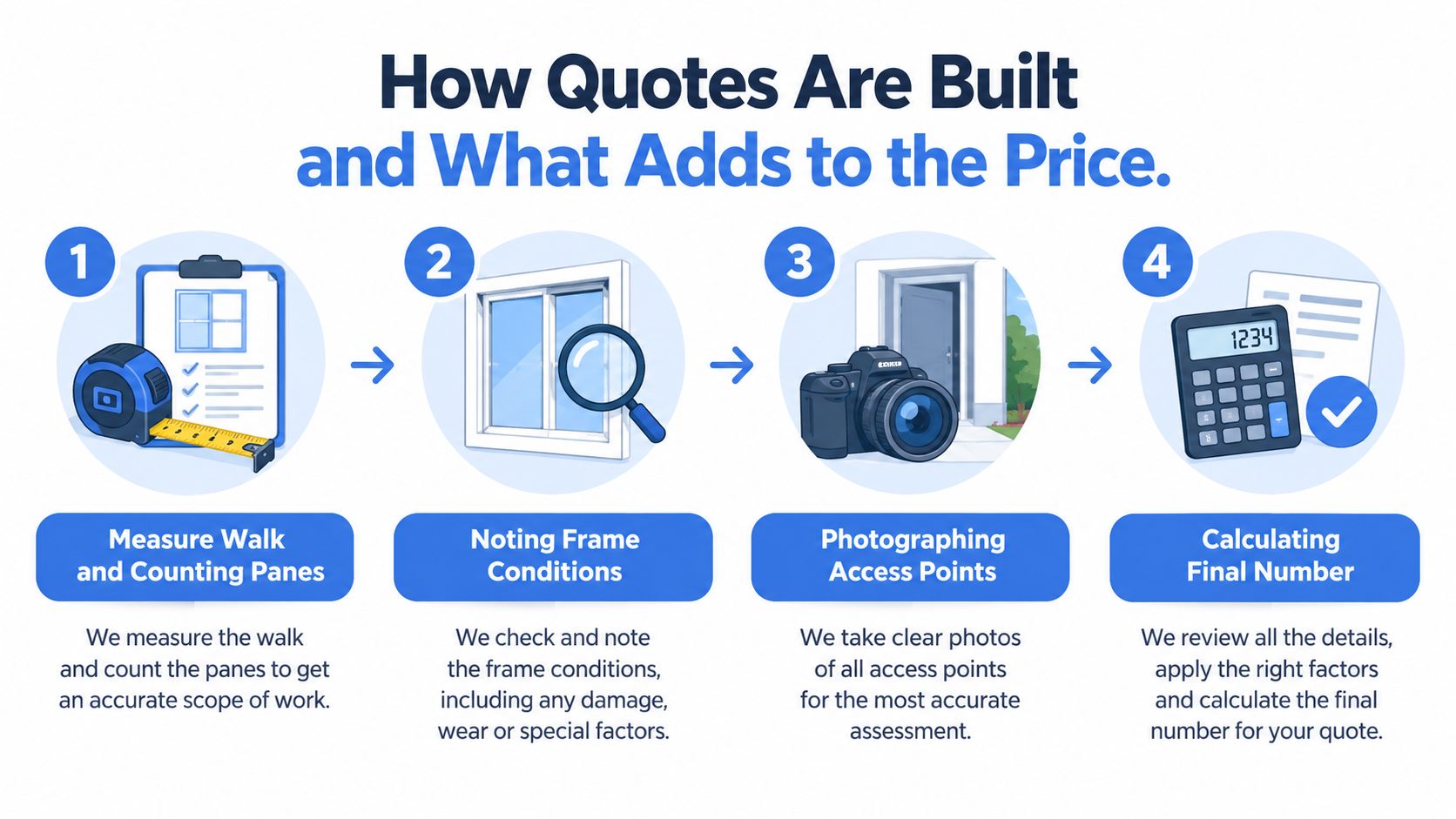
The contractor then converts the site information into labor hours, crew requirements, access equipment, and mobilization. A rope-access project may require roof setup and anchor checks. A suspended platform may require delivery, rigging, operation, and removal. A lower elevation may be assigned to pure-water poles while upper sections receive squeegee cleaning.
The proposal should state whether the number covers exterior glass only or includes interior work. It should also identify frames, sills, tracks, screens, doors, skylights, atriums, and difficult architectural glass.
Some services are best priced per window because the labor follows each unit. Others make more sense as a flat project charge because they involve setup, treatment, or equipment.
Glass condition and architecture are major pricing inputs because mineral deposits, paint, pollen, dust, curved panes, coatings, balconies, and recessed sections slow the work. (high-rise building conditions and access constraints)
“What condition or access issue could change this price after work begins?” Ask the estimator to answer that in writing.
Scope creep usually starts with an unclear phrase such as “complete window cleaning.” If the owner expects frames, screens, interior glass, and hard-water removal but the contractor priced exterior glass only, the first invoice becomes a dispute. A line-item proposal prevents that problem.
The safest savings come from removing wasted setup and uncertainty, not from asking a crew to work faster at height. A property manager can often improve the economics by making the building easier to service repeatedly.
A multi-year agreement can support a locked rate when the scope, access, and service schedule remain stable. It also gives the contractor a reason to plan crews and equipment instead of rebuilding the estimate for every visit.
Bundle compatible work during the same mobilization. Exterior and interior glass may be scheduled together when tenant access allows it. Screens, frames, and tracks can also be handled while the crew is already positioned, provided the proposal defines the added labor.
Coordinate tenant notices, loading zones, parking restrictions, escorts, and guest traffic before the crew arrives. A technician waiting for access is still consuming scheduled labor, and a missed elevation can trigger another mobilization.
Schedule maintenance around known dust, pollen, or weather conditions where practical. The goal isn't to promise a perfect day. It's to avoid sending a crew into conditions that stop production or leave the building needing an immediate return visit.
Scottsdale, Tempe, Chandler, and Gilbert property managers should also document irrigation overspray, planting bed staging areas, and restricted parking before requesting bids. Those details help the estimator assign the right method instead of discovering the problem after equipment arrives.
A one-time quote can look attractive because it postpones recurring coordination and maintenance decisions. Compare what the building spends across its expected service period, including mobilization, equipment, restoration, disruption, and the risk of a return visit.
Negotiate a predictable unit structure when the glass and access are repetitive. A per-window or per-elevation rate can help with budgeting, but only if the proposal clearly lists exclusions and conditions that trigger a change order.
The cheapest bid isn't necessarily the economical bid. If it omits insurance, trained access technicians, rescue planning, or fall protection, the apparent savings disappear when the owner has to correct the missing work or respond to a claim.
The two variables that deserve the most attention are height and access method. Glass count determines a large portion of the labor, but the access plan determines whether that labor can happen efficiently and safely.
A mid-rise property may remain in the low-thousands range when elevations are straightforward and the scope is routine. Taller towers that require rope access, suspended platforms, or extensive staging commonly move into five-figure territory, particularly when the facade has setbacks, difficult roof access, heavy mineral buildup, or strict operating restrictions.
Frequency should be evaluated alongside the per-cleaning number. A recurring plan can make mobilization and scheduling more predictable, while one-off work may carry the full burden of setup and a first-clean condition that requires extra attention.
Before requesting proposals, assemble:
Send the same information to two or three bonded contractors and request written site-visit proposals. Comparing identical scope is more useful than collecting several headline totals.
Verify the insurance information, access training, rescue plan, anchor documentation, weather policy, and responsibility for permits or pedestrian controls. The proposal should specify the method for each elevation, identify what is included, and separate optional work such as screens, tracks, interior glass, and hard-water treatment.
A clear high rise window cleaning cost estimate doesn't need to predict every condition from a distance. It needs to show how the contractor reached the number and what would cause it to change.
Professional Window Cleaning has been cleaning windows for over 26 years! The company provides residential, commercial, and high-rise window cleaning with estimates based on building height, access, glass condition, and service scope. Visit Professional Window Cleaning to request a consultation for your building and receive a proposal that explains the method and total cost.
Read our blog posts regularly and keep learning.