Care and Maintenance
Best Commercial Glass Cleaner: How to Choose
Compare the best commercial glass cleaner options, from ammonia formulas to pure-water systems. Find the right cleaning method for your building type.


It’s a frustrating cycle, isn't it? Your windows get hit by the sprinklers or a passing rain shower, and once the water dries, you're left with a mess of milky, white spots. If you want to clean water stained windows for good, you have to go after the mineral deposits left behind. Your typical spray cleaner just won't cut it.
The secret is using the right techniques—the ones pros rely on—that specifically dissolve those stubborn mineral residues without harming the glass. Professional Window Cleaning has been cleaning windows for over 26 years, and we know exactly how to get that perfect shine in cities like Phoenix, Denver, and Las Vegas.
Ever wonder why water from your sprinklers or a rainstorm leaves such a stubborn, hazy film on your glass? The problem isn't the water itself, but what's dissolved in it. This is a huge issue for homeowners in areas with hard water, something our clients in Phoenix, AZ know all too well.
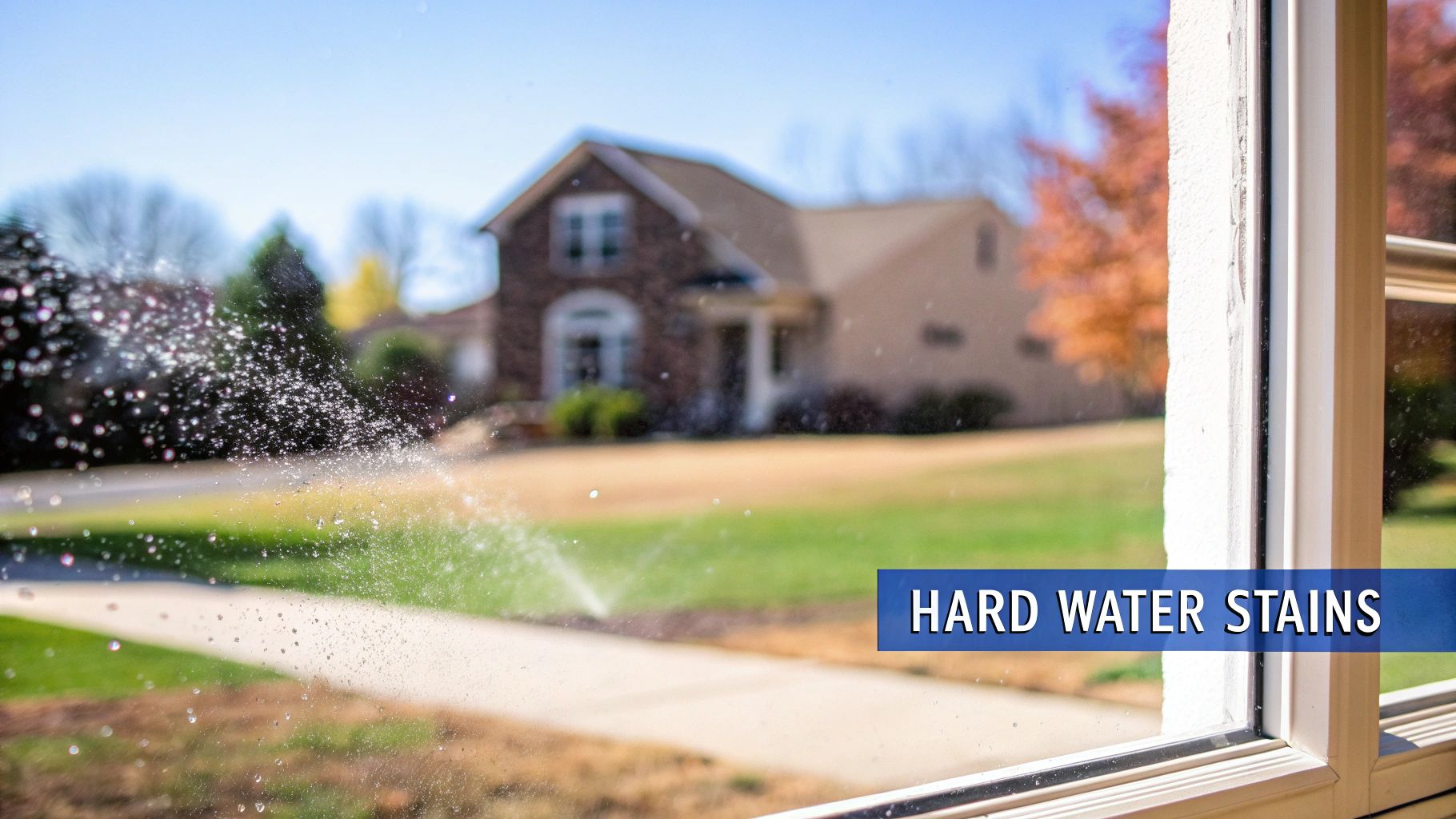
When a water droplet evaporates from your window, it leaves behind everything it was carrying. In many places, that means high concentrations of minerals like calcium and magnesium. Over time, these minerals build up and actually bond with the glass, creating those cloudy spots we call hard water stains.
If you've already tried to tackle these spots with a standard glass cleaner, you were probably pretty disappointed with the results. That's because most household cleaners are designed to break down organic stuff like dirt, grime, and fingerprints—not mineral deposits. They just don’t have the right chemistry to break the bond between the minerals and your glass.
This widespread frustration has fueled major growth in our industry. In fact, the contract window cleaning market generated an incredible USD 93.2 billion in revenue, driven partly by the need for solutions to stubborn hard water and pollution stains. It makes sense, as homeowners report up to 30% better curb appeal after a professional cleaning, which can directly lift property value. You can find more details on these market trends and their impact on professional services.
To give you a better idea of what you're up against, here’s a quick breakdown of different stains and how effective various cleaning methods are.
As you can see, the longer a stain sits, the tougher it is to remove with household products, which is why professional services are in high demand in cities like Scottsdale and Denver.
At Professional Window Cleaning, we know that mineral buildup requires a specific game plan. When it comes to professional window cleaning, there are ONLY two methods the pros use for guaranteed results:
Understanding the cause of the stain is the first step toward removing it. Mineral deposits require a different strategy than simple dirt, which is why professional methods are far more effective than off-the-shelf sprays.
By recognizing that you're fighting minerals, not just dirt, you can stop wasting time with methods that don't work. In the next sections, we'll walk you through some DIY techniques that can handle light staining and explain when it's time to call in the experts.
Before you start researching heavy-duty chemicals, take a breath. For many homeowners, the solution to clean water stained windows is already sitting in the pantry. Light mineral spots, especially those from recent sprinkler overspray or a single rainstorm, often don't need an aggressive approach. Simple, acidic household solutions can usually do the trick.
The key is using a mild acid to break down the alkaline mineral deposits—like calcium and magnesium—that have bonded to your glass. This approach is gentle, inexpensive, and surprisingly effective for fresh stains. It’s always the best place to start. For over 26 years, Professional Window Cleaning has seen this method work for minor cases across Phoenix and Las Vegas.
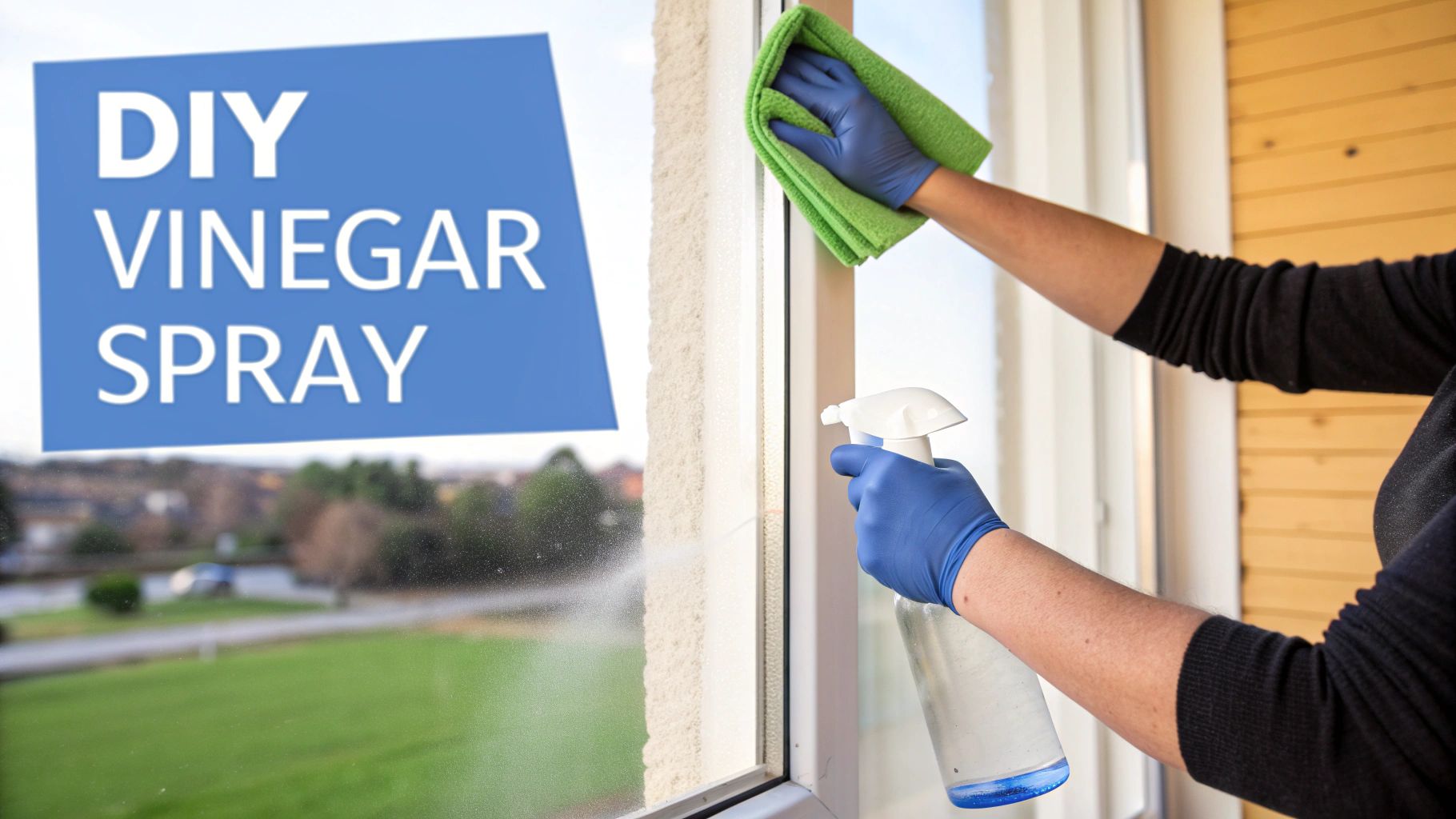
Distilled white vinegar is the go-to DIY weapon against hard water buildup. Its acetic acid is just strong enough to dissolve the minerals without posing a risk to the glass itself. Getting the mixture right is simple, but it's the key to making this work.
Here's the ratio we recommend for an effective cleaning spray:
Spray the solution generously over the stained area, making sure the spots are fully saturated. Let it sit for about 10-15 minutes. This dwell time is non-negotiable—it gives the acid time to work on breaking down those stubborn mineral bonds. After it soaks, gently scrub the area with a non-abrasive microfiber cloth.
Pro Tip: For a completely streak-free finish, use one microfiber cloth for cleaning and a separate, dry one for polishing the glass afterward. This two-cloth method prevents you from simply spreading the loosened minerals around.
If the smell of vinegar isn't for you, fresh lemon juice offers a similar acidic punch. The citric acid in lemon juice works the same way, dissolving mineral deposits with ease. You can apply it directly to the glass, let it sit for about ten minutes, and then wipe it away. This is a great natural approach for smaller, targeted areas.
Whether you're in a desert climate like Scottsdale, AZ, where sprinkler overspray is a daily battle, or just dealing with the aftermath of a rainstorm, these simple solutions can restore clarity to your windows.
When tackling light stains, it's easy to get impatient and reach for something more aggressive. This is where costly mistakes happen. Never use abrasive scouring pads, harsh brushes, or steel wool without a proper lubricant and technique. Dry scrubbing with these materials will almost certainly cause permanent, ugly scratches on your glass.
The goal is to dissolve the minerals, not physically scrape them off by force. Mild acidic solutions and gentle cloths are your best friends here. If the stains aren't budging, it's a sign that you might need a more advanced solution or a professional touch. At Professional Window Cleaning, we’ve seen countless windows damaged by well-intentioned but improper DIY methods over our 26 years in business. Stick to the basics first—it often works wonders.
So, you’ve tried the vinegar sprays and elbow grease, but those cloudy, baked-on mineral deposits just won’t budge. This is a common story, and it’s a clear sign that you need to move beyond basic DIY solutions. When stains have had a long time to bond with the glass, it’s time to bring out the heavy hitters: commercial-grade products and techniques designed to clean water stained windows that have seen it all.
For these tough jobs, you’ll need a specialized hard water stain remover. These aren’t your everyday glass cleaners. They are carefully formulated with mild acids or ultra-fine abrasives designed to break down the stubborn calcium and magnesium deposits clinging to your glass. When you use them, always read the manufacturer's directions to a T—you want to avoid accidentally damaging your window frames or rubber seals. In cities like Denver, where water chemistry can be a challenge, using the right product is essential.
Here’s a method straight from the pros, but it comes with a big warning: using ultra-fine #0000 steel wool. We sometimes turn to this technique for the most severe, caked-on stains, but it demands absolute precision. You can't just grab a pad and start scrubbing. The steel wool must be lubricated with a quality cleaning solution or mineral deposit remover.
Never, ever use it dry. You’ll scratch the glass, guaranteed.
The process involves applying gentle, even pressure and working in small, circular motions directly over the stain. It’s the combination of the fine abrasive action and the chemical lubricant that works together to lift the mineral buildup without etching the glass itself.
This method is incredibly effective, but it’s also unforgiving. One wrong move—too much pressure, not enough lubricant—can cause permanent scratches. You could quickly turn a cleaning project into a costly window replacement. It’s a perfect example of why some jobs are best left to those with years of experience.
While these advanced methods can deliver incredible results, the risks are real. There's a reason the market for effective glass cleaners is booming—valued at USD 3.8 billion, it’s projected to hit USD 7.4 billion by 2035. More and more, property owners are realizing that improper cleaning techniques lead to expensive damage, especially in dry climates like Arizona and Nevada where hard water is a constant battle. In the commercial world, flawless glass isn't just about looks; it has been shown to boost customer trust by 20%. You can learn more about the expanding glass cleaner market and why professional care is becoming essential.
When you’re dealing with large panes of glass, expensive custom windows, or commercial properties like those in Denver, CO, the stakes are just too high for guesswork. You can dive deeper into finding the right cleaner for hard water stains in our detailed guide. At Professional Window Cleaning, we bring over 26 years of hands-on expertise to safely restore your glass, giving you a perfect finish without the risk.
When you see a truly immaculate, crystal-clear window, you're not just seeing clean glass—you're seeing the result of professional technique. That flawless, streak-free finish that seems impossible to get on your own comes down to two things: the right tools and, even more importantly, the right water. For over 26 years, we at Professional Window Cleaning have perfected the ONLY two methods the pros trust.
It’s about more than just wiping away dirt; it's a science. The real goal is to remove 100% of the residue, from everyday grime to the stubborn mineral deposits that leave those frustrating cloudy spots. One method is a time-tested art, while the other is a modern technological marvel. This is true for our work in every city we service, from Phoenix to Las Vegas.
You might think a squeegee is a simple tool, but in the hands of a seasoned professional, it’s an instrument of precision. The traditional squeegee method is so much more than dragging a rubber blade across soapy glass. It's a practiced combination of the perfect cleaning solution, the right blade angle, and just the right amount of pressure.
Pros use specialized soaps that create the perfect amount of "slip," allowing the squeegee to glide smoothly while lifting away every speck of dirt and mineral residue. The technique involves overlapping strokes and a specific "fanning" motion that pulls all the dirty water away from the glass. Nothing is left behind to dry and cause streaks. It's an incredibly effective method that remains a cornerstone of professional window cleaning.
The biggest leap forward in modern window cleaning has to be the pure-water system. This technology is our ultimate weapon to clean water stained windows, especially on those hard-to-reach upper floors. The system works by forcing tap water through a multi-stage filtration process that usually involves reverse osmosis and deionization.
This process strips out 100% of the total dissolved solids (TDS)—we’re talking about minerals like calcium and magnesium that cause hard water spots. The resulting water is so pure that it's often described as "hungry."
When this purified water hits a window, it aggressively attracts and dissolves dirt, grime, and mineral deposits. Because the water contains zero solids of its own, we can just let it air dry for a completely spotless, streak-free finish. No squeegee required.
The demand for these advanced solutions is skyrocketing. Residential window cleaning is a booming industry, with the global market projected to hit USD 15.2 billion in 2025. Here in hard water regions like Las Vegas, NV, stains affect up to 70% of homes, making professional services an absolute necessity. These services don't just improve your view; they can increase natural light by 25-40%, boosting your mood and even your home's energy efficiency.
This infographic breaks down the core steps we use for advanced stain removal.
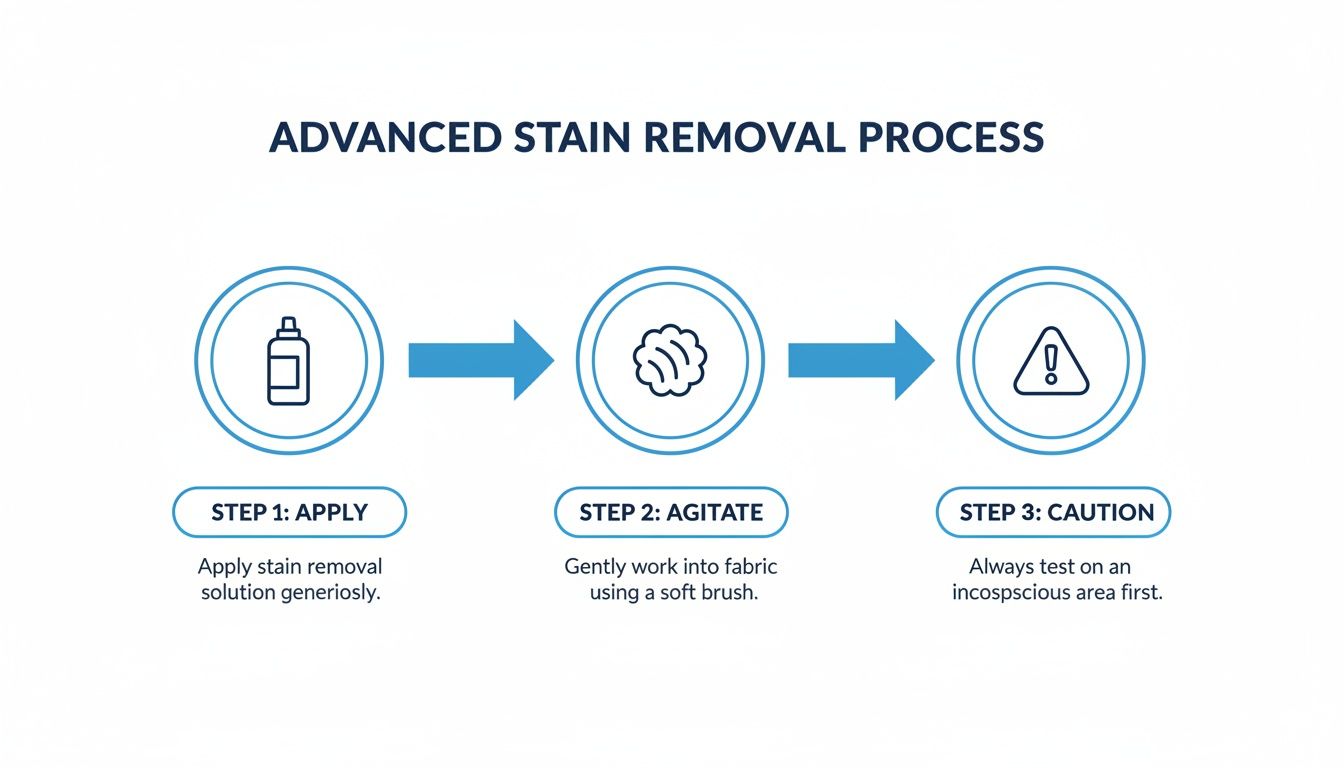
The process involves applying a specialized solution, agitating it to break down stubborn minerals, and always exercising caution to protect the glass. It’s a safe and effective treatment every time. If you’re curious about the nitty-gritty, you can learn more about how we use pure water window washing in our dedicated guide.
DIY cleaning is a great skill to have, but true wisdom is knowing your limits. When you're dealing with something as fragile as glass, pushing too far can lead to costly mistakes or, even worse, serious injury. Learning to spot the signs that it’s time to call in a professional will save you time, prevent damage, and give you results that DIY methods just can't match.
One of the biggest red flags is when your best efforts just aren't cutting it. If you’ve tried the solutions we’ve covered and the stains are still there, you’re probably up against old, baked-on mineral deposits that have started to etch the glass. Continuing to scrub aggressively at this stage is a huge gamble—you could permanently scratch the surface, turning a fixable problem into irreversible damage. For homeowners in Scottsdale or Denver, where sun can bake minerals on quickly, this is a common issue.
Beyond stubborn stains, the physical risks are a massive factor. Cleaning second-story windows, skylights, or tricky architectural glass without the proper safety equipment is incredibly dangerous. It’s just not worth it.
Professional window cleaners have the training, insurance, and specialized gear like industrial-grade ladders, harnesses, and water-fed poles to get the job done safely and efficiently. A fall is a risk you should never take.
The sheer scale of the project is another thing to consider. For a large home or a commercial property in a place like Las Vegas, NV, the time and energy a DIY job demands are enormous. What might take you an entire weekend, a professional team can often knock out in a few hours.
When you hire an expert, you’re not just paying for clean windows. You're investing in safety, efficiency, and a guaranteed flawless result that eliminates the risk of property damage and personal injury.
At Professional Window Cleaning, our 26 years of experience mean we can instantly identify the type of stain and pick the perfect method—whether it’s our traditional squeegee technique or a pure-water system—to clean water stained windows without causing any harm. We bring a level of precision and care to every job that only comes with decades of practice.
Here are the key indicators that it’s time to pick up the phone:
Ultimately, knowing when to step back is a crucial part of smart property maintenance. When you run into these challenges, calling a professional isn't giving up—it's the smartest, safest, and most effective decision you can make.
So, you’ve put in the work to get those windows sparkling clean again. The last thing you want is for those chalky, hazy water stains to come right back.
The truth is, the best way to deal with water stains is to stop them before they even start. Preventing mineral deposits from forming in the first place saves you so much time and effort down the road, and it’s the secret to keeping your glass looking professionally maintained all year. Whether you're in Las Vegas or Phoenix, prevention is key.
Believe it or not, one of the biggest culprits we see is sprinkler overspray. It sounds simple, but it’s amazing how often this is the root cause of stubborn stains. Take a few minutes to watch your irrigation system run. Are the sprinkler heads blasting your windows with hard water every morning?
A quick adjustment to aim them away from the house can make a world of difference, especially for those ground-floor windows that get hit the hardest.
Living in a place like Phoenix, AZ, you're probably no stranger to pools and outdoor misters. Windows near these high-splash zones need a little extra attention. A quick wipe-down with a dry microfiber cloth after the fun is over will stop water from evaporating and leaving those stubborn mineral rings behind.
Proactive prevention is all about minimizing contact. The less mineral-rich water that sits on your glass, the less cleaning you'll have to do. A few small adjustments can eliminate the problem at its source.
If you want a more robust, long-term solution, it’s time to look into hydrophobic glass sealants. These coatings are a game-changer for window maintenance. They create an invisible, super-slick barrier on the glass that water just can’t stick to.
Instead of spreading out and leaving minerals behind as it dries, water beads up and rolls right off. It actually takes the dirt and dissolved minerals along with it, which is a huge win. This technology is incredibly effective at preventing the buildup that leads to those tough, baked-on stains.
Here’s why we love using a good sealant:
By taking these preventative steps—redirecting sprinklers, doing quick wipe-downs, and applying a quality sealant—you’re building a strong defense against future water stains. With 26 years of experience under our belts at Professional Window Cleaning, we know that smart prevention is just as important as a powerful cleaning technique. These simple habits will help you maintain that flawless, crystal-clear look you love.
For a guaranteed spotless finish without the risk, trust the experts who have been serving communities in Arizona, Colorado, and Nevada for over two decades. Contact Professional Window Cleaning today for a free estimate and see the difference true expertise makes. Get Your Free Estimate Now!
Read our blog posts regularly and keep learning.