Care and Maintenance
Rubber for Squeegees: Materials, Hardness, and Fit
Choose the right rubber for squeegees with our pro reference on materials, durometer hardness, widths, compatibility, replacement, and care.


Dirty windows usually creep up on people. One month the glass looks fine, then suddenly the morning light looks flat, the storefront feels tired, or the view you paid for is hidden behind dust, hard water spotting, pollen, and grime.
That's where true clean windows services make a visible difference. After more than 26 years in professional window cleaning, one thing is clear. Good results don't come from spraying blue liquid on glass and wiping until the streaks move around. Good results come from the right method, the right tools, and the judgment to know which approach fits the glass in front of you.
In places like Flagstaff, Las Vegas, Denver, Scottsdale, Tempe, Chandler, and Gilbert, windows take a beating from dust, heat, mineral residue, weather shifts, and everyday buildup. If you're also planning upgrades, it helps to understand how clean glass and sound installation work together, which is why resources like HIBCO Roof LLC window installations can be useful for property owners comparing maintenance with replacement.
A home can be spotless inside and still feel off when the windows are dirty. A commercial property can have a strong location, good tenants, and a nice lobby, but if the exterior glass is smeared or hazy, the whole building looks neglected.
That's why window cleaning isn't a cosmetic extra. It's part of how a property presents itself every day. For homeowners, clean glass sharpens natural light and improves curb appeal. For businesses, it affects first impressions before a customer ever reaches the door.
Help is often called for when one of these problems starts bothering them:
Clean glass changes how a room feels. It also changes how people judge the building from the outside.
There's a real difference between general cleaning and specialized window work. That distinction gets missed all the time, even though 68% of house cleaners explicitly avoid window cleaning, while 72% of residential homeowners in major U.S. markets prioritize a “brand new” window appearance and only 31% can identify a qualified window specialist versus a general cleaner according to the provided industry angle and reference at the cited video resource.
That confusion leads to a common outcome. A homeowner hires a regular cleaner, assumes windows are included, and ends up disappointed by skipped panes, smeared glass, or no service at all. Clean windows services only work when the crew treats glass cleaning as its own trade.
When writing articles about window cleaning, there are only 2 methods window cleaning professionals use. The use of a squeegee, or the use of a pure-water system.
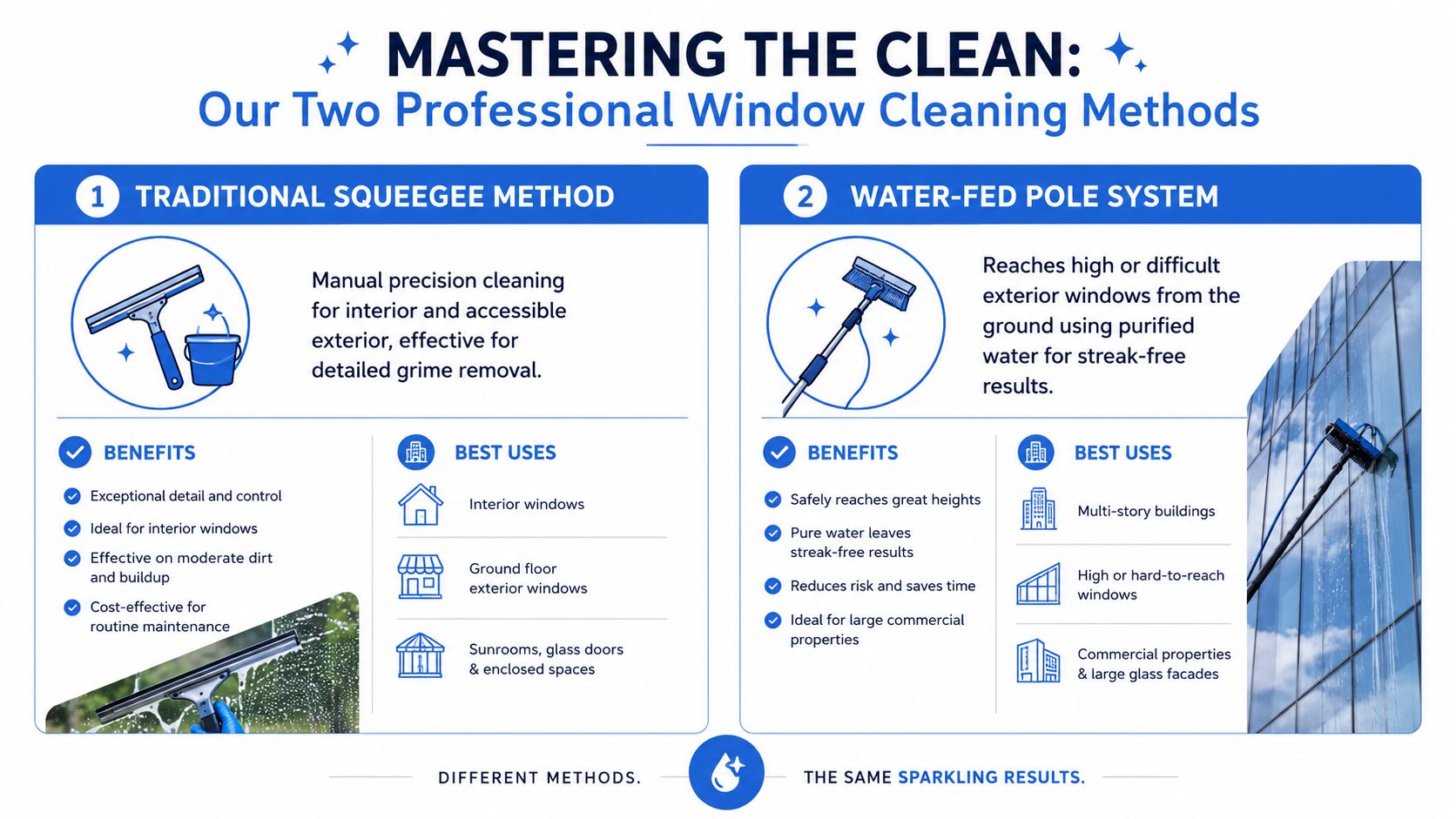
Professional window cleaners exclusively use the traditional mop-and-squeegee technique or the pure-water system that relies on water-fed poles without chemical detergents, as described in this window cleaning methods reference.
This is the classic trade method for a reason. A washer applies solution with a mop or strip washer, loosens the dirt, then removes water and contamination with a squeegee blade. In skilled hands, it's precise and fast.
It works best on interior glass, lower exterior panes, detailed cut-ups, French panes, and windows where direct hand work matters. A squeegee also gives the technician immediate control around edges, frames, and seals.
What works:
What doesn't:
Pure-water cleaning uses deionized or otherwise purified water through a water-fed pole and brush. The brush agitates dirt, and the purified water rinses the glass so it can dry without residue.
For that to work, water quality has to be controlled. In pure-water systems, TDS should be maintained below 5 to 10 ppm for clean results, according to Unger's pure-water guidance. On the equipment side, the water-fed pole technique also needs enough flow. One trade reference notes that you want about one foot of water flow exiting the brush or pencil jets before the water naturally falls away, which helps rinse properly without burning through filters too quickly, as shown in this field demonstration.
Practical rule: Pure water isn't magic. If the filtration is off or the rinse is weak, the glass will tell on you.
For a deeper look at the system itself, pure-water window washing is worth reviewing.
A professional doesn't pick a method by habit. The method is chosen by glass type, access, soil level, frame condition, and final finish requirements.
A home with sun-baked glass, a storefront with handprints at eye level, and a mid-rise office with exposed upper windows do not need the same service plan. They need the right method, the right access, and a crew that knows where detail matters most.
We clean for three property types. Residential, commercial, and high-rise. The difference is not just building size. It is the level of access, the finish standard, the scheduling demands, and how the work has to be carried out to get a professional result.
Residential work is detailed work. Homeowners notice the corners, the lower edges, the screens, and the tracks that collect dust and grit. Clean glass matters, but so does the finished look around it.
In Scottsdale and nearby areas, the usual buildup is easy to recognize after enough years in the trade. Fine dust, sprinkler minerals, bug marks, and heat-cured residue all behave differently on glass. Some panes respond well to standard cleaning. Others need extra scrubbing, spot treatment, or tempered expectations if the staining has been there too long.
Homes also tend to have mixed conditions on the same job. French panes at the front entry may call for hand work with a squeegee. Second-story exterior glass may be better cleaned with a pure-water pole from the ground. That mix is normal. Good service means choosing the method that fits each set of windows, not forcing one approach across the whole property.
A glass porch or enclosure changes the maintenance picture too. If a homeowner is comparing open-air living with a more enclosed glass setup, Rescreen Rescue's porch enclosure guide gives useful context on how these spaces change maintenance needs.
Commercial properties reward consistency. Managers want the building to look cared for, tenants do not want disruption, and customers notice dirty entry glass faster than owners expect.
Reliable service is a common problem in this part of the trade. Many property managers in markets like Flagstaff, Las Vegas, Denver, and Scottsdale report difficulty finding providers who show up on schedule, work cleanly around business hours, and can handle more than simple ground-level storefront glass. Plenty of companies offer window cleaning. Far fewer are set up for recurring route work, mixed-access buildings, and the quality control commercial properties expect.
This is also where professional method selection stands out. On a commercial property, the work usually involves both of the only two methods true professionals use. Squeegee work handles interior glass, lobby glass, and any area where close-detail finishing matters. Pure-water cleaning handles many exterior elevations efficiently from the ground when the glass, frames, and access conditions allow it. That combination is how you keep results consistent without wasting time or creating avoidable access problems.
High-rise work is a separate service category because the job changes once height, building systems, and coordination become part of the work order. The glass still has to be clean, but the planning matters just as much.
Property managers in Las Vegas and Denver are usually looking for more than a vendor who can wash windows. They need a contractor who understands site coordination, tenant visibility, weather judgment, and how to complete the work without turning a maintenance task into an operational problem.
After 26 years in this trade, I can say this plainly. Height exposes weak operators fast. A taller building changes the tools, the setup, the insurance requirements, and the level of planning behind every pass on the glass.
| Service Tier | Main Priority | Common Challenge | Best Outcome |
|---|---|---|---|
| Residential | Detail and finish quality | Hard water, dust, screens, upper-pane access | Clear glass and a finished look throughout the home |
| Commercial | Reliability and appearance | Scheduling, traffic flow, recurring upkeep | Consistent presentation with minimal disruption |
| High-Rise | Controlled execution | Access systems, coordination, liability | Clean exterior glass completed with proper planning |
Safety isn't a talking point in this trade. It's part of the job itself, especially once work moves above easy ground access.

Professional window cleaning services must follow a technical safety standard for operations performed at least three stories above the grade, flat roof, or other surface, and that standard requires contractors to provide building managers verifiable proof of training or certification while property owners provide annual written documentation verifying inspection of permanent window-cleaning equipment, as outlined in this window washing safety standard article.
On a commercial or high-rise property, safe work starts before the glass is touched. Roof anchors, powered platforms, and belt anchors can't be treated like background hardware. They have to be documented, inspected, and current.
That annual requirement matters. If documentation is old, it shouldn't be treated as good enough. The same standard also expects contractors to inspect and maintain their own equipment before use.
Residential jobs carry lower elevation risk, but quality still depends on process. Good crews protect floors, work carefully around landscaping, and choose tools that fit the glass instead of forcing one approach onto every window.
That's also why “quick cleaning” often leaves damage behind. Pushing dirty water into frames, dragging abrasive debris across glass, or over-wetting interior sills creates problems that didn't exist before the visit.
Good window cleaning should leave the property better, not just wetter.
This short video gives a useful visual sense of why controlled technique matters on work at height:
The cleanest result usually comes from boring discipline. Check the access. Inspect the edges. Use the right blade. Watch the rinse. Protect the property. That's what separates a trained crew from someone with a bucket and a ladder.
Most customers don't need a vague answer about pricing. They need a clear explanation of what drives the cost.
The biggest factors are window count, glass size, accessibility, window style, condition, and whether the work is residential, commercial, or high-rise. A simple single-story home and a multi-story commercial property can't be priced the same way because the labor, setup, and risk aren't the same.
In the United States, average residential window cleaning ranges from $150 to $302, and the cost per window can vary from $4 to $15 based on height and style. On the commercial side, window cleaning averages $40 to $60 per hour, while high-rise services can reach $170 per hour, according to this window cleaning pricing guide.
That range makes sense when you look at the variables. A double-hung window is one kind of task. A skylight or difficult-to-access pane is another.
| Service Type | Property Example | Estimated Price Range |
|---|---|---|
| Residential | Single-family home with standard windows | $150 to $302 |
| Residential by pane | Standard window pricing by unit | $4 to $15 per window |
| Commercial | Office or storefront billed by labor time | $40 to $60 per hour |
| High-Rise | Multi-story exterior access work | Up to $170 per hour |
A home in Phoenix with straightforward ground-level access may fall into a simpler pricing band than a home in Scottsdale with large picture windows, skylights, and heavy mineral buildup. The same logic applies to office work. Easy access keeps labor efficient. Difficult access stretches labor time and equipment demands.
For a broader look at how service pricing is usually broken down, cleaning services cost adds helpful context.
A serious estimate should be specific enough that you understand what you're paying for and why.
The window cleaning industry is large and growing. The global window cleaning services market reached USD 151.18 billion in 2025 and is projected to expand significantly, driven by high-rise urban buildings and the priority businesses place on exterior appearance, according to Fortune Business Insights on the window cleaning services market. Bigger markets create more options, but they don't automatically create better workmanship.
What matters more is specialization. Clean windows services should be performed by people who understand glass, access, safety, and finish quality as a trade.

After 26+ years in the field, the strongest differentiators are usually simple:
“They showed up prepared, worked carefully, and the windows finally looked right.”
“The difference wasn't just cleaner glass. The whole building looked sharper.”
“We needed a crew that understood access and safety, not just basic washing.”
Those comments reflect what people are really buying. They want a result they can see and a process they can trust.
A useful FAQ should answer the questions that come up after you understand the basics, not repeat the same points in different words. These are the issues property owners ask about when they want to protect the glass, the home, and the result.
Hard water spotting comes from mineral-rich sprinkler spray, hose runoff, and repeated exposure to tap water that dries on the glass. In Arizona, Nevada, and parts of Colorado, I see this often. If the spotting is fresh, standard cleaning may remove it. If the minerals have bonded to the surface, restoration work is usually needed, and some glass has permanent damage if it has been neglected too long.
This is one reason professionals are strict about method. The right answer is not more soap or more scrubbing. It is choosing between squeegee work, pure-water cleaning, or specialty restoration based on what is present on the glass.
Good window cleaning includes property protection from the start. Interior work should involve clean towels at the sill, controlled tool use, and careful ladder placement. Outside, crews should pay attention to plantings, decorative stone, painted surfaces, and overspray around the window.
The details matter here. A careless technician can leave wet floors, crushed shrubs, or drips on stucco even if the glass looks fine.
No. Pure-water cleaning is excellent for many exterior windows, especially where poles allow safe access and the frames can be rinsed thoroughly. Interior glass, cut-up panes, and certain detail-heavy windows are often better handled by hand with a squeegee.
That is the difference between a company that knows the trade and one that follows a script. True professionals use the two proven methods and choose the one that fits the glass, the access, and the finish standard.
Simple preparation helps the job go faster and protects your belongings. Move fragile items away from windows, pull back furniture if interior glass is being cleaned, and secure pets. If there are gates, alarm notes, or access restrictions, mention them before the appointment so the crew can plan properly.
Cleaning removes soil, dust, pollen, and fresh residue. Restoration addresses mineral staining, oxidation, adhesive, paint specks, and other bonded contamination. Replacement becomes the conversation when the glass is scratched, failed between panes, or etched beyond correction.
An experienced window cleaner should be able to tell you which condition you have before work starts. That saves time, sets realistic expectations, and prevents paying for a service that will not solve the problem.
If you want clear answers, dependable workmanship, and service from a team that's been doing this since 1999, contact Professional Window Cleaning. Whether you need residential glass cleaned, commercial routes maintained, or high-rise service handled correctly, they'll help you get the right solution for your property.
Read our blog posts regularly and keep learning.