Care and Maintenance
How to Restore Window Glass and Frames the Right Way
Learn how to restore window glass, frames, and seals with pro methods, real tools, and honest trade-offs. A practical guide


The loudest advice about a drone window cleaning service is usually the least useful one, the claim that drones will replace squeegees and pure-water systems across every property. That's not how real buildings work. A drone is strongest as an access tool, not as a universal finish solution, and property managers who understand that difference make better decisions on cost, compliance, and appearance.
A good contractor can still deliver a better final result with a traditional squeegee or pure-water system on many jobs. Professional Window Cleaning has spent over 26 years on windows in Arizona, Colorado, and Nevada, and the practical lesson is consistent, the right method depends on glass type, access, and the owner's finish expectations. For a deeper look at how access strategy changes the job plan, the rope-access discussion at rope access window cleaning is a useful companion.
Market interest is real, though. One 2025 report valued the high-rise window cleaning drone market at $0.8 billion and projected $3.7 billion by 2034, with the Asia Pacific region at 38.5% of 2025 revenue and quadcopter systems at 42.3% share. Those numbers show a category that has moved beyond novelty, but they don't prove every façade should be cleaned from the air. For a broader lens on whether the economics fit a given portfolio, the market opportunity assessment framework is a useful way to think about demand, constraints, and adoption.
Drone cleaning solves one problem extremely well, getting a technician off a lift or rope system and into hard-to-reach glass zones. It does not automatically solve the harder problem, which is leaving every pane with the same finish a skilled cleaner can deliver by hand. That difference matters on premium glass, busy streets with visible glare, and properties where the owner inspects windows from the ground every day.
A drone window cleaning service can be the right answer when the building geometry makes traditional access expensive, slow, or risky. It can also be the wrong answer when the property needs detail work around frames, transoms, or heavy spotting. A drone is usually washing from the outside with a controlled spray path, while a human technician can change pressure, angle, detailing, and wipe-down technique panel by panel.
Practical rule: if the question is “Can we reach it safely?”, drones often help. If the question is “Can we match the best possible finish everywhere?”, traditional methods still matter.
That's why drone cleaning should be viewed as a selective tool, not a blank-check replacement. Buildings with repetitive glass, consistent access issues, and exterior-only maintenance needs are strong candidates. Buildings with ornate trim, mixed glass conditions, or strict visual standards often need a hybrid plan, sometimes drone access for the upper elevations and traditional cleaning at lower levels or on detail-sensitive sections.
The broader market picture supports that nuance. Independent reporting treats the category as a structured commercial segment now, but the segment's growth doesn't erase the fact that glass quality expectations vary by site and by owner. On a portfolio level, the best decision is usually not “drones or nothing.” It's “where do drones save time without sacrificing the final result?”
A drone cleaning rig may look simple from street level, but the work sits in the water-delivery system. The aircraft is positioning a spray head, not carrying a heavy tank. That is why tethered or hose-fed setups are so common, and why the operator's job is part flight control, part wash-quality control.
Typical product specs show operating pressures of about 8 to 30 MPa at the nozzle, with 2 m spray heads, 50 to 100 m hoses, and 10 to 20 m spray distance for façade work, according to one product specification page for a building cleaning drone. Flight times are usually about 18 to 35 minutes, and some systems keep ascent speeds at ≤5 m/s or even <3 m/s to keep the spray pattern steady near glass surfaces. Those numbers matter because they show what the system is built to do, hold position, keep the wash consistent, and avoid unstable spray behavior. Product specifications for a building cleaning drone
The cleaning liquid is often deionized water, fed from a ground station through the tether. That matters because deionized water helps reduce residue and spotting, the same finish principle traditional pure-water systems rely on. The drone is changing the delivery method, not replacing the chemistry of cleaning.
A well-designed rig also keeps the aircraft light enough to remain controllable, while the hose and ground unit carry the operational load. That is the main mechanical reason the category works on tall façades, and why hose drag, wind loading, and spray stability become the key engineering constraints instead of battery size alone.
If you care about how airframe design supports specialized mission profiles, one industry overview on additive manufacturing for UAS is worth a look. The practical point is simple. The drone is only one part of the system, and wash quality depends on the whole setup working together.
The financial case for drone window cleaning gets strong fastest on buildings above 3 stories, where scaffolding, swing stages, and boom lifts can dominate the job. One commercial exterior cleaning source says drone-based washing can cost 40% to 60% less per square foot than traditional methods in that height range. The same source says the savings come from removing scaffolding rental costs of roughly $2,000 to $5,000 per week, reducing crew size from 3 to 4 workers to 1 operator, and shortening job duration by 50% to 70%. Commercial drone cleaning cost and efficiency discussion
The biggest savings usually aren't hidden in cleaning chemistry. They come from fewer setup hours, less access equipment, and lower labor coordination. That's why a drone can look expensive as a line item but still be cheaper in the total project budget once access, safety prep, and disruption are included.
Published operator data also points to high throughput. One platform reports 500 sqm/hour for window cleaning and 1500 sqm/hour for façade cleaning, while another advertises 300+ sq ft/min and vertical reach up to 150 ft. A separate industry source says drone cleaning can be 2 to 4 times faster than traditional access methods, up to 5 times faster, and in some cases up to 80% faster on buildings three stories and higher. Another cited case reduced cleaning time from an average of 11 days to about 11 hours. Window-cleaning drone performance examples
| Factor | Drone Cleaning | Traditional Methods |
|---|---|---|
| Access setup | Minimal surface disruption, no scaffolding in many cases | More setup with lifts, stages, or rope access |
| Labor | Often a single operator plus ground support | Usually a larger crew |
| Job duration | Shorter on repetitive exterior façades | Longer when access equipment is involved |
| Best cost scenario | Tall, repetitive, exterior glass with predictable access | Lower rises, detail-heavy glass, or mixed interior and exterior work |
| Main hidden cost | Site constraints, weather windows, permitting | Equipment rental, labor coordination, and access setup |
Tethered systems are a big reason the numbers hold up, because they bypass battery-cycle bottlenecks. Still, a property manager should treat those savings as site-dependent, not automatic. Tight setbacks, strong wind, limited water staging, or difficult ground access can narrow the advantage quickly.
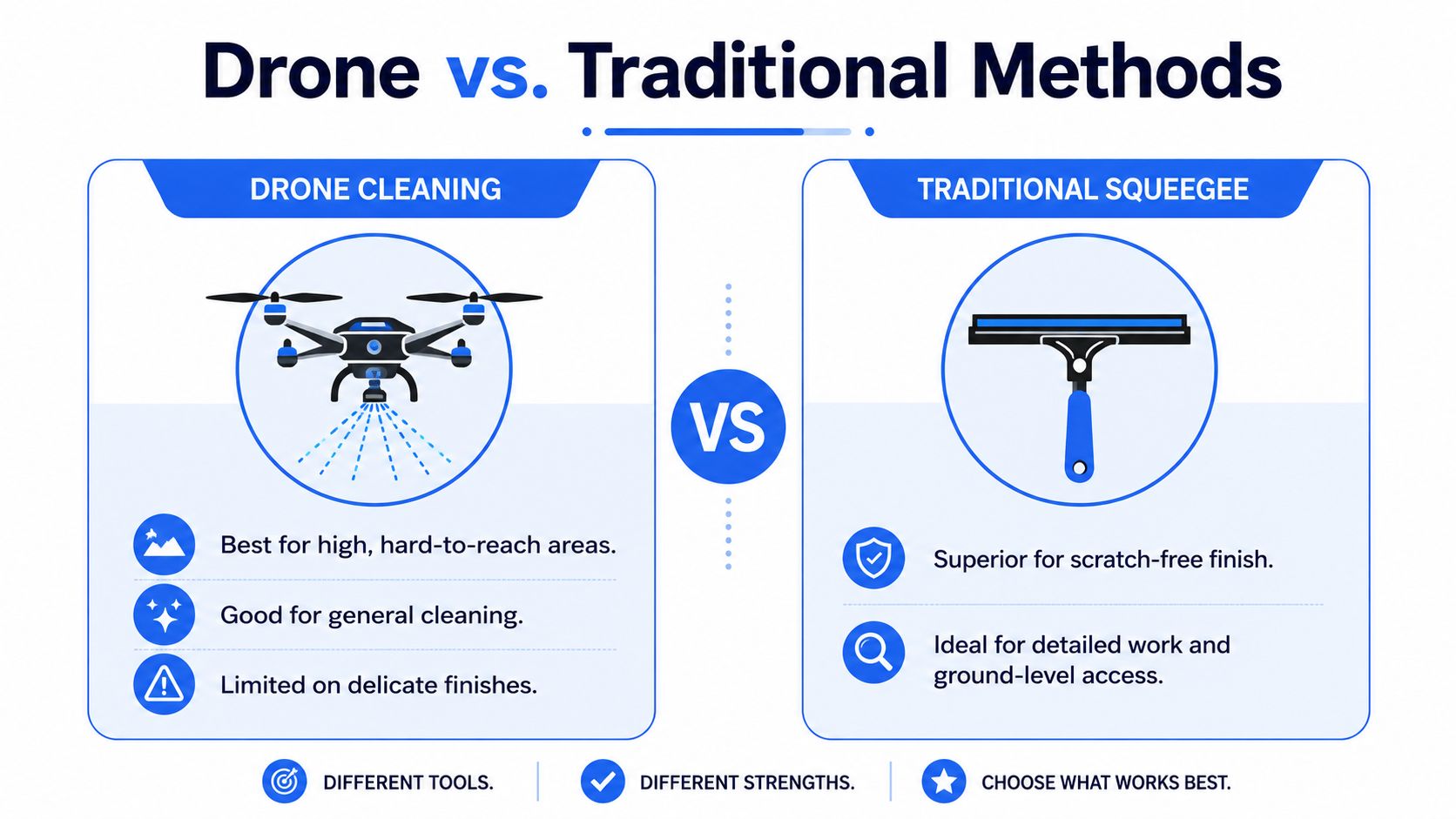
Drone systems shine on access. Traditional methods still win on control. That's the split that matters most on real jobs, especially when the owner is measuring finish quality by what they can see from the lobby, the sidewalk, or the parking lot.
A skilled technician using a squeegee can cut a sharp finish on glass and work edges, corners, and frame lines with more detail than a spray head usually can. A pure-water system gives the crew a way to clean exterior glass without residue, and it's especially effective when the goal is broad, consistent exterior maintenance rather than targeted problem removal. Those are the two professional methods that still anchor most window cleaning work, because they solve different finish problems.
Drone washing is weaker when the glass has heavy mineral deposits, construction residue, or hard water staining that needs mechanical agitation. It can also struggle where frames, mullions, and decorative elements need close-up attention. That doesn't mean it's a poor technology, it means it's an access-first technology, not a finishing-first one.
A drone can save a difficult façade. It can't always replace a careful hand on glass that needs detail work.
The best use case is often hybrid. For example, a tower in Phoenix, Denver, or Las Vegas may use drone cleaning on the upper exterior runs where access is hardest, then shift to squeegee or pure-water methods for lower levels, interior glass, and visible entry zones. That approach protects both schedule and finish expectations.
Historic buildings, retail façades with detailed trim, and properties with glass that shows spotting immediately are also poor candidates for a drone-only plan. The technology has a place, but the old tools still win where craftsmanship and visual precision matter most.
The legal question is usually the first real gate, even if it's the last question property managers ask. In the U.S., commercial drone window cleaning generally requires an FAA Part 107 Remote Pilot Certificate, and operators must stay within visual line of sight (VLOS). Flights over people or moving vehicles need special FAA waivers, which means the work is regulated as an aerial operation, not just a cleaning visit. FAA compliance discussion for drone cleaning
The right provider should be able to explain the airspace around the property, the flight plan, and any waiver or authorization needs in plain language. A building near airports, heliports, stadium traffic, or dense pedestrian movement can trigger extra planning even if the service itself looks straightforward.
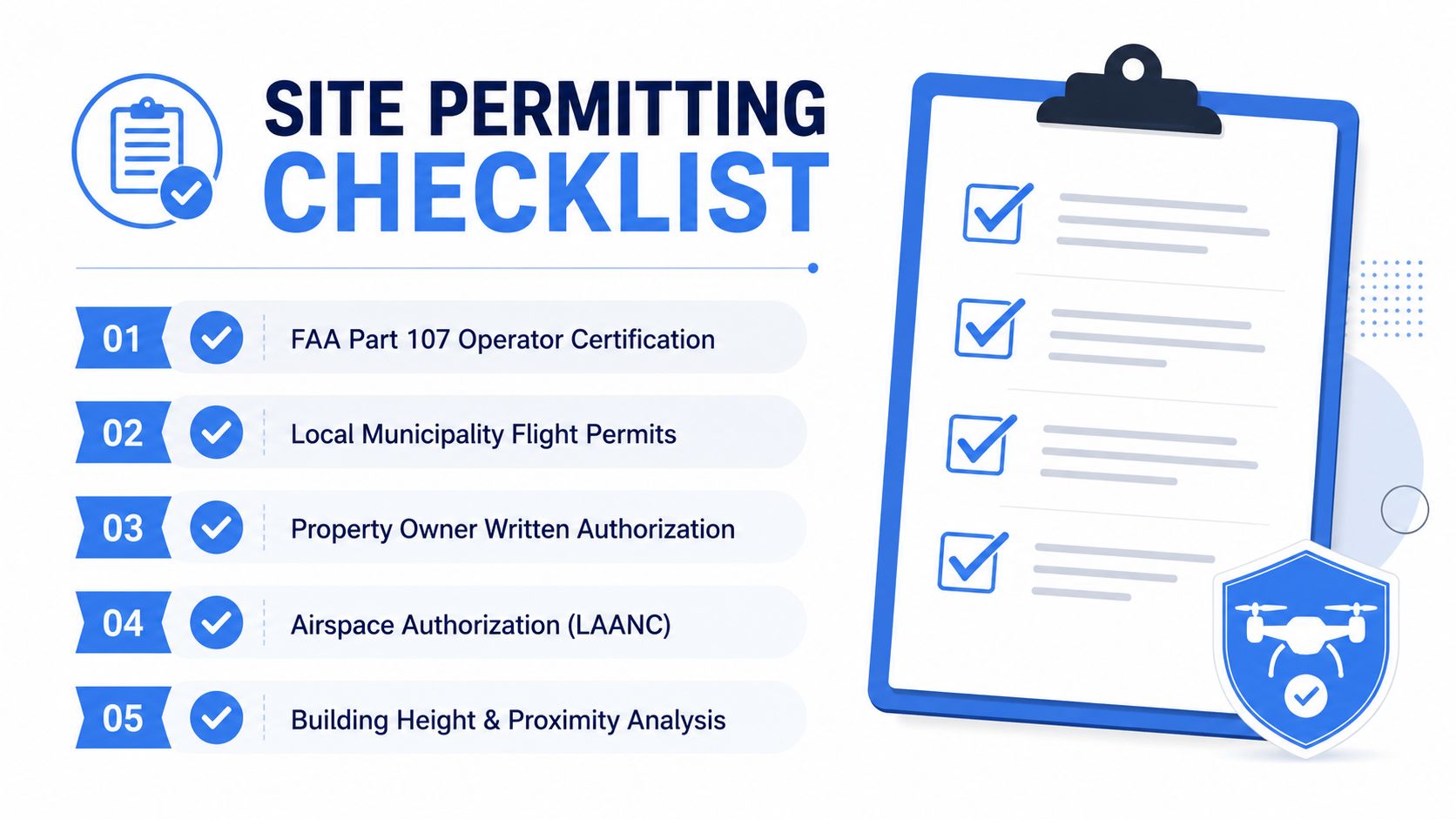
A practical permitting checklist should include the following:
For managers in places like Scottsdale, predictable compliance matters more than sales language. Hospitals, stadiums, and high-rise condominiums can't afford a provider who treats the site as generic. The plan has to fit the airspace, the building, and the day's operational conditions.
A current overview of drone law changes, like the one from browse drone legislation updates, is useful for understanding how quickly this area can shift across markets. That's exactly why a provider should talk in specifics, not slogans.
The best drone jobs share the same traits, height, repetition, and access pain. High-rise office towers with long runs of similar glass are a natural fit. So are condominium complexes, car dealerships with large glass showrooms, professional stadiums, and medical facilities that want exterior cleaning with minimal disruption.
Residential buildings accounted for 24.3% of market share in the 2025 market report, or about $0.19 billion, which shows the technology isn't limited to extreme towers alone. That matters for condos and mixed-use properties, where upper façade access can be difficult but the glass surfaces are still repetitive enough for efficient drone passes. Market sizing for high-rise window cleaning drones
Repetitive façade panels are where the method feels most efficient on site. The operator can maintain a steady cleaning path, the ground unit keeps the wash supplied, and the drone doesn't have to reset access equipment between sections. In properties above 3 stories, that's where the time savings start to show up in both schedule and tenant disruption.
Some sites still need a more traditional approach. Historic buildings with ornate details, properties with heavy landscaping that blocks staging, and buildings that require frequent interior glass work are usually better served by human crews. The same is true when the owner wants precise edge work at entry doors, lobbies, and other visibility-critical areas.
For portfolio managers in Arizona, Colorado, and Nevada, the question isn't whether drones are modern. It's whether the building's shape, glass layout, and access constraints make them the better tool for that specific day. That's the decision that keeps budgets honest and finish quality acceptable.
Price alone won't tell you whether a provider is qualified. A good proposal should make certification, insurance, water quality, and contingency planning easy to verify before anyone schedules the first flight. If a vendor can't answer those questions clearly, they're not ready for a commercial façade.
Start with the pilot. Confirm FAA certification, ask about VLOS operating limits, and ask how the crew handles buildings where access is partially restricted. Then move to equipment. You want to know whether the provider uses a pure deionized water system, how they manage spotting risk, and what happens if weather changes before the job is complete.
Experience on similar properties matters too. A provider who has cleaned small retail façades may not be ready for a hospital tower or a multi-building condo site. References from comparable buildings in Tempe, Chandler, and Gilbert tell you much more than a generic sales deck ever will.
For managers comparing options, the high-rise guidance at high-rise window washing is a good reminder that access method should follow the building, not the other way around.
Decision check: choose drone cleaning for difficult exterior access, traditional methods for detail-heavy or interior glass, and a hybrid plan when the site has both.
Before you sign, make sure the provider can define finish expectations in writing. If they promise speed, ask how they protect quality. If they promise quality, ask how they document compliance. The right answer should feel specific, not broad.
If your property needs a clear answer on whether drone cleaning, squeegee work, or pure-water service fits best, Professional Window Cleaning can help you compare the options against your building, budget, and access constraints. The team serves residential and commercial properties across Arizona, Colorado, and Nevada, and it brings the kind of field experience that helps owners avoid expensive guesswork.
Read our blog posts regularly and keep learning.