Care and Maintenance
Commercial Window Cleaning Phoenix: Costs and Schedules
Commercial Window Cleaning Phoenix explained: services, squeegee vs pure-water methods, pricing factors, heat-safe scheduling and how to request a quote.


A property manager preparing a storefront, medical office, stadium, or high-rise for tenants and visitors has more to coordinate than clean glass. Appearance, occupant disruption, access, weather, safety documentation, and budget all affect the service decision. A reliable plan starts by choosing between the only two professional window-cleaning methods used by professionals, the squeegee and the pure-water system, then matching that method to the building.
Professional Window Cleaning has been cleaning windows for over 26 years, serving properties in Las Vegas, Phoenix, Denver, and Scottsdale. The following commercial window cleaning tips focus on the decisions property managers make: how to inspect conditions, select equipment, plan safe access, schedule service, prevent mineral buildup, and control long-term operating costs. For teams also reviewing practice marketing services, a documented maintenance program can support both the physical appearance of a property and the way its business is presented.
The squeegee remains the precision method for commercial glass. A technician wets and agitates the surface, then uses a rubber blade to draw away solution and suspended soil in controlled strokes. The method works especially well when a building has interior fingerprints, stubborn marks, framed panes, display glass, or areas where a technician needs close control over water movement.
A 45-degree blade angle is a useful working reference because it keeps the rubber in contact with the glass without forcing excessive drag. Consistent pressure matters just as much. Too little pressure leaves a film or broken channel. Too much pressure can distort the blade edge, push solution into seals, or create uneven passes.
For a car dealership or professional stadium, technicians often work across large visual elevations where missed strips become obvious under changing light. Overlapping strokes help prevent narrow untouched lines between passes. The blade should be wiped between runs so collected residue doesn't return to the next section.
Property managers should also approve a small test area before a broad production run, particularly when glass has coatings, older seals, painted frames, or visible mineral deposits. A test confirms how the surface responds and gives the client an opportunity to identify priority areas before the crew moves across the building.
Professional Window Cleaning applies this method where close control is the practical advantage, including medical offices in Flagstaff, Las Vegas, and Denver. The company's guide to how to squeegee a window provides additional technique guidance for teams evaluating the process.
A short demonstration can help building staff understand why blade condition, pressure, and stroke overlap affect the final appearance.
Pure-water cleaning changes the access decision as much as the cleaning decision. Deionized or reverse-osmosis-treated water has dissolved minerals removed. A brush agitates the soil, and the purified water rinses it away. When the water dries, it can leave glass without the mineral residue associated with ordinary tap water, provided the system is operating correctly and the surface is suitable for the method. Pure-water cleaning guidance explains this basic process.
The standard setup combines a water-fed pole with a brush head, hose, and filtration or purification unit. Depending on the equipment, poles can reach up to about 60 feet, or roughly 20 meters according to a pure-water system explanation. That reach can let technicians work from the ground instead of relying on ladders or scaffolding for appropriate elevations.
High-rise condominiums in Denver may use pure-water systems where ground-based work can reduce exposure to edges and simplify access. Property managers in Scottsdale may also prefer the method for properties that want to limit routine chemical use. The trade-off is that pure water isn't a universal substitute for detailed squeegee work. Heavy debris, grease, adhesive residue, and some mineral deposits may need targeted agitation or a separate precision treatment.
A manager procuring this service should ask how the contractor verifies water quality. Filters require maintenance according to the equipment manufacturer's specifications, and a TDS meter can help confirm whether the purification system is producing suitable water. Dry conditions generally support predictable results, but the crew still needs enough time for the glass to rinse and dry, particularly in low humidity.
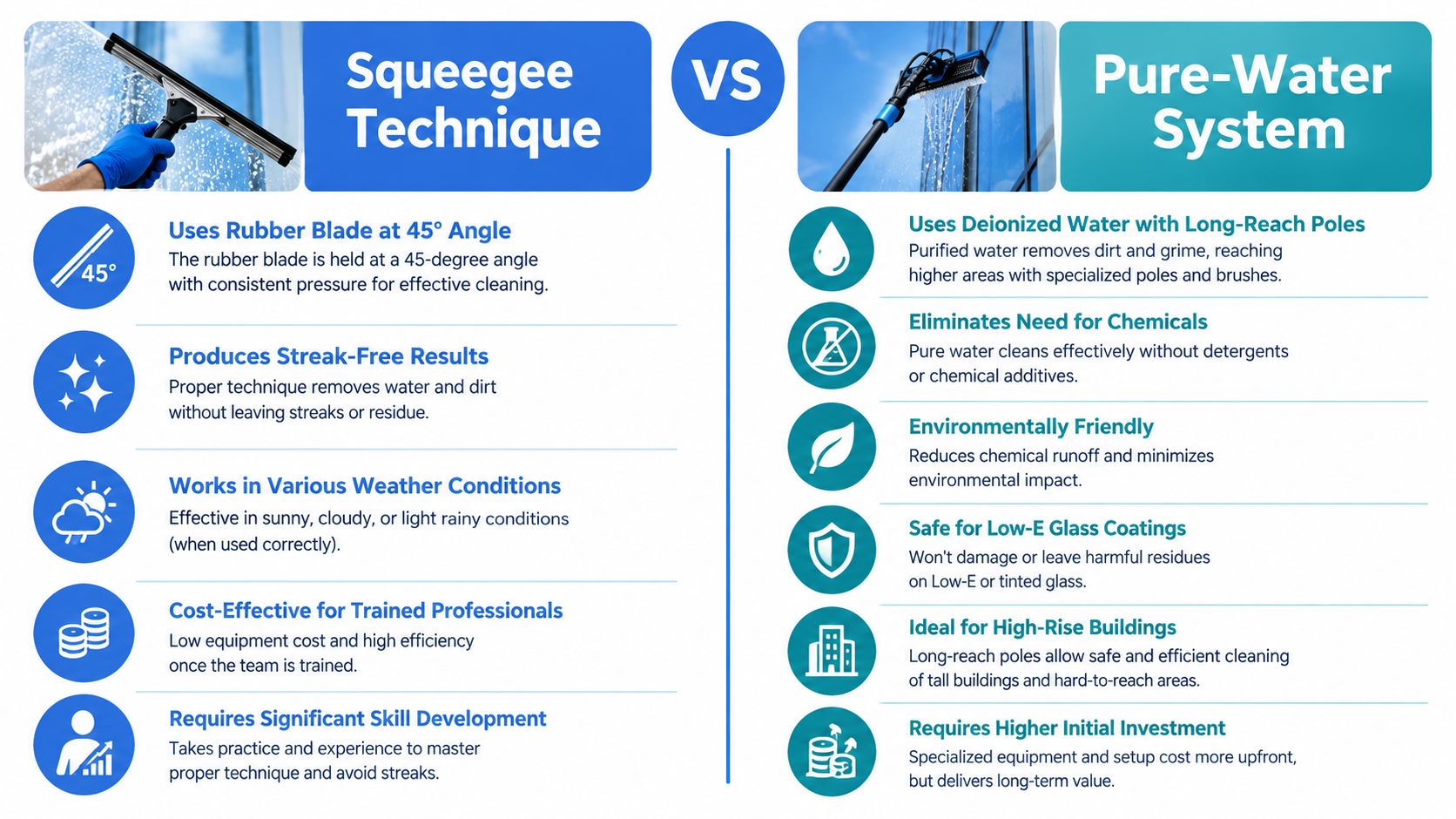
Procurement question: Ask whether the building needs pure-water production, close squeegee control, or a planned combination of both.
Professional Window Cleaning describes the pure-water window-washing method for commercial clients comparing chemical-free exterior cleaning with traditional squeegee work.
The best commercial window cleaning tips begin before a technician wets the glass. A pre-cleaning assessment identifies the condition of the panes, frames, seals, screens, ledges, and surrounding surfaces. It also separates ordinary soil from problems that require a different treatment plan, such as hard-water deposits, mold, damaged frames, failed seals, or deteriorated coatings.
This inspection is particularly useful at professional stadiums in Las Vegas and Phoenix, where exposed elevations collect dust and weather-related deposits. It also helps property managers in Chandler and Gilbert track changes in window condition over time instead of treating every service visit as an isolated cleaning.
A property record should connect observations to specific elevations, rooms, or window groups. Photos can show mineral severity, cracked frames, damaged gaskets, paint on glass, or areas where access is restricted. Written notes should distinguish pre-existing damage from conditions discovered during service.
The assessment should also capture the client's expectations. A tenant may want fingerprints removed from an entry system, while an owner may be more concerned about exterior mineral buildup. Those are different work priorities, even when they appear on the same pane.
Sunlight can reveal residue that isn't obvious in shade, while wind can affect high work and carry fresh dust onto recently cleaned surfaces. The University of Toronto's window-cleaning safety guidance notes that high winds, inclement weather, and extreme temperatures can make window cleaning unsafe. Managers should therefore treat weather notes as operational records, not merely quality-control comments.
High-access work should be planned as a safety operation first and a cleaning operation second. Office buildings, high-rise condominiums, and tall commercial structures may require water-fed poles, lifts, scaffolding, or rope descent systems. The correct choice depends on elevation, façade geometry, anchor availability, pedestrian exposure, and the need to keep entrances or tenant areas operating.
OSHA's rope-descent-system rule took effect with a compliance deadline of November 20, 2017. Under the rule, building owners must inform employers in writing that each anchorage has been identified, tested, certified, and maintained to support 5,000 pounds in any direction for each worker attached. The rule also requires annual inspections and recertification at least every 10 years, limits rope descent systems to heights of no more than 300 feet above grade, and requires each worker to use a separate independent personal fall arrest system. These requirements are summarized in OSHA rope-descent-system information.
Cornell's Window Washing Program states that outside window cleaning is allowed only for windows constructed, equipped, and maintained as safe for cleaning with fall protection. Its limited exception applies to work from a sill or ledge no more than 4 feet above the ground or an equivalent surface. Ontario's Regulation 859 requires a fall-arrest system when a worker is exposed to a fall of more than 3 metres and isn't working from a ladder, with free fall limited to 1.5 metres. The UK's HSE also requires work at height to be properly planned, supervised, and performed by competent people, as described in its work-at-height guidance.
Elevated cleaning isn't scheduled safely until the access method, rescue plan, equipment inspection, and building documentation are all current.
High-rise services throughout Denver and multi-story condominiums in Las Vegas benefit from experienced high-access teams that coordinate occupant notifications, exclusion zones, routes, and weather windows. Where the façade allows, pure-water equipment can reduce the need to place a technician directly at the glass. Professional Window Cleaning has provided commercial and high-rise service for over 26 years, but every job still requires a site-specific review.
Some streaks aren't caused by poor squeegee technique. They come from water chemistry. Irrigation overspray, sprinkler mist, repeated rinsing with mineral-heavy water, and runoff can leave calcium and other deposits on commercial glass. A stronger squeegee pass won't remove a mineral film that has bonded to the surface.
Commercial properties in Las Vegas frequently face mineral-deposit concerns because desert landscaping and water exposure can repeatedly affect lower elevations. Phoenix office buildings can face the same problem around irrigation zones, parking structures, and façades near landscaping. The first management decision is whether the mark is loose soil, soap residue, mineral buildup, or etching. Each condition calls for a different response.
A technician may need extended dwell time, controlled scrubbing, and multiple application cycles for mineral deposits. Acid-based chemistry can be appropriate for calcium buildup, but it must be selected and used carefully around frames, seals, coatings, and adjacent materials. A small test area should come before broad treatment, and the glass needs a thorough rinse afterward.
The long-term answer is prevention. A pure-water system can reduce new mineral residue during routine cleaning, but it won't automatically repair glass that has already been etched. Building management should also investigate sprinkler direction, leaking irrigation heads, overspray, and runoff paths.
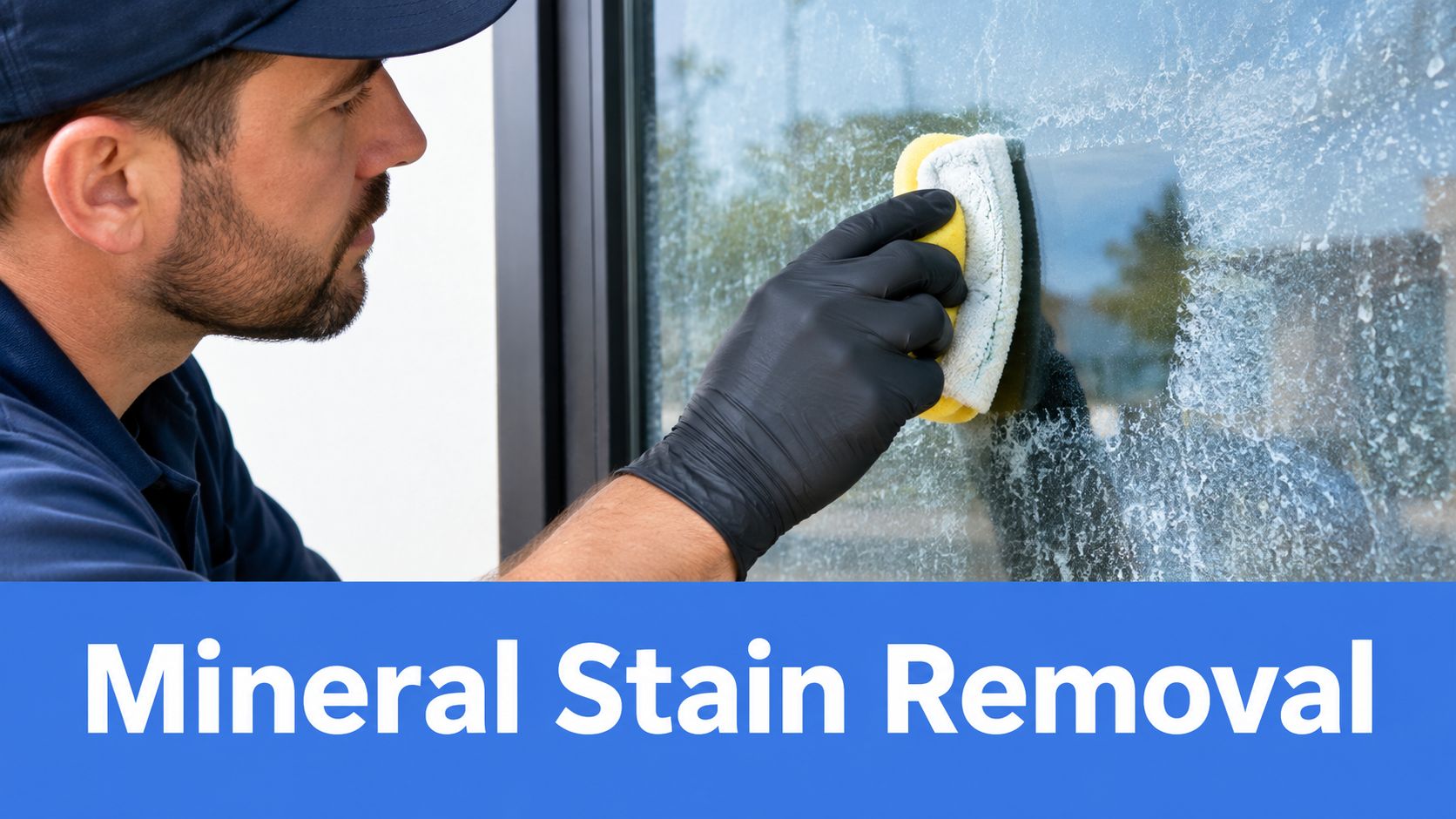
Professional Window Cleaning can help property managers distinguish routine soil from mineral deposits before they approve a larger restoration effort. That distinction protects the budget because repeated standard cleaning won't solve a chemistry problem.
A maintenance schedule should reflect how quickly a property becomes visibly dirty, how much traffic its glass receives, and how difficult the façade is to access. A storefront entrance, medical office lobby, stadium concourse, and high-rise office tower don't need identical service plans. The right schedule keeps the property presentable without paying for the same intensity everywhere.
High-traffic commercial areas often need more frequent attention because doors, sidelights, lobby partitions, and lower panes collect fingerprints and contact marks. Medical offices need a consistent appearance around reception and patient-facing areas. Stadiums benefit from seasonal planning, while high-rise exteriors may require careful coordination around access equipment, tenants, weather, and building operations.
Use the building's location and operating conditions as the starting point. Dusty environments, harsh weather, construction nearby, heavy landscaping, and irrigation overspray can shorten the useful interval between visits. A property manager shouldn't select a frequency only because another building uses it.
A practical program can assign different service levels to different zones:
Document every visit, including the method used, access restrictions, weather conditions, defects, and areas deferred. A yearly program review can reveal whether the property is over-serviced, under-serviced, or receiving the wrong method. Combining window work with other planned property maintenance may also reduce coordination effort, but only when the schedules don't create conflicting access or safety conditions.
Professional Window Cleaning supports commercial programs across Las Vegas, Phoenix, Denver, and Scottsdale. The useful comparison isn't just the price of one visit. It's whether the program preserves appearance, reduces avoidable restoration work, documents building conditions, and fits the property's operating calendar.
| Method / Service | Implementation Complexity | Resource Requirements | Expected Outcomes | Ideal Use Cases | Key Advantages |
|---|---|---|---|---|---|
| Squeegee Technique with Proper Blade Angle and Pressure | Moderate–High, requires training and practiced technique | Squeegee with quality rubber blades, towels, basic cleaners; ongoing blade replacement | Immediate, streak-free inspectionable finish | Ground-level commercial windows, intricate frames, dealerships, medical offices | Cost-effective for trained pros; tactile feedback; works in varied weather |
| Pure-Water System Technology for Chemical-Free Cleaning | Moderate, equipment operation and water-quality management | DI/RO purification, long-reach poles, tanks, possible vehicle mount; higher capital cost | Chemical-free, spot-free drying; safe for Low-E glass | High-rise, inaccessible windows, environmentally sensitive properties | Eliminates chemicals; eco-friendly; reduces liability for managers |
| Pre-Cleaning Assessment and Frame Inspection Protocol | Low–Moderate, requires experienced technicians and procedures | Inspection tools, camera, documentation records, time allocation | Identifies risks, selects appropriate method, documents pre-existing damage | New contracts, complex staining scenarios, high-value or high-liability sites | Prevents damage, enables accurate estimates, documents condition for liability |
| High-Access and Safety Equipment Utilization | High, specialized training, certifications, and planning | Lifts/booms/scaffolding, harnesses, rope systems, inspections, insurance | Safe access to elevated glass; comprehensive facade cleaning | High-rise office buildings, multi-story condominiums, large commercial facades | Enables safe high-rise work; OSHA compliance; reduces worker and occupant risk |
| Specialized Treatment for Hard Water Stains and Mineral Deposits | Moderate–High, requires treatment selection and staged applications | Specialized cleaning solutions, pads, soaking materials, additional labor time | Restores clarity, removes mineral buildup, prevents permanent etching (when possible) | Areas with hard-water/desert conditions (e.g., Las Vegas, Phoenix) and neglected glass | Addresses issues pure-water can't; extends glass lifespan; improves appearance |
| Regular Maintenance Scheduling and Preventive Care Programs | Low–Moderate, planning and coordination required | Scheduling system, routine crews, documentation, flexible frequency | Consistent cleanliness, early detection of issues, predictable budgeting | Stadiums, medical offices, multi-building portfolios, high-traffic commercial sites | Reduces long-term costs, maintains aesthetics, improves tenant satisfaction |
Clean windows are easier to manage when the property team treats them as a recurring operational asset rather than an occasional cosmetic task. Start with an inspection. Document the condition of the glass, frames, seals, screens, access points, and surrounding surfaces before work begins. That record gives the manager a practical baseline and helps separate removable soil from damage or mineral etching.
Then select one of the two professional methods. Choose the squeegee when the work demands close control, detailed interior cleaning, or targeted removal of stubborn residue. Choose a pure-water system when suitable exterior elevations can be reached from the ground and the property benefits from a low-residue rinse. In some commercial settings, the best plan uses both methods, with pure water for appropriate exterior glass and squeegee work for interior panes or problem areas.
Safety documentation should be verified before work is scheduled. Review the access method, anchor information, fall-protection equipment, inspection records, rescue planning, occupant notifications, and insurance documentation. Height, façade design, wind, temperature, and public exposure all influence whether a proposed method is appropriate. A low-disruption method isn't automatically a safe method unless the complete workflow supports it.
Frequency should follow traffic, climate, dust, landscaping, irrigation, and the building's public role. Storefronts and stadium entrances may need closer visual monitoring than remote office elevations. Medical offices require a dependable presentation around patients and visitors. High-rise buildings need schedules that account for access logistics rather than relying on last-minute cleaning.
Mineral deposits deserve early attention, especially in desert markets. If a mark returns after ordinary cleaning, investigate water chemistry and overspray instead of repeatedly changing squeegee technique. Early treatment and prevention can protect the glass from worsening conditions, while documented photos help management decide whether a treatment is justified.
Finally, compare maintenance programs by total operating value, not one-off price. Consider tenant disruption, access planning, rework, documentation, safety coordination, mineral prevention, and the appearance standards of the property. Professional Window Cleaning has more than 26 years of experience and serves commercial properties in Las Vegas, Phoenix, Denver, and Scottsdale. Each market presents different combinations of sun, dust, access, traffic, and water exposure, so the service plan should be evaluated against the actual building.
For a site-specific plan, Professional Window Cleaning can assess your glass, access conditions, mineral concerns, and preferred service cycle using squeegee or pure-water cleaning. Visit Professional Window Cleaning to discuss commercial service for your storefront, stadium, medical office, condominium, or high-rise property.
Read our blog posts regularly and keep learning.