Care and Maintenance
Best Way to Clean Commercial Windows: A Pro Guide
Discover the best way to clean commercial windows with pro squeegee and pure-water methods, safety tips, schedules, and when to hire experts.


When it comes to water spots, a simple DIY fix often does the trick. For most fresh stains, a 50/50 mix of white vinegar and distilled water is acidic enough to break down the minerals and clear things up. But for those really stubborn, baked-on spots, calling in a professional who uses either a squeegee or a pure-water system is the surest way to restore your glass without causing any accidental damage.
Staring through cloudy, mineral-stained windows is a frustration every property owner knows, especially if you live somewhere with hard water. Those chalky spots aren't just dried water. They’re what’s left behind—minerals like calcium and magnesium—that have bonded to your glass after the water has evaporated.
Before you grab a sponge and start scrubbing for hours, it helps to know what you’re up against.
The most common home remedy is a simple vinegar solution. The natural acetic acid in white vinegar works wonders at dissolving the alkaline mineral deposits, making them easy to wipe away. This trick is perfect for light spotting from a recent sprinkler session or a rain shower.
But not all water spots are created equal. Older, more stubborn stains might have already started to etch into the glass itself, making them nearly impossible to remove with home remedies. This is where professional techniques really shine.
At Professional Window Cleaning, we see firsthand how local water quality affects glass. After over 26 years in this business, we’ve learned that the hard, alkaline water in places like Las Vegas and Phoenix can etch spots into glass twice as fast as in areas with softer water. The market reflects this, too. The commercial window cleaning industry continues to grow as more people realize the value of professional maintenance. You can find more details in the North America glass cleaner market report.
Over our 26 years in business, Professional Window Cleaning has found that the two most effective, professional-grade methods are the traditional squeegee and modern pure-water systems. These techniques guarantee a streak-free result that DIY methods can rarely match.
Deciding between a DIY attempt and calling a pro can be tricky. To help you figure out the best approach for your windows, we’ve put together this quick comparison table.
As you can see, while a vinegar mix is great for a quick touch-up, it has its limits. When you're dealing with stains that just won't budge, the specialized tools and expertise of a professional are what you need to get that crystal-clear finish without any risk.
Before you can get rid of those frustrating water spots, you have to know what you’re up against. Those cloudy, stubborn marks aren't just dried water. They're what’s left behind when water evaporates: a tiny pile of mineral deposits, mostly calcium and magnesium.
This is a huge issue in places with "hard water," where the mineral content is naturally sky-high. Professional Window Cleaning has been cleaning windows for over 26 years, and we have seen the havoc that hard water in cities like Denver and Scottsdale can wreak on homes and businesses.
Water spots are a real headache, especially in sunny states. Sprinklers or rain dry up fast, leaving behind these stubborn white deposits. In fact, over 60% of our residential clients around Scottsdale are dealing with spots from local hard water, which has calcium levels pushing 300 ppm—well above the 100 ppm threshold for soft water. If you're curious about the industry, you can learn more about the window cleaning services market on Fortune Business Insights.
This is the most important thing to get right. Identifying which kind of water spot you have dictates your entire game plan for getting rid of it.
Type I Spots (Surface Deposits): These are the fresh ones. They're just mineral deposits sitting right on top of the glass. You can usually feel their chalky, dotted texture if you run your finger over them. Sprinkler overspray is the classic culprit here.
Type II Spots (Etched Stains): This is where things get serious. When minerals are left on the glass for too long, their high alkaline content starts to corrode and literally etch into the glass. These spots feel smooth because they’ve become part of the window, making them a nightmare to remove.
The biggest mistake we see is homeowners trying to scrub away Type II spots with something abrasive. It won’t remove the etching, but it will almost certainly leave permanent scratches on your glass.
Think of it this way: a light sprinkler mist that you clean off within a week will probably leave behind simple Type I spots. But if that same sprinkler hits your window every day all summer, the sun will bake those minerals right into the glass. Soon enough, you'll have deep Type II etching that a simple vinegar solution won't touch. Getting this difference right will save you a ton of time, effort, and potential damage to your windows.
For those fresh, surface-level water spots—the kind left behind by a recent run-in with the sprinklers—a simple DIY approach is often all you need to get your windows back to crystal clear. Before you even think about reaching for harsh chemicals, the most reliable home remedy is probably sitting in your kitchen pantry right now.
The real power player here is distilled white vinegar. Its natural acidity is perfect for cutting through the alkaline mineral deposits, like calcium and magnesium, that create those annoying spots. When you mix it right, it dissolves the residue without being harsh enough to do any damage to the glass itself. In cities we service like Las Vegas or Phoenix, this can be a great first step.
Putting together your primary weapon against light water spots couldn't be easier. You only need a few basic things to get started, and chances are you already have them on hand.
Once your mix is ready, spray it generously onto the window, making sure to cover all the spots. Let it sit for at least a minute. This "dwell time" gives the acetic acid a chance to really get to work breaking down that mineral buildup.
After letting the solution do its thing, take your cleaning microfiber cloth and gently rub the spots in a circular motion. You should be able to feel the gritty texture of the minerals breaking down under the cloth.
For the best possible results, follow up immediately with a squeegee. Make sure to wipe the blade clean after each pass to avoid dragging dirty water back across the glass.
No squeegee? No problem. Your second microfiber cloth will work just fine for drying. The key is to wipe the glass completely dry to prevent new water spots from forming as it air-dries. This simple process is a lifesaver for homeowners dealing with those common sprinkler marks. If you want to dig a bit deeper, you can learn more about how to get hard water spots off windows in our more detailed guide.
Here's a critical mistake to avoid: never use anything abrasive on your windows. That means no scouring pads, standard steel wool, or gritty cleaners. These will create tiny micro-scratches that permanently damage the glass, turning a minor annoyance into a major, irreversible problem.
While vinegar is the undisputed champion for this job, lemon juice can also be a decent backup. Its citric acid works in a similar way to vinegar's acetic acid. You can apply fresh lemon juice directly to stubborn spots, let it sit for a few minutes, and then wipe it away. Just be aware that it can get sticky, so you’ll need to do a thorough rinse with water afterward.
It's always good to know what your options are, both homemade and store-bought. For instance, checking out a review of various glass cleaners can give you a better sense of what’s out there. But honestly, for light, fresh spots, these safe and simple DIY methods should always be your first line of defense.
So you’ve tried the vinegar, put in some serious elbow grease, but those frustrating water spots just won’t budge. It’s a common story, especially when you’re up against older, baked-on mineral deposits that have had months or even years to etch themselves into the glass.
When your DIY efforts aren’t cutting it, that’s a clear sign it’s time to call in the professionals.
Professional Window Cleaning has been cleaning windows for over 26 years, and we’ve learned that advanced stains require more than a simple spray and wipe. Our technicians rely on only two proven, industry-leading methods: traditional squeegee work and modern pure-water systems. These aren't just cleaning techniques; they're precise processes designed to restore your glass without causing damage in the communities we service like Denver and Scottsdale.
This decision tree can help you quickly figure out if your window spots need a professional touch.

As you can see, the moment spots go beyond light and fresh, professional help becomes the safest and most effective option to avoid accidentally damaging your glass.
In the hands of a skilled professional, a squeegee is far more than a simple rubber blade—it’s a precision tool. Our technicians pair it with professional-grade, ammonia-free cleaning solutions that are powerful enough to dissolve heavy mineral buildup without harming your window seals or surrounding frames.
The technique involves applying the solution, agitating the surface to lift the deposits, and then systematically clearing the glass. Each stroke is deliberate, overlapping slightly to guarantee no streaks or residue are left behind. It’s a method that provides a level of clarity that’s nearly impossible to replicate with a spray bottle and a cloth.
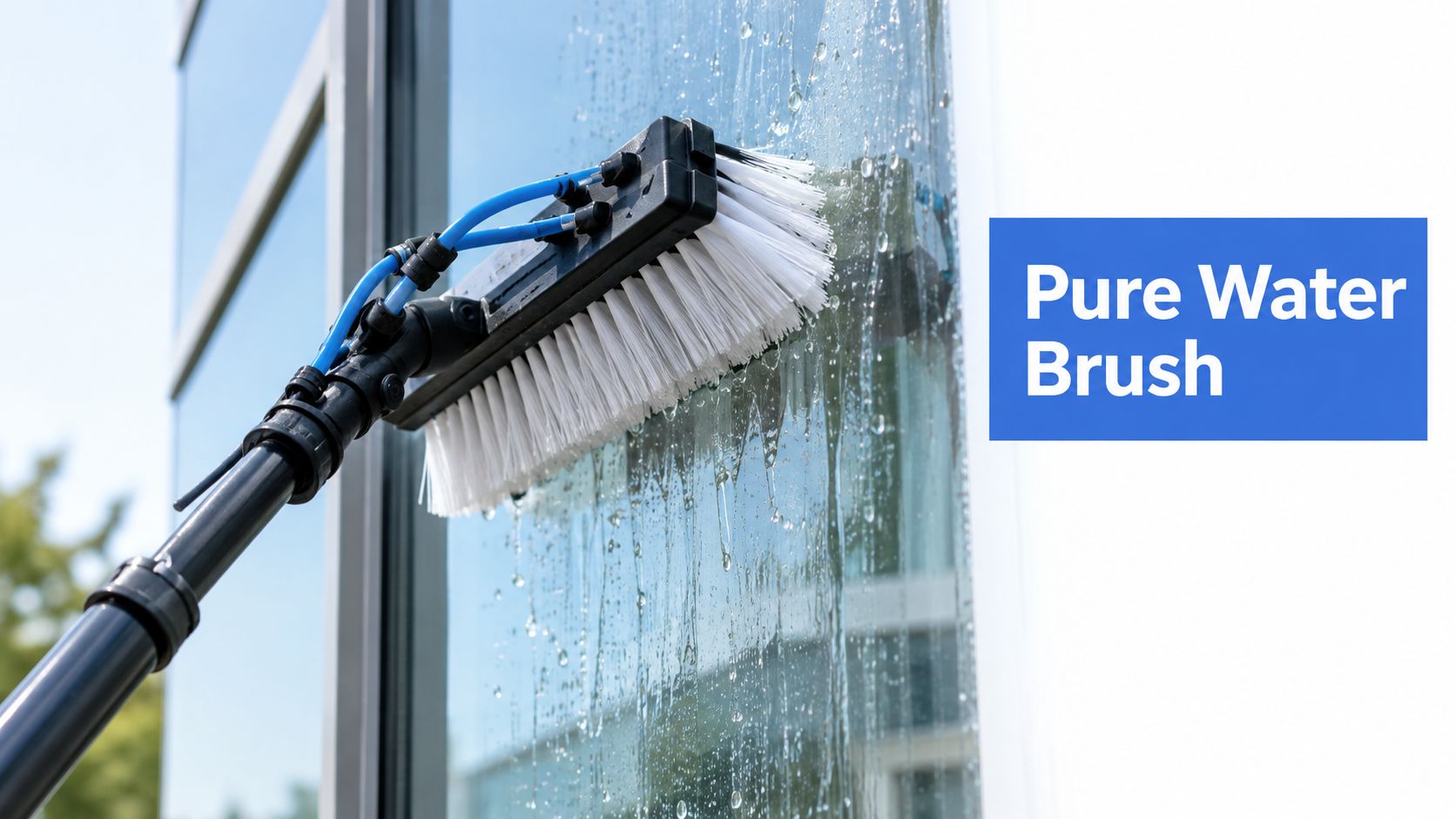
For hard-to-reach windows or properties with widespread, severe spotting, we often turn to our pure-water systems. This technology, also known as a water-fed pole system, is a true game-changer in the world of professional window cleaning.
The system works by taking ordinary tap water and running it through a multi-stage filtration process that removes 100% of its mineral content. This deionized or "pure" water is then pumped through a long, lightweight pole to a specialized brush at the end.
Pure water is essentially a natural cleaning agent. Because it's free of minerals, it actively attracts and bonds with the dirt, grime, and mineral deposits on your windows, lifting them right off the surface. The window is then rinsed with more pure water and left to air dry to a perfectly spot-free finish.
This method is exceptionally safe for high-rise buildings, as our technicians can work from the ground, eliminating the risks that come with ladders and lifts.
Unfortunately, many well-intentioned DIY attempts can go wrong. Some studies show that homeowners using newspaper rubs often remove only 30% of spots, while acidic cleaners can damage window seals in 25% of cases, leading to costly repairs. In contrast, professional techniques can cut the recurrence of spotting by 75%.
For severely etched glass where the minerals have actually corroded the surface, a standard cleaning might not be enough. In these rare cases, we may recommend more specialized services. You can learn more about our glass polishing techniques that can restore even heavily damaged windows.
It feels great to finally get those stubborn water spots off your glass, but that victory doesn't last long if they just come right back. The real secret to keeping your windows crystal clear isn't scrubbing harder—it's shifting your focus from removal to prevention. A few smart, proactive steps can save you a ton of time and frustration down the road.
One of the most common culprits we see causing water spots on residential homes is sprinkler overspray. It’s an easy thing to miss, but that daily misting is the perfect recipe for mineral buildup, especially during the hot, dry summers you find in places like Phoenix and Las Vegas.
The first line of defense is simply taking control of your environment. You’d be surprised how a few small adjustments can make a massive difference in stopping those mineral deposits before they even start.
Adjust Your Sprinkler Heads: This is hands-down the easiest and most impactful fix. Take a few minutes to walk your property while the irrigation system is running. Make sure the spray pattern is watering your lawn and garden, not the side of your house. Angling the heads downward and away from your windows can eliminate the primary source of spotting.
Apply a Hydrophobic Coating: For a more high-tech solution, consider a glass sealant or hydrophobic coating. These products create an invisible barrier on the glass that makes water bead up and roll right off. Instead of sitting there and evaporating—leaving all those minerals behind—the water just takes the gunk with it.
After 26 years in the business, we've learned that proactive prevention is always more cost-effective than reactive cleaning. A single afternoon spent adjusting sprinklers can prevent months of frustrating buildup.
When it comes to commercial properties, prevention is about more than just convenience; it’s about protecting a major investment. In cities like Scottsdale and Denver, the constant exposure to the elements means mineral buildup can become a serious, damaging issue if it isn't managed correctly.
For businesses, nothing beats a regularly scheduled professional cleaning. By never giving those minerals a chance to accumulate and etch into the glass, you preserve the integrity and appearance of your entire property. Our teams use only two professional methods—a traditional squeegee for that flawless, hand-detailed finish or a pure-water system that leaves a spot-free shine—to maintain the pristine look your business deserves.
By combining these simple environmental tweaks with a smart maintenance plan, you can stop water spots before they ever get a foothold. This proactive approach ensures your view stays unobstructed and your windows stay protected for years to come.
While DIY methods can sometimes handle fresh surface spots, stubborn or long-neglected water stains are a different beast entirely. They often require a professional touch.
With over 26 years of hands-on experience, Professional Window Cleaning has been cleaning windows and has seen every type of water spot imaginable. We've dealt with everything from minor sprinkler overspray to severe mineral etching that has literally become part of the glass itself.
Our trained technicians can quickly assess the situation. Is it a simple Type I surface stain, or have the minerals etched into the glass, creating a more serious Type II spot? Getting this diagnosis right is critical. Using the wrong method, like an abrasive scrubber on etched glass, can lead to permanent scratches and costly damage. We’ve seen it happen—homeowners in Scottsdale and Phoenix accidentally ruining a beautiful window just by trying to scrub away baked-on minerals.
The real difference often comes down to the tools. Our investment in professional-grade equipment, specifically pure-water systems and traditional squeegees, delivers results that are simply impossible to achieve with household supplies.
These advanced systems use deionized water, which acts like a magnet for minerals. It actively pulls them from the tiny pores of the glass, leaving behind a flawless, spot-free finish that dries perfectly clear every time. A skilled squeegee technique achieves the same pristine result.
Your time is valuable, and your property is a significant investment. Hiring an expert is the safest, most effective solution for restoring your windows to their original, sparkling condition without the risk of costly mistakes.
We've handled countless scenarios where DIY attempts led to damaged window seals or scratched glass, costing homeowners far more in the long run. By highlighting our deep experience serving communities across Arizona, Nevada, and Colorado, we aim to build trust.
Calling in a professional isn't just about getting clean windows; it's about protecting your investment and ensuring the job is done right the first time. Let us handle the tough work so you can get back to enjoying that pristine view.
When you're trying to figure out how to get rid of stubborn water spots on your windows, a few questions always seem to pop up. Homeowners and property managers alike want to know the risks, what tools are safe to use, and how to stop the problem from coming back. Professional Window Cleaning has been cleaning windows for over 26 years, and we've got the answers.
Yes, they absolutely can. If you let them sit for too long, the minerals in hard water will start to eat into the glass itself. This is what we in the industry call Type II water damage.
The alkaline minerals literally corrode the surface, creating a permanent haze that no amount of standard cleaning will remove. At that point, your only options might be professional glass polishing or, in the worst cases, a full window replacement to get that clarity back. This is a common issue in hard-water areas like Las Vegas and Phoenix.
We get this question a lot, and the answer is almost always no. We strongly advise against using any standard steel wool you'd find at a hardware store—it will almost certainly leave deep, permanent scratches on your glass.
Now, you might see professionals use ultra-fine #0000 grade steel wool, but it’s always paired with a specific lubricating solution and a very practiced technique. It’s a last resort for severe cases and requires an expert touch to avoid causing more harm than good. For any DIY cleaning, it's much safer to stick to non-abrasive materials like microfiber cloths.
In areas known for hard water, like many communities in Arizona and Nevada, we recommend a professional window cleaning at least twice a year for homes. This simple step can prevent mineral buildup from ever reaching the point of permanent etching.
For commercial properties or homes in places like Denver and Scottsdale where sprinkler systems frequently hit the glass, bumping that up to a quarterly schedule is the best way to keep your windows looking their best all year.
When stubborn water spots just won't budge, it's time to call in the experts. At Professional Window Cleaning, we have more than two decades of experience and the right tools and techniques to restore your view safely and effectively. Get your free estimate today!
Read our blog posts regularly and keep learning.