
Care and Maintenance
How to Clean Building Windows Safely in 2026
Learn how to clean building windows with professional squeegee and pure-water methods. Step-by-step guide covering safety, tools, and maintenance.


If you're looking at glass that was just cleaned, yet still looks cloudy, chalky, or streaked white, you're usually not dealing with dirt. You're dealing with mineral deposits. In dry markets, that buildup gets baked onto the glass by sun, sprinkler overspray, pool water, and repeated hard-water runoff.
That's the point where many property managers get frustrated. The windows get washed, but they don't get clear. Standard soap and a squeegee won't remove bonded mineral scale. A pure-water system won't dissolve it either. In professional window cleaning, those are still the only two actual cleaning methods we use for the glass itself, a squeegee or a pure-water system. But when hard water staining is already on the surface, you sometimes need a separate restoration step before either method can deliver a clean finish.
That's where a phosphoric acid cleaner comes in. Used correctly, it can break down the mineral residue that ordinary window cleaning leaves behind. Used carelessly, it can haze glass, damage nearby surfaces, and create runoff problems on vertical work.
The most common call goes like this. “We had the windows cleaned, but the spots are still there.” On storefronts, condo glass, dealership windows, and upper-floor panels, those spots are usually hard water stains, not leftover cleaner.
In places like Phoenix, Scottsdale, Las Vegas, and Denver, I'd expect to see chalky white spotting from sprinkler systems, overflow lines, facade runoff, or mineral-heavy wash water that dried in the sun. The pattern tells the story. Tight droplets usually come from sprinklers. Vertical drips often come from masonry, frames, or rooftop runoff.

A lot of owners try vinegar first. Sometimes it helps on light fresh spotting. On established buildup, it usually doesn't do enough. The glass may look a little better when it's wet, then turn right back to dull once it dries.
Stains that survive a normal wash are usually bonded minerals. You won't “scrub harder” and win that fight.
If you're comparing restoration options before bringing in a contractor, Titan Coatings water spot solutions is a useful reference point because it helps show the difference between light cosmetic spotting and heavier mineral contamination that needs a stronger chemistry.
After more than 26 years in this trade, the pattern is consistent. If the stain is inorganic and locked onto the surface, a dedicated acid cleaner is often the tool that moves the job forward. The key is choosing the right one and applying it like a professional, not like a general-purpose bathroom cleaner.
A phosphoric acid cleaner is a medium-strong acid cleaner used to break down inorganic deposits such as rust, calcium scale, lime, and similar mineral residue. The easiest way to think about it is this. It's a specialized key for the kinds of bonds that ordinary glass soap fails to release.

On mineral staining, phosphoric acid targets the contamination rather than just lubricating the surface. That's why it has a real place in restoration work. It's also why it shows up across industrial cleaning and metal treatment.
Its role as a cleaning and metal treatment agent is well established, with worldwide production reaching approximately 90.3 million metric tons in 2024 according to Statista's phosphoric acid production data. That matters for one reason. This isn't niche chemistry somebody dreamed up for a gimmick bottle. It's a widely used industrial acid with a long track record.
Compared with household vinegar, phosphoric acid is typically far more effective on stubborn mineral staining. Compared with muriatic acid, it's a more controlled choice for many cleaning tasks because pros use it when they want strong mineral removal without jumping straight to the harshest option.
That doesn't make it safe by default. It makes it useful when selected properly.
Here's the practical breakdown:
Practical rule: Use a phosphoric acid cleaner for mineral problems, not for everyday window washing.
Property managers sometimes assume any acid cleaner will do the same job. They won't. The chemistry matters, the dilution matters, and on glass, especially vertical glass, the handling matters even more.
A property manager in Las Vegas calls because the lobby glass still looks cloudy after routine cleaning. The issue usually is not dirt. It is mineral load baked onto the glass from sprinklers, concrete runoff, or oxidized metal above the pane. That is where a phosphoric acid cleaner earns its place in the kit.
On windows, the best use is restoration of mineral contamination. Standard soap handles dust, pollen, fingerprints, and normal route work better. Phosphoric acid is for hard water spotting, light concrete residue, rust transfer, and stubborn runoff lines that stay put after a proper scrub.
Glass is the surface that gets oversimplified in generic product guides. On vertical glass, especially in Arizona and Nevada, the cleaner has to remove deposits without drying too fast, streaking, or running into edges and frames. Phosphoric acid does that job well because it breaks down mineral buildup more effectively than mild household acids, while still giving the technician more control than harsher acid options.
Results depend on the stain and the condition of the pane. If the problem is surface deposit, the glass can come back clear. If the minerals have already etched the surface from months of heat and evaporation, the deposit may come off and the damage will still show. Property managers need that distinction up front because it affects expectations and bid approval.
I see this most often on lower storefront panels, pool-facing glass, and entrance systems near irrigation.
If you manage commercial properties and want a broader look at restoration options, this commercial hard water stain remover guide is worth reviewing alongside chemical treatment choices.
Phosphoric acid cleaner also has a place around metal, particularly where rust or oxidation is staining nearby glass. It can clean transfer staining from fasteners, hardware, and frame runoff without jumping straight to a more aggressive acid. That matters on mixed-material buildings where the goal is to clean the stain, not create a second problem.
Use extra caution around these areas:
Always test a small area first. Some finishes tolerate contact well. Others discolor, dull, or streak faster than expected, especially in hot sun.
Concrete, stucco, stone, and masonry are often the source of the stain. New construction splash, efflorescence, and alkaline runoff can keep feeding the same window for months. Cleaning the pane helps, but it does not solve the cause if the wall, cap, or sill is still shedding material every time the building gets watered or washed.
In Denver, I have seen this on glass below precast bands and balcony edges. In Phoenix, it is common around irrigation zones where hard water dries on hot glass day after day. Surface compatibility is not just about whether phosphoric acid can touch the stain. It is also about identifying what is upstream of the glass and whether that source needs correction.
If you're trying to understand the broader water-quality side of recurring mineral buildup, this guide to combating limescale gives useful background on why these deposits keep returning in hard-water environments.
Clean the glass. Fix the source. Otherwise the same stain comes right back.
A technician is six feet up on a ladder, working west-facing glass at 2 p.m. in Nevada. The panel is hot, the cleaner starts sliding the second it hits the surface, and one missed drip can mark a frame, spot the next pane down, or burn nearby plantings. That is how acid work goes bad on windows. Fast.
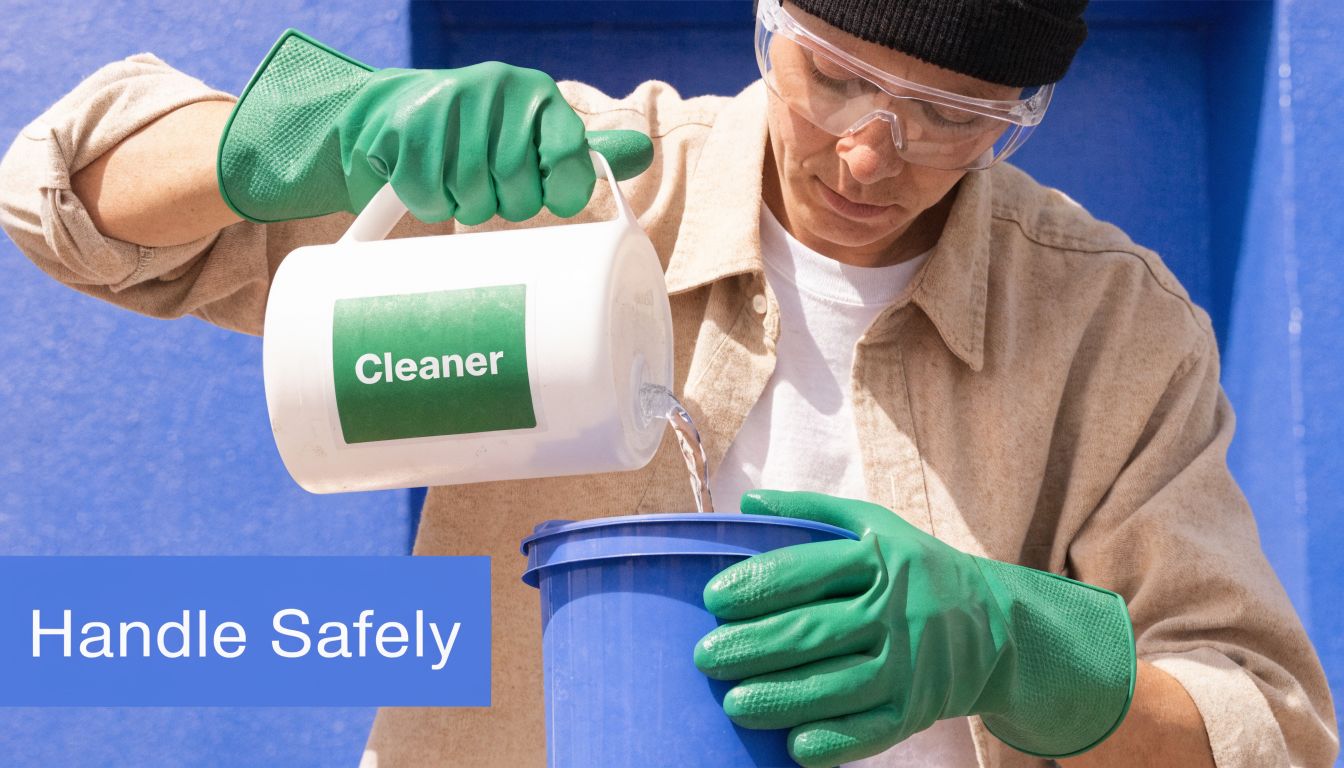
Phosphoric acid is often sold as a milder acid option, but on vertical glass the margin for error is still small. Heat, wind, overspray, and runoff change the job. On storefronts, entry glass, and upper panels, the cleaner has to be controlled from the first spray to the final rinse.
Crews handling phosphoric acid on glass need proper PPE, not the basic gear used for routine route work.
I treat eye protection as mandatory any time acid is used above waist height. On vertical glass, runoff finds its way back at you.
Generic cleaner directions are usually written for tile, bowls, floors, or masonry. Windows are different because gravity keeps moving the product. It can collect at gasket lines, sit in frame corners, drip onto anodized trim, and carry dissolved minerals onto lower sections of glass.
That is the part many maintenance teams underestimate. The risk is not only skin contact. The primary field problem is uncontrolled dwell time where the product runs and sits.
A practical rule on hot glass in Arizona or Nevada is simple. If the surface is heating up enough to flash water quickly, postpone the work or reduce the exposure with shade and smaller sections. Acid that dries on the pane creates a second problem you now have to remove.
Safe handling starts before the bottle is opened.
A short handling refresher helps if your maintenance team hasn't worked with this kind of cleaner before.
One more point matters on commercial properties. Do not let acid work drift into regular production speed. On a route day, crews are trained to move. On restoration glass, speed causes mistakes. Slow the pace, control the runoff, and rinse fully. That is how you get the stain off without creating a frame, seal, or liability problem.
A bad acid application on glass usually looks the same. Dry edge at the top, streaking down the pane, residue packed into the gasket, and a frame that now needs separate repair work. On vertical windows in Las Vegas, Phoenix, or dry parts of Nevada, that happens fast because the pane heats up and the mix flashes off before the stain fully breaks.
Dilution has to match three things. The deposit, the temperature of the glass, and how much control you have over runoff on a vertical surface. Stronger is not better if it shortens your working time and leaves you chasing drips.
Start mild. Increase strength only if the test spot says you need more.
| Phosphoric Acid Cleaner Dilution Guide | ||
|---|---|---|
| Stain Severity | Water to Cleaner Ratio | Common Use Case |
| Light | More water than cleaner | Fresh spotting, light mineral film, small touch-up areas |
| Moderate | Equal parts water and cleaner | Established hard water spots on glass and frames |
| Heavy | Less water, stronger cleaner mix | Thick mineral crust, rust transfer, baked-on runoff lines |
Earlier product guidance in this article noted that a 1:1 dilution is a common reference point for hard water stain work with acid-safe sprayers. Treat that as a starting line. Real job conditions matter more than a label ratio, especially on sunlit exterior glass.
Cool and control the pane
If the glass is hot, rinse it first and work the shaded side or a smaller section. On desert properties, I keep each section tight enough to finish before the cleaner starts to tack up.
Apply low on the section and build upward
That reduces long runs and gives better control on vertical glass. Flooding the pane from the top creates drip tracks and increases frame contact.
Give it short dwell time
Let the deposit soften, but stay on it. If the cleaner starts drying at the edges, stop and rinse. Dwell time on windows is usually shorter than crews expect.
Agitate with the least aggressive tool that works
White pad, soft nylon brush, or dedicated applicator. Save razors and restoration blades for a separate decision based on glass condition, fabrication debris risk, and the property's liability tolerance.
Rinse heavily, especially edges and gaskets
Many maintenance teams often cut corners at this stage. Residue left at the top edge or behind the frame lip often shows up later as streaking, seal staining, or repeat spotting after the glass dries.
Wash the glass normally after the stain is removed
Finish with your regular professional method so the pane dries clean and uniform. If your team is also reviewing eco-friendly window cleaning methods, keep acid work separate from routine maintenance procedures.
A short dwell and full rinse beat a hot mix every time.
On a Denver mid-rise with irrigation overspray, a moderate mix may stay workable long enough to clean efficiently. On west-facing storefront glass in Henderson at 2 p.m., the same mix can dry before you finish agitation. That is why test spots matter. The right dilution on paper can still be wrong on the building.
Coverage also changes a lot on vertical glass because runoff, overspray control, and repeat passes eat material. Order enough product for the job, but expect actual use to swing based on stain thickness and how carefully the crew works.
For managers trying to reduce chemical load across the property, it also makes sense to compare lower-impact maintenance products for non-restoration cleaning. For that broader housekeeping side, you can discover Boat Juice's greener boat care and see how other industries are shifting toward less aggressive cleaners where heavy mineral removal is not the main task.
On windows, phosphoric acid should stay a targeted restoration tool. Mix for control, apply in small sections, and rinse like residue will hide where you cannot see it, because it usually does.
Phosphoric acid cleaner solves real stain problems, but runoff is the trade-off every responsible contractor and property manager needs to think through. Once rinse water carries phosphate off the work area, it stops being just a cleaning issue.
Verified guidance notes that phosphoric acid cleaners introduce bioavailable phosphorus into runoff, which raises environmental concerns. It also notes that Colorado's 2025 HB 1254 in the Denver metro is pushing for low-phosphate alternatives, and that recent studies found citric acid can remove 92% of calcium deposits with 70% less eutrophication risk according to the discussion summarized in this Aqua Mix technical article.
That doesn't mean phosphoric acid is obsolete. It means disposal and compliance now matter more than they used to.
For smaller controlled work, the safest approach is straightforward:
If your building operations team is already evaluating lower-impact maintenance products in other categories, this article on discover Boat Juice's greener boat care is a decent example of how specialty cleaning markets are shifting toward less harmful chemistry overall.
Citric-acid and gluconic-acid based products are worth a serious look when you need a lower-phosphate option or when the stain level is moderate rather than severe. They may fit properties with tighter environmental standards or more sensitive runoff concerns.
For a broader look at low-impact methods and service planning, this eco-friendly window cleaning resource can help frame the decision.
The best cleaner isn't always the strongest one. It's the one that clears the stain without creating a new problem downstream.
A small ground-level test spot on accessible glass is one thing. A multi-pane storefront, upper-floor condo stack, dealership facade, or high-rise elevation is something else.
Call a professional when any of these apply:
On commercial properties, the value isn't just stain removal. It's getting the glass restored safely, then finished correctly with the only two professional window cleaning methods that belong in the final step: a squeegee or a pure-water system.
After 26 years in this business, that's the line I'd draw for any property manager. If there's any doubt about chemistry, access, or runoff, bring in a crew that does this work for a living.
Yes, but only with care. It can be effective on mineral deposits on glass, especially hard water stains. The risk is improper use on vertical glass, where dwell time, runoff, and poor rinsing can lead to haze or damage.
For stubborn mineral buildup, usually yes. Vinegar can help with lighter fresh spotting, but a phosphoric acid cleaner is generally the stronger restoration tool for bonded inorganic residue.
No. It's a restoration chemical, not a routine wash solution. After stain treatment, the glass still needs to be cleaned and finished with a squeegee or pure-water system.
Sometimes, yes, but only after testing. Some finishes tolerate it better than others. Overspray, pooling, and edge runoff are where problems usually start.
In practice, crews neutralize residue after a thorough rinse so acid isn't left sitting on the surface or surrounding materials. The exact approach depends on the product used, the site, and local disposal requirements.
If your windows have hard water staining, mineral runoff, or chalky white spots that won't come off with a normal wash, Professional Window Cleaning can help. With more than 26 years of experience serving homes, commercial buildings, and high-rises in Arizona, Colorado, and Nevada, the team knows when a phosphoric acid cleaner is the right restoration tool, when a different approach is smarter, and how to finish the glass safely with professional window cleaning methods that effectively leave it clear.
Read our blog posts regularly and keep learning.