Care and Maintenance
Hard Water Stain Remover Shower: What Actually Works
Find the right hard water stain remover shower fix for glass, tile, grout, and chrome. Safe DIY recipes, product picks, and prevention tips that work.


When you see a stubborn hard water stain on a commercial building, you're not just looking at an eyesore. You're seeing the first signs of progressive glass damage. The only real fix is a professional-grade commercial hard water stain remover, a specialized product made with the right balance of acids or fine abrasives to dissolve mineral deposits without harming the glass. These aren't your typical DIY remedies; they're formulated for the tough, baked-on stains common on commercial properties in cities like Las Vegas, NV and Phoenix, AZ.
Hard water isn't just an aesthetic headache for your business—it's an ongoing battle that can permanently damage your building's glass. Those cloudy, white spots are far from harmless. They're the result of a chemical process that, if ignored, can lead to expensive glass replacement and a tarnished brand image.
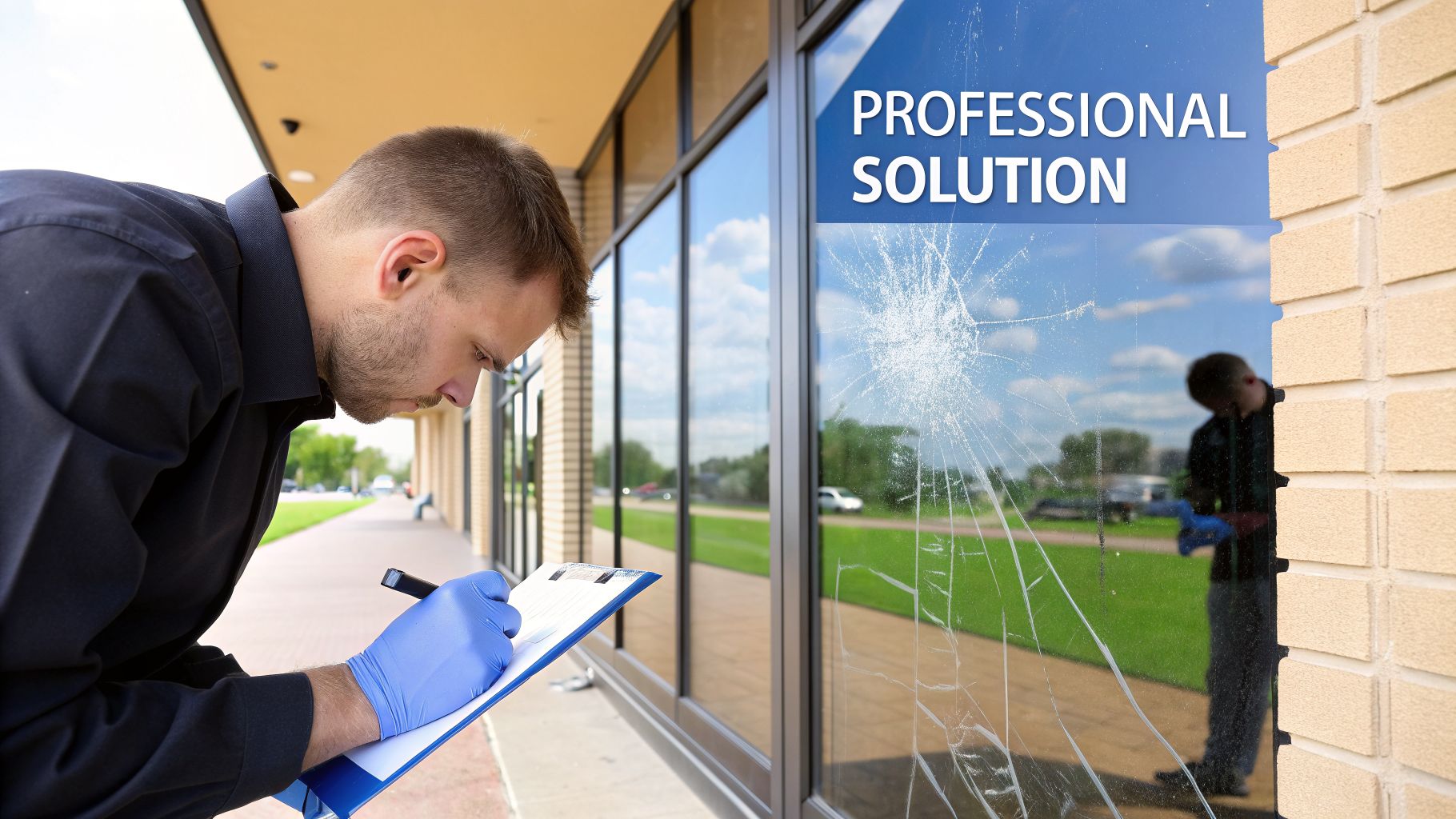
This is a huge issue for businesses in places with notoriously hard water, like Las Vegas, NV, where the mineral content in the water supply is off the charts. What might start as a minor annoyance from a misaligned sprinkler can quickly become a major liability that tanks your property's value.
To get why a professional solution is so vital, you need to understand what’s going on at a microscopic level. This isn't just dirt sitting on a window; it's a full-blown chemical reaction.
Hard water is loaded with dissolved minerals, mainly calcium carbonate (CaCO3) and magnesium carbonate (MgCO3). When water droplets dry on your windows, these minerals get left behind.
At first, these deposits are just sitting on top of the glass. But over time, the high pH of these alkaline minerals starts to eat away at the glass itself in a process called etching. This is the moment the stain becomes part of the window.
Once etching begins, the damage is no longer superficial. The minerals have physically changed the glass, creating microscopic pits and craters. At this stage, no amount of scrubbing with household cleaners will ever bring back the window's original clarity.
Many property managers understandably reach for common DIY solutions first, hoping for a quick, cheap fix. You’ll see plenty of suggestions online for vinegar, lemon juice, or baking soda, but these methods are completely outmatched when it comes to commercial-scale problems.
Here’s why they just don't work:
Trying to tackle severe stains without the right know-how can lead to permanent damage. A wrong move can cloud the glass for good, ruin window frames, or kill surrounding landscaping—turning a simple cleaning job into a very expensive repair project.
A professional service, like Professional Window Cleaning, brings over 26 years of experience to every job. We get the chemistry behind stain removal and use a strategic, proven approach. We don't just clean glass; we restore it.
This means using a true commercial hard water stain remover and the right techniques. For window cleaning professionals, there are ONLY two methods used: a squeegee for accessible areas, or an advanced pure-water system for larger or multi-story buildings. These methods guarantee the right product is applied safely and effectively, neutralizing the mineral deposits and rinsing them away without a trace.
Choosing a professional is an investment in protecting the integrity and look of your property for the long haul.
Before you even think about grabbing a bottle of commercial hard water stain remover, you need to play detective. Just like a doctor wouldn't prescribe medication without a diagnosis, you can’t treat a hard water stain without first understanding exactly what you’re up against.
Using a product that’s too weak is a waste of your time and money. But using one that’s too strong? That can cause permanent, irreversible damage to the glass.

This is a critical step, and honestly, it’s where most in-house maintenance teams go wrong. They see a white spot and treat it like any other. But in the world of professional window cleaning, we know that hard water damage happens in two very different stages, and each one needs its own game plan.
Your first move is a simple visual and tactile check. You need to figure out if you're looking at mineral deposits sitting on the surface (Stage 1) or if the problem has gone deeper and etched the glass itself (Stage 2).
Stage 1 Damage: These are your fresh or light mineral deposits. The window might look a little cloudy or hazy, or you might see distinct water spots. The key here is that the glass underneath the stain is still smooth and undamaged. These minerals are just sitting on top.
Stage 2 Damage: This is what happens when minerals sit on the glass for too long. Their high pH literally starts to corrode and eat into the glass, a process called etching. Now, the glass itself is physically damaged. The stain often looks milky or opaque, and if you run your hand over it, it will feel rough or even gritty.
For a business in a hard-water hotspot like Phoenix, AZ, something as simple as sprinkler overspray on a high-rise can turn Stage 1 into severe Stage 2 in no time, especially with that intense sun baking the minerals right into the glass.
To help you get it right on-site, we've put together a quick reference table.
This table breaks down the two stages of damage, what to look and feel for, and what the pros would do next.
This assessment is your roadmap. It tells you whether you're facing a simple clean-up job or a full-blown glass restoration project.
Here’s a simple, field-tested trick we’ve used at Professional Window Cleaning for years. It’s a fast and surprisingly accurate way to gauge the severity on the spot.
Find a small, out-of-the-way section of the stained glass. Gently try to scrape the deposit with your fingernail.
If the deposit flakes off or you feel your nail catch on a distinct layer, you’re almost certainly dealing with Stage 1 damage. This tells you the minerals are just resting on the surface.
But what if your nail just glides over the spot, and the glass itself feels pitted or rough? If you can't scrape anything off, you've got Stage 2 etching. The stain is no longer on the glass; it’s in the glass.
This quick test is what tells a pro whether a light chemical cleaning will do the trick or if it's time to break out the heavy-duty polishing gear.
Let's put this into practice. The context of the stain is often as telling as the stain itself.
Scenario 1: Faint Cloudiness on Ground-Floor Office Windows
Scenario 2: Opaque, Rough Stains on a Glass Awning
Getting the diagnosis right is the most important part of the entire process. It’s what separates a beautifully restored window from a costly, irreversible mistake.
The market for cleaning products is absolutely saturated, but not all are created equal—especially when you're up against stubborn mineral deposits. Picking the right commercial hard water stain remover is one of the most critical decisions you'll make on a job, and it's what separates a quick fix from a lasting solution.
You have to think like you're creating a buyer's guide, breaking down the options into three main camps: acid-based cleaners, abrasive powders, and advanced polishing compounds. Understanding the science behind each one isn't just a "nice to know"—it's non-negotiable. The wrong choice can lead to wasted time, poor results, or worse, irreversible damage to your client's glass.
For Stage 1 hard water stains, acid-based cleaners are usually the first line of defense. These products are carefully formulated with specific acids, like hydrofluoric or phosphoric acid, that are designed to chemically react with and dissolve the alkaline deposits of calcium and magnesium.
It’s like using a specialized solvent. The acid breaks down the molecular bonds holding the stain together, turning it into something you can simply wipe and rinse away. This chemical reaction is incredibly fast and effective, which is why pros often reach for these solutions first when dealing with surface-level staining.
But their power comes with some serious risks.
These aren't your everyday, all-purpose cleaners. Acid-based removers are hazardous materials that demand expert handling, precise dilution, and strict safety protocols, including full Personal Protective Equipment (PPE). This is a job reserved for seasoned professionals, like our team at Professional Window Cleaning, who has been cleaning windows for over 26 years, managing these potent chemicals safely.
If you don't know what you're doing, you can cause severe chemical burns, destroy window frames and seals, or kill nearby landscaping. For anyone but a trained and insured professional, the risk is just too high.
When you're dealing with Stage 2 damage—where the glass is physically etched and feels rough to the touch—chemicals alone won't cut it. The damage is no longer on the glass; it's in the glass. This is where abrasive powders and polishing compounds come into the picture.
These products don't work with a chemical reaction, but through mechanical action. They contain extremely fine, uniform particles that, when paired with a professional polishing machine and the right pad, physically grind away a microscopic layer of the glass. This process smooths out the pits and etching caused by the mineral deposits, restoring the glass to its original clear, smooth state.
Think of this method as a restoration project, not just a cleaning job. It requires a delicate touch and a deep understanding of how different types of glass behave. For a closer look at specific products and their applications, check out our comprehensive guide on the best hard water stain removers for various scenarios.
Deciding on the right commercial hard water stain remover isn't a one-size-fits-all situation. It comes down to a careful evaluation of a few key factors:
Ultimately, the smartest move is often to bring in an expert. A professional assessment guarantees that the right product and method are used from the start, protecting your investment and delivering flawless results every single time.
Knowing which commercial hard water stain remover to use is half the battle. The other half is applying it with the kind of precision and expertise that separates a true professional from an amateur. This is where theory meets practice. It’s not about just splashing chemicals on a window; it's a meticulous process designed to restore the glass without harming anything around it.
At Professional Window Cleaning, we’ve spent 26 years refining our approach. For window cleaning, there are ONLY two methods professionals use. For windows we can reach by hand, nothing beats the control of a traditional squeegee. But for high-rise buildings or sprawling commercial properties, like many we service in Phoenix, AZ, we rely on modern pure-water systems to get flawless results safely and efficiently.
The core of the professional workflow is simple: assess the damage, select the right tool for the job, and then apply it with skill.
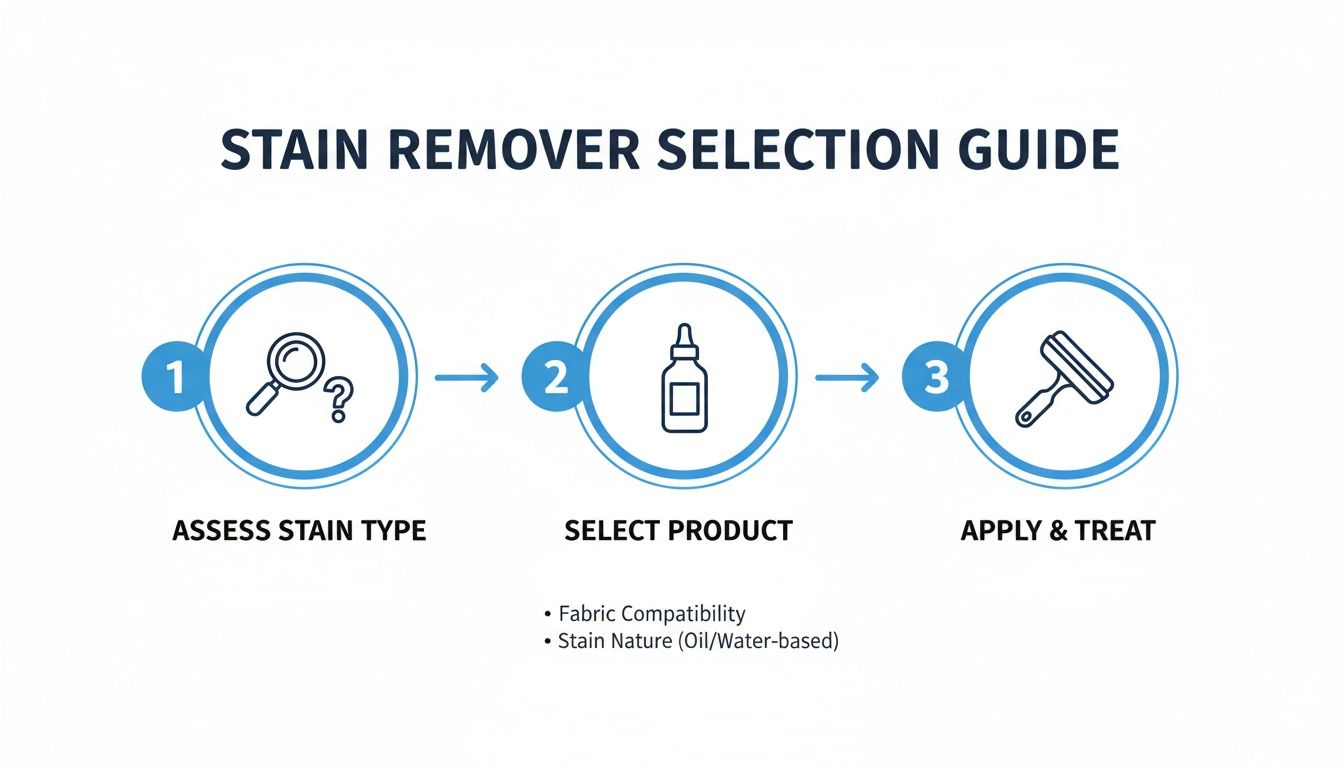
As you can see, application is the final step, and it only happens after a careful diagnosis and product selection.
Before a single drop of product ever touches the glass, our first priority is always safety and site protection. This is non-negotiable. It’s what protects your property, our team, and the surrounding environment from any potential damage.
A professional crew always starts by:
You can’t effectively treat a stain if the window is covered in a layer of dirt, dust, and grime. A pro always starts by giving the window a standard cleaning to get rid of all the loose debris. This simple step ensures the commercial hard water stain remover makes direct contact with the mineral deposits, letting it get to work right away.
This initial wash also gives our technicians one last chance to inspect the glass up close, confirming their diagnosis of the stain's severity before committing to a specific chemical or abrasive method.
Now for the critical phase. The goal here is to apply the remover evenly and work it into the mineral deposits without scratching or damaging the glass itself.
Insider Tip: We always work in small, manageable sections, usually no larger than 2x2 feet at a time. This is key to preventing the chemical from drying on the glass, which can create a new, even more stubborn type of stain.
The product is applied with a specialized, non-abrasive applicator pad or a hog's hair brush. The technician then uses controlled, consistent pressure to agitate the solution, helping to physically break down the mineral bonds. This isn't aggressive scrubbing—it’s a methodical process that lets the chemical do the heavy lifting.
Understanding this process on glass can even provide clues for other surfaces. For instance, knowing how to remove hard water stains from boat gelcoat highlights how different materials demand unique approaches to agitation and chemical choice.
After agitation, the product is left to "dwell" on the surface for a very specific amount of time, usually just a few minutes. This dwell time is crucial—it allows the chemical reaction to complete and fully dissolve the minerals. But leaving it on for too long is just as bad as not leaving it on long enough, as it dramatically increases the risk of etching the glass.
Once the dwell time is up, the surface is thoroughly rinsed. If we used an acid-based remover, this step often includes a special neutralizing agent to bring the glass pH back to a safe, neutral level before the final rinse.
The last step is to give the window a final, meticulous cleaning to ensure a perfect finish. As pros, we ONLY use one of two methods:
Following this comprehensive process doesn't just get rid of the hard water stains. It leaves the window in pristine condition, enhancing the appearance of the entire building.
The DIY spirit is great for many things, but tackling commercial hard water stain removal isn't always one of them. Sometimes, going it alone is not just impractical—it’s downright risky. Knowing when to step back and call in an expert is key to avoiding costly, irreversible damage. That line between a manageable cleanup and a full-blown disaster can be surprisingly thin.
Professional Window Cleaning has been cleaning windows for over 26 years, and we've seen firsthand where that line is. There are certain jobs that simply aren't negotiable; they demand the specialized skills, equipment, and insurance that only a seasoned pro brings to the table.
The most obvious red flag? Height and scale. Cleaning windows on a multi-story office building or a sprawling commercial complex is a world away from sprucing up a ground-floor storefront. It’s a high-risk job that requires certified safety training, proper insurance, and specialized gear like aerial lifts or intricate rigging systems.
For large-scale properties, like those you see in commercial hubs like Scottsdale, AZ, a DIY approach just isn't efficient. A professional crew can achieve in a few days what might take an in-house team weeks, all while following strict OSHA safety standards.
If you’ve done your homework and the diagnostic tests from earlier point to Stage 2 damage—where the glass feels rough, pitted, or has a cloudy, milky haze—chemical removers are not going to cut it. This isn’t a cleaning issue anymore. It’s a glass restoration project.
Trying to fix etched glass without the right tools is a recipe for disaster. At best, you’ll waste your time. At worst, you’ll leave behind widespread scratches and completely ruin the window. This kind of damage calls for industrial-grade polishing machines, specialized abrasive compounds, and the kind of delicate touch that only comes from years of hands-on work.
Scrubbing away at etching is like trying to sand a hardwood floor with a kitchen sponge. You need the right tools for the job and a deep understanding of the material to get a flawless result.
This is a big one. If the solution to your stain problem is an acid-based commercial hard water stain remover, you need to call a professional. Period. These chemicals are incredibly effective at dissolving stubborn mineral deposits, but they are also incredibly hazardous if handled incorrectly.
Using them improperly opens you up to huge risks:
Our teams go through rigorous training to handle these materials safely. We use full PPE and precise application methods to protect your property and the surrounding environment—a major concern, especially for properties in areas like Denver, CO, where environmental consciousness is key.
One of the biggest advantages we bring to any job is our investment in equipment that’s just not practical for an in-house maintenance team. For professional results, there are ONLY two methods of window cleaning professionals use: a traditional squeegee for easily accessible windows, or a pure-water system for everything else.
Water-fed poles running pure water let us safely clean windows several stories high right from the ground. This water is filtered to remove 100% of all minerals, so it cleans brilliantly and dries completely spot-free without any chemical runoff. It’s faster, safer, and delivers a finish that’s impossible to replicate otherwise. To see how these methods protect your investment, you can explore our comprehensive commercial window cleaning services.
Ultimately, bringing in a professional is about managing risk and guaranteeing a great result. It's a smart investment in your property's value, safety, and long-term appearance.
Even with the best plan, there are always a few lingering questions. Professional Window Cleaning has been cleaning windows for over 26 years in cities like Las Vegas, NV and Phoenix, AZ, and we have heard just about everything from property managers and business owners. Here are the answers to the most common ones.
Yes, they absolutely can, and it happens faster than you might think.
Initially, the hard water leaves behind mineral deposits like calcium and magnesium that just sit on the glass surface. At this early stage, they can be cleaned off with the right commercial hard water stain remover.
But if you let them sit, things get serious. The high pH of these alkaline minerals starts to corrode the glass itself. This is a process called etching, and it's physical damage—not just a stain. Once glass is etched, it can't be "cleaned" away. Severe etching often means intensive glass polishing or even a full window replacement, which is why tackling it early is so critical.
We strongly advise against this unless you're a trained professional. Acid-based removers are powerful, hazardous chemicals that demand expert handling.
Without the proper training and equipment, you risk severe skin burns, permanent damage to your window frames and seals, and even killing off expensive landscaping. Professionals are trained in using personal protective equipment (PPE), containing the chemicals, and neutralizing them safely. For the safety of your property, your team, and yourself, acid washing is a job that must be left to experienced and insured technicians.
Prevention is always the best long-term strategy. Once your windows have been professionally restored to their former glory, the goal is to keep them that way.
Here are a few effective strategies:
The same minerals that stain your windows can cause issues inside, too. Many property owners also deal with related problems, like how to unclog your shower head and restore water pressure, which is often caused by the same hard water buildup.
The honest answer? It depends entirely on your location and how hard your local water is.
For businesses in areas with notoriously hard water, like our clients in Las Vegas, NV, we often recommend a professional assessment and cleaning at least twice per year. For properties in regions with more moderate water, an annual service might be all you need.
The key is to be proactive rather than reactive. A consistent maintenance schedule is far more affordable than footing the bill for a major restoration project to fix severely damaged glass.
When hard water stains have become too much to handle, it's time to call in the experts. The team at Professional Window Cleaning has the experience and equipment to restore your property’s glass safely and effectively. Visit us at https://www.professionalwindowcleaning.com to get a quote and see the difference a professional clean can make.
Read our blog posts regularly and keep learning.