
Care and Maintenance
High Rise Windows Explained for Building Owners
Learn what high rise windows are, how they work, and how to hire pros to clean and maintain high rise windows safely and efficiently.


If you've ever gone to battle with those stubborn, cloudy spots on your windows, you already know that your average, everyday cleaner just doesn't cut it. The best hard water stain removers get the job done by using either mild acids or gentle abrasives. This allows them to dissolve or physically lift away the mineral deposits—we're talking calcium and magnesium—that have chemically fused themselves to the glass. It's a targeted approach for a specific problem because you're fighting a chemical residue, not just a bit of dirt.
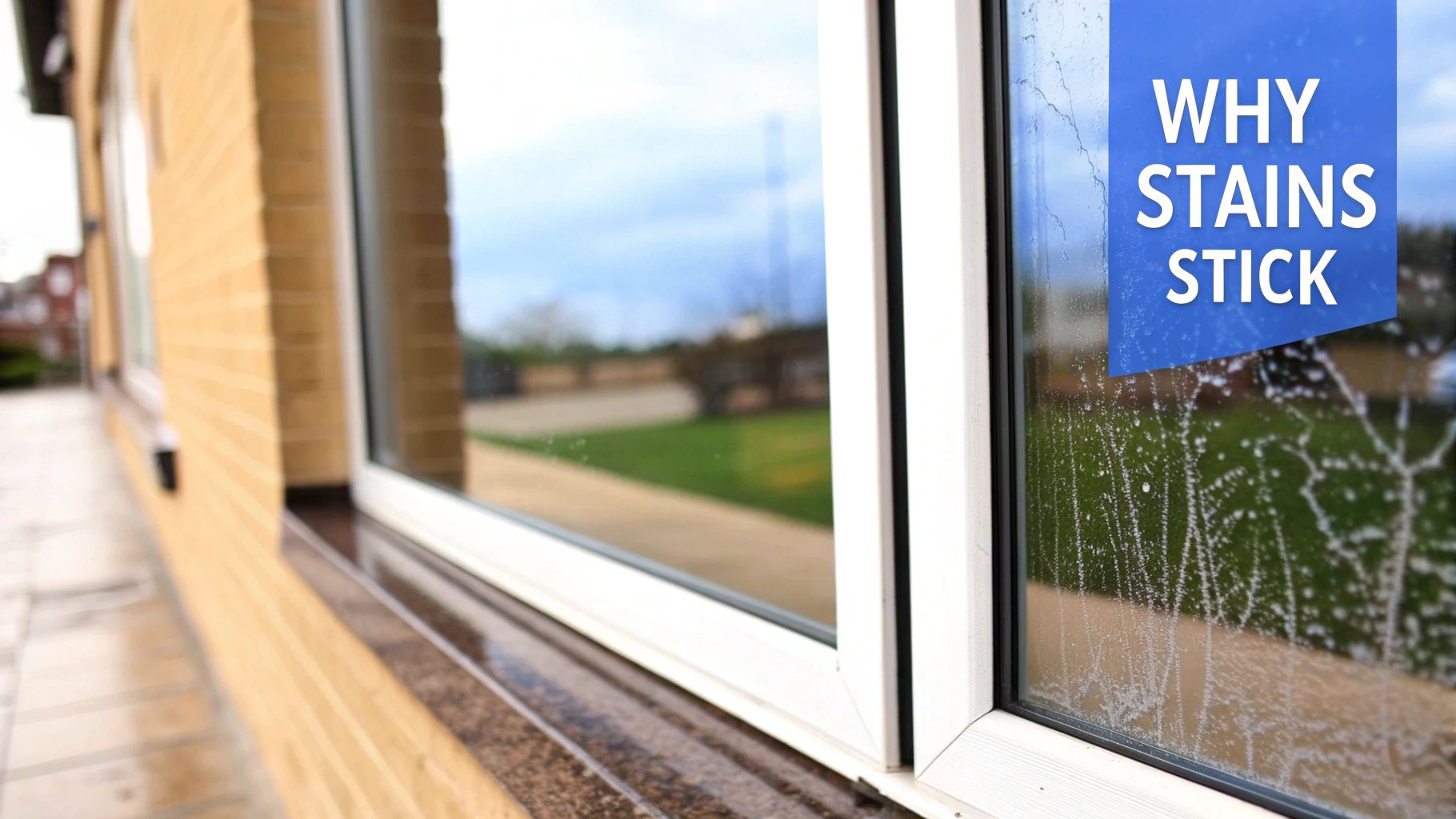
That frustrating, milky film isn't just grime; it’s a stubborn layer of mineral scale left behind when water evaporates. This is a common headache for property owners, especially in areas where the water is naturally rich in minerals. Every time a stray sprinkler hits your window or rainwater dries in the sun, it leaves its mineral content behind, mostly calcium and magnesium carbonates.
These minerals don't just sit politely on the surface. Over time, they actually form a chemical bond with the silica in the glass. This bond is what makes them so incredibly difficult to remove with standard ammonia-based window cleaners. The longer they sit, the stronger that bond gets, which can eventually lead to etching—a process where the minerals start to corrode the glass itself.
The process is simple but surprisingly destructive. Water is just the delivery truck for the minerals. Once the water is gone, the minerals have nowhere to go. This is why you’ll often see the worst staining on windows that get hit by sprinklers day after day. Each splash-and-dry cycle adds a fresh layer of minerals, making the problem worse.
The core issue is a chemical reaction. You're not just wiping away grime; you're trying to break down a crystalline mineral structure that has adhered to your window's surface. This is why a different approach is necessary.
This problem is so widespread that it has created a huge demand for effective solutions. In fact, the global market for hard water stain removers hit a valuation of USD 3.12 billion and is expected to nearly double by 2033. That number really highlights how common this frustrating issue is for homeowners and property managers everywhere. You can discover more about the market's growth and trends from this detailed report.
Not all hard water stains are created equal. The right way to tackle them really depends on how long the deposits have been there and how severe the buildup is. Figuring out what stage the stain is in is your first step toward getting that clear view back. For example, a homeowner in a city we service like Las Vegas, NV, might deal with more advanced staining simply because of the region's water quality and dry, hot climate.
Before you grab a bottle of anything, take a close look at your windows. You can usually sort the stains into one of three categories:
To make it even simpler, here's a quick table to help you diagnose the problem at a glance.
Use this table to quickly identify your stain level and find the right starting point for getting your windows clean.
Once you know what you're dealing with, you can choose the right tools for the job instead of wasting time on methods that won't work.
This decision tree gives you a visual path to follow to quickly figure out how serious your hard water problem is.
As the flowchart shows, the main question is whether you're dealing with a surface-level deposit or if the glass itself has been damaged. Answering that question will tell you exactly what to do next. Honestly, understanding what you're up against is half the battle won.
Before reaching for specialized hard water removers, you might want to check your pantry first. For those lighter, more recent stains, some of your most powerful tools are simple, acidic household items that are fantastic at dissolving the alkaline mineral deposits stuck to your glass.
These DIY solutions are the perfect first line of defense. They’re cheap, easy to find, and much gentler on your windows (and you) than harsh commercial chemicals. Tackling spots early is especially key in sunny places like Scottsdale, AZ, where intense heat can literally bake minerals onto the glass, making them a nightmare to remove later.
The science here is pretty simple: it’s all about acid-base chemistry. The minerals in hard water, like calcium and magnesium, are alkaline. When you apply a mild acid, it triggers a chemical reaction that neutralizes and dissolves those chalky deposits, letting you wipe them right off. The two best household acids for the job are easily white vinegar and lemon juice.
White vinegar, with its acetic acid, is a classic for a reason. Its acidity is just right for breaking down that cloudy film on your windows. Lemon juice works the same way thanks to its citric acid, dissolving the buildup while leaving a much fresher scent behind.
To make your cleaning solution, just mix equal parts white vinegar or fresh lemon juice with distilled water in a spray bottle. Using distilled water is a critical pro tip—tap water will just add more minerals back onto the glass, defeating the whole purpose.
For a little extra kick, you can warm the vinegar mix in a microwave-safe bowl for about 15-20 seconds. A little warmth helps speed up the chemical reaction, giving it more power against stubborn spots.
Remember, the key is to let the acid do the heavy lifting. Spray the solution generously onto the glass and let it sit for at least five to ten minutes. This "dwell time" is crucial for the acid to penetrate and break down the mineral bonds.
After the solution has had a chance to work its magic, use a non-abrasive scrubbing pad or microfiber cloth to work the area in small circles. You should be able to feel the gritty mineral texture breaking down as you scrub.
Sometimes an acidic spray just doesn't have enough muscle. When you’re dealing with slightly tougher spots, adding a mild abrasive gives you the physical scrubbing power you need to lift the minerals without scratching the glass. Baking soda is perfect for this.
Baking soda is a fine, gentle abrasive that’s great at physically knocking mineral particles loose. When you mix it with a bit of water or vinegar, it forms a paste that adds some serious scrubbing power to your efforts.
Here’s how to do the baking soda paste method:
Finally, the most important step for a streak-free finish—whether you used a spray or a paste—is how you dry the window. After more than 26 years of experience, we can tell you that only two methods deliver perfect results: a squeegee or a pure-water system. For a DIY job, a good-quality squeegee is your best tool. It pulls all the moisture and dissolved minerals off the glass before they can dry and create new spots. This final step is what separates an okay job from a professional one.
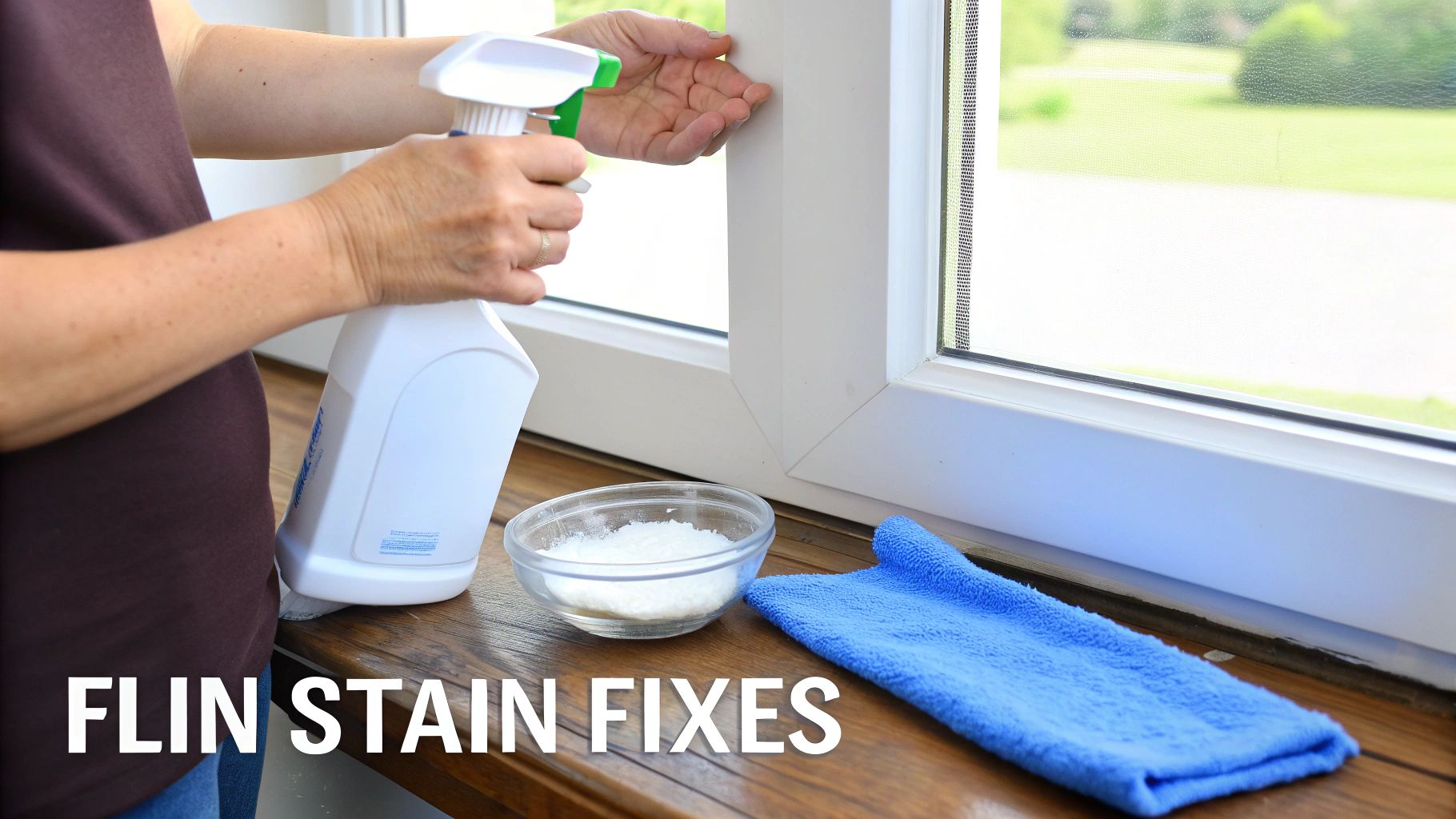
Sometimes, home remedies like vinegar and baking soda just don't have the muscle to cut through years of mineral buildup. When you're facing those stubborn, chalky stains that refuse to budge, it's time to bring in the pros—the commercial hard water stain removers.
The problem? Store shelves are overflowing with options, all promising a miracle in a bottle. The secret to picking the right one isn't about flashy labels; it's about understanding what's inside that bottle and how it works. These products are engineered to break the tough chemical bonds minerals form with glass, and they typically fall into two camps: cleaners that use mild acids to dissolve stains and others that use fine abrasives to polish them away.
The real magic behind a commercial remover lies in its active ingredients. Once you know what to look for, you can read labels like an expert and choose the perfect product for the job.
Here are the most common ingredients you'll come across:
Think about how the best descaler for coffee machines tackles that tough limescale buildup. The same science of dissolving mineral deposits applies to your windows, just on a larger scale.
Grabbing the strongest cleaner isn't always the best move. A product that's too harsh can do more harm than good, potentially etching or damaging your glass. On the other hand, a cleaner that’s too weak will just leave you frustrated. It’s all about finding the right balance.
For light spots or moderate cloudiness, a liquid or cream cleaner with a mild acid is usually all you need. But for those thick, caked-on deposits that look like they've been there for decades, you may need to step up to a paste or powder with a gentle abrasive. It takes more physical effort, but it can restore glass that looks completely hopeless. We've seen this countless times in places like Phoenix, AZ, where the intense sun bakes hard water minerals right into the glass.
Safety First: Always wear protective gear when you're working with commercial-grade cleaners. That means, at a minimum, waterproof gloves and safety glasses. You don't want any of this stuff splashing onto your skin or in your eyes. Good ventilation is also a must.
Over the past few years, we've seen a big shift in the market. More people are looking for safer, greener cleaning solutions, and companies have responded. Now, you can find a growing number of eco-friendly and biodegradable hard water stain removers that use plant-derived acids and other sustainable ingredients to get the job done.
Choosing the right cleaner is half the battle, but applying it correctly is what delivers those crystal-clear results. For more on application techniques, check out our guide on finding the best cleaner for hard water stains on glass.
Ultimately, after 26 years in this business, we know that for a truly flawless, streak-free finish, nothing beats professional tools. Only two methods guarantee that perfect shine: a masterful squeegee technique or a pure-water system.
So, you’ve tried the vinegar sprays and store-bought cleaners, but that stubborn, hazy film just won’t budge. It’s easy to feel defeated at this point. But before you resign yourself to permanently cloudy windows, there are a couple of advanced, hands-on techniques you can try.
Think of these as the last resort before calling in the pros. We’re moving from chemical solutions to gentle, physical abrasion. The goal is to physically knock off those caked-on mineral deposits without harming the glass itself. It takes a steady hand and some patience, but it can often save windows that seem like a lost cause.
This is your final DIY boss battle. Get it right, and you’re rewarded with crystal-clear glass. But one wrong move could leave you with fine scratches. That’s why a strict, safety-first approach isn't just recommended—it's non-negotiable.
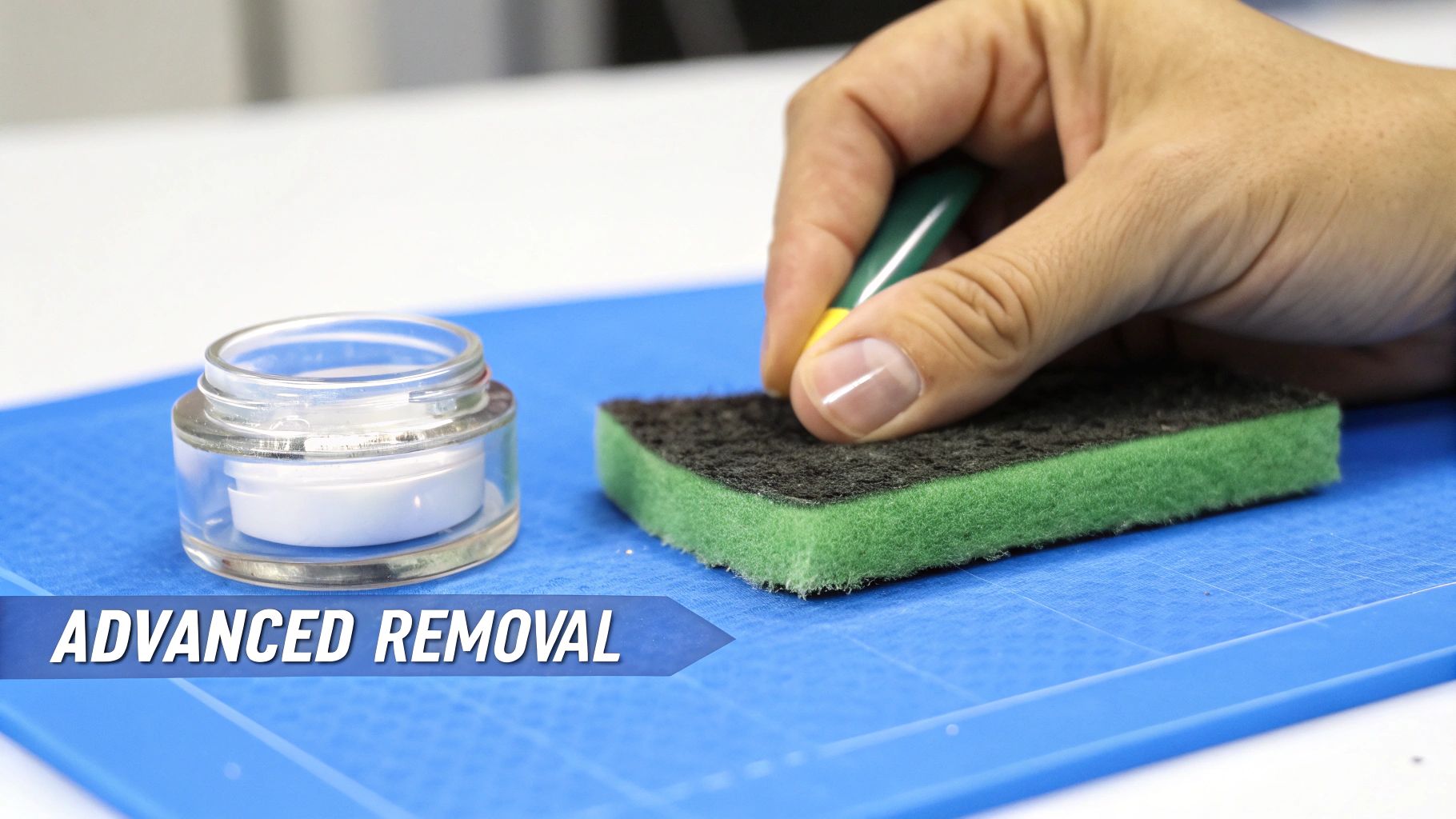
The thought of rubbing steel wool on glass probably sounds like a recipe for disaster. But we’re not talking about the coarse pads you’d use on a rusty grill. The secret is #0000 grade steel wool, the finest grade you can get. It’s so fine that it has just enough abrasive power to shear off mineral deposits without scratching the incredibly hard surface of the glass.
But before you go to town on your entire window, you must do a test.
If the glass is clear and scratch-free, you can confidently move on to the rest of the stained areas. Just remember to keep that surface well-lubricated. This method is especially effective for property owners in places like Denver, CO, where the high mineral content in the water can lead to some seriously tough buildup over time.
If even the #0000 steel wool couldn't completely cut through the stains, your next move is a specialized glass polishing compound. These products contain extremely fine abrasives—often cerium oxide—suspended in a paste. For context, cerium oxide is what pros use to polish out minor scratches and imperfections in glass.
This method is less about cleaning and more about gentle restoration. The compound is actually resurfacing the very top layer of the glass, taking the etched-in minerals right along with it.
The process requires a bit of precision.
Just repeat this process across all the affected areas. It can be time-consuming, no doubt, but the results are often dramatic.
This is the most aggressive technique you should ever try on your own. If these advanced methods don't solve the problem, the issue is likely severe etching that has physically compromised the glass. At that stage, any more DIY work risks causing permanent damage. It’s time to call in the experts. With over 26 years of experience, we have the specialized tools—like pure-water systems and professional-grade polishing equipment—to safely restore your view without risking your glass.
You've sprayed, scrubbed, and polished with everything you can think of, but those ghostly white stains just won't budge. We get it. Sometimes, despite your best efforts with even the most potent DIY hard water stain removers, the problem is simply too stubborn for household solutions.
This is the point where continuing to experiment can actually do more harm than good. Pushing too hard can lead to permanent scratches or chemical damage to the glass itself. Recognizing when to put down the tools and pick up the phone is the smartest move you can make to protect your windows.
If you’ve tried it all and are still staring at cloudy, hazy glass, that's your cue. With over 26 years of experience, we've seen every level of mineral buildup imaginable. Our team has specialized equipment that solves problems DIY methods simply can't touch.
Deciding to call for help isn't admitting defeat—it's making a smart decision to get the job done right without causing permanent damage. There are a few clear signs that your hard water stain problem has gone from a weekend project to a job for the pros.
These are the most common scenarios we see:
If you determine that calling a professional is your best bet, it can be useful to understand typical house cleaning prices to get a general idea of service costs. However, for a specialized task like this, getting a direct quote is always the best approach.
When our team shows up, we're not using the same tools you find on store shelves. Professional Window Cleaning has been cleaning windows for over 26 years! There are only two methods that guarantee flawless, streak-free results on even the worst hard water stains. Every single time.
The right method depends entirely on the situation, but both deliver a level of clean that’s simply out of reach without professional training and equipment.
At Professional Window Cleaning, we never compromise on quality. Our entire business is built on two proven techniques: traditional squeegee mastery and modern pure-water technology. This focus ensures every client gets a perfect finish.
For homeowners in places like Phoenix, AZ, where hard water is a constant battle, our service is the definitive answer to restoring your view.
The first method is the classic art of traditional squeegee cleaning. A seasoned pro uses a proprietary, eco-friendly cleaning solution that’s formulated to dissolve mineral buildup. Then, with a high-quality squeegee, they whisk away every last drop of water before it can dry, leaving absolutely nothing behind. It's a skill that takes thousands of hours to perfect.
Our second, more advanced approach is the pure-water system. This technology is a game-changer. It uses a multi-stage filtration process to strip 100% of all dissolved solids from the water, creating lab-grade pure water.
We then use a water-fed pole to scrub and rinse the windows from the ground. Because the water is completely pure, it dries to a perfectly clean, spot-free finish without any need for a squeegee. It’s incredibly effective and the safest way to clean high windows.
To understand the science behind it, you can learn more about how hard water stains form on glass and see why pure water is the ultimate weapon against them.
Even with a solid game plan, you're bound to run into questions when you’re staring down a stubborn patch of hard water spots. To make sure you’re ready for anything, we’ve put together answers to the questions we hear most often from homeowners fighting that frustrating mineral buildup.
Getting clear, straightforward information is the final piece of the puzzle. This is especially true in places like Phoenix, AZ, where the combination of intense sun and mineral-heavy water is the perfect recipe for window stains.
Yes, they absolutely can, and it happens more often than people think. If you let those mineral deposits—mostly calcium and magnesium—sit for too long, they start a chemical reaction with the silica in your glass.
This process is known as etching or glass corrosion. Once it starts, it creates a permanent cloudiness that no amount of scrubbing will ever remove. It literally becomes part of the glass itself.
The key takeaway here is that hard water buildup isn't just an eyesore; it's a progressive problem that can cause irreversible damage. Acting fast can save you from a costly professional glass polishing service or even a full window replacement down the road.
Many modern, eco-friendly stain removers are surprisingly good, especially if you're dealing with light to moderate stains. They typically rely on plant-based acids, like citric acid, which are much safer for your family, pets, and the garden below.
Now, these gentler formulas might need a little more "dwell time" on the glass to work their magic, and you may need to put in a bit more elbow grease compared to harsher chemicals. But for routine upkeep and newly formed spots, they are an excellent first choice. For severe, years-old buildup, however, you’ll likely need a more powerful solution to break through those calcified layers.
Prevention is, without a doubt, your best long-term strategy. The number one culprit behind stained windows? A misaligned sprinkler system. Your first and most effective step should be to adjust every sprinkler head so they stop spraying your windows and frames.
Beyond that, the goal is to get water off the glass before it has a chance to evaporate and leave minerals behind. When you wash your windows, always dry them immediately and thoroughly. Professional Window Cleaning has been cleaning windows for over 26 years, and we have found that only two methods guarantee a perfect, spot-free finish: a high-quality squeegee or a professional pure-water cleaning system.
Using a squeegee correctly pulls every single drop of mineral-rich water off the surface. For the ultimate preventative solution, our pure-water systems rinse windows with water that is 100% free of dissolved minerals. That means there is literally nothing left behind to create a spot.
When you've tried everything and need a guaranteed solution, the team at Professional Window Cleaning is ready to restore your view. With over 26 years of experience, we have the tools and expertise to tackle the most stubborn hard water stains safely and effectively. Visit us at https://www.professionalwindowcleaning.com to get your free estimate today.
Read our blog posts regularly and keep learning.