Care and Maintenance
How to Clean Building Windows Safely in 2026
Learn how to clean building windows with professional squeegee and pure-water methods. Step-by-step guide covering safety, tools, and maintenance.


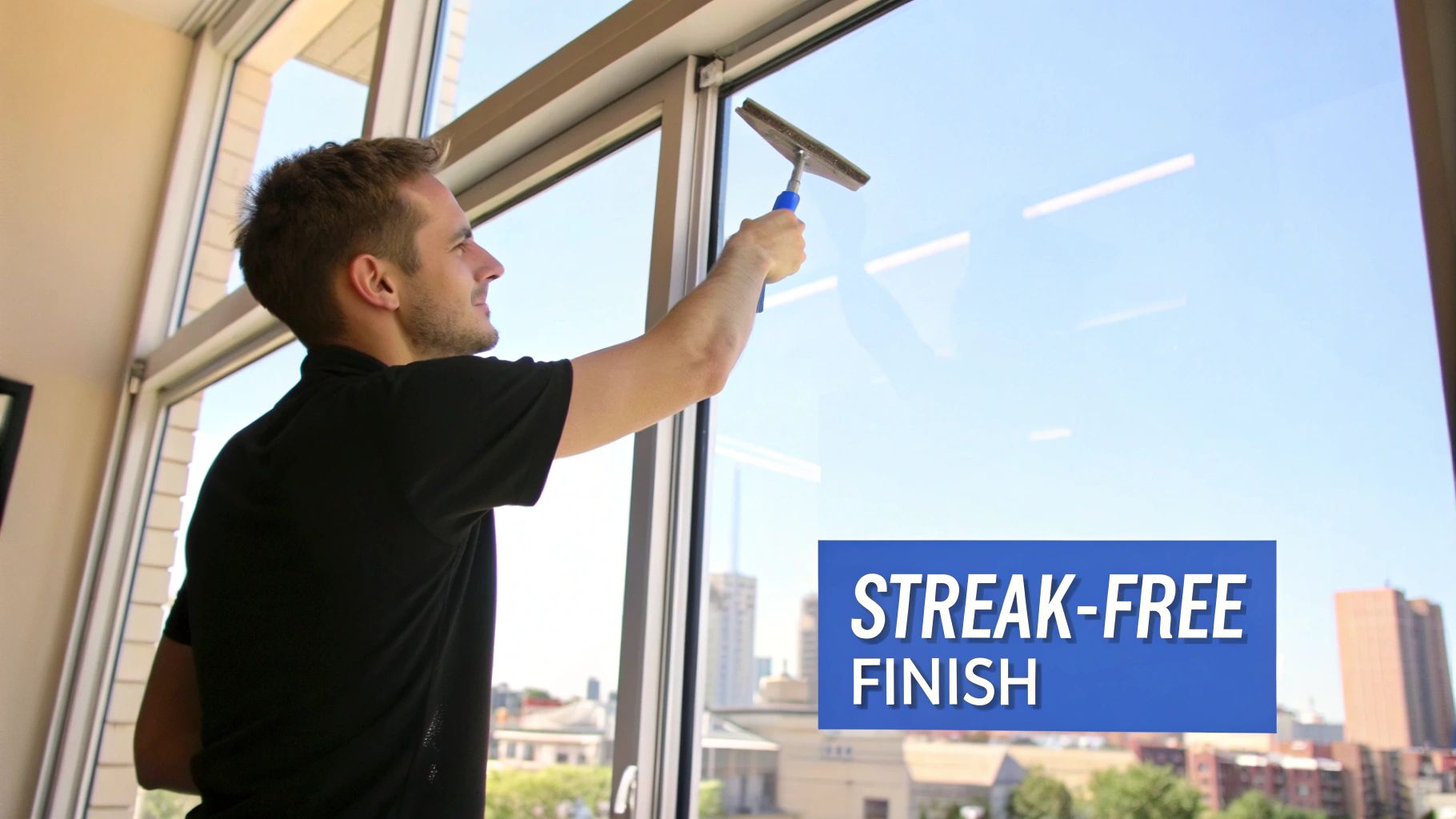
Getting that invisible, streak-free window isn't about luck—it's about method. The secret to how to clean windows without leaving streaks is ditching the paper towels and adopting one of two techniques the pros swear by: the traditional squeegee or a modern pure-water system. As Professional Window Cleaning, we've been cleaning windows for over 26 years, and we can tell you these are the ONLY two methods professionals use for a flawless finish.
This guide cuts through the myths to show you exactly why these methods deliver a perfect shine, every single time.
If you've ever spent an afternoon spraying and wiping your windows only to step back and see a blurry, streaky mess, you're not alone. The common DIY approach—a spray bottle of blue cleaner and a roll of paper towels—is fundamentally flawed.
Honestly, it just pushes dirt around. Worse, it leaves behind lint and chemical residue that create those frustrating streaks, especially when the sun hits the glass just right.
At Professional Window Cleaning, we've spent over 26 years perfecting our craft in cities like Las Vegas and Phoenix. I can tell you with certainty that there are really only two methods the pros rely on for consistently flawless results: using a high-quality squeegee or a pure-water system. These are the ONLY two methods professionals use.
These are the exact techniques our teams use on everything from residential homes in Scottsdale to the high-rise commercial buildings in bustling downtown Phoenix.
The secret isn’t some magic solution; it's the process. Both professional methods are designed to remove 100% of the water and dirt from the glass surface. Nothing is left behind to dry and cause streaks.
For a quick look at how these approaches stack up, here’s a simple breakdown.
As you can see, the difference is in the removal. One method pulls everything off, while the other just moves it around.
The core principle is simple: move the dirt and water off the glass completely. Paper towels absorb, but a squeegee removes. That single difference is what creates a truly professional, streak-free shine.
This is the foundation for getting pro-level results on your own, whether you're tackling windows on your home in Denver or a commercial storefront in Las Vegas. By adopting the right tools and techniques, you can finally learn how to clean windows without leaving streaks and enjoy the pristine view you deserve.
The difference between a frustrating chore and a truly satisfying result almost always comes down to your equipment. To really learn how to clean windows without streaks, you have to ditch the paper towels and that mystery blue spray bottle. The pros rely on a simple, yet incredibly effective, set of tools designed for one purpose: getting every bit of dirt and water off the glass.
Having the right gear doesn't just make the job easier; it completely changes the outcome. It’s the reason our teams at Professional Window Cleaning can deliver flawless results on homes across Denver and commercial properties in Phoenix.
The heart and soul of any professional window cleaning kit is the squeegee. I'm not talking about the flimsy, plastic tool you find in the discount aisle. A high-quality squeegee has a sturdy channel (usually brass or stainless steel) and, most importantly, a sharp, precision-cut rubber blade.
That blade does all the real work. Think of it like a razor-sharp windshield wiper, pulling every last drop of dirty water off the glass before it can evaporate and leave behind mineral deposits and streaks.
Here’s what you should look for when picking one out:
You can dive deeper into the specific types of professional window cleaning equipment we use every day in our guide.
Beyond the squeegee, a few other key items will take your window cleaning game from amateur to expert. These tools work together to prep the window, apply your solution, and handle the final, crucial details.
The "two-bucket method" is simple but critical. By using one bucket for your soapy water and a second for clean rinse water for your scrubber, you avoid contaminating your cleaning solution. This stops you from just smearing dirty, gritty water back onto the glass—a common mistake that guarantees streaks.
The North American glass cleaner market is booming, yet so many people still struggle with streaks from residue. At Professional Window Cleaning, we've sworn by the 'two-bucket method' since we began serving areas like Scottsdale and Las Vegas to get perfectly clear results. It's easy: one bucket gets a simple dish soap solution (about one teaspoon per gallon), and the other gets clean rinse water. Dip your scrubber, work top-to-bottom, then squeegee. The single-bucket approach just moves dirty water around, which is a major cause of streaks, according to industry veterans.
You can walk right past the aisle of expensive, chemical-heavy window cleaners. The best solution is one you can make yourself, and it costs pennies.
All you need is a bucket of cool water and a few drops of a quality liquid dish soap—that's it. A good rule of thumb is about half a teaspoon of soap per gallon of water. You're looking for just enough soap to create a little slip on the glass, which helps the squeegee glide smoothly, but not so much that you're dealing with a mountain of suds.
This simple mix is powerful enough to cut through grease and grime. More importantly, it rinses completely clean. Many commercial cleaners contain additives, dyes, and scents that leave behind a sticky film. That film is a magnet for more dust and is a primary cause of streaks, especially in places like Las Vegas where hard water minerals can react with those chemicals. For really tough exterior grime, looking into tools like soap injectors for pressure washers can also offer clues about what cleaning agents work best for the toughest jobs.
This is where the real magic happens. If you’re serious about getting a truly professional, streak-free finish, learning to use a squeegee correctly is the single most important skill you can develop. It’s not just about wiping; it’s a practiced motion that physically lifts and removes every last bit of dirt and water from the glass.
This is the exact technique our teams at Professional Window Cleaning have perfected over 26 years on countless homes and commercial buildings across Phoenix and Denver. Once you get the hang of it, you'll be amazed at how quickly and effectively you can clean. It’s a satisfying process that delivers consistently perfect results.
The process boils down to three core components: a bucket for your solution, the solution itself, and the all-important squeegee.
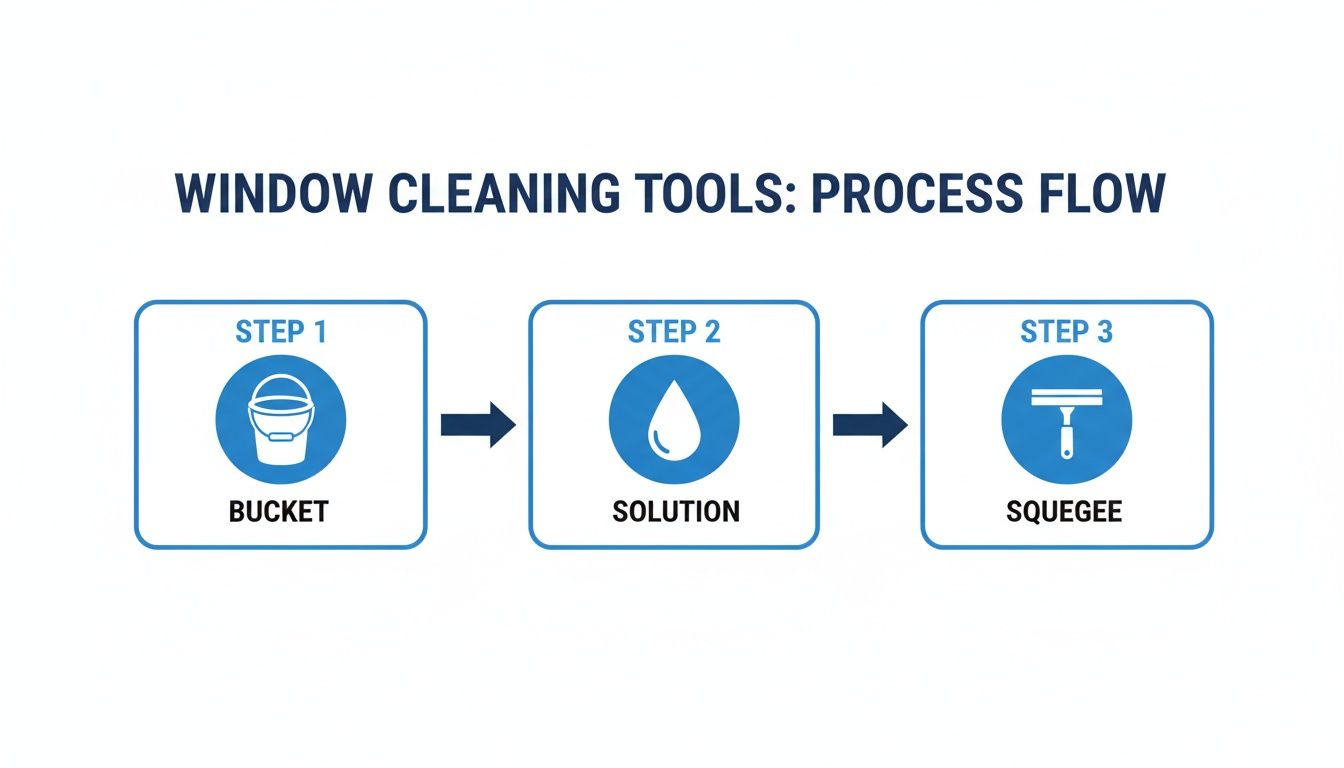
This just goes to show that professional window cleaning isn't about complex chemicals. It’s about mastering a simple set of high-quality tools.
Before your squeegee even touches the glass, a couple of quick prep steps are essential.
First, use your scrubber to apply a generous, even coat of your cleaning solution to the entire pane. Don't be shy here—you want the glass completely wet. This lubricates the surface and allows the squeegee blade to glide smoothly without skipping. Work the scrubber in overlapping strokes, both horizontally and vertically, to loosen all that built-up dirt and grime.
Next, you need to create a dry starting zone for your squeegee. This is a crucial step that many beginners miss. Take a clean microfiber cloth, wrap it around your index finger, and run it down one side of the window frame. You're just wiping a thin, one-inch strip of the glass completely dry from top to bottom. This technique is called "cutting the edge."
Pro Tip: By creating this dry edge, you give the squeegee a clean place to start. This prevents dirty water from seeping out from behind the blade and running down the side of your freshly cleaned pane—a common source of frustrating vertical streaks.
With the window prepped, you're ready for the main event. We use two primary techniques, and which one you choose really just depends on the size of the window.
For smaller, standard-sized windows, the straight top-to-bottom pull is the most effective method.
For larger panes of glass, like picture windows or the commercial storefronts common in Denver, a simple top-to-bottom pull is inefficient and can lead to mistakes. This is where the pros use a more advanced technique called the "S-Method" or "fanning." It’s a fluid, snake-like motion that cleans the entire pane without ever lifting the squeegee from the glass.
This technique definitely takes some practice, but it's the fastest and most effective way to tackle big windows. It involves pivoting the squeegee in your hand as you move down the glass, always directing the water toward the uncleaned portion of the window.
To really get a feel for the movements, watching a video demonstration can be a huge help. You can learn more about how to precisely execute both of these techniques in our detailed guide on how to squeegee a window like a true professional.
No matter which method you use, the final step is detailing. Grab a fresh, dry microfiber cloth to wipe any remaining water from the edges and corners of the pane and along the windowsill. This final touch is what separates a good job from a perfect one. Mastering these skills is the key to finally learning how to clean windows without leaving streaks.
While a squeegee is perfect for most residential jobs, not all window cleaning challenges are created equal. Sometimes you run into stubborn problems that demand a completely different game plan, from tough mineral stains to hard-to-reach glass on multi-story buildings.
Knowing how to pivot your approach is what really separates a DIY attempt from a professional outcome. At Professional Window Cleaning, we know there are really only two methods the pros rely on. When a squeegee just won’t cut it, we turn to our second secret weapon: a pure-water system.
This advanced technique is the gold standard for tackling the trickiest scenarios, especially for the high-rise buildings you see dotting downtown Las Vegas or Scottsdale.
So, what makes a pure-water system such a game-changer? It’s all about filtration. The system takes regular tap water and runs it through a multi-stage process that strips out 100% of the dissolved minerals. This leaves you with deionized, or "pure," water that is incredibly effective at cleaning.
Here's how it works: Water in its pure state is highly reactive and naturally wants to grab onto minerals, dirt, and grime. When we feed this deionized water through a long, water-fed pole and spray it onto a window, it acts like a magnet for gunk.
The pure water attracts and dissolves dirt particles right off the glass, while a specialized brush on the end of the pole gently agitates any stubborn spots. The best part? Because the water has zero mineral content, it can be left to air dry on its own. The result is a perfectly clear, spot-free finish without ever touching the glass with a squeegee.
This is exactly why pure-water systems are essential for cleaning high-rise windows. Technicians can safely and efficiently clean exterior glass several stories high from the ground, eliminating the need for ladders or scaffolding in many situations.
One of the most common and frustrating problems we see, especially for our clients in Arizona and Nevada, is hard water stains. Those cloudy, white spots are mineral deposits (mostly calcium and magnesium) left behind after water evaporates. Unfortunately, they can't be removed with a simple soap-and-water solution.
You might be tempted to grab a scraper, but please don't—this can permanently scratch your glass. Instead, you need a mild acid to safely dissolve the mineral buildup.
These methods can restore clarity to your windows without causing damage. For extensive hard water damage, however, calling in a professional is often the safest and most effective bet.
What about windows that are absolutely caked in dirt, like after one of those major dust storms rolls through Phoenix? If you go straight in with your scrubber, you’ll just turn all that dirt into a muddy, streaky mess.
The key here is a pre-rinse. Before applying any soap, give the window a gentle rinse with clean water to wash away the heavy, loose layers of dust and grit. This simple step prevents you from grinding abrasive particles into the glass with your scrubber.
After rinsing, you might need a slightly stronger soap solution. Try increasing from a half-teaspoon to a full teaspoon of dish soap per gallon of water. This gives you extra cleaning power to cut through the remaining film of grime before you start your standard squeegee process. This two-step approach is our go-to for ensuring a brilliant shine, no matter how dirty the window was to begin with.
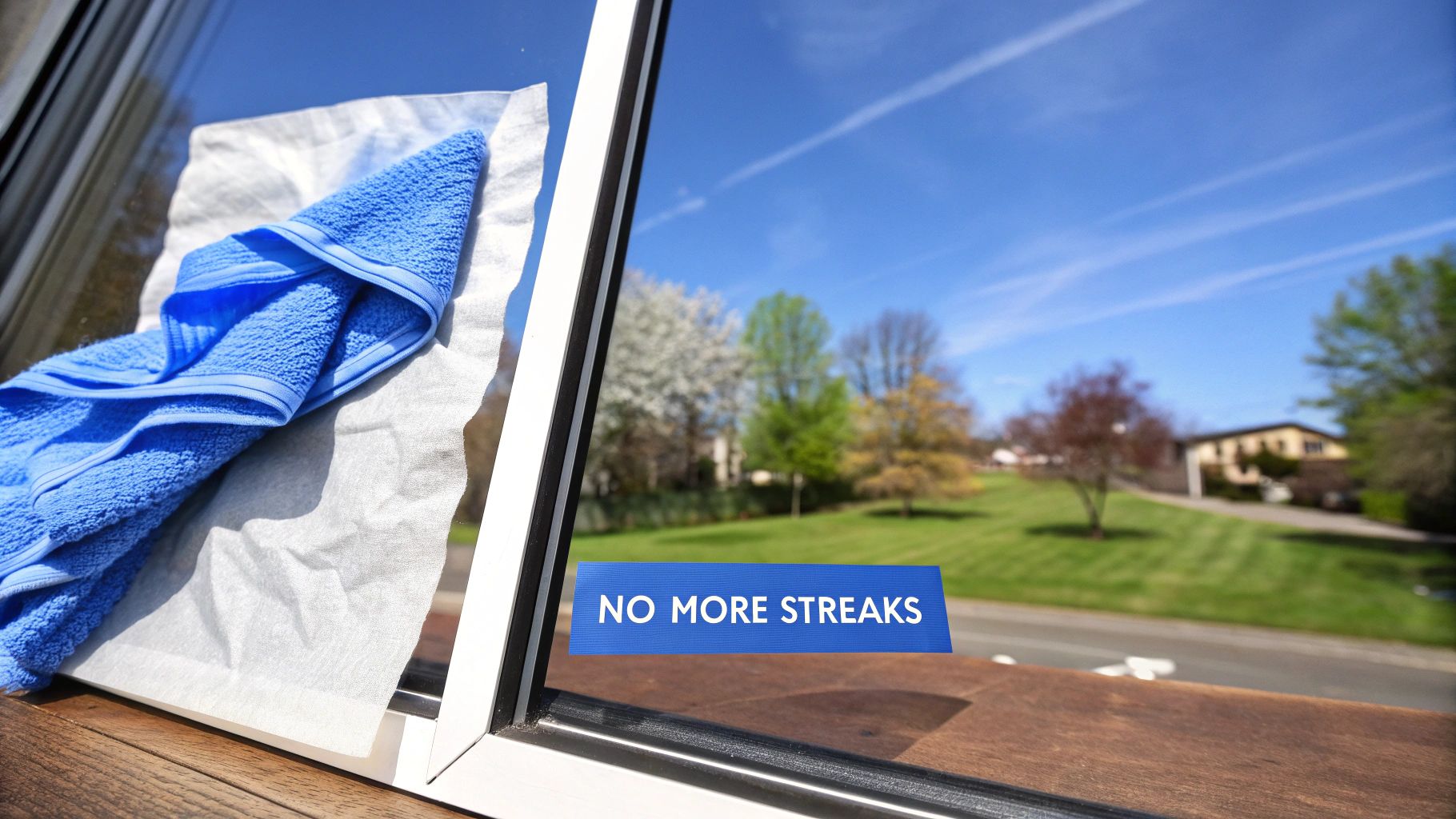
You can follow every instruction to the letter and still end up with a window that’s just… okay. It's frustrating, but a nearly perfect job can be ruined in the final moments by tiny, overlooked mistakes. Learning how to get that 100% flawless, streak-free finish really comes down to mastering the details.
These aren't complicated fixes, either. They’re just simple tweaks to your process that head off common problems before they can even start. Avoiding these pitfalls is what separates a frustrating afternoon of DIY from a truly satisfying, professional-grade result.
The number one way a great window cleaning job goes sideways? Drips. After you’ve squeegeed the pane to perfection, that little bit of water left hiding in the corners or along the frame slowly runs down, creating brand-new streaks on your beautifully dry glass.
This is exactly why detailing is non-negotiable. Grab a clean, bone-dry microfiber cloth and thoroughly wipe the edges of the pane and the windowsill as your final step. It’s a simple move that catches those sneaky drips before they have a chance to sabotage your hard work.
Another rookie mistake we see all the time is poor timing. It might seem like a bright, sunny day is perfect for spotting every last bit of dirt, but you should never clean your windows in direct, hot sunlight. The heat is your enemy here.
Sunlight causes your cleaning solution to evaporate almost instantly, long before you have a chance to properly squeegee it off. What gets left behind is a film of soap residue and mineral deposits from the water—the very definition of streaks.
The best time to clean windows is on an overcast day, or in the early morning or late afternoon when the sun isn't beating directly on the glass. This gives you plenty of time to work and ensures the solution stays wet until you're ready to wipe it clean.
This simple adjustment to your timing can make a world of difference, especially in sun-drenched climates like we see in Denver, CO, and Scottsdale, AZ.
Even with the best technique, a few bad habits can creep in and ruin your results. Here’s a quick troubleshooting guide for the most common mistakes we see people make.
Streak-free windows aren't about luck—they're about science. Since our company, Professional Window Cleaning, started serving areas from Las Vegas, NV to Phoenix, we've seen it all. A key difference-maker is drying: pros who buff with a lint-free microfiber right after squeegeeing slash streaks significantly. Many DIY attempts fail because paper towels leave behind that lint residue, and ammonia-based cleaners react poorly with the hard water so common in places like Arizona. For our commercial clients, we often use deionized water systems, which remove nearly all impurities—an essential for medical offices where perfect clarity is non-negotiable. You can discover more insights on the professional window cleaning industry from Housecall Pro.
Mastering the art of streak-free windows is incredibly rewarding, but let's be honest—some jobs are just better left to the experts. Knowing when to put down the squeegee and pick up the phone isn't giving up; it's a smart decision for quality, safety, and your own sanity.
At Professional Window Cleaning, we've spent more than 26 years perfecting this craft. Trust us, we know exactly when a job calls for professional-grade equipment and a seasoned touch.
The most obvious sign it’s time to call a pro? Window accessibility. If you’ve got second-story windows, vaulted ceilings with high glass, or skylights, trying to clean them yourself can get dangerous fast. Juggling a bucket and squeegee while balanced on a ladder is a recipe for disaster.
Our technicians are fully trained and insured to handle those heights safely. For commercial property managers in Phoenix, AZ, or high-rise condo owners in Las Vegas, NV, professional service isn't just a good idea—it's non-negotiable. We bring out the specialized equipment like water-fed poles and aerial lifts to make sure every single pane is cleaned perfectly and, most importantly, safely.
Another thing to consider is the glass itself. Specialty windows with tints, films, or delicate coatings can be ruined by the wrong cleaning solution or a heavy hand. A professional knows exactly how to treat these surfaces without voiding a warranty or leaving behind costly scratches.
Hiring a professional isn't admitting defeat. It's making a strategic choice for superior results, safety, and peace of mind. For complex jobs, the time, risk, and potential for error in a DIY attempt often far outweigh the cost of an expert service.
If you're a business owner, you know that appearances matter. Streaky, dirty windows can turn customers away before they even step inside. Pristine glass, on the other hand, boosts your curb appeal and creates a welcoming vibe. Consistency is everything, and that's what professional services deliver—a flawless finish, every single time.
There's a reason the window washing industry is a multi-billion dollar business: people understand just how essential streak-free windows are for both homes and businesses. In high-rises across Denver, CO, pros often use purified water systems that can slash the potential for streaks by up to 95%. For homeowners in demanding climates like Scottsdale, AZ, hiring an expert is often more cost-effective than a botched DIY attempt that needs a professional do-over anyway. Since Professional Window Cleaning began, our teams have turned thousands of cloudy residential panes into crystal-clear views. You can learn more about the scale of the window washing industry from experts like Fish Window Cleaning.
Ultimately, if you're short on time, don't have the right equipment, or are facing a job that feels overwhelming or unsafe, calling a professional is the smartest move you can make. It frees you up to focus on what you do best while we handle what we do best—making your windows look brand new.
Even with the best guide in hand, questions pop up. After 26 years of helping homeowners and businesses in cities like Phoenix and Las Vegas get sparkling clean windows, we’ve pretty much heard them all. Here are a few of the most common ones our crews get asked every day.
This one’s easy. The most effective—and safest—solution you can mix up at home is simply a gallon of cool water with about a teaspoon of mild dish soap. That's it.
This simple formula is a powerhouse for cutting through grime, but it's gentle enough that it won't leave behind the film that vinegar or ammonia-based cleaners often do. This is the exact solution our pros use to get a professional, streak-free shine every single time.
We hear this one a lot! While it's a classic tip that’s been passed down for generations, it’s a bit outdated, and we strongly recommend against it.
Newspaper ink can easily bleed onto your window frames and sills, creating a whole new mess to clean up. Plus, the paper fibers break down and leave behind lint, which is a major cause of streaks. For detailing edges and wiping your blade, a quality, lint-free microfiber cloth is your best friend. It’s way more absorbent and won't leave any debris behind.
That’s a great question, and the honest answer is: it depends on where you are and what kind of property you have.
It’s incredibly frustrating to put in all that work only to be left with streaks. If you're using a squeegee and still seeing them, it usually comes down to one of a few common culprits.
The number one cause of streaks is a dull, nicked, or dirty squeegee blade. Your rubber blade needs to be sharp and perfectly clean. Wiping the blade with a microfiber cloth after every single pull isn't just a pro-tip—it's a non-negotiable step for a flawless finish.
Other things to check are cleaning in direct sunlight (which makes your solution dry too fast) or using too much soap in your water. When it comes to the cleaning solution, less is definitely more. Making these small adjustments is the key to finally getting that perfectly invisible, streak-free look.
Ready for a guaranteed streak-free shine without all the hassle? Trust the experts at Professional Window Cleaning. With over two decades of experience, we have the right tools and proven techniques to make your windows sparkle. Contact us today for a free estimate!
Read our blog posts regularly and keep learning.