Care and Maintenance
Cloth for Window Cleaning Choices That Deliver Results
Choose the best cloth for window cleaning by comparing microfiber, cotton, lint-free, and chamois options, plus care and selection tips.


The view usually tells the story first. A Reno homeowner looks out at the mountains after a windy afternoon, and the glass has already picked up a dry film of dust, a few sprinkler spots, and the faint haze that only shows up when the sun hits it sideways.
That’s why reno window cleaning isn’t the same as window cleaning in a mild, humid climate. In the high desert, glass takes a beating from dust, hard water, strong sun, and fast weather changes. Windows can look dirty again long before anticipated, especially when frames, tracks, and exterior panes keep collecting grit.
Professional window cleaning has become a bigger, more established trade for a reason. The industry was valued at $2.9 billion in 2024 and projected to reach $3.2 billion by 2029, reflecting steady demand from residential and commercial property owners who want clean, functional glass that lasts longer, according to Window Genie’s industry statistics overview.
A Reno window can look fine at noon and look filthy by 7 a.m. the next day. The change is usually not new dirt overnight. It is angled sunlight catching the dust film, dried mineral spots, and fine streaking that high desert conditions expose fast.

Reno is hard on glass for three main reasons. Wind carries fine grit. Hard water leaves mineral deposits. Strong sun bakes residue onto the pane and makes poor cleaning work show up quickly.
That combination changes how windows should be cleaned and how often they need attention. A light dust layer on the exterior can turn into visible haze in a day or two on a west-facing window. Sprinkler overspray is worse. If those minerals sit through repeated hot afternoons, they can bond to the surface and become much harder to remove without restoration work.
I have seen property owners blame the cleaner when the issue was old hard water staining that had already started to etch. Good service starts with knowing the difference between loose soil, bonded residue, and permanent glass damage.
A few clues help:
The goal is not just clear glass for a day. The goal is clean glass that stays cleaner longer in Reno’s dry, dusty conditions.
That takes the right sequence. Screens and tracks need attention first, or dust goes right back onto the pane. The glass needs the right method for its condition. Frames need to be checked for oxidation and runoff. Timing matters too. Cleaning hot glass in direct sun can dry solution too fast and leave extra detailing work, especially on large exterior panes.
For property owners, the practical questions are straightforward:
Clean results also depend on safe access. Second-story ladders, roof work, and awkward exterior glass should be handled with proper planning and working at heights safety, especially on properties with uneven grades or tight landscaping.
After 26 years in the trade, the pattern is consistent. Reno window cleaning is less about wiping glass and more about controlling dust, minerals, heat, and technique. Get those four right, and the windows stay clearer longer. Get them wrong, and the sun will expose every shortcut.
Window cleaning sounds like one service until you look at the property. A single-story home in South Reno, a dealership in Sparks, and a downtown condo tower do not get cleaned the same way. The tools, crew setup, access plan, and safety demands change with the building.
Inside a home, detail matters more than speed. Floors, walls, furniture, blinds, and window coverings are all close to the work area, so a good technician cleans glass without splashing frames or dragging dirty water onto painted surfaces.
Residential work usually includes more hand work than owners expect. Tracks collect dust and bug debris. Screens hold fine grit. French panes, cut-ups, and hard-to-reach bathroom windows take longer than a large plain pane that looks more intimidating from the yard.
A good home service visit usually focuses on things like these:
If a cleaner treats every residential pane the same, the result usually tells on them. Homes need finesse, not brute speed.
Commercial jobs are more about consistency, access, and timing. A medical office wants clear glass and minimal disruption. A car dealership wants showroom glass to stay sharp in direct sun. Retail storefronts need predictable maintenance so the entrance never looks neglected.
That’s where route planning and crew efficiency become part of service quality. If you manage multiple stops or recurring buildings, smart route optimization for service businesses helps crews arrive on time and avoid wasted travel, which is one reason strong commercial operators run tighter schedules and cleaner service windows.
Commercial work in places like Scottsdale or Denver often involves broad exterior glass, entry systems, lobby glass, and repeat service cycles. The same applies in Reno when buildings have public-facing glass that can’t stay dusty for long.
High-rise work is its own category. It requires a different mindset, specialized equipment, and strict planning before the first tool comes out. Access method, anchor points, drop zones, wind, pedestrian traffic, and glass type all matter.
For tall buildings, the primary issue isn’t just cleaning technique. It’s risk control. Anyone hiring for upper-story work should understand the basics of working at heights safety, because the company on your building should already have a serious plan for fall protection, access, and site control.
Here’s the practical difference between service types:
| Service type | Typical focus | What changes the job |
|---|---|---|
| Residential | Detail, interior care, screens, tracks | Furnishings, ladder placement, delicate surroundings |
| Commercial | Recurring appearance, low disruption | Business hours, access, traffic flow, uniform results |
| High-rise | Safety, access systems, exterior efficiency | Height, wind, equipment, crew training |
A useful first call is simple. Ask what method they’ll use, whether they clean tracks and screens, how they handle hard water, and what access issues they see on your property.
If the answers are vague, that usually means the process is vague too. Good reno window cleaning starts with matching the service type to the building, not forcing every property into the same routine.
In real trade work, there are only two professional ways to clean windows. The traditional squeegee method and the pure-water system. Everything else is a variation, an add-on, or a shortcut.
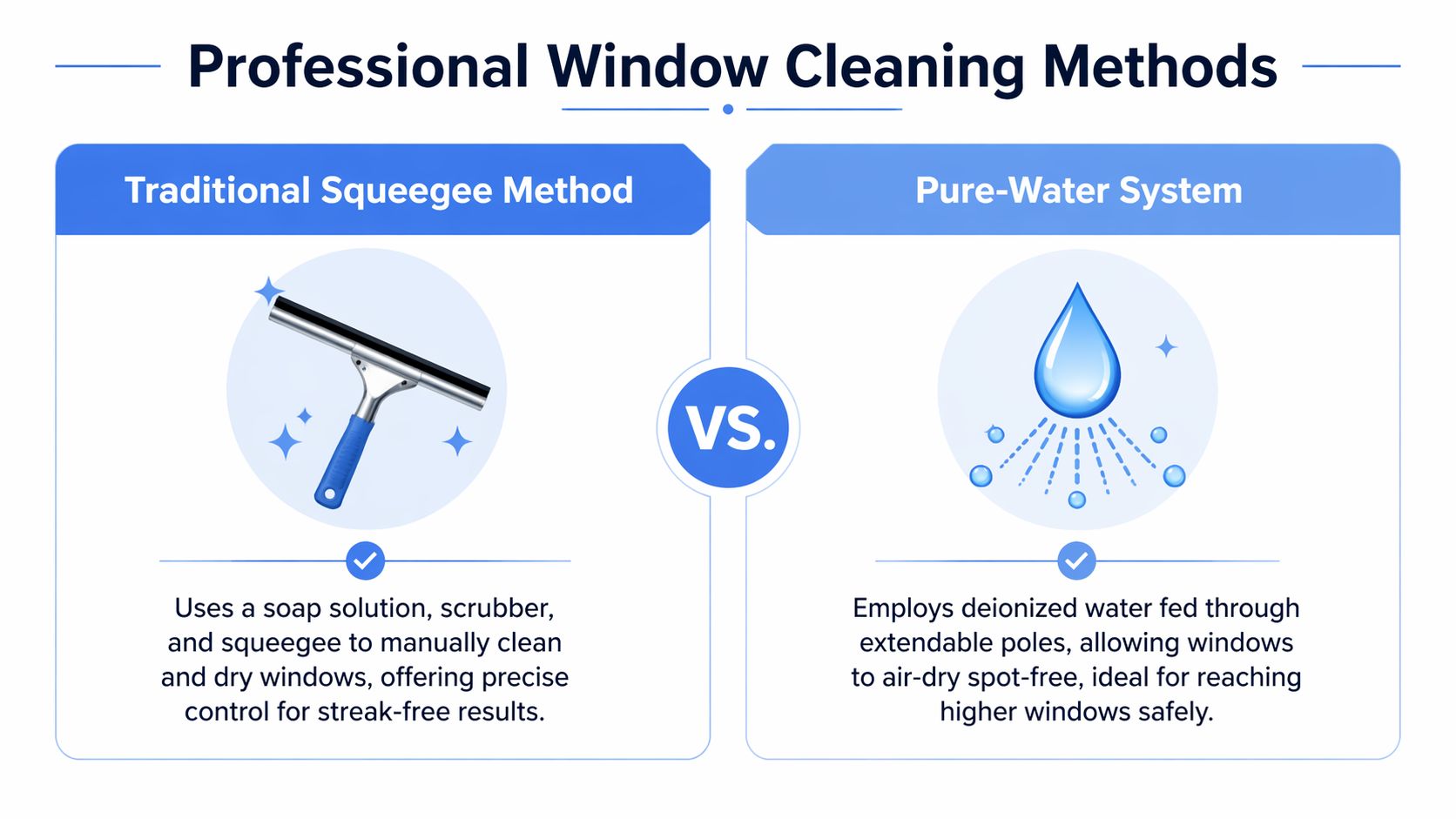
This is still the benchmark for precision work. It’s what experienced cleaners use on interior glass, detailed exterior panes, first-floor storefronts, and any job where control matters most.
The core technique is the S-shaped squeegee pattern. According to the verified trade guidance in this professional demonstration reference, the method uses a soapy solution with a scrubber or lamb’s wool applicator, then removes the water in continuous S-motions from top to bottom. The blade should stay close to the glass without lifting more than a finger’s width, and the rubber should be wiped clean after each pass to avoid putting dirt back on the pane.
That same reference notes several practical results:
A squeegee gives the cleaner direct control over pressure, edge work, and detailing. That matters on divided panes, interior glass, mirrors, and windows with edge contamination that needs hand-finished attention.
It also avoids one of the most common DIY mistakes. People scrub the window, then try to dry it with paper towels or cotton cloths. That often leaves lint, haze, and drag marks. The verified trade notes above specifically favor microfiber over cotton rags, because cotton tends to shred and lint when wet.
Straight pulls can work in the right hands, but uneven pressure often leaves vertical lines. The S-pattern keeps the water film moving and removes it more evenly.
Pure-water window cleaning is the other professional method, and for many Reno exteriors it’s the right one. It uses reverse osmosis and deionization to strip minerals from the water, then applies that purified water through a water-fed pole and brush. The glass is scrubbed, rinsed, and left to dry on its own.
The reason it works is simple. Tap water leaves minerals behind. Purified water doesn’t.
According to the verified technical guide from M2’s professional window cleaning insights, a pure-water system produces water with less than 10 ppm total dissolved solids, using RO membranes filtering to 0.0001 microns and DI polishing for very high purity. The same source explains that poles can reach up to 70 feet, which allows many upper windows to be cleaned from the ground.
That matters in Nevada because hard water is a real issue. The same guide notes 200 to 400 ppm TDS average in hard water areas like Nevada, which is exactly why tap-water rinsing leaves spots.
Pure water is ideal for exterior residential windows, multi-story buildings, solar-exposed glass, and commercial properties where speed and safe access matter. The verified guide above also reports these benchmarks for pure-water cleaning:
If you want a deeper explanation of the method itself, this overview of pure water window washing breaks down why purified water changes the result.
The biggest mistake owners make is assuming one method is always better. It isn’t.
Use a squeegee when:
Use pure water when:
What doesn’t work is mixing poor technique with the wrong water. In Reno, a fast wipe with dirty cloths and mineral-heavy water often makes the glass look worse in direct sun than if you had left it alone.
You get a quote in spring, then wonder why the glass still looks rough by August. In Reno, that usually comes down to three things the cheap bid ignored. Dust load, hard water exposure, and sun-baked residue. Those conditions change both the labor and the result.
If you want a broader pricing breakdown, this guide to window cleaning service cost considerations covers how companies build estimates. Here in Reno, local conditions usually decide whether a price is fair or incomplete.
Glass count matters, but it is rarely the whole story. Twenty large panes that are maintained twice a year can be easier than ten neglected windows with mineral staining, packed tracks, and screens full of cottonwood and dust.
Access is another big one. Windows over stairwells, steep landscaping, narrow side yards, and high foyer glass slow the job because they require more setup and more careful movement. On exterior work, sprinkler overspray and west-facing sun exposure often add time too. Hard water spots baked into hot glass do not come off with a quick wash.
The condition of the property changes the price more than many owners expect. Regular maintenance means dust removal, detail work, and a predictable process. First-time or catch-up cleaning often means extra scraping, screen washing, track cleanup, and spot treatment. That is why two homes with similar square footage can price very differently.
| Pricing Factor | Description | Impact on Cost |
|---|---|---|
| Number of windows and panes | More glass means more labor, especially when panes are divided into small sections | Higher count usually raises labor time |
| Interior, exterior, or both | Exterior-only service is faster than full interior and exterior work | Full service costs more because setup and detailing increase |
| Window style | French panes, sliders, skylights, transoms, and high foyer glass take different handling | Complex styles usually increase labor |
| Height and accessibility | Upper-story glass, tight side yards, landscaping, and steep approaches slow the work | Difficult access raises labor and equipment needs |
| Dirt level | Dust film is one thing. Heavy residue, track buildup, and mineral spotting are another | Heavier buildup increases time and specialty work |
| Screen and track cleaning | Many owners want the full package, not just glass | Adds labor but improves the final result |
| Safety setup | Commercial and elevated work may require more planning and equipment | More setup usually means a higher quote |
A low quote can mean exterior glass only. It can also mean no screen cleaning, no track detailing, no hard water treatment, and no allowance for windows that need ladder work or careful hand detailing.
Written scope matters. Ask whether the quote includes interior glass, exterior glass, screens, tracks, mirrors, skylights, and mineral spot removal. Ask how the company handles badly neglected panes. If that part is vague, expect a change order or a disappointing finish.
I have seen plenty of Reno homes where the owner thought they were comparing the same service. They were not. One bid covered a maintenance cleaning. The other covered restoration-level labor on sun-beaten glass.
Cost check: The fair quote is the one that clearly lists the work, the condition issues, and the access challenges before the crew starts.
Pricing is not only about what happens at the window. It is also affected by how a company schedules crews, groups jobs, and controls drive time across Reno and Sparks. Businesses that use route optimization usually run tighter appointment windows and waste less time between stops.
That does not automatically make them cheaper. It often makes them more reliable.
For Reno property owners, the practical question is simple. Does the quote reflect your actual glass, your actual access, and the kind of buildup our high desert climate leaves behind? If it does, the price usually makes sense. If it reads like a generic national template, it probably misses work that will show up later on the glass or on the invoice.
You hire a crew after a windy week in Reno. The windows looked dirty, but once the dust is off, sprinkler spots, baked-on residue, and old screen bleed suddenly show up. That is usually the moment a property owner finds out whether they hired a real window cleaning contractor or someone doing a quick wash.

In Reno, clean glass is only part of the job. High desert dust settles fast. Hard water can leave mineral spotting that cleaning alone will not fully erase. Intense sun bakes residue onto the glass and exposes every shortcut.
A good contractor should be able to walk the property and point out what is soil, what is mineral staining, and what is permanent damage. If they cannot explain the difference, they are guessing with your glass.
I would also pay attention to how they talk about maintenance. A contractor who works here year-round should discuss exposure by side of house, nearby dirt lots, wind patterns, irrigation overspray, and how often screens are loading up with dust. Generic answers are a bad sign.
Price matters, but the estimate conversation tells you more than the number.
Ask these questions:
Short, direct answers are usually a good sign. Vague reassurance is not.
Well-run companies usually communicate better, show up in the scheduled window, and send quotes that match the work. That often comes from good systems, not just good technicians. Many serious operators also invest in digital marketing for home services because clear communication, consistent branding, and easy scheduling help homeowners evaluate them before the first call.
Marketing does not prove workmanship. It does make it easier to spot companies that explain their process clearly and run a tighter operation.
Some Reno property owners want lower-impact products around landscaping, pets, or garden beds. Others care more about getting stubborn residue off first and worry less about the chemistry. Both are reasonable. The right contractor should be able to explain what they use and where those products make sense.
Benny’s Window Cleaning highlights a gap many local companies still gloss over, including customer interest in greener cleaning products and related exterior cleaning concerns. The practical takeaway is simple. If product choice matters on your property, ask during the estimate, not after the crew unloads.
Here’s a useful visual on what a professional visit should feel like in the field.
Crews who have worked in places like Las Vegas and Phoenix usually recognize the same trouble patterns we see in Reno. Dust abrasion, hard water spotting, heat-baked residue, and oxidized frame runoff all require better inspection and better technique than a basic soap-and-rinse approach.
After 26 years in this trade, I judge contractors by what they notice on the walkthrough. Do they check the sprinkler side first? Do they inspect sun-heavy elevations more closely? Do they explain what will clean up, what may improve only partially, and what is already etched into the glass?
Good contractors inspect carefully, choose the right method for the glass, and tell you the likely result before they start.
That is the difference between a lasting clean and a one-day improvement.
Good window cleaning is a partnership. The crew handles the tools, technique, and finish. The owner can make the visit smoother and help the results last longer, especially in a dusty climate.
A little prep saves time and protects your belongings.
The first day after a cleaning is usually when owners either help the result last or shorten it.
If you need to remove a fingerprint or dog nose mark, keep it simple.
Use a clean microfiber cloth with a light mist of water. Wipe gently, then dry with a second clean microfiber. Don’t scrub with bath towels, paper napkins, or anything abrasive. And don’t try to “polish out” hard water spots by hand. That usually spreads the mineral residue or adds scratches if grit is present.
Clean glass stays cleaner longer when screens, frames, and irrigation are managed. Most repeat dirt comes from the surroundings, not from the glass itself.
For Reno homeowners, that’s the maintenance mindset that works. Protect the result, reduce mineral contact, and don’t undo professional work with bad touch-ups.
It depends on exposure, not just preference. Homes near open lots, traffic, or frequent wind usually need more attention than sheltered properties. In Reno, exterior glass often shows buildup faster because dust and hard water combine quickly. If your views matter daily, a recurring exterior schedule usually works better than waiting until the glass looks far gone.
They should be, and that’s a fair question to ask before booking. Professional cleaners should explain what they use on the glass, what they use on frames or tracks, and whether purified water is part of the process. If you want lower-impact or vegan product options, ask directly during the estimate so the company can match the method and products to your concerns.
Interior cleaning should be controlled, careful, and dry around the edges. That means protecting floors, using clean detailing cloths, and avoiding drips on walls or furnishings. As for rain, light rain by itself usually doesn’t make properly cleaned windows dirty. In Reno, the bigger issue is rain carrying dust onto already dirty frames or screens. A good company should explain its policy clearly before the job, including what qualifies for a touch-up and what doesn’t.
If your glass is fighting Reno dust, hard water, and harsh sun, Professional Window Cleaning can help with residential, commercial, and high-rise service backed by more than 26 years of experience. Whether you need routine maintenance or a reset on badly neglected windows, their team uses the right professional method for the job so your views stay clearer, longer.
Read our blog posts regularly and keep learning.