
Care and Maintenance
All Seasons Window Cleaning: A Complete Year-Round Guide
All seasons window cleaning explained: how weather affects glass, season-by-season scheduling, methods pros use, and the real benefits of regular service.


You see the problem on site before the machine even starts. The hose is connected, the customer’s spigot is open, and the water supply still feels weak. In the Southwest, that’s common. A house in Scottsdale, a storefront in Las Vegas, or a commercial property in Denver can all have enough water for everyday use, but not enough steady flow for professional cleaning equipment.
That’s where a pressure washer buffer tank stops being optional gear and becomes part of a dependable setup. For window cleaners, especially those using equipment across residential, commercial, and high-rise work, the tank solves one of the most expensive field problems there is. Inconsistent feed water.
Professional window cleaners really use only two methods. We clean with a squeegee or with a pure-water system. Both methods depend on reliable water handling somewhere in the workflow. After more than 26 years in the trade, one lesson holds up on every route. Weak supply water slows jobs, stresses pumps, and creates avoidable downtime.
You feel the problem fast on a Southwest job. The customer has water at the house, but your machine still hunts for supply. In Scottsdale, Las Vegas, and parts of Colorado, that happens on properties that look perfectly fine from the curb. The issue is not whether water is present. The issue is whether the spigot can deliver steady volume under working demand.
A pressure washer buffer tank is a reserve tank installed between the property’s water source and your equipment. The source fills the tank at its own pace, and your pump draws from stored water instead of fighting the spigot directly. That separation is what keeps the machine fed when jobsite supply is weak, inconsistent, or slow to recover.
That matters in window cleaning because pumps do not handle starvation well. When incoming water falls behind demand, the pump starts pulling air and vapor along with water. You hear it as surging or chatter. Keep running like that and you build heat, lose consistency, and shorten pump life.
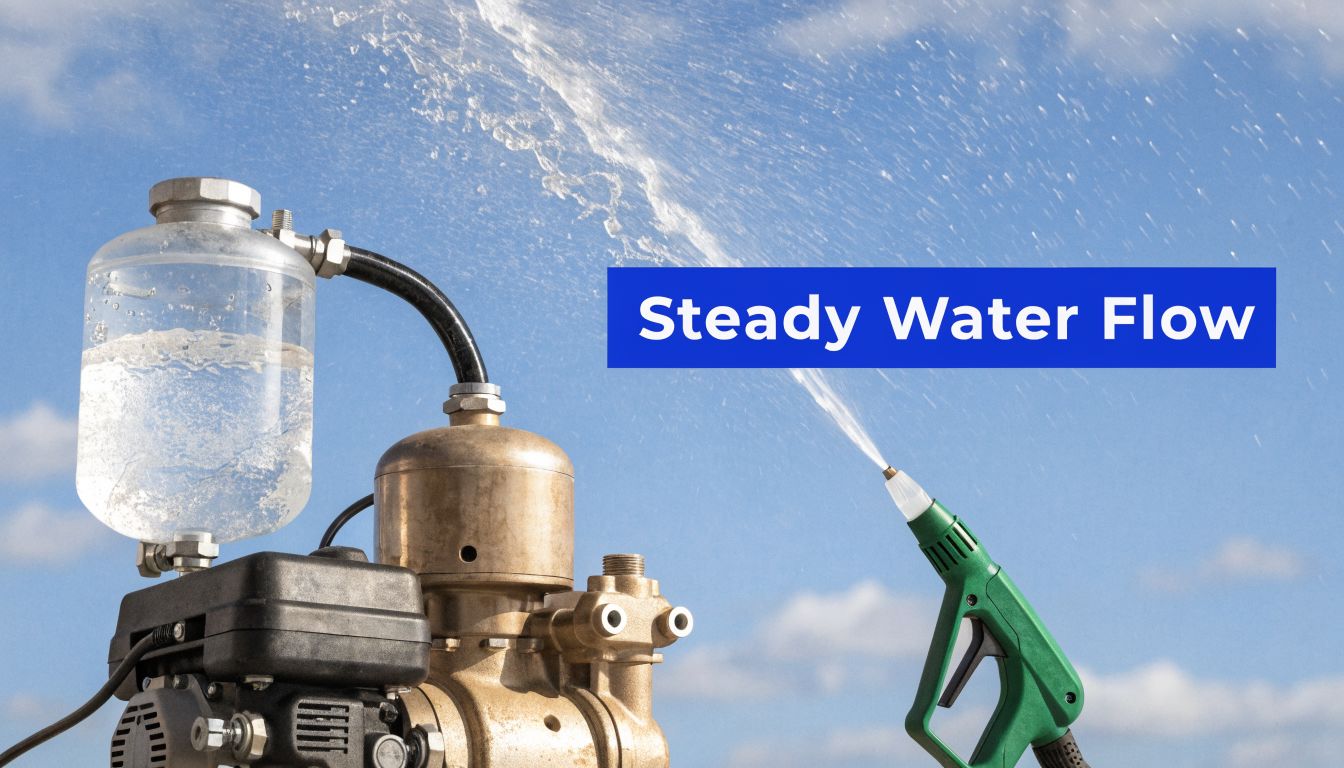
General equipment guides often treat a buffer tank like optional trailer gear for high-GPM pressure washing crews. In the arid Southwest, that misses the field reality. Low municipal pressure, long plumbing runs, aging hose bibs, elevation changes, and undersized service lines all show up on residential and commercial window cleaning jobs. If you want a plain-language explanation of the plumbing side, this guide on what causes low water pressure covers the common reasons supply falls off at the spigot.
After 26 years in this trade, I look at a buffer tank as protection for the entire job, not just the pump head.
Window cleaners work with less margin for interruption than a lot of contractors do. If water delivery gets unstable, rinse quality changes, filtration performance drops, and crews stop to troubleshoot instead of cleaning. That is a problem whether you are using support equipment around a squeegee workflow or running a pure-water setup all day.
It also matters for anyone who uses a pressure washer in the mix for selected surfaces, prep work, or restoration support. The water supply feeding that machine still has to stay consistent, especially if you are cleaning windows with a pressure washer as part of a broader exterior cleaning workflow and need predictable output from start to finish.
A buffer tank protects more than hardware. It protects production.
Homeowners often assume any outdoor faucet should be enough. In the field, that assumption costs time. Your machine does not care whether low supply comes from city pressure, old plumbing, a long hose run, or a restrictive valve. It only responds to the water reaching the inlet. The buffer tank gives your equipment a reserve to draw from, which is why crews working Arizona, Nevada, and Colorado routes treat it as standard equipment once they have been burned by low-pressure jobs a few times.
Pull up to a property in Scottsdale or Henderson with weak supply pressure, hook a pressure washer straight to the spigot, and the problem shows up fast. The machine wants a steady feed. The house gives you a weak, uneven one. A buffer tank separates those two realities so your equipment can keep working at a consistent pace.
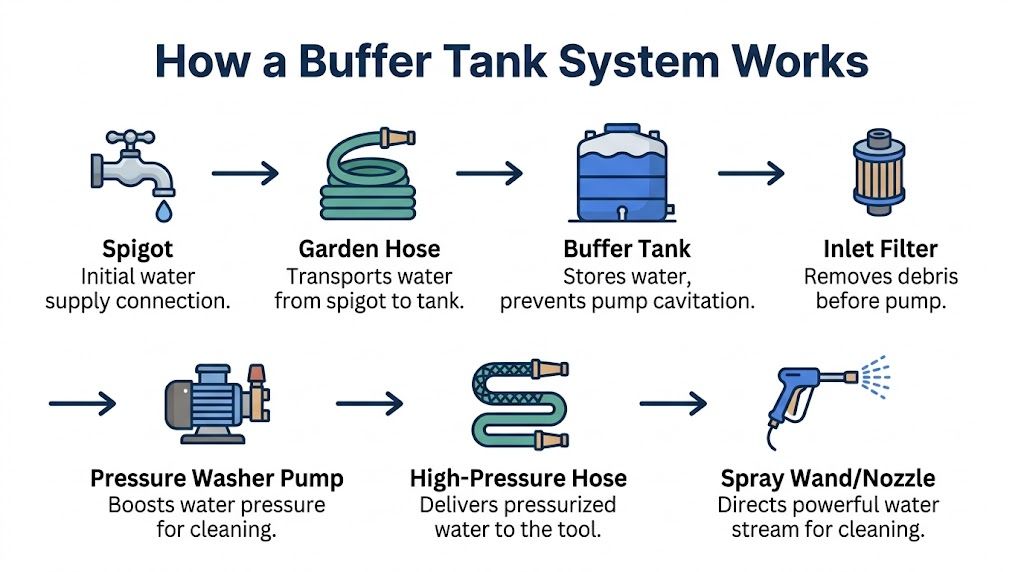
A properly set up system follows a straightforward path. Jobsite water feeds the tank first. The tank holds reserve volume. Your machine then draws from that reserve instead of trying to pull directly from a faucet that may be undersized, restricted, or inconsistent.
That order matters a lot in Arizona, Nevada, and parts of Colorado. Dry-climate properties often have long hose runs, older valves, pressure fluctuations, or irrigation plumbing that was never meant to support professional cleaning equipment. On those jobs, the tank is what keeps the machine supplied even when the source side is mediocre.
Here is the basic flow:
Spigot connection
Water enters from the customer’s faucet through a garden hose or supply line.
Tank inlet with float valve
The tank fills from the top or upper side. The float valve shuts off incoming water at the set level so the tank does not overflow.
Reserve water inside the tank
The stored volume absorbs dips in source flow and gives the machine something reliable to draw from.
Bottom outlet through a bulkhead fitting
Water leaves through a sealed outlet near the lower part of the tank, where the feed line gets its supply.
Feed hose to the pump
The pressure washer pulls from the tank, not the faucet. That change is what protects inlet flow.
Pump, hose, and tool downstream
Water moves through the machine and out to the hose, reel, gun, wand, surface tool, or support equipment.
Good systems are simple, but the small parts still matter.
A float valve controls refill without constant attention from the crew. If it sticks open, you waste water and create a mess. If it sticks closed or fills too slowly, the tank level drops under load and the machine starts starving.
Bulkhead fittings fail for predictable reasons. The hole is cut rough. The gasket is twisted. The fitting is overtightened. I have seen plenty of leaks that traced back to installation, not the part itself.
The hose between the tank and the pump has to stay open under suction. A soft garden hose can flatten, especially in heat. Once that happens, the pump acts like the tank is empty even when you are staring at water in it.
Tanks also need proper venting so water can leave without creating a vacuum effect. Outlet size matters too. If the outlet or valve is undersized for the machine, the tank cannot deliver what the pump is asking for.
The best buffer tank setups are usually plain, short-plumbed, and easy to service in the field.
Booster pumps have their place, but they add another motor, another switch, more plumbing, and another point of failure. For route work, that matters. The more parts you add, the more chances you give yourself to lose time on a job.
An unpressurized buffer tank solves the more common problem. It gives the machine reserve water to pull from when the source cannot keep up. In the Southwest, that is usually the issue. Low incoming volume and inconsistent pressure are more common than a complete lack of water.
That distinction matters if your crew does mixed exterior work. On some jobs, pressure equipment supports prep, restoration, or selected surface cleaning around the property. On others, it should stay away from the glass. If you need that line explained clearly, this guide on cleaning windows with a pressure washer lays out where pressure fits and where it causes problems.
Window cleaners usually run one of two production methods. Traditional squeegee work or pure water.
For traditional work, the tank helps when low supply affects rinse tasks, support tools, or any pressure washer work tied to the job. For pure water systems, stable feed matters because filtration performs better with consistent incoming flow. In dry Western markets, that is not a small detail. It is often the difference between working steadily and babysitting the water source.
What works best in the field is pretty consistent:
Crews who clean across Phoenix, Las Vegas, and Front Range service areas learn this fast. If the source water is unreliable, the tank becomes part of the production system, not an accessory.
Most buying mistakes happen before the tank is ever installed. People choose by what fits the trailer, what’s on sale, or what another contractor happens to be running. The right way is to size the tank around the water deficit your machine has to bridge.
Tank sizing begins with one question. How much more water does your machine use than the source can deliver?
A verified example makes the math clear. If a pressure washer uses 10 GPM and the water source supplies only 7 GPM, the shortfall is 3 GPM, which equals 180 gallons per hour. In that case, a 125-gallon tank is inadequate for sustained work, while 275 gallons is a safer professional benchmark to prevent cavitation, based on this breakdown of buffer tank sizing by flow deficit.
Buy for the deficit you actually face on jobs, not the best-case water supply you hope to get.
| Machine GPM | Job Type | Recommended Minimum Tank Size (Gallons) |
|---|---|---|
| Lower-flow machine | Residential work with reliable source water | Smaller buffer tank, matched to your actual deficit |
| 7 GPM machine | Professional operation where continuous supply matters | 275-gallon tank is a safer benchmark |
| 10 GPM machine with 7 GPM supply | Sustained professional use with a 3 GPM shortfall | 275-gallon tank |
The main point isn’t to memorize one number. It’s to stop guessing. If you know your machine output and know what the source really delivers, the tank decision gets easier.
Smaller tanks can work on light residential routes when the supply is fairly steady and the tank is serving as a cushion rather than a primary reserve. They’re easier to mount, easier to plumb, and easier on payload.
They stop working well when jobs involve weak water supply, long run times, or commercial work where interruptions cost more than extra capacity. In those conditions, undersizing creates the exact problem the tank was supposed to solve.
Three field realities usually push crews toward more capacity:
If you’re building a mobile rig, this overview of truck-mounted equipment for window cleaning gives useful context on how the tank fits into the broader setup.
Once size is right, material and shape become the next decision.
For mobile window cleaning work, polyethylene tanks are a common practical choice because they resist rust and handle outdoor use well. That matters in Arizona and Nevada where heat and sun punish gear left on trailers and truck beds.
Metal tanks can work, but they require more attention to corrosion and condition over time. In most service fleets, simpler maintenance wins.
Horizontal tanks usually make more sense for mobile units because they sit lower and are easier to secure. That lower profile helps with stability.
Vertical tanks can save footprint when space is tight, but they raise the water mass higher and need careful placement. On vehicles, that trade-off matters.
A good pressure washer buffer tank should disappear into the workflow. If you’re constantly thinking about whether it will keep up, it’s probably too small.
A good tank with bad plumbing is still a bad system. Installation decides whether the setup feeds clean, stays leak-free, and survives daily use on a truck or trailer. Most field failures come from a handful of avoidable mistakes.

The feed line from the tank to the pump has to hold its shape. That sounds obvious, but plenty of installs still use hose that looks fine until the pump starts pulling hard. Then the line softens, pinches, or collapses under suction.
Use a non-collapsible suction hose on the tank outlet side. Keep it as short and direct as possible. Every unnecessary bend makes the pump work harder to draw.
A reliable install usually follows these habits:
Bulkhead fittings fail for simple reasons. The hole is rough. The gasket is backwards. The fitting is overtightened and warps the tank wall. Or thread sealant is used where the gasket should have done the sealing.
Take time on this step. A proper bulkhead install should seat cleanly and stay dry under regular vibration and movement.
What usually works best:
Field note: If a bulkhead weeps on day one, it usually gets worse on the road, not better.
Long supply hose runs rob flow. That’s a real problem on larger properties, dealership lots, stadium grounds, and high-rise support areas where the water source may be far from the work area. According to this video on buffer tank placement and friction loss, flow can drop by nearly 25% due to friction loss in long supply hoses, and a strategically placed 100-gallon buffer tank can mitigate that. The same source also notes that a full 225-gallon tank weighs over 1,875 pounds, so trailer capacity has to be verified before deployment.
That has two immediate implications for installation:
For downtown routes and large commercial properties, placement often matters as much as capacity. A smartly positioned smaller tank can outperform a poorly placed larger one.
Water shifts. Tanks flex. Vehicles bounce. If the tank isn’t secured properly, the plumbing won’t stay happy and the rig won’t stay safe.
Use proper restraint hardware and mount the tank on a stable base. Keep the load balanced over the vehicle or trailer so one side isn’t carrying the bulk of the mass. On mobile setups, weight distribution is a safety issue first and a convenience issue second.
A useful visual reference on setup and return plumbing is below.
A pressure washer buffer tank works best when the plumbing is boring. No leaks, no mystery surging, no strange starvation issues halfway through a route.
A buffer tank doesn’t ask for much, but it does need regular attention. The biggest maintenance mistakes come from neglect. Crews install the system, run it hard, and assume it will stay clean and trouble-free indefinitely. In Arizona sun or Colorado cold, that assumption doesn’t last.
In hot climates, standing water and sunlight create conditions for slime, film, and algae buildup inside the tank. Once that starts, it affects valves, screens, hoses, and overall water cleanliness. You don’t want that contamination moving through the rest of the system.
A simple routine helps:
If the setup is used regularly, a periodic cleaning flush keeps the system from turning into its own contamination source. You don’t need an elaborate protocol. You need consistency.
A clean tank protects more than the tank. It protects every component downstream of it.
Crews working in and around Denver know the opposite problem. Freezing weather can crack fittings, split hoses, and damage valves if water is left in the system.
Before freezing temperatures hit:
Winterization matters even if the tank itself survives a cold snap. A tiny crack in a fitting or valve body can create a leak that only shows up later when the rig is back in service.
Most buffer tank issues fall into a short list. That’s good news because they’re usually fixable without rebuilding the whole system.
Start with the float valve. It may be stuck, fouled by debris, or adjusted incorrectly. Also check whether incoming pressure is forcing water past a worn valve seat.
If the tank has water but the pump still surges, inspect the suction hose first. A collapsing line, clogged screen, or restrictive outlet fitting is often the cause. Air leaks on the suction side can create the same symptoms.
Look upstream. The problem may be the source hose, spigot flow, or inlet obstruction. Weak fill rate is often a supply-side problem rather than a tank problem.
Check the bulkhead fitting and gasket alignment. Road vibration can loosen hardware over time, especially if the tank wasn’t braced well.
The best habit is a short inspection at day's close. Not a major service routine. Just a walk-around.
That’s the difference between planned maintenance and jobsite troubleshooting. The first one takes minutes. The second one burns the part of the day you can’t bill.
A crew pulls up to a stucco home in Scottsdale at 8:00 a.m. The water pressure at the hose bib looks passable for the first few minutes, then the feed falls off once irrigation kicks on or someone inside starts using water. On a Las Vegas commercial stop, the problem is different but the result is the same. The machine wants more water than the property can deliver consistently, and the job slows down right when the clock matters most.
That is where return on investment gets real. A buffer tank protects production time. In dry Southwest markets like Arizona, Nevada, and parts of Colorado, it also protects your schedule from the weak or inconsistent supply that shows up far more often than general equipment guides admit.
The cleanest way to price a tank is to measure what happens without one. If a technician has to stop working, feather the machine, wait on refill, or troubleshoot a pump that is being starved, that time is billable labor with no progress attached to it.
Pump repairs matter too, but day-to-day delay usually costs more over a season.
A useful industry breakdown in this video on buffer tank ROI and downtime savings walks through the basic math. The numbers change by crew size and pricing, but the pattern stays the same. Small delays repeated across a route cost more than many owners expect, and a properly sized tank can pay for itself faster than bigger-ticket upgrades.
In the field, the payoff usually shows up in a few predictable places:
For owner-operators, that may mean finishing the last job on time instead of apologizing for a delay. For larger crews, it means less idle payroll and fewer schedule gaps.
This matters more in arid cities because weak supply is common enough to plan around. In the Southwest, especially across AZ, NV, and CO, crews regularly deal with properties that have low pressure, long hose runs, restrictive plumbing, or demand spikes from irrigation and building use. A buffer tank is not there for looks. It lets the machine draw water at the rate it needs while the source refills at the rate the property can provide.
That difference changes bidding decisions.
Without a tank, some jobs carry too much uncertainty. With a tank, the same property can fit into the route with a lot less risk of delay, pump trouble, or a return visit. Property managers may never ask what equipment is on the trailer, but they notice whether the crew finishes on schedule and whether common-area work stays on track.
Good ROI comes from matching the setup to the work. A residential route with shorter jobs usually needs enough reserve to smooth out poor supply and keep the machine fed through normal interruptions. A commercial route may need more capacity because the run times are longer and the consequences of stopping are bigger.
Bad ROI usually comes from one of three mistakes:
I have seen small tanks earn their keep quickly because the plumbing was right and the route had chronic low-pressure stops. I have also seen oversized tanks add weight, eat payload, and solve very little because the outlet plumbing was undersized.
The tank pays for itself when it removes repeat delays, reduces avoidable pump stress, and lets the crew complete work on the clock they already sold. In Southwest window cleaning, especially where municipal pressure runs weak and properties are spread out, that is usually a straightforward business decision.
A few questions come up repeatedly from homeowners, property managers, and newer technicians. These are the answers that matter in real use.
| Question | Answer |
|---|---|
| Do window cleaners really need a pressure washer buffer tank? | If the water source is inconsistent, yes. It protects the pump and keeps the workflow steady. In many Southwest conditions, it’s a practical necessity rather than an upgrade. |
| Does a buffer tank matter if you clean windows with a squeegee instead of pure water? | It can. Professional window cleaning comes down to two methods, squeegee or pure-water. A tank is most directly useful anywhere the overall system depends on stable water supply. |
| Is a booster pump better than a tank? | Usually not for reliability. A buffer tank system is simpler and has fewer failure points. Booster pumps can help in some setups, but they add complexity. |
| What’s the biggest beginner mistake? | Undersizing the tank or using plumbing that restricts flow. A full tank won’t help if the outlet hose collapses or the fittings choke the feed. |
| Why are buffer tanks so common now in professional equipment? | The pressure washer buffer tank became a critical component in the late 1970s and early 1980s as pump technology advanced to speeds exceeding 3600 rpm, which created water flow demands many sources couldn’t meet. That shift helped support industry growth, with the global pressure washing market projected to hit $3 billion by 2026, as noted in this history of pressure washing equipment evolution and market growth. |
| Are they only for huge commercial rigs? | No. Large commercial work makes the need obvious, but smaller service vehicles benefit too when source water is weak or inconsistent. |
| What’s the best material? | For most mobile service applications, a durable poly tank is a practical choice because it handles regular use and avoids rust concerns common with metal tanks. |
| Do high-rise jobs benefit more than residential jobs? | Often yes, because long hose runs, staging constraints, and larger site layouts make consistent feed water harder to maintain. |
Buffer tanks don’t make weak water strong. They make weak water usable by storing enough volume to feed the machine properly.
For experienced crews, that’s the primary value. Less guessing at the spigot. Less abuse on the pump. More consistent production across houses, storefronts, medical offices, car dealerships, and high-rise properties.
If you need experienced help with residential, commercial, or high-rise window cleaning in Arizona, Nevada, or Colorado, Professional Window Cleaning has been serving clients since 1999. From homes and condominiums to dealerships, medical offices, and large commercial properties, the team uses the right method for the job, either traditional squeegee cleaning or pure-water cleaning, and shows up prepared for the water, access, and equipment challenges that come with real field conditions.
Read our blog posts regularly and keep learning.