Care and Maintenance
Window Cleaning with Pure Water: A Practical Guide
Learn how window cleaning with pure water works, the equipment behind it, real benefits and limits, and what to expect on cost for homes and high-rises.


You notice it when the light changes.
Early morning sun hits the glass, and instead of a clear view, you see dust, streaks, sprinkler spots, fingerprints, and that hazy film that seems to come back no matter what you wipe with. In Arizona, that often means hard water and dust. In Colorado, it may be runoff, pollen, or winter residue. In Nevada, desert grime builds fast and shows up even faster on glass.
Many individuals embark on window cleaning similarly. They grab paper towels, a spray bottle, maybe a store-bought squeegee, and spend half a Saturday chasing streaks from one pane to the next. The windows look better for an hour. Then the sun hits them again.
That gap between “looks okay up close” and “looks clean from every angle” is where professional technique matters. It’s also why window cleaning com searches usually come from people who are done experimenting and want the job handled correctly.
Clean glass changes a property more than people expect. A home feels brighter. A storefront looks cared for. An office lobby stops looking tired. On a high-rise, the difference is even sharper because every flaw gets amplified by light and distance.
That’s one reason this trade keeps growing. The global contract window cleaning services market was valued at USD 93.2 billion in 2024 and is projected to reach USD 128.7 billion by 2030. That growth reflects something simple. Window cleaning isn’t cosmetic fluff. It’s basic property maintenance for homes, commercial buildings, and taller structures in places like Scottsdale, Denver, Phoenix, and Las Vegas.
After more than 26 years in this business, the biggest lesson is that clean windows come from method, not effort alone. You don’t win with more soap. You don’t win with more pressure. You win by matching the right process to the glass, the soil on it, and the way the building is built.
Dirty windows rarely need more force. They need the right method.
Some jobs need traditional hand work for perfect detailing. Others need purified water and reach from the ground. Some properties need recurring service because irrigation, dust, and traffic film never really stop. Others need periodic deep cleaning with extra attention to screens, tracks, and sills.
The useful question isn’t “Do I need my windows cleaned?” It’s “What method fits my property, and how do I avoid damage while getting a result that lasts?”
DIY window cleaning usually fails in predictable ways. The glass may be wet, but not fully cleaned. The edges get ignored. Frames drip after you’re done. A cheap rubber blade leaves chatter marks. And once the sun hits the pane, every shortcut shows.
The problem isn’t that homeowners don’t work hard. The problem is that window cleaning is one of those trades where technique matters as much as effort. A person can spend hours on glass and still leave behind residue, drag marks, and missed debris in the corners.
The first mistake is using the wrong tools. Grocery-store squeegees often have poor rubber and uneven channels. Household sprays can leave film. Cotton rags can drop lint back onto the glass. That combination creates the classic result, which is widely recognized. It looks clean until you step back.
The second mistake is overworking the pane. People scrub too long, let soap dry, or wipe over partially loosened dirt. That pushes grime around instead of lifting it away. On exterior windows, the problem gets worse because dust, pollen, oxidation, and mineral spotting don’t respond well to casual wiping.
The third mistake is access. Second-story and awkward windows become ladder jobs fast. That’s where a simple chore turns into a safety issue.
A homeowner in a suburban neighborhood may have time to handle one patio door. A business owner with storefront glass doesn’t have the same margin for trial and error. When customers walk up to a medical office, dealership, or retail entrance, the windows are part of the first impression.
Professional window cleaning isn’t about making glass wet. It’s about removing soil completely and leaving nothing behind.
That difference also shows up in workflow. A trained crew moves through a property with a system. They know when to detail by hand, when to switch rubber, when a frame needs to be dried before runoff stains the pane again, and when exterior buildup needs a different approach than interior dust.
A good visual on the basics is below.
A professional service doesn’t just save time. It changes the quality of the outcome.
| Area | DIY approach | Professional approach |
|---|---|---|
| Finish quality | Often streaky in sunlight | Clean, even finish with detailed edges |
| Tool quality | Consumer-grade | Trade tools matched to the job |
| Access | Limited by ladder comfort | Planned access and safer methods |
| Soil removal | Surface cleaning | Method matched to dust, film, and spots |
| Consistency | Varies window to window | Uniform result across the property |
That’s why DIY often feels disappointing even when a lot of work went into it. Window cleaning rewards repeatable skill. The better the glass, the more obvious the difference.
There are only two professional methods for cleaning windows. That’s it. A traditional squeegee method or a pure-water system.
Everything else is a variation, a specialty add-on, or a bad idea.
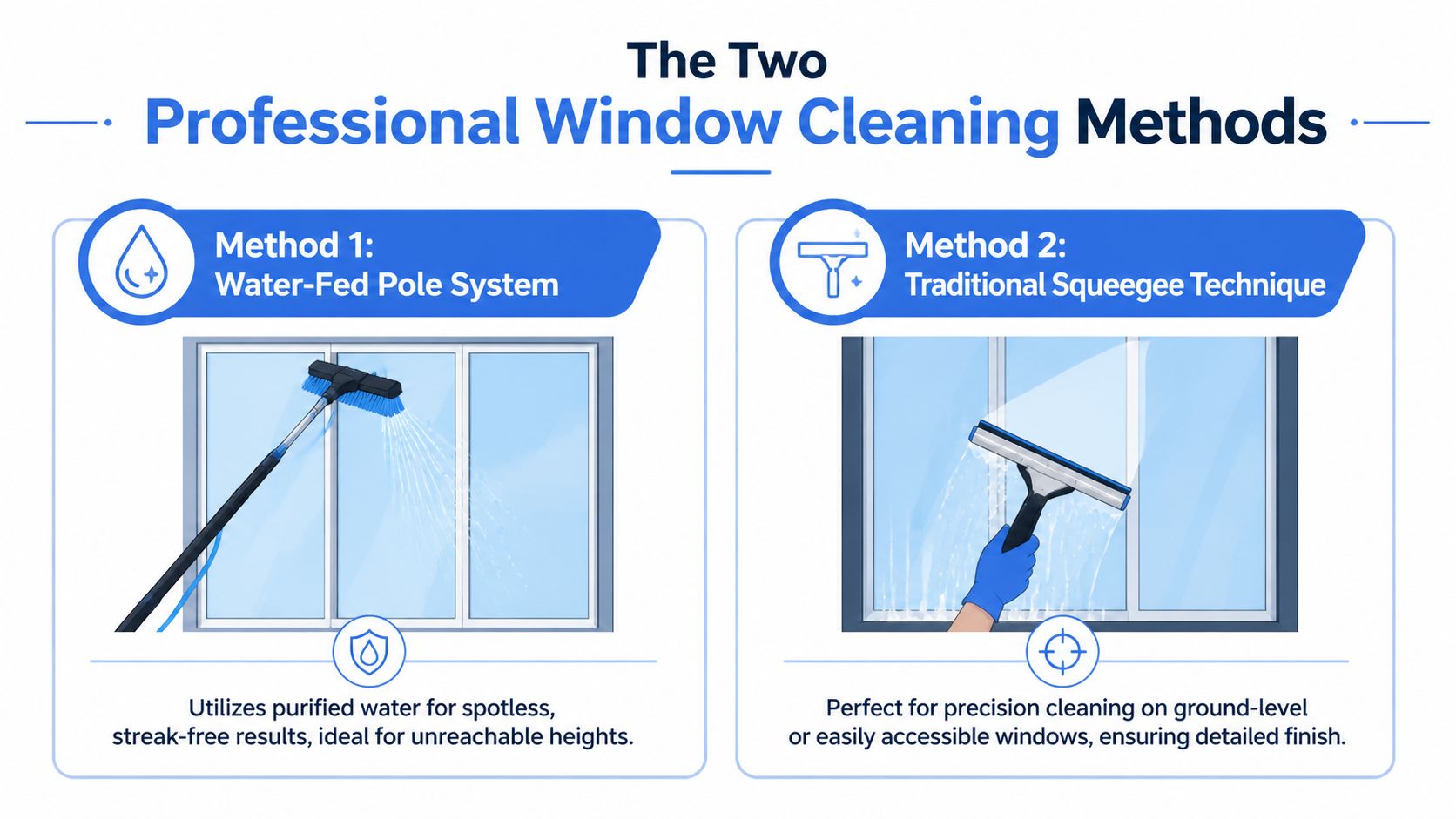
This is the classic professional method, and in skilled hands it’s still unmatched for detail work. The setup is simple on paper. An applicator wets and loosens soil. A professional squeegee with a straight channel and quality rubber removes the solution. Towels or detailing cloths catch edges and finish corners.
That sounds easy until you try to do it well on every pane.
Good squeegee work depends on pressure, angle, clean rubber, and controlled movement. If the blade is too dry, it skips. If the rubber is worn, it leaves lines. If the glass isn’t properly scrubbed first, you’re dragging grit across the surface instead of cleaning it. On interior windows and ground-level glass, this method gives precise control and a finished look that’s hard to beat.
It’s often the best choice for:
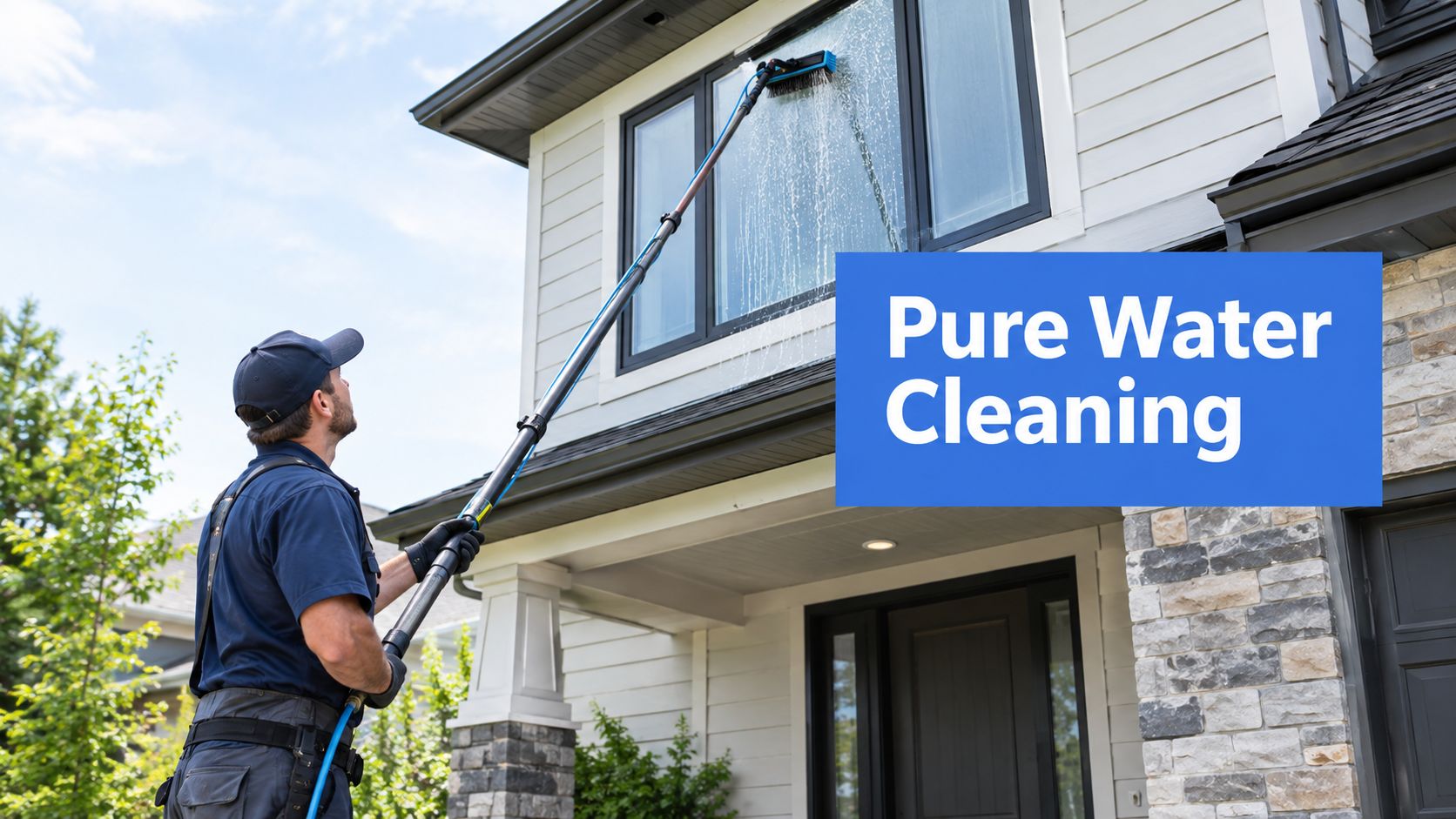
The second professional method is a pure-water system, usually with a water-fed pole. Water is purified so it dries without leaving mineral residue behind. The brush agitates dirt on the glass and frames, and the purified rinse leaves a spot-free finish when done correctly.
This method is excellent for exterior work on windows that are harder to reach safely by hand. It also cleans frames and surrounding edges effectively, which matters because dirty frames often bleed back onto freshly cleaned glass.
A lot of people first hear about it and assume it’s just spraying water on windows. It isn’t. The important part is the purity of the water and the brushing technique. If the water isn’t purified, or if the operator doesn’t rinse thoroughly, the result won’t be right.
For a closer look at that process, this guide to pure-water window washing is a useful reference.
One of the worst mistakes on glass is treating it like concrete or siding. Pressure above 1,500 PSI can etch glass, and improper squeegee technique can leave residue that increases re-soiling rates by 40%. That’s why trained crews use the right pressure, soft-wash techniques where appropriate, and pH-neutral detergents on delicate surfaces.
| Method | Best use | Main advantage | Main limitation |
|---|---|---|---|
| Squeegee | Interior, storefront, detail work | Precision and edge control | Slower on larger exterior elevations |
| Pure-water system | Exterior residential and commercial, higher access from ground | Safe reach and spot-free rinsing | Requires proper water purification and technique |
If someone wants to solve every job with one tool, they’re not cleaning professionally. They’re improvising.
A single-story home may need both methods on the same visit. Interior glass usually benefits from traditional squeegee work. Exterior second-story windows may be faster and safer with a pure-water pole. A dealership may need storefront hand detailing at the entrance and pure-water cleaning on broader exterior elevations. A mid-rise office may rely heavily on pure water up to practical reach, then transition to specialized access methods above that.
Climate changes the decision too. In Arizona, mineral-heavy water spots and dust demand careful rinsing and proper chemistry. In Colorado, wind and seasonal debris can change how quickly soap dries on glass. In Nevada, sun exposure exposes every streak.
The method never starts with what tool a cleaner likes best. It starts with the glass, the soil, and safe access.
Not all window cleaning jobs are versions of the same job. A residence, a storefront, and a high-rise each create different demands. The best crews adjust the workflow to the property instead of forcing one routine onto every building.
Homeowners usually notice the small things first. Dirty screen edges. Debris in the lower track. Water spots near sprinklers. Fingerprints on the patio slider. Residential window cleaning is often as much about care as speed.
That matters in places with landscaping, stucco, decorative grids, and mixed window heights. On a home, crews have to protect floors inside, work carefully around furniture, avoid splashing walls, and manage runoff outside so dirt doesn’t streak onto patios or frames.
For homes in Scottsdale, Flagstaff, Chandler, Gilbert, and Tempe, local conditions also matter. Desert dust settles fast. Irrigation creates mineral spotting. Wind pushes grime into tracks and corners where basic wipe-downs don’t fix much.
Commercial properties have another priority. The cleaning has to happen without disrupting business.
A car dealership wants clean showroom glass without slowing customer traffic. A medical office wants a polished exterior and clean entry glass without creating a mess at the front door. Property managers care about consistency because one neglected section makes the whole building look poorly maintained.
That’s why commercial scheduling matters as much as the tools. Early mornings, lower-traffic windows, recurring routes, and coordinated access often matter more than brute speed. Building owners who think broadly about appearance usually benefit from larger maintenance planning too. A practical resource on that side of operations is this checklist for 2025 building upkeep for businesses, especially if you’re evaluating exterior care as part of a wider property standard.

High-rise window cleaning isn’t just “commercial but taller.” It’s a separate discipline. Once the glass is beyond safe ladder reach, safety systems, anchor points, descent equipment, and worker training become central to the job.
For high-rise work in cities like Denver and Las Vegas, OSHA requires Rope Descent Systems, and each component must support at least 5,000 pounds. Workers also need a separate fall arrest system, a standard that reduces fall risks by 70% compared with older methods. That tells you something important. On a tower, technique matters, but safety protocol matters first.
On a high-rise, the cleaning method is only one part of the job. The access plan is the other half.
A property manager in downtown Denver won’t choose a provider the same way a homeowner in Scottsdale does, and shouldn’t. The property type decides the workflow, the equipment, the timing, and the level of risk management.

Window cleaning prices vary because the work itself varies. Two properties can have the same number of windows and require very different labor. One may have wide, easy-access panes. The other may have divided lights, stubborn mineral spotting, screens, deep tracks, and difficult second-story access.
When people search window cleaning com terms, they often want a shortcut to price. The better way to think about it is what drives the quote.
The first factor is the glass itself. Large picture windows clean differently than French panes. Sliding doors aren’t priced mentally the same way as a row of narrow divided windows. More edges and more sections mean more hand work.
The next factor is condition. Routine maintenance cleaning is usually more straightforward than first-time service on neglected glass. Paint specks, hard water film, adhesive residue, and construction dust change both the tools and the time.
Access matters too. Ground-level exterior windows are different from windows over tile roofs, landscaping, or interior stairwells. Some jobs are simple walk-up work. Others require ladders, poles, or specialized planning.
For a broader explanation of how service quotes are structured, this article on cleaning services cost gives a helpful overview.
A lot of customers think of “window cleaning” as just the glass. In practice, there are related tasks that affect the total:
| Pricing factor | Why it matters |
|---|---|
| Window count and layout | More panes and more divisions mean more labor |
| Soil level | Heavy buildup requires extra scrubbing and detailing |
| Accessibility | Difficult access increases setup time and equipment needs |
| Service scope | Interior, exterior, screens, and tracks each add work |
| Property type | Homes, storefronts, and larger buildings are priced differently |
A good quote should make sense when you hear it. You should understand what’s included, what isn’t, and why the job costs what it does. If the provider can’t explain whether the price covers screens, tracks, interior glass, mineral removal, or difficult access, that’s a problem.
The cheapest quote often leaves out the labor that makes the windows actually look finished.
Transparent pricing usually signals organized service. It means the company knows how long the work takes, what equipment the job needs, and where the challenges are before the crew arrives.
Choosing a window cleaner shouldn’t come down to who answered the phone first. It should come down to whether they know what they’re doing, whether they work safely, and whether they understand the conditions your property deals with.
That matters even more in the Southwest. A 2025 Angi report noted that 42% of residential reviews in Arizona and Nevada mentioned stubborn water spots and film that standard methods didn’t resolve. That’s a local clue. If a company doesn’t understand hard water, dust, and mineral residue, the result may look incomplete even if the crew worked hard.
Ask whether the company is properly insured for the type of work they perform. Ground-level residential service is one thing. Ladder work, commercial service, and higher access create a different risk profile. A serious provider should be able to discuss safety practices clearly and without hesitation.
Experience matters too, but only if it shows up in method. A company should be able to explain when they use a squeegee, when they use pure water, and why one is better for your property. If the answer is vague, the result probably will be too.
Reviews help when you read them carefully. Look for comments about punctuality, detail, professionalism, and how the windows looked in full sun. Generic praise is nice. Specific praise is more useful.
A good way to think about this is the same way you’d evaluate any exterior trade. Homeowners often compare companies by checking proof of experience, scope, and credentials. The logic in this guide to vetting roofing contractor credentials applies surprisingly well here too.
Some warning signs are obvious. A provider talks only about being “fast.” They can’t explain safety procedures. They don’t ask about access, window type, or condition before pricing. They promise every stain will disappear without even seeing the glass.
Others are more subtle. They rely on pressure washing language for window work. They treat every property the same. They dismiss local mineral spotting as normal rather than something to address properly.
A good window cleaner asks better questions before they give confident answers.
In Arizona, Colorado, and Nevada, local knowledge isn’t a bonus. It’s part of the job. The cleaner has to recognize what sun, dust, irrigation, runoff, and elevation do to glass, then choose the method that fits.
Some questions come up right before a customer books. They’re practical questions, and the answers should be practical too.
It depends on the property and the environment around it. Homes near traffic, construction, open desert, or heavy irrigation usually need more frequent service than homes in lower-exposure areas. Storefronts and customer-facing commercial buildings also tend to benefit from a regular schedule because appearance matters every day, not just when the buildup gets obvious.
A useful rule is to stop thinking in calendar terms only and think in exposure. If the glass is collecting dust fast, spotting quickly, or affecting the way the property looks, it’s time.
Rain by itself usually doesn’t make professionally cleaned windows dirty. Dirt makes windows dirty. If glass was cleaned correctly and the seals, frames, and screens aren’t holding loose debris, light rain often dries with minimal effect.
Weather still matters for safety and quality. Wind, storms, and active runoff can change scheduling. On taller buildings, weather decisions are even more important because access methods depend on safe conditions.
For exterior-only cleaning, many customers don’t need to be present as long as access is arranged in advance. If interior windows are being cleaned, someone usually needs to provide entry unless another plan has been made.
Commercial properties often handle this by scheduling around business hours or giving access instructions ahead of time. Residential jobs are usually simplest when access details are clear before the crew arrives.
A little prep helps the job move smoothly.
Tinted glass needs more care, not more aggression. The wrong tool or chemistry can damage the film or affect the edges. If you have aftermarket tint or specialty glass, mention that before the appointment. For a useful outside perspective on safe handling, these tips for cleaning tinted windows in Atlanta outline the same basic principle professionals follow everywhere. Gentle tools and the correct method protect the finish.
Because consistency matters. The U.S. window washing industry had 35,344 businesses in 2024, and that number has declined annually, pointing toward consolidation among larger professional operators. In plain terms, established companies tend to have more defined systems, more accountability, and more staying power.
That doesn’t guarantee quality by itself. But long experience, especially across Arizona, Colorado, and Nevada, usually means the provider has already learned what works and what doesn’t on different types of glass and buildings.
If you want a clear, honest quote from a team that’s been doing this since 1999, contact Professional Window Cleaning. They provide residential, commercial, and high-rise service across Arizona, Colorado, and Nevada, and they know when to use a squeegee, when to use pure water, and how to do the work safely.
Read our blog posts regularly and keep learning.