
Care and Maintenance
Residential Window Cleaning: The Homeowner's Guide
Master residential window cleaning with our guide. Learn professional methods, costs, frequency, and how to choose a service for AZ, CO, and NV homes.


Colorado homes are commonly scheduled for two professional window cleanings each year, typically in April–May and September–October. Properties near construction, busy roads, or sprinkler overspray may need service four times annually, while commercial storefronts often use monthly cleaning and HOA or multi-unit properties commonly use quarterly schedules, according to this Colorado window-cleaning market guide. That schedule isn't excessive. Colorado combines dust, pollen, snow residue, strong sun exposure, and mineral residue from drying water, so glass can deteriorate faster when owners treat cleaning as an occasional chore.
Colorado glass takes punishment from several directions at once. High-altitude sunlight, dry airborne dust, spring pollen, irrigation overspray, and winter residue all land on the same pane, then bake or crystallize as water evaporates. The result is often more stubborn than ordinary household dirt.
The most important distinction is between loose contamination and bonded residue. Dust can often be lifted with the correct scrubber and rinsed clean. Mineral deposits from repeated wetting and drying are different. Denver's treated water is described as soft to moderately hard, with South Platte water varying between 60 and 120 mg/L as calcium carbonate and average hardness often reported around 113 mg/L, according to the Denver water quality report. Sprinkler droplets that dry on exterior glass can leave visible spotting, and repeated exposure can contribute to etched deposits.
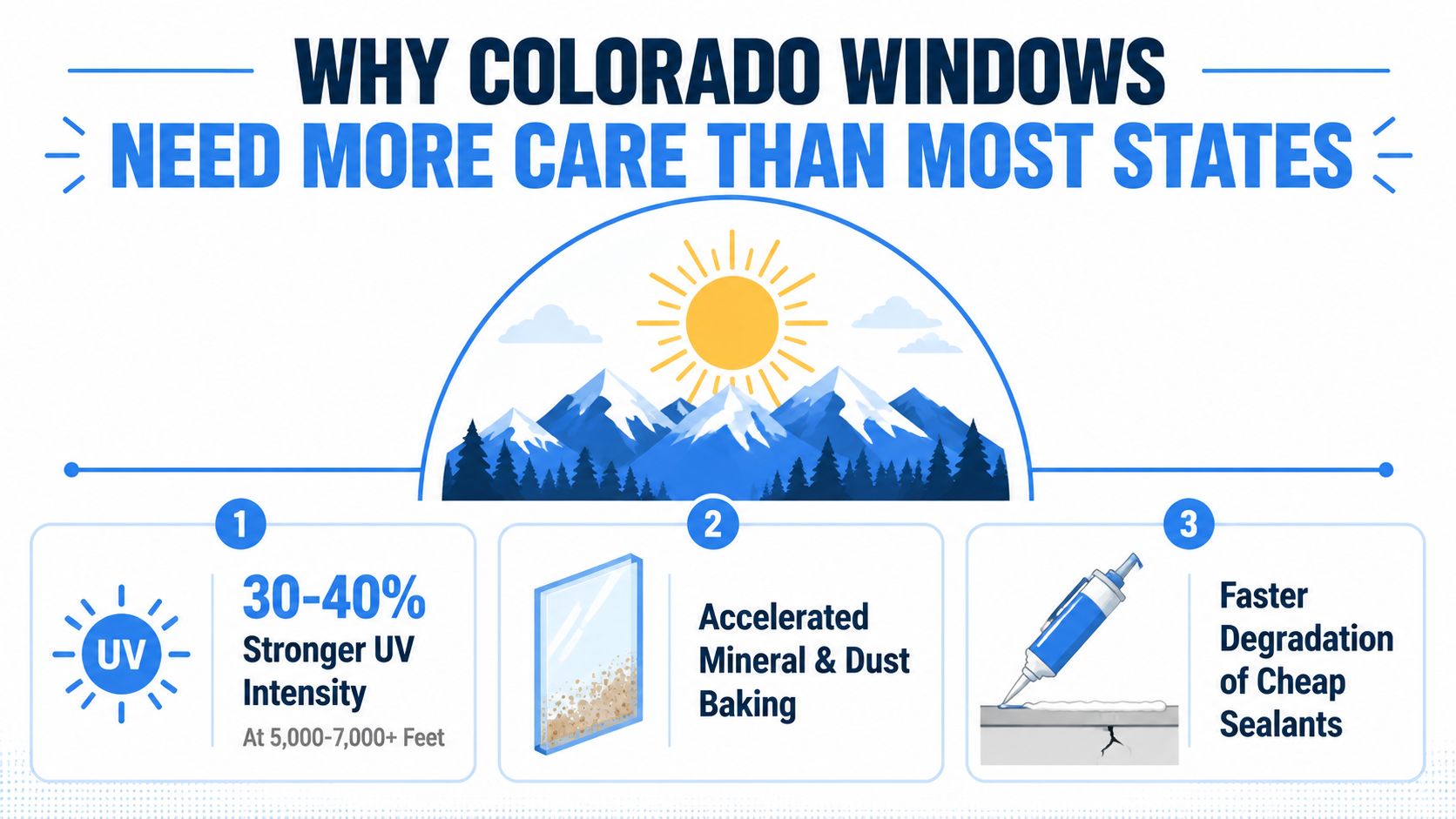
Spring pollen sticks to damp glass. Summer dust settles into wet tracks and sills. Snow residue and road film remain on lower panes through winter, especially around driveways and busy roads. Strong sunlight then makes every spot easier to see and can harden residue before an inexperienced cleaner removes it.
Don't attack that buildup with aggressive scraping, a pressure washer, or a rough household towel. Those shortcuts can scratch glass, damage seals, force water into vulnerable areas, or leave residue behind. A practical exterior-maintenance checklist, including broader care for homes exposed to seasonal weather, is available in this Utah home maintenance checklist from Superior Home Improvement.
Practical rule: Keep irrigation heads aimed away from glazing. Preventing mineral-laden droplets is safer and cheaper than trying to remove established deposits later.
Professional service is especially important for high windows, specialty glass, and commercial façades. Colorado has had an organized commercial high-rise cleaning presence for decades. Bob Popp Building Services states that it was founded in 1975 and has served high-rise, mid-rise, and ground-level commercial properties across Colorado since then, as described in this Colorado commercial window-cleaning market reference. The work involves trained crews, access planning, and equipment suited to the building, not just a longer household ladder.
There are only two professional window-cleaning methods: the traditional squeegee and the pure-water system. A legitimate crew may use different tools within those systems, but the cleaning logic comes back to one of those two approaches.
The technician starts with a bucket of prepared solution and a T-bar or applicator. The scrubber wets the pane, loosens dirt along the frame and edges, and gives the solution time to suspend contamination. The worker then pulls a rubber squeegee across the glass in controlled, overlapping strokes, wiping the blade between passes when needed.
The final details separate a clean pane from a streaky one. The technician cleans the edges with a detail cloth, removes runoff from the frame, and wipes the sill. This method remains especially useful for interior glass, ground-level storefronts, post-construction cleanup, and panes where hard-water spotting has already bonded to the surface. A professional technique guide describes the same basic process, including overlapping passes and a finishing pass along the frame, in this window-cleaning training whitepaper.
A pure-water system treats water through deionization or reverse osmosis. Professional systems commonly reduce total dissolved solids to below 10 parts per million, according to the National Window Cleaning Authority's methods overview. That water travels through a telescoping pole to a soft brush head, where the brush agitates the glass and the purified water carries away suspended dirt.
The final rinse matters most. Because the water contains very little dissolved mineral content, it can dry on the pane without leaving the spotting associated with ordinary tap water. This makes the system valuable for upper floors, properties with limited ladder access, and homes with solar panels, where keeping workers on the ground improves access control.
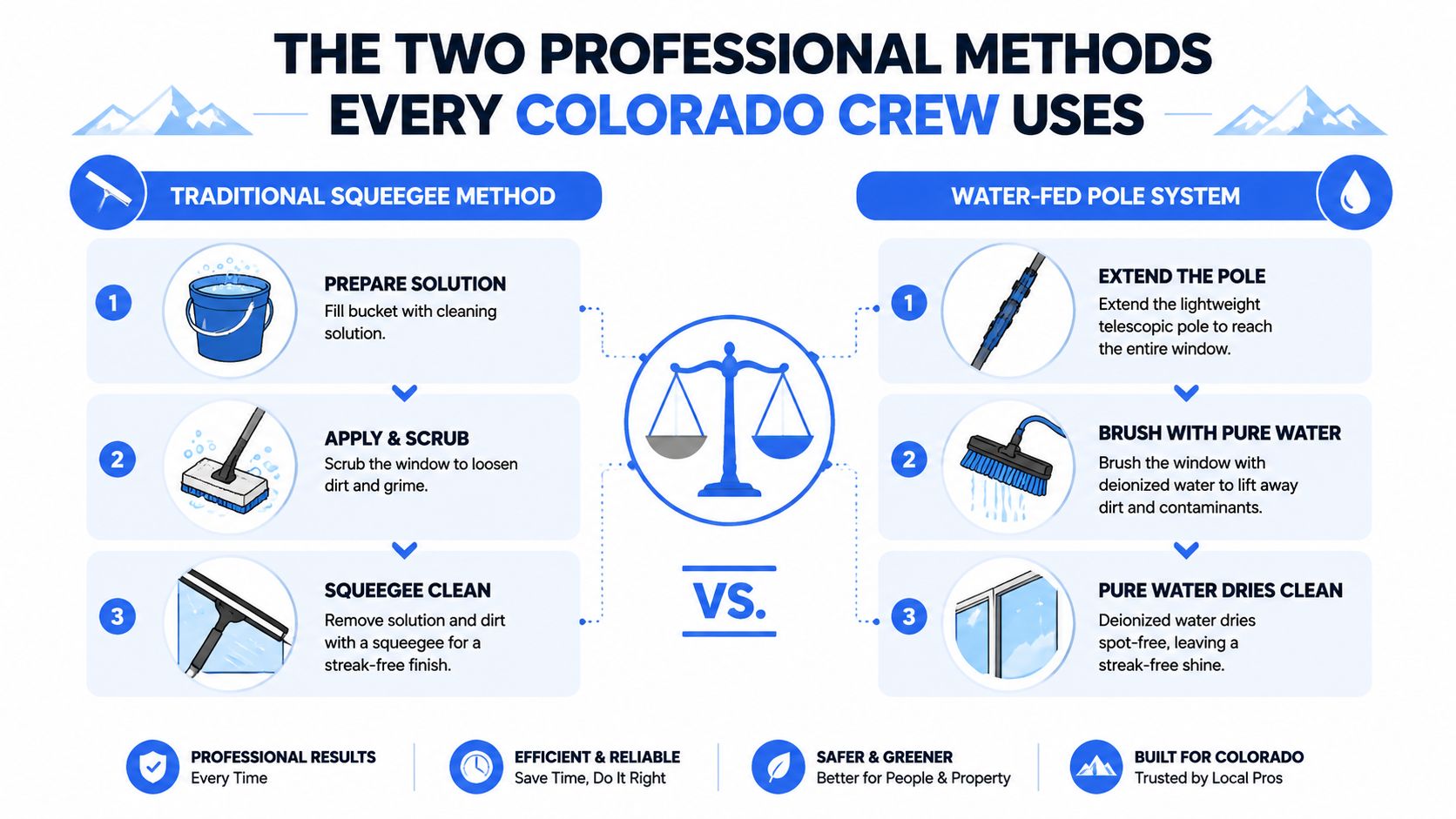
A pure-water pole doesn't replace squeegee work in every situation. Interior panes, grease, construction debris, and severe mineral deposits often need direct scrubbing and blade work. Colorado's mineral residue makes the pure-water advantage particularly useful for maintenance, while the squeegee remains the better corrective tool when buildup has already set in.
This guide to pure-water window washing provides more detail on the system and its practical applications.
A good visit starts before the crew loads the van. The quote should account for pane count, window style, access points, screens, interior and exterior scope, and specialty glass such as French panes, storm windows, skylights, and fixed picture windows. If those details aren't discussed, the price may look attractive while the final invoice becomes less predictable.
Ask the estimator to record the conditions that affect labor and safety:
On arrival, the crew protects the work area with drop cloths and shoe covers. Ladders should be stabilized on suitable footing, and commercial teams may place cones around the active area. For multi-story work, the crew chooses a water-fed pole, rope descent, or another access method based on the façade, anchors, worker positioning, and exposure.

Screens come off first when the scope includes them. The technician washes them separately, cleans frames, vacuums tracks where appropriate, and then uses the squeegee or pure-water system suited to the pane and access. Sills are wiped dry instead of left with a dirty runoff line.
Safety isn't a decorative item. High-rise and commercial work depends on formal procedures, including OSHA-aligned practices, EM385-1-1 fall-protection knowledge, and ANSI/IWCA I-14.1 knowledge, as reflected in this window-cleaning safety benchmark. Colorado crews also need to account for wind, altitude-related ladder conditions, uneven ground, and winter ice on exterior surfaces.
The final walkthrough should identify cracked panes, compromised seals, and hard-water etching discovered during service. The owner should have a chance to inspect representative panes, approve the completed work, and receive a maintenance recommendation based on exposure rather than a generic calendar.
Window-cleaning pricing is driven by labor, access, risk, and the condition of the glass. A reliable quote makes those variables visible instead of hiding them inside one unexplained total.
Pane count is the baseline. Residential companies may quote by window or by the overall home, while larger commercial bids often use glass area and production time. A French-pane window can require much more handwork than a single clear pane, even when both are counted as one window.
Access changes the quote quickly. Second- and third-story glass, skylights, interior panes behind furniture, steep landscaping, and roof access all require additional setup or specialized equipment. A water-fed pole can reduce ladder use, but it doesn't eliminate the need to assess reach, water recovery, nearby surfaces, and worker positioning.
Frequency also affects value. Colorado-focused guidance recommends standard homes receive service twice yearly, with more frequent cleaning for properties exposed to construction, traffic, or sprinkler overspray, as described in this Colorado window-cleaning scheduling guide. Recurring work usually keeps buildup lighter and makes each visit more efficient, but any discount should be stated clearly rather than assumed.
Property type changes the billing structure. Storefronts, medical buildings, condos, and high-rise façades involve coordination, access controls, and commercial safety requirements. Residential work is usually simpler, but specialty glass, screen cleaning, hard-water removal, and post-construction film should still appear as separate line items.
For broader cost context, see this window-cleaning services cost guide.
No verified price schedule was provided for Colorado, so a responsible quote should be treated as property-specific rather than forced into invented ranges.
| Property Type | One-Time Clean | Quarterly Contract | Notes |
|---|---|---|---|
| Single-family home | Quote required | Quote required | Pane count, stories, screens, and interior scope drive the price |
| Storefront | Quote required | Quote required | Access, pedestrian control, and service frequency matter |
| HOA or multi-unit property | Quote required | Quote required | Commonly scheduled quarterly |
| High-rise or commercial building | Site assessment required | Contract proposal required | Façade access and safety planning are core variables |
Ask whether the estimate includes screens, tracks, sills, hard-water treatment, and post-construction residue. A lower quote that excludes necessary preparation isn't a lower-cost clean. It's an incomplete scope.
Window-cleaning work changes across Colorado because elevation, weather, building type, and access change together. Denver has dense neighborhoods, office towers, condos, medical buildings, and storefronts, so crews may shift from interior squeegee work to water-fed poles or high-rise access systems within the same service area.
Denver remains the central metro market. Highlands Ranch, Wash Park, Aurora, Lakewood, Castle Rock, and Parker bring residential projects with picture windows, upper stories, screens, and irrigation spotting. Downtown properties require tenant coordination, pedestrian protection, and façade-access planning. Dry air and airborne dust can leave exterior glass visibly hazy, while hard-water deposits require agitation rather than a quick rinse.
Boulder and Fort Collins include older homes, new construction, and commercial properties connected to academic, technology, hospitality, and retail activity. Older single-pane or delicate windows respond well to controlled pressure and careful squeegee technique. Pure-water cleaning suits accessible exterior glass where dust and pollen are the main contamination. Squeegee work remains the better choice for interior glass, greasy residue, and bonded mineral film.
Colorado Springs includes military housing, suburban homes, and larger lots. Crews often encounter tall picture windows, newer construction, landscaping barriers, and sloped ground. Snow residue and irrigation overspray can leave mineral spotting, so the method depends on whether the glass needs routine rinsing or direct scrubbing.

Dillon, Silverthorne, and Vail combine high elevation, intense sun, changing weather, seasonal occupancy, and difficult access. Mountain homes are commonly scheduled in May–June and September, according to this Colorado-focused service guide. Short-term rental turnover, snow residue, and shoulder-season travel can affect timing more than a standard suburban calendar.
Commercial corridors often use maintenance agreements, while residential demand centers on spring and fall. A dependable provider should identify its service cities and explain how equipment, weather, and travel affect scheduling in each area.
A Colorado window schedule should follow contamination, not habit. Spring removes winter residue, summer controls dust and sprinkler spotting, fall clears buildup before snow, and winter spot work prevents mineral film from sitting on exposed panes for months. Altitude, intense sun, pollen, and dry soil can shorten the useful life of a once-a-year cleaning.
April and May are common residential cleaning months. Pollen, dust, and snow residue can combine with morning moisture and form a film that a quick rinse will not remove. Direct scrubbing followed by squeegee work usually gives better results when pollen has bonded to the glass.
Homes near construction, busy roads, or irrigation overspray may need service more often. Waiting for one annual visit gives deposits time to harden, which increases the corrective work required.
Summer storms leave droplets that dry into spotting, especially near sprinkler zones. Front Range construction and dry soil also add airborne dust to exterior glass. Street-facing storefronts often benefit from regular touch-ups because fingerprints and weather film show quickly.
Pure-water cleaning suits accessible exterior glass with routine dust and pollen. Squeegee work remains the better choice for interior panes, greasy residue, and deposits that need direct agitation. The methods address different problems, rather than serving as interchangeable steps.
September and October are strong months for a thorough exterior clean. Conditions are often calmer than during the spring pollen period, and the service removes summer dust before winter weather arrives. Mountain properties commonly schedule work in late spring and early fall, when access, occupancy, and changing weather make timing more practical.
Winter is not automatically a no-service season. Road residue, snowmelt, and low-angle sunlight can make lower and south-facing panes look dirty, while ice creates a clear safety hazard. Crews should inspect conditions before working and avoid climbing onto frozen surfaces.
For a standard home, two cleanings annually generally means April–May and September–October. More exposed properties often benefit from quarterly service. Commercial storefronts commonly need monthly visits, while HOA and multi-unit properties often use quarterly schedules.
A practical schedule also accounts for elevation and access. High-altitude sun can bake residue onto glass, while freeze-thaw cycles leave mineral marks along lower edges. Schedule before those deposits become bonded, and treat winter cleaning as targeted maintenance rather than a routine full-property visit.
The biggest DIY mistake is treating every mark as loose dirt. Colorado glass often carries mineral residue that needs controlled removal, not harder rubbing.
Paper towels and newspaper shed fibers, leave lint, and can drag grit across the pane. When mineral residue is present, repeated wiping can spread the deposits instead of lifting them. Use clean microfiber detailing cloths for edges and frames, and use professional treatment when spotting has bonded to the glass.
Vinegar is another overused answer. It can help with light household film, but it isn't a complete solution for calcium and magnesium residue from repeated sprinkler overspray. Scrubbing harder after the solution fails increases the chance of scratching the surface or damaging adjacent seals.
The correction: Match the tool to the contamination. Use a squeegee system for controlled agitation and removal, or pure water for a clean final rinse without mineral residue.
Ignoring screens defeats part of the cleaning. A blocked or dusty screen can keep releasing pollen and fine dust onto the pane, especially after the first breeze. Remove and wash screens separately, then reinstall them only after the surrounding frame and sill are clean.
Tracks and sills collect leaves, grit, and moisture. If you ignore them, decomposing material can stain frames and create an unpleasant source of odor or organic growth. Vacuum loose debris, clean the track without flooding it, and wipe the sill dry.
Don't use a pressure washer on residential glass. High pressure can disturb seals, drive water behind the pane, and damage surrounding trim. Professional crews use controlled water flow, soft brushes, applicators, squeegees, and detail cloths instead.
A maintenance schedule also beats emergency cleaning. Routine service keeps contamination manageable, protects access planning, and makes it easier to spot failed seals or cracked glass before those defects become a larger property problem.
The best hiring decision starts with the provider's process, not the lowest verbal price. A professional operation should explain how it handles ladders, high-altitude work, rope access, pure-water equipment, interior protection, and final inspection.
Look for four signals:
Training matters because the two professional systems demand different judgment. A technician needs to know when a squeegee is the right corrective tool, when pure water is the safer maintenance choice, and when a pane should be flagged for etching, seal failure, or breakage rather than overworked.
Professional Window Cleaning has been cleaning windows for over 26 years, with the publisher stating that the business began in 1999. Its stated service categories include residential window cleaning, commercial window cleaning, and high-rise window cleaning across its operating markets.
Before booking, have the property address, approximate window count, last service date, access restrictions, and any known hard-water or construction residue ready. Smaller properties may begin with an online quote or phone estimate. Larger commercial properties should request an on-site walkthrough so the provider can evaluate façade access, safety controls, tenant activity, and water management.
A final satisfaction walkthrough is worth requesting. You should be able to inspect the glass, ask about any permanent etching or compromised seals, and confirm whether the recommended schedule reflects your property's actual exposure.
If Colorado's pollen, dust, sprinkler residue, or winter film has left your glass overdue, request a quote from Professional Window Cleaning. The team offers residential, commercial, and high-rise window cleaning, using squeegee and pure-water systems for the access and contamination conditions your property presents. Book a first-time clean or set up recurring maintenance before the next seasonal buildup becomes harder to remove.
Read our blog posts regularly and keep learning.