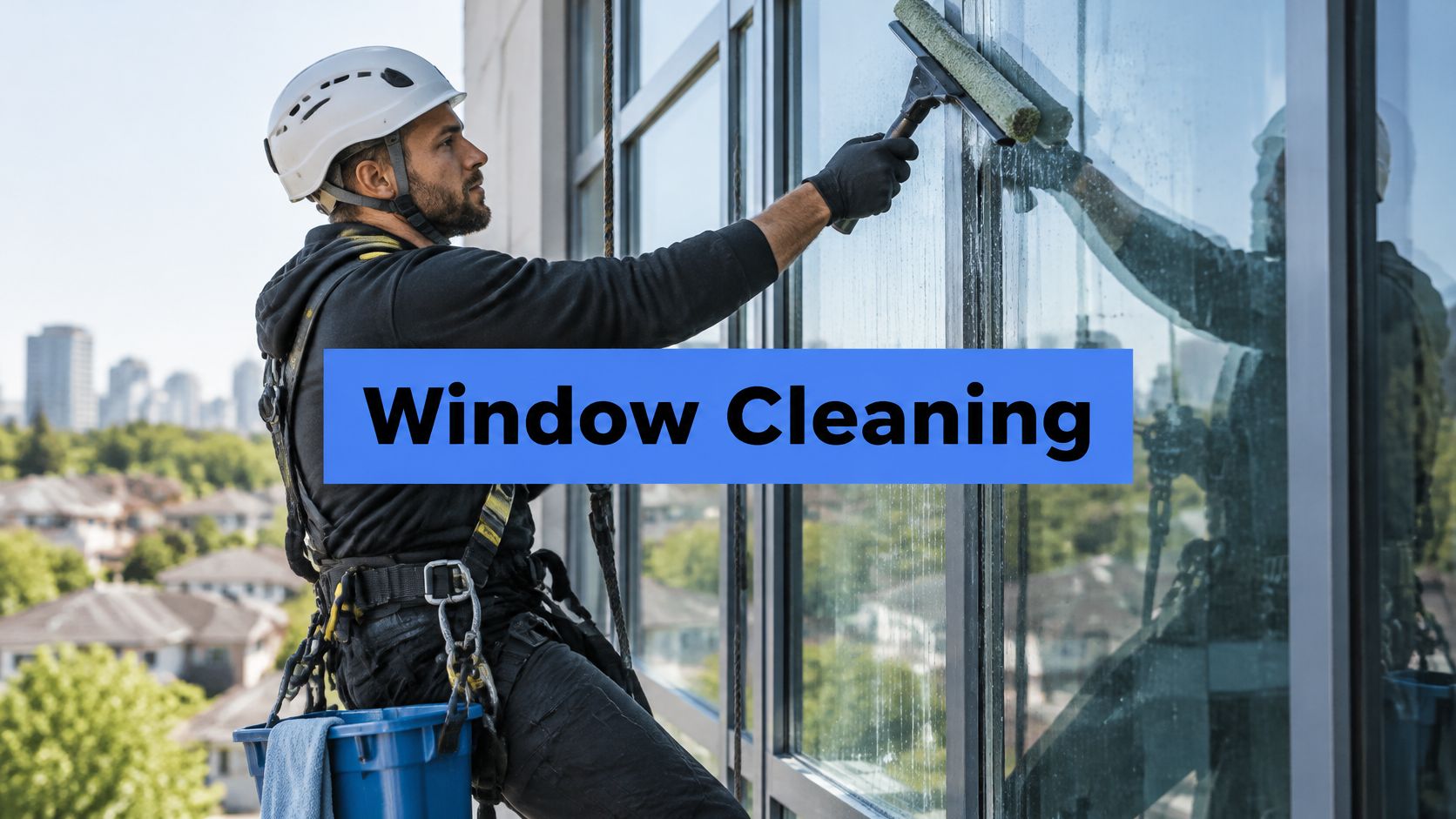
Care and Maintenance
Window Cleaner Services Explained for Homes and Buildings
Learn what window cleaner services cover for homes, offices and high-rises, the two cleaning methods, safety checks and how to book a free estimate.


You're standing at a window that should be showing you the mountains, the street or the parking lot, and instead the view looks like someone breathed on it. The glass isn't opaque, just softened by a grey film you can't quite place. Is it dirt, is it the glass itself, or is it something a previous cleaner did to it?
From inside a room, dirty glass and damaged glass look nearly identical. That confusion sells a lot of unnecessary work: film applied to fix haze caused by mineral buildup, units replaced when a proper wash would have cleared them, and harsh scrubbing on a coating that should never have been touched.
Two things decide how a window looks and how it performs afterwards. The method used on it, and the type of glass it is. Everything below comes back to that pairing, because better view window cleaning is a method decision and a glass decision, not a stronger scrub.
Professional window cleaning comes down to two methods and no more: a squeegee or a pure-water system. Every quote you collect, every crew that shows up and every result you judge is some version of one of those two.
With the squeegee method, an applicator sleeve loads a cleaning solution onto the glass and a rubber-bladed squeegee pulls that solution off, taking the suspended dirt with it. It's mechanical removal rather than a rinse, which is why a storefront or lobby pane comes out dry and crisp in seconds. It also suits interior glass, ground-floor panes, and any first clean on glass that hasn't been touched in years.
Pure-water systems send deionized or reverse-osmosis-treated water through a water-fed pole and brush. The brush scrubs, purified water rinses, and the glass air-dries with no blade on it. Purity is the whole trick. Water-fed systems typically run below 10 parts per million of total dissolved solids, because dissolved minerals are exactly what leave spots when water evaporates, as this comparison of window cleaning methods sets out. Strip the minerals out and there's nothing left to dry into a mark.
Reach separates the two more sharply than anything else. A pole lets an operator work from the ground, and one supply source puts that ceiling at 55 feet, roughly five stories, while a pure-water cleaning overview estimates about 65 feet depending on the pole and site conditions. Upper-floor squeegee work at those heights means lifts or rope access, not a ladder. Brushing and rinsing also clean the frame and sill as the brush passes, so the full unit gets attention, not just the pane.
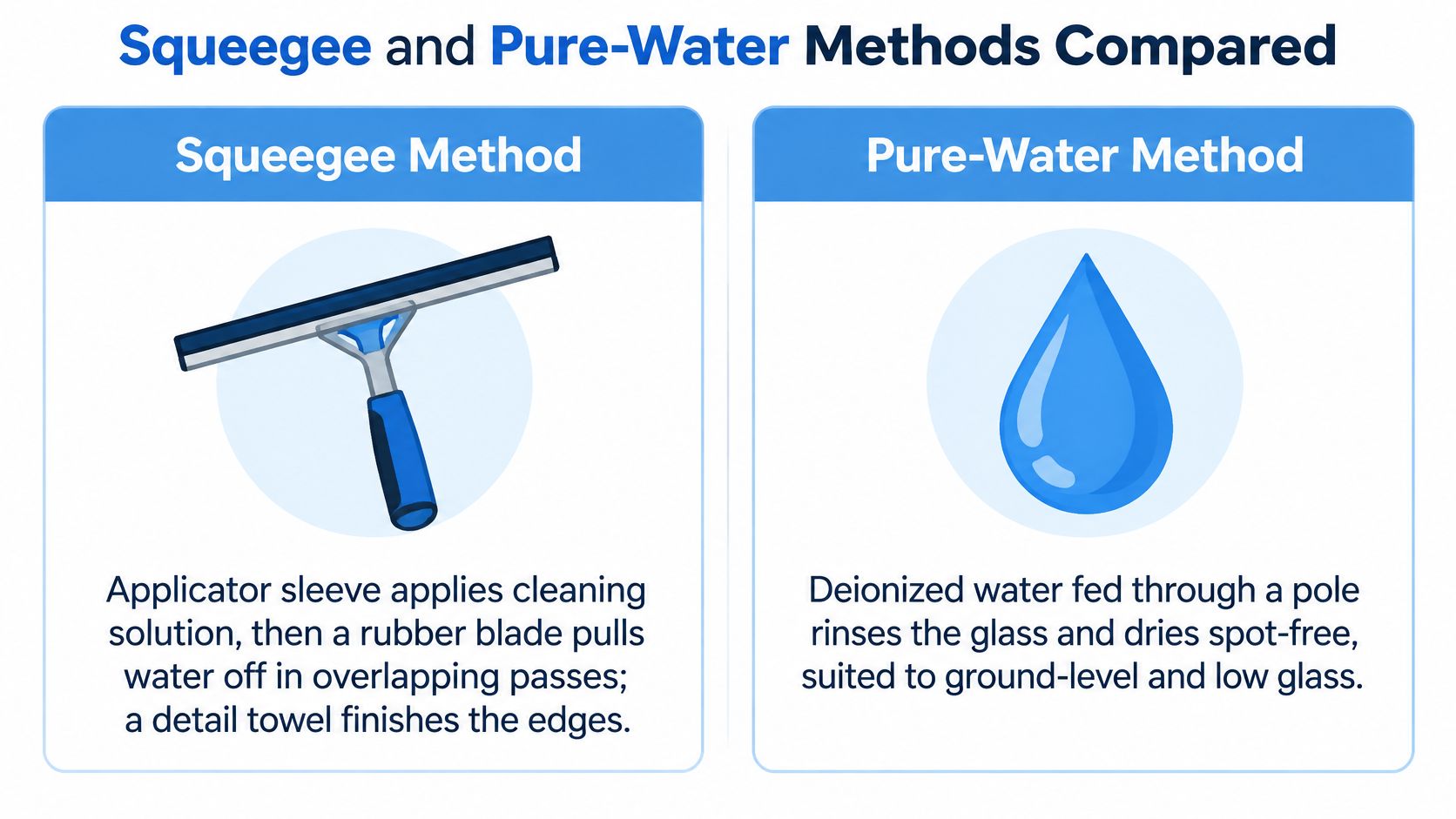
Squeegee vs pure-water cleaning at a glance
| Method | How it works | Water and spotting | Best fit |
|---|---|---|---|
| Squeegee | Cleaning solution applied with a sleeve, then pulled off with a rubber blade | Standard water with solution; streaks possible if the blade is not wiped | Interior glass, storefronts, first cleans on ground-level panes |
| Pure-water | Scrubbed with a water-fed brush, rinsed and air-dried | Below 10 ppm total dissolved solids; no squeegee, so no blade streaks | Exterior glass, frames and sills, hard-to-reach panes reached from the ground |
Exterior glass you can reach from the ground goes to pure water, because it's faster and there's no blade edge to leave a line. Interior glass and heavily neglected first cleans go to the squeegee, because a well-handled blade removes years of grease and construction film in a single pass that a rinse alone won't touch. A crew that keeps a pro squeegee method for spotless glass on interior work and pure water on the outside is showing you it understands both tools rather than defaulting to one.
A storefront window on a main street sells harder than the sign above it. Clear glass tells people the business is open, staffed and cared for. A cloudy pane says the opposite, and it says it before anyone reads a word about the product inside.
That impression is strongest where people look closely: entrances, medical office reception windows, dealership showroom glass, and a home about to be listed. Buyers and patients read a smudged window as evidence of how the rest of the building is run, whether or not that's fair.
Glass is also the building's daylight control surface, and that side of it has hard evidence behind it. A U.S. General Services Administration evaluation of the EPA Wynkoop building in Denver estimated daylighting could save approximately 244,000 kWh annually in open-plan office space, an estimated 72% reduction in overhead-lighting energy for that area, per the GSA evaluation of the EPA Wynkoop building. That figure belongs to one building with a deliberate daylighting strategy. Treat it as a benchmark for what good glazing conditions can do, not a savings guarantee for any office you manage.
Cleaning doesn't manufacture that saving. It protects what the design already put in place by keeping visible-light transmission where it was specified. What cleaning cannot fix is equally clear: poor orientation, low visible transmittance glass, glare on an elevation that needed shading, or a failed seal that has fogged a unit from the inside.
Clean glass restores the light a building was designed to admit. It cannot add light the glass was never built to pass.
A 2024 apartment study found high-transmittance glass delivered 15% more measured visible light than low-energy glass, with significant differences in daylight satisfaction and sleep-related outcomes between the two glass types, and a 2025 review that screened 5,616 articles and included 121 studies found associations between window-view characteristics and physical, psychological and lived-experience outcomes, as summarized in this research on glazing, daylight and occupant outcomes. Read together, those findings say the glass sets the ceiling on daylight and view quality, while cleaning decides how much of that ceiling you get.
That's why view quality belongs in a service conversation for medical offices, condominiums, offices, dealership suites and stadium hospitality areas, not only in a design conversation. Nobody schedules a clean because of a study. They schedule it because the room felt dim, or a suite holder mentioned the view.
Every market has its own dirt, and the high-sun belt has a distinct mix. Airborne dust arrives in coats after a wind event and settles hardest on façades facing traffic. Pollen sticks to the cooler north and east faces and holds moisture against the glass. Construction residue sets like thin cement on new buildings through their first year. Bird contamination concentrates on ledges and parapets and washes down in streaks during rain. Hard water from irrigation and sprinklers bakes on in intense sun until it needs a mineral treatment rather than another wash. In a high-sun market, dust and solar exposure make façade soiling more noticeable and raise the operational value of keeping glazing unobstructed.
Run that for two cycles and the interval stops being guesswork.
Above the height a pole can reach from the ground, the job changes entirely. Crews move to suspended access: platforms, bosun's chairs and rope descent, all staged from the roof. Every decision up there affects the glass below, because a stage that swings or a rope rigged at the wrong angle is how frames get struck, coatings get scuffed and a pane that should have been washed ends up replaced.
The trade earned its safety rules the hard way. High-rise cleaning grew up with New York's skyscrapers in the late 19th century, when cleaners stood on narrow ledges and held window frames by hand; by the 1930s the city was reporting roughly one death per 200 window cleaners per year, and rope-descent anchor systems today carry a minimum capacity of 5,000 pounds per attached employee, according to this history and safety account of high-rise window cleaning. The 1950s curtain wall pushed the work outdoors for good, because those windows don't open from inside.
For high-rise window cleaning, suspended access equipment has to be treated as a fall-protection system, not a platform. OSHA places powered platforms used for building maintenance, window cleaning included, under 29 CFR 1910.66, and requires workers to use a compliant personal fall-arrest system. For single-point adjustable scaffolds, the supporting rope has to stay vertical, and the platform has to be positioned so that swinging cannot bring it into contact with surrounding surfaces.
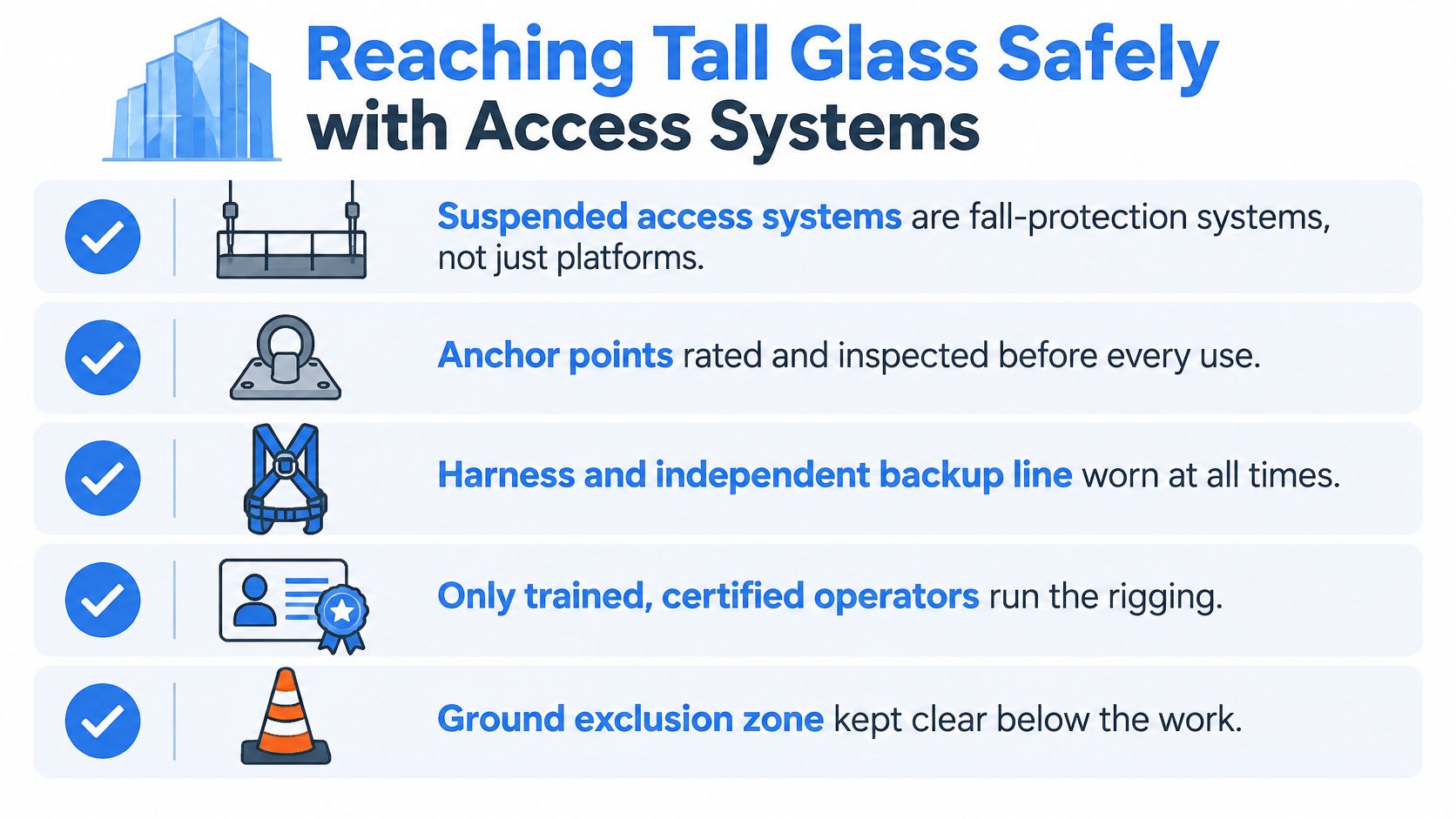
That no-swing rule protects more than the crew. A platform that drifts sideways puts pressure on frames, sills and seals, and on coated or tinted glass an impact can turn a cleaning visit into a glazing repair. Powered platforms and swinging scaffolds can carry guardrails and stabilization against the building, and none of that helps if a rope is worn or the crew skips the pre-use check. The cause and effect is direct: inadequate suspension or stabilization increases swing, impact and fall exposure, while properly selected and inspected systems cut those failure paths off before the platform leaves the roof.
The inspection routine is where one bid separates itself from another. Before each use, the crew documents suspension points, ropes, platform components, stabilization devices and fall-arrest equipment; confirms the roof anchor and rigging match the building's engineered design; and writes down wind limits, façade projections and pedestrian controls at the base. Uncontrolled platform movement endangers the crew and everyone walking underneath, which is why condominiums, commercial towers and stadium structures need those controls written into the job rather than assumed.
A ground exclusion zone matters as much as a harness. On a busy sidewalk, the person hurt by a dropped tool or a swinging stage is usually not the cleaner.
The stakes aren't theoretical. FacilitiesNet reported OSHA data showing 28 window-washing incidents over the five years through 2024, 11 of them fatal, in its report on OSHA window-washing incident data.
That level of documentation is the standard we uphold for high-rise window cleaning for towers, hotels and casinos, where advanced techniques and specialized equipment let the crew safely reach any window, regardless of its location or height.
Harder cleaning is not better cleaning. On modern glass it's frequently worse, and the damage doesn't announce itself as a scratch. It shows up as a building that lost its solar control.
Newer buildings run Low-E, tinted, dynamic, thermochromic and photovoltaic glazing, and each type behaves differently in light, heat and maintenance. Treat glass as a performance surface and the stakes become clear: the coating is doing a job, and the wrong pad or chemical retires it early. A review of thermochromic glazing reports it can reduce solar transmittance by 51%, with modeled energy savings of 18.8% during heating seasons and 37.4% during cooling seasons, per this review of thermochromic glazing performance. Etch or strip a coating like that and the loss is measured in energy, not in how dull the pane looks.
Start with the manufacturer label in the corner of the unit, usually a small etched or printed mark on the spacer or the glass edge, and read the coating designation off it. Then look for etched markings on the pane itself, and for an obvious tint, checking whether that tint belongs to the glass or to a film applied later. Work out which face the coating sits on, because Low-E coatings typically sit on an interior face of the sealed unit while films sit on the room-side surface. A faint, slightly iridescent reflection at a low angle is the usual visual clue that a coating is present.
Film is the one that bites back. Film edges lift, bubble or show a hard line, and blades and scraping accelerate all three.
Three habits do most of the harm: abrasive pads on a coated pane, aggressive chemicals left to dwell, and razor blades or scraping used to fight hard water. Each is a shortcut around the proper fix, and each can strip a coating, lift a film edge or leave a scratch no cleaning will remove.
Cleaning and restoration are different jobs, and mixing them up is how glass gets wrecked. Removing everyday soil, dust and fingerprints is cleaning. Removing bonded mineral scale, repairing scratched glass or replacing a unit with a failed seal is restoration, and restoration calls for manufacturer documentation, sometimes a specialist, and sometimes new glass.
In Arizona, Nevada and Colorado the pressure to go harsher is real. Intense sun bakes deposits on, irrigation water leaves mineral rings, and airborne dust abrades whatever rubs it, so owners reach for the strongest product on the shelf exactly where the glass can least afford it. I would start with the mildest method that removes the soil and step up only with documentation in hand.
Glass types, identification and safe cleaning
| Glass type | How to identify it | Cleaning caution | Next step |
|---|---|---|---|
| Standard annealed glass | No coating label or tint | Blades and hard-water scraping still scratch the surface | Routine pure-water or squeegee cleaning |
| Low-E coated glass | Manufacturer label; faint coating visible at an angle | Avoid abrasive pads and harsh chemicals | Ask the manufacturer for cleaning guidance |
| Tinted or film glass | Visible tint; film edges that lift or bubble | Avoid blades and scraping; film can peel | Use a mild, non-abrasive solution |
| Thermochromic or dynamic glass | Labelled as smart or dynamic glazing | Harsh chemicals can damage the active coating | Follow manufacturer documentation before specialized work |
| Photovoltaic or specialty glass | Labelled as PV or specialty glazing | The active surface varies by manufacturer, so no single method is safe to assume | Confirm the method with the manufacturer before service |
When a label is missing or unreadable, stop and get the documentation, because the cost of guessing is a coating nobody can put back. For residential units, this guide to how to clean Low-E glass walks through the method step by step.
The complaint that brings people back is almost always the same one: lines of water running down the pane after the crew left.
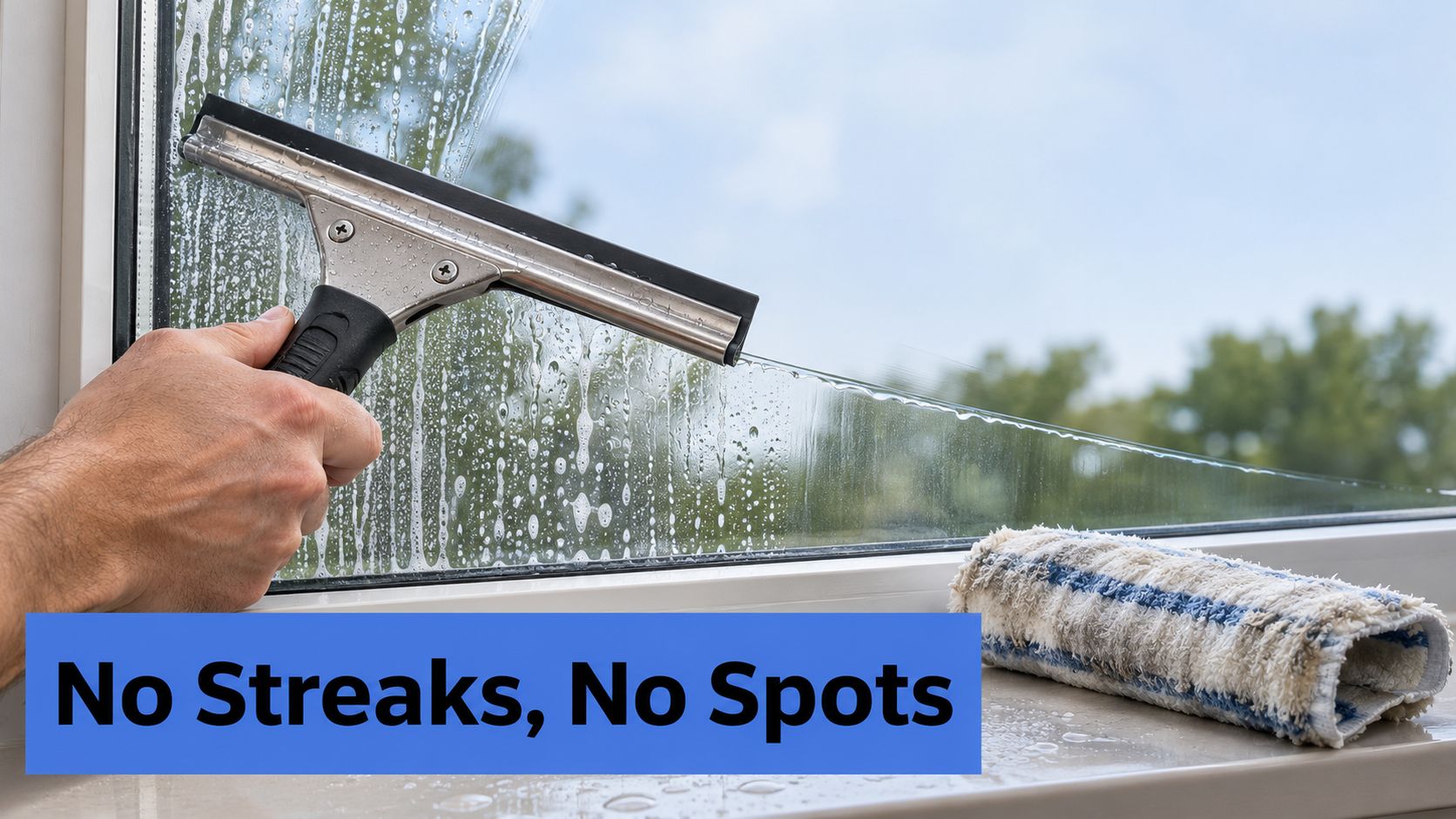
Nearly every time, it traces to a blade that wasn't wiped between passes or an applicator sleeve carrying grit and grease from the previous window. Both are single-visit fixes, and both are habits rather than equipment problems.
White spots that stay after the glass dries are a different animal. They're dissolved minerals, and purified-water rinsing prevents them before they form; once a deposit has baked on, it needs a mineral treatment rather than another wash, which is why we keep specialized treatments for hard water stains and mineral deposits for exactly these calls.
A short walk-through of the blade work shows where those lines come from.
Haze on coated glass usually points to an abrasive pad or a strong chemical used on an earlier visit. Stop both products and check manufacturer guidance before anything else touches that pane, because the coating itself is what's hazy. Dust that returns within days is a source problem, not a cleaning problem: nearby construction, seasonal pollen or bird contamination means a shorter interval scheduled around the source, not a stronger scrub.
Post-cleaning symptoms, causes and fixes
| Symptom | Likely cause | Fix |
|---|---|---|
| Streaks or lines after squeegee work | Blade not wiped between passes, or a dirty applicator sleeve | Wipe the blade after each pass and rinse the sleeve |
| White spots that stay after drying | Dissolved minerals in the water | Rinse with purified water; use specialized treatment for mineral deposits |
| Hazy or dull film on coated glass | Abrasive pads or aggressive chemicals | Stop harsh products and check manufacturer guidance |
| Dust returns within days | Nearby construction, pollen or bird contamination | Shorten the interval and schedule around the source |
| Dirt along frames and sills | Only the glass was cleaned | Include frames, sills and tracks in the service |
Sort the fixes by timeline before you spend anything. Single-visit repairs: wiping the blade after every pass, rinsing the sleeve, adding frames, sills and tracks to the scope so the dirt stops washing back onto the glass. Multi-week plans: mineral treatment where deposits have bonded, and a shortened interval where construction dust, pollen or bird contamination keeps returning.
Turn all of this into a short list you can act on this week.
Pricing follows four variables: window count, height and access, glass type, and how often the job recurs. A high exterior pane on a building with engineered anchors prices differently from a ground-floor storefront, and a coated curtain wall takes more care than standard annealed glass at the same height. Ask each provider to put its inspection routine and satisfaction terms in writing before you book, since that written scope is what you compare quotes against.
Exterior window cleaning is a defined activity in the federal statistical system, NAICS 561720, kept separate from pressure washing and sandblasting according to the U.S. Census Bureau product list for janitorial services, so a provider who spells out scope, method and inspection is following normal trade practice rather than asking for something unusual.
Window washing is a $2.9 billion U.S. industry in 2024, forecast to reach $3.2 billion by 2029, per Jobber's window cleaning industry statistics. Plenty of providers exist and they vary enormously in how they work, which is why the free estimate is the cheapest way to find out which kind you're dealing with.
We've been cleaning windows for over 26 years, and the process ends with a detailed inspection done alongside you to confirm the work meets your expectations. If something isn't right, the satisfaction guarantee means we address it promptly. Our service area covers Flagstaff, Las Vegas, Phoenix, Scottsdale, Denver, Tempe, Chandler and Gilbert, for homes, condominiums, offices, medical facilities, dealerships and high-rise buildings.
Professional Window Cleaning has been cleaning windows for over 26 years across Arizona, Nevada and Colorado, and we match the method to the pane instead of scrubbing every surface the same way. Book a free estimate and we'll identify your glass, plan the access, and walk the finished work with you so you can judge the difference in daylight, not just in a photograph. Visit Professional Window Cleaning to schedule your estimate.
Read our blog posts regularly and keep learning.

