Care and Maintenance
Las Vegas Hi Rise Window Cleaning: Safety and Access
Learn how Las Vegas hi rise window cleaning works, including access methods, safety planning, heat and glass limits, and property considerations.


You're standing in the lobby of a building you manage, or on the front walk of your own house, and the glass that should be invisible has gone milky at the corners. A few panes carry hard-water rings. The second-story windows haven't been touched in two years because nobody wants to put a ladder on that slope.
That's usually the moment people start searching for window cleaner services, and the first quote they get is often the one that sounds simplest. Window cleaning is a trade with two cleaning methods, a set of access systems that carry real risk, and a scope that reaches past the glass into screens, frames, sills and tracks.
This is written for owners, property managers and facility teams who need to compare providers on more than price: what the crew cleans, how it reaches high glass, what protects the person doing the work, and how clean glass affects the way a building gets used.
Window cleaner services fall into four service types: residential, commercial, high-rise and specialized facility. Match the service to both your property and how people use it. An occupied office needs a different access and scheduling plan from a house or a high-rise condominium.
The scope reaches beyond the glass. Screens, sills, frames and tracks need attention too, so ask which are included rather than assuming a glass-cleaning quote covers the whole window.
| Service type | Typical customers | What is included | How the glass is reached |
|---|---|---|---|
| Residential | Homeowners and condo owners | Interior and exterior glass, screens, sills and frames | Ground-level reach or water-fed pole |
| Commercial | Offices, storefronts, medical offices, churches, dealerships | Interior and exterior glass, frames, tracks and hard-water treatment | Ground level or elevated access, with scheduling around building activities |
| High-rise | Skyscraper owners, high-rise condominiums, property managers | Exterior facade glass, with other window components specified in the quote | Swing stage, boatswain's chair, rope descent or lift, with appropriate fall protection |
| Specialized facility | Stadiums, buildings with vaulted windows, unique facilities | Vaulted windows, tracks and treatments matched to the facility | Access selected for the facility layout and window height |
Professional Window Cleaning offers all four service types in Las Vegas, NV and Scottsdale, AZ. Its window washing covers interior, exterior, seasonal, storm and post-construction cleaning. Screen, sill and frame cleaning are included, and track cleaning uses specialized tools to reach the corners.
Building use should shape the scope.
For offices, schools and medical buildings, discuss daylight, access to opening windows and disruption to occupied rooms. Clean glass supports daylight; where windows provide ventilation, include tracks in the scope and ask whether operation needs separate attention. Cleaning should not be treated as a repair service.
Height changes the risk and access requirements, even when the cleaning task looks straightforward. Ask how the crew will reach each elevation and keep building users clear of the work. Professional Window Cleaning offers office cleaning at any window height, with flexible scheduling to minimize disruption. Services and offices are available 24 hours a day, and estimates are free and carry no obligation.
Two methods exist. Not three, not a dozen. Lifts, swing stages, boatswain's chairs and rope descent describe how a crew reaches the glass, never how it cleans it. Once a cleaner is standing at the pane with tools in hand, the choice is a squeegee or purified water.
The two methods are easiest to see side by side.
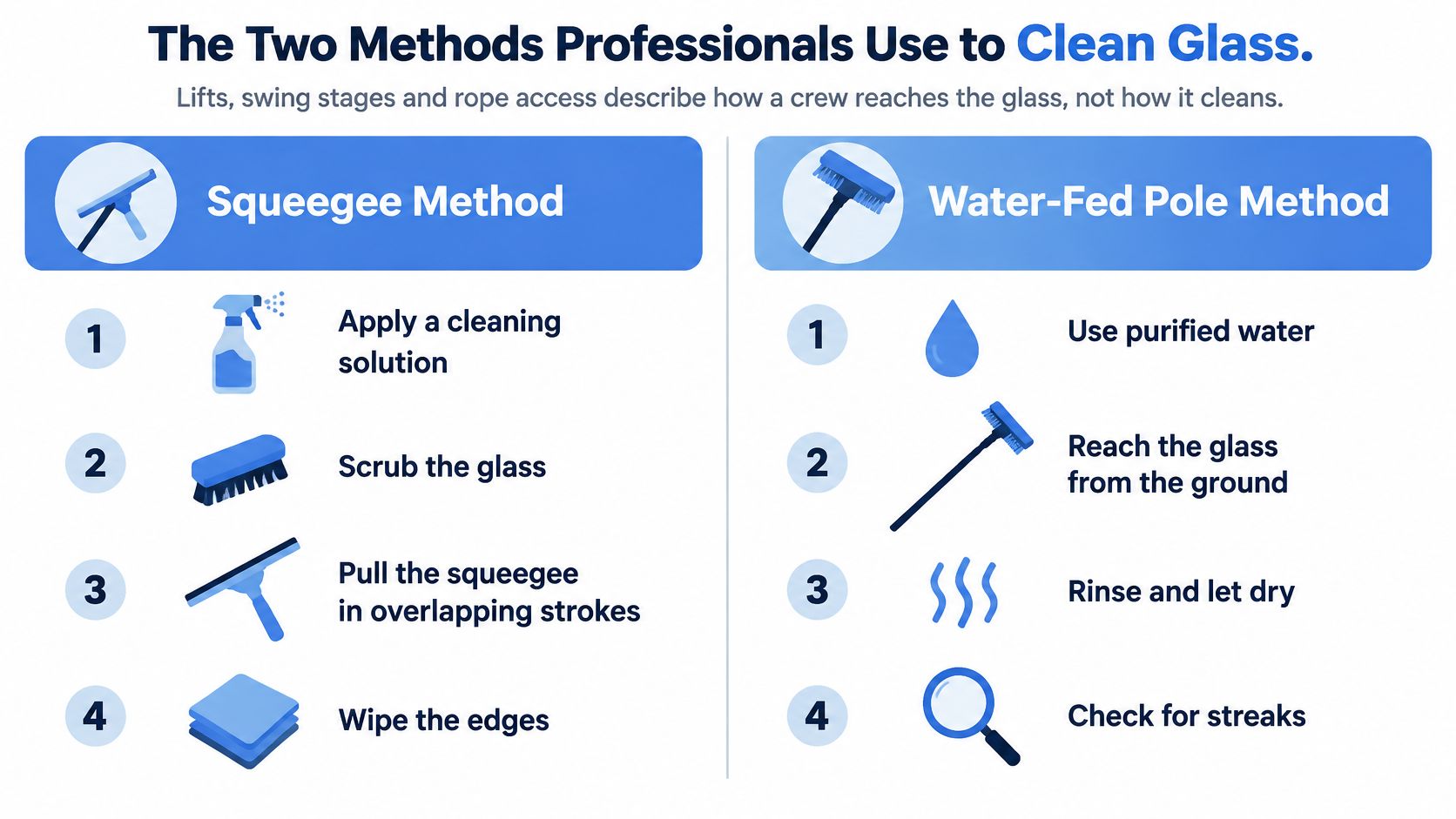
Purity is the whole trick behind the second method. Purified water is typically treated to below 10 parts per million of total dissolved solids, which is what lets mineral-free water evaporate without leaving spots or a haze behind (National Window Cleaning Authority's method comparison).
The easiest way to hold the difference in your head: a squeegee works like a wiper that pulls the dirty film off the glass and takes it away, while a pure-water rinse replaces that film with water that leaves nothing behind when it dries.
Seeing the two motions is faster than reading them.
| Factor | Squeegee method | Pure-water system |
|---|---|---|
| How it works | Solution applied with a washer or applicator sleeve, then a rubber blade removes solution and soil | Purified water sent through a water-fed pole and brush, scrubbed and rinsed |
| Drying | Blade removes the solution in controlled strokes | Glass dries naturally with no squeegee |
| Water quality | Standard water with cleaning solution | Purified water, typically below 10 ppm total dissolved solids |
| Residue risk | Depends on how fully the solution and soil are removed | Mineral-free water evaporates without residue |
| Typical setting | Interior glass and accessible exterior glass | Exterior glass reached from the ground with a water-fed pole |
For high windows we use water-fed poles with eco-friendly solutions, because a pole on a four-story facade is faster and safer than dragging a ladder and a bucket onto a roof.
If the glass has gone cloudy from minerals rather than dirt, the fix starts before the pole comes out. A walkthrough on how to fix cloudy shower glass shows how much of that white film responds to proper treatment instead of another pass with a household spray.
Ask this before you book: which method will you use on this glass, and why that one? A crew that answers with a reason, interior glass and a squeegee, sun-facing exterior panes and purified water, knows the trade. A crew that answers with a shrug is guessing.
A house call is a full-window job, not a pane wipe. What gets cleaned, in the order it usually gets attention:
Owner-occupied homes and condominiums both get this treatment, and the scope on a condo is often the same as on a house plus whatever the building's management requires for access.
Office work is wider. All glass surfaces of the office come into scope, along with cobwebs and debris around the window areas, which is the kind of thing a tenant notices before they notice a clean pane. Hard-water stains and mineral deposits get dedicated treatments rather than a general wash, because a mineral film that has baked on through a summer needs a different product than dust. We use environmentally friendly, effective and safe products for office work, and we schedule around business hours so a storefront or a medical waiting room isn't full of ladders at 10 a.m.
Churches and other buildings with vaulted windows need their own approach. Vaulted glass is often high, often hard to reach and often old, so we clean vaulted windows as a specialized facility job rather than slotting them into a standard route.
In Arizona, Nevada and Colorado, windows get opened for ventilation while dust, heat and wildfire smoke sit outside. Those choices affect the building, not just the glass. A 2025 study of arid educational buildings found that opening windows for at least 60 minutes in summer and 20 minutes in winter lowered indoor temperature by 1 to 2 °C and reduced CO2 concentrations by 36%, while noting that thermal discomfort can push occupants to keep windows shut (Scientific Reports on window operation in arid schools).
That study says nothing about clean glass, and it shouldn't be read as one. The practical point for a facility manager is timing: clean the glass before an indoor air quality assessment so dust and residue aren't confounding the readings, and schedule the work outside smoke events, dust storms, high pollen and extreme heat where the calendar allows.
The distinction to hold on to: clean glass gives you better daylight and clearer views. Cleaner air comes from the ventilation system, the filters and the ductwork.
If the complaint behind the call is dust settling indoors rather than hazy glass, the ventilation side is worth attention too, and air duct cleaning explains what that work involves. Glass cleaning and air handling are two different services, often done by two different trades, and coordinating them with a facility manager keeps both useful.
Height doesn't change the cleaning method. It changes the reach and the protection, and that's where a bargain crew and a professional one stop resembling each other. Two-point adjustable suspension scaffolds, commonly called swing stages, are among the most frequently used suspended systems for skyscraper window washing, and federal investigators reviewing suspension-scaffold falls have repeatedly found equipment failure involved. The other routes up are roof-supported boatswain's chairs and rope-descent systems, powered lifts, and the water-fed poles our crews pair with eco-friendly solutions for high glass that stays within safe reach of the ground.
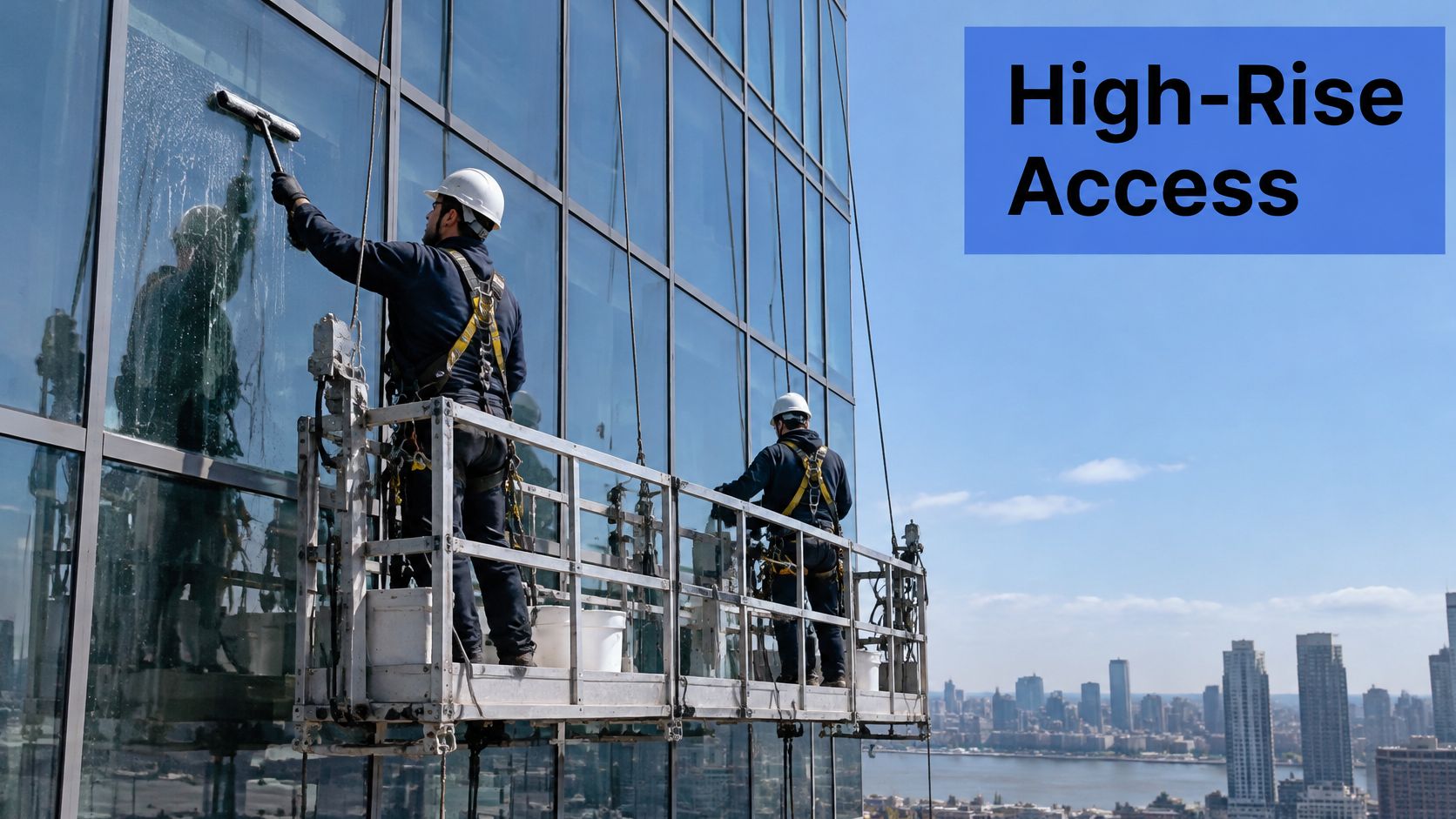
On a swing stage more than 10 feet (3.1 m) above a lower level, OSHA requires both a guardrail system and a personal fall-arrest system (OSHA guidance on two-point adjustable suspension scaffolds). The two controls cover different failure pathways. Guardrails reduce the chance of a worker leaving the platform at all. A personal fall-arrest system limits what happens if a fall occurs anyway. One prevents, the other catches.
Suspension scaffolds must also be tied or otherwise secured against sway when a competent person determines stabilization is needed. Window-cleaning anchors can't serve as scaffold tie points: an anchor built for worker fall protection isn't automatically designed for the lateral loads a swaying stage puts on it. An owner who accepts a crew tying off to a facade anchor has accepted a shortcut.
Roof anchorages carrying the suspension equipment must be permanent, sound, rigid and able to support the maximum intended load without displacement or deformation. OSHA guidance puts the requirement at four times the maximum intended load for permanent anchorages that support portable suspension equipment, with independent anchorages provided for safety lines, so that one structural failure can't take out both the platform and the fall protection (OSHA's 1986 standard interpretation on roof anchorages). Buildings where crews descend on rope systems carry a further duty: the owner must provide written confirmation that permanent anchorages have been tested, certified and maintained.
The consensus standard behind much of this is ANSI/ASME 39.1-1987, Safety Requirements for Window Cleaning, adopted by ANSI on June 4, 1987. OSHA guidance tied to that standard specifies a minimum dead-weight capacity of 8,400 pounds for certain anchorages used with safety belts, harnesses, lanyards, lifelines and drop lines (OSHA's 1987 interpretation on window-cleaning safety). We clean office glass at any window height, which is why the access conversation starts early rather than at the loading dock.
Protection runs downward too. In an occupied building, an office, a school, a medical facility, the work happens over entrances, walkways and floors full of people, so a real plan covers barricades and drop zones below the rig, not only the rigging above it. Flexible scheduling keeps the crew off the facade during arrival rushes, dismissal times or clinic hours where the calendar allows. Before authorizing facade work, ask for the platform type, the guardrail configuration, confirmation that lifeline connections are independent of the suspension supports, and the documented pre-use inspection. Weather limits and facade design then decide which system fits: a glass curtain wall with clean anchor points and a setback roof can take a stage, while a jagged historic facade with no safe anchorage may call for a lift.
Start with the estimate. We provide a free, no-obligation estimate, so the first number costs you nothing but the time to describe the building.
What moves that number:
A quote worth comparing lists each of those lines, so two bids can be read side by side rather than judged on the last figure. If you want to see how the numbers usually break down before you ask, our guide to how much window cleaners charge walks through the patterns.
Ask for the scope in writing. Two bids are comparable only when each lists height and access, window count, interior and exterior, frames, sills and tracks, screens, and any mineral treatment.
Scheduling matters as much as scope. Office work offers flexible scheduling to minimize disruption to the business's activities, which is why a medical office can take glass work before opening hours and a dealership can take it before the lot fills. On high-rise jobs, tenant notification, exclusion zones and weather limits can stretch the calendar, so ask for the schedule in writing and leave room for a wind day.
Tell the provider four things before the estimate: floor count, window count, access points, and the time window you can live with. Add any special feature, such as vaulted glass or tracks that haven't been touched in years.
The lowest bid is often the riskiest one, and not because the crew is careless. It's because a low price usually leaves something out, whether that's fall protection, equipment inspection, adequate insurance limits or a rescue plan. Once a bid is missing those, it isn't cheaper than the other bid. It's a different job.
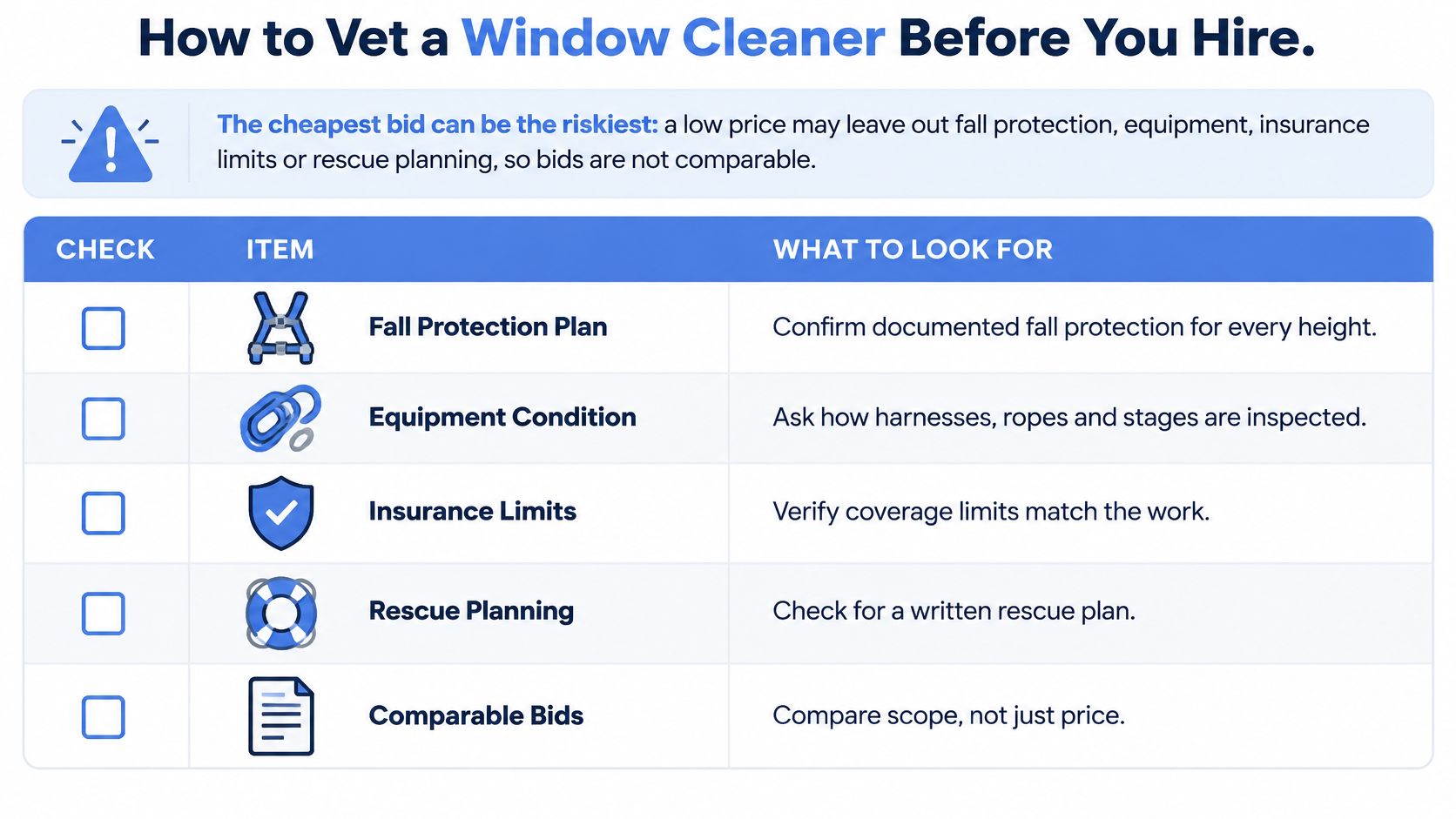
Ask these six questions of every provider, in writing, and score the answers against the same list.
| Question to ask | Why it matters | A strong answer sounds like |
|---|---|---|
| Which cleaning method do you use? | Shows whether the crew uses a squeegee, a pure-water system or both | Names the method and explains where each one fits |
| What access system will you use for high work? | Swing stages, roof-supported and rope systems carry different fall risks | Names the platform, anchorage and fall-protection setup |
| Can you show anchorage certification and inspection records? | Roof anchorages must be permanent, sound and rigid | Provides current documents, not verbal assurance |
| How does your crew train for height and rescue? | Generic insurance claims don't prove risk controls | Describes training, rescue planning and insurance limits |
| Which cleaning products do you use? | Products reach glass, frames and nearby surfaces where people work | Names environmentally friendly, safe products used for each job |
| What happens if I am not satisfied? | Shows how concerns get resolved after the job | Describes a satisfaction guarantee and prompt follow-up |
A provider who can't name the access system, who can't produce certification or inspection records, or who answers every safety question with a general claim of being insured is telling you something. So is a provider who treats rope access, a boatswain's chair, a lift and a water-fed pole as interchangeable. They aren't, and the safest method depends on facade design and access points rather than on what's parked in the yard.
Red flags: no named access system, no documentation, no rescue plan, and a price that arrived before anyone looked at the building.
Put the risk in proportion. OSHA's national falls program tracks window cleaning as an activity needing specific attention, and its 2014 to 2021 data record 5,369 fatal falls to a lower level across all industries, which is 13 percent of the 40,531 workplace fatalities in that period (OSHA's falls campaign directive). That figure covers every industry, not window cleaners, so it isn't a verdict on any one crew. It's a reason to judge a provider on controls rather than on fear.
Products and follow-up belong in the same conversation. We use environmentally friendly, effective and safe products for office window cleaning, and we offer a satisfaction guarantee, with any concern a customer raises addressed promptly. Ask what happens after the job, not only before it; a provider with a clear answer is easier to hold to the scope.
Insurance is its own question. Whether a crew is bonded or merely insured changes what you can recover if something goes wrong at your building, and our breakdown of bonded vs insured sets out what each one covers.
The habit worth building is simple: send the six questions in one email, keep every reply, and compare the answers from each provider against the same checklist before anyone signs.
Request the free, no-obligation estimate before you choose a service date. Send the property type, residential, commercial or high-rise, the floor count, the window count, the access points and the time window you can live with. Include special features such as vaulted glass, screens, sills, frames or tracks that need attention.
Professional Window Cleaning has been in business since 1999, with residential, commercial and high-rise window cleaning services (company profile). Service is available in Las Vegas, NV and Scottsdale, AZ. Window washing covers interior, exterior, seasonal, storm and post construction glass, plus screens and frames, so the whole window looks clean.
For commercial and high-rise properties, access planning matters as much as glass care. Our offices are open 24 hours, and window cleaning services are available 24 hours a day at every location. That helps when a storefront needs work before opening or an office needs cleaning around business hours. Flexible scheduling reduces disruption, while water-fed poles, eco-friendly solutions and hand work are matched to the height and surface.
Send the property details with the request. What comes back should be a scope you can read line by line, with the cleaning method, access plan and safety paperwork named rather than assumed. Ask about hard water stains, mineral deposits, cobwebs, debris, screens, frames and protective treatments for sills. Office work can include all glass surfaces, window area cleanup and specialized treatments.
Professional Window Cleaning handles homes, condos, storefronts, offices, churches, high-rise facades and unique facilities with both cleaning methods in the truck, a squeegee where interior glass and hand work call for it and purified water where a pole reaches the pane safely. If the questions above have narrowed your shortlist, put them in the estimate request and get the answers in writing before a date is booked. Professional Window Cleaning can start the scope conversation from your property type, floor count and window count.
Read our blog posts regularly and keep learning.