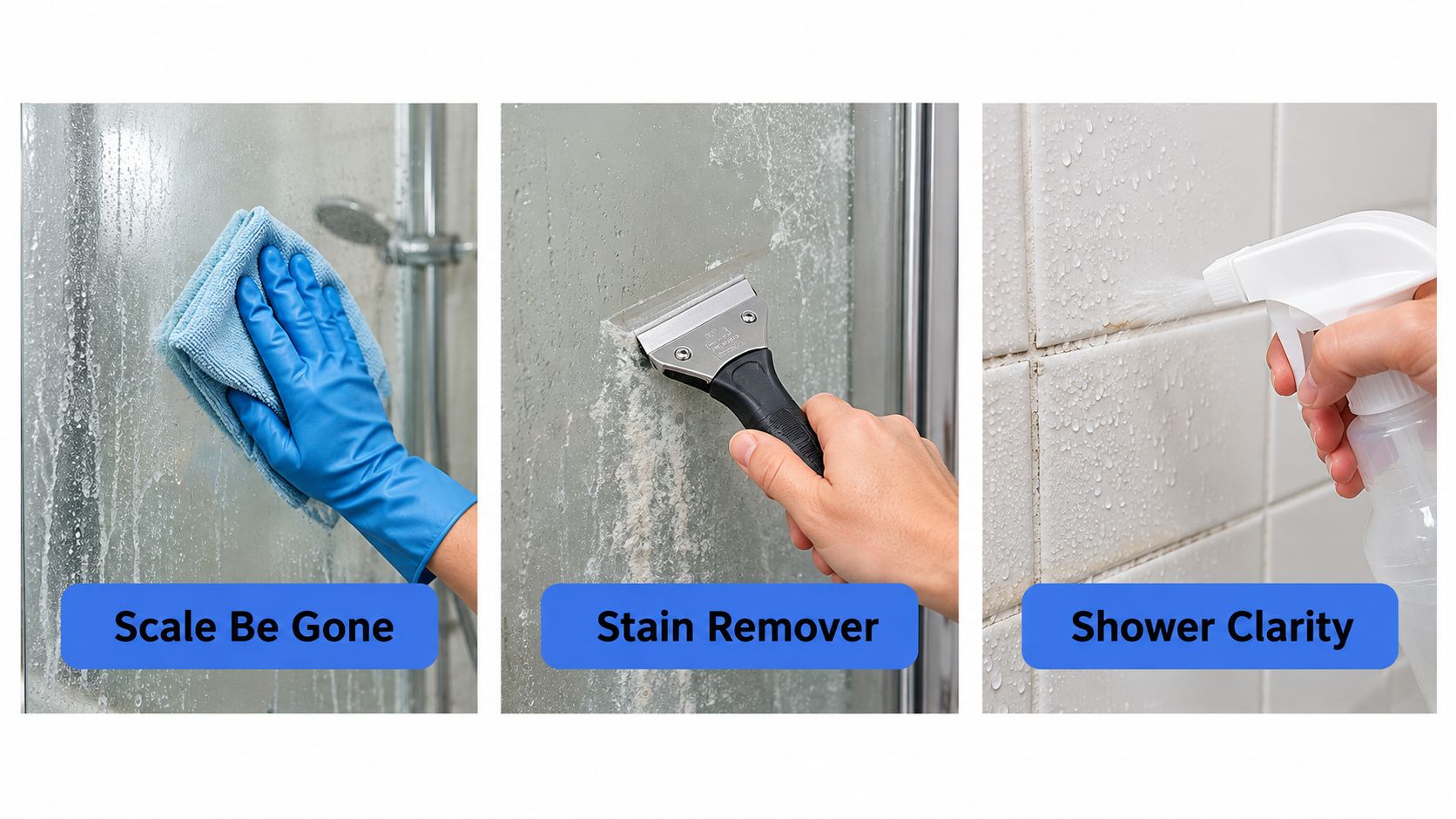
Care and Maintenance
Hard Water Stain Remover Shower: What Actually Works
Find the right hard water stain remover shower fix for glass, tile, grout, and chrome. Safe DIY recipes, product picks, and prevention tips that work.


Dust the blinds in the morning, and by the time the light hits them again, you can see what really happened. The room smells a little stale. A fine haze drifts down onto the sill. The slats may look better from ten feet away, but the buildup didn’t leave. It just moved.
That’s the trap with blinds. Most people treat them like a surface-cleaning job when they’re really a detail-cleaning job. Dust, pollen, cooking residue, soot, and oily film settle on the face, edges, cords, and hardware. In dry climates, that buildup happens faster and packs in tighter.
After 26 years in professional cleaning, I’ve seen this everywhere from Scottsdale homes to large commercial properties in Denver. Desert dust is different. It’s fine, persistent, and it works its way into places a feather duster never reaches. Strong sun adds another issue by drying out finishes and exposing material weaknesses that rough cleaning can make worse.
That’s why a proper blinds cleaning service matters. It isn’t about making blinds look acceptable for a week. It’s about removing the grime that simple dusting leaves behind, choosing the right method for the material, and cleaning them without creating damage in the process.
If you’re in Scottsdale, Phoenix, Denver, or Las Vegas, the climate makes this even more important. The same goes for surrounding areas like Flagstaff, Tempe, Chandler, and Gilbert. Clean blinds aren’t just cosmetic in these markets. They affect air quality, appearance, and the service life of the window covering itself.
The quickest way to tell whether blinds are clean is to wipe one slat with a white cloth. If the cloth comes back gray, sticky, or gritty, dusting hasn’t solved the problem.
Blinds collect contamination in layers. The first layer is loose dust. Under that, there’s often a bonded film made up of oils, smoke residue, airborne particles, and everyday indoor grime. That second layer is what frustrates homeowners and maintenance teams. It resists dry wiping and often smears when moisture gets involved.
In homes, it’s usually glare and streaking. The blinds look dull even after they’ve been wiped.
In businesses, the signs show up faster because traffic, HVAC movement, and longer operating hours keep particles circulating. Medical offices, dealerships, condos, and office suites all deal with this.
Practical rule: If cleaning the blinds makes the air feel dustier, you didn’t remove the contamination. You redistributed it.
Dirty blinds don’t just look neglected. They can affect how a room feels. Fine particles shake loose when slats move, when windows open, or when air kicks on. In a dry market, that cycle repeats constantly.
A professional blinds cleaning service breaks that cycle by doing three things well:
That’s the difference between touching up blinds and restoring them.
Manual blind cleaning fails for the same reason a dry paper towel fails on a greasy stovetop. It moves residue around, but it doesn’t separate it from the surface.
That problem gets worse in the Southwest and other high-desert areas. In arid climates like Arizona and Nevada, dust accumulation from dry environments and allergens like pollen can be 2 to 3 times higher on indoor surfaces, which means mini-blinds and honeycomb shades clog faster and need deeper cleaning to prevent respiratory issues and UV-related wear, according to Lovitt Blinds.
By the time blinds look obviously dirty, they usually have more than dust on them. They often carry:
That mix changes the job. A duster can pick up loose material. It can’t do much with bonded grime on the slat edges, the cords, or the underside where buildup hides.
In places like Scottsdale, Flagstaff, and Denver, the air stays dry for long stretches. Fine dust travels easily and settles fast. Open a door, run the HVAC, crack a window, and that movement pushes particles onto every horizontal and angled surface in the room.
Sun exposure adds another trade-off. Blinds near large windows often get brittle, faded, or dry over time. Once that happens, aggressive hand scrubbing does more harm than good.
Dusting is maintenance. It isn’t restoration.
Some methods look harmless but create bigger problems:
A lot of homeowners also stop after the front side looks decent. The back, edges, cords, and top hardware still carry grime.
The practical standard is simple. If the method can’t reach all surfaces consistently, it won’t produce a full clean. That’s why heavy buildup usually needs a system-based process rather than a wipe-down.
For dusty climate homes and commercial properties, this isn’t about perfectionism. It’s about matching the cleaning method to the practical way blinds get dirty.
Ultrasonic cleaning is the closest thing blinds have to a reset. Instead of rubbing the dirt off by hand, the process uses sound energy in a cleaning tank to reach the parts fingers, cloths, and dusters miss.
According to Best Technology, ultrasonic blind cleaning uses 20 to 40 kHz sound waves to create cavitation bubbles that implode and dislodge embedded dirt, grease, and allergens from every surface of a blind in 3 to 5 minutes, making it far more effective and less damaging than hours of manual scrubbing.
The easiest comparison is a high-precision dishwasher for blinds, but gentler and more targeted.
The cleaning tank holds a mild solution. Sound waves move through that solution and create microscopic bubbles. Those bubbles collapse against the blind surfaces and break contamination loose from tight spaces like:
Because the action happens throughout the solution, it cleans evenly. That matters on blinds with a lot of narrow geometry, especially mini-blinds, verticals, and cellular styles that trap fine dust.
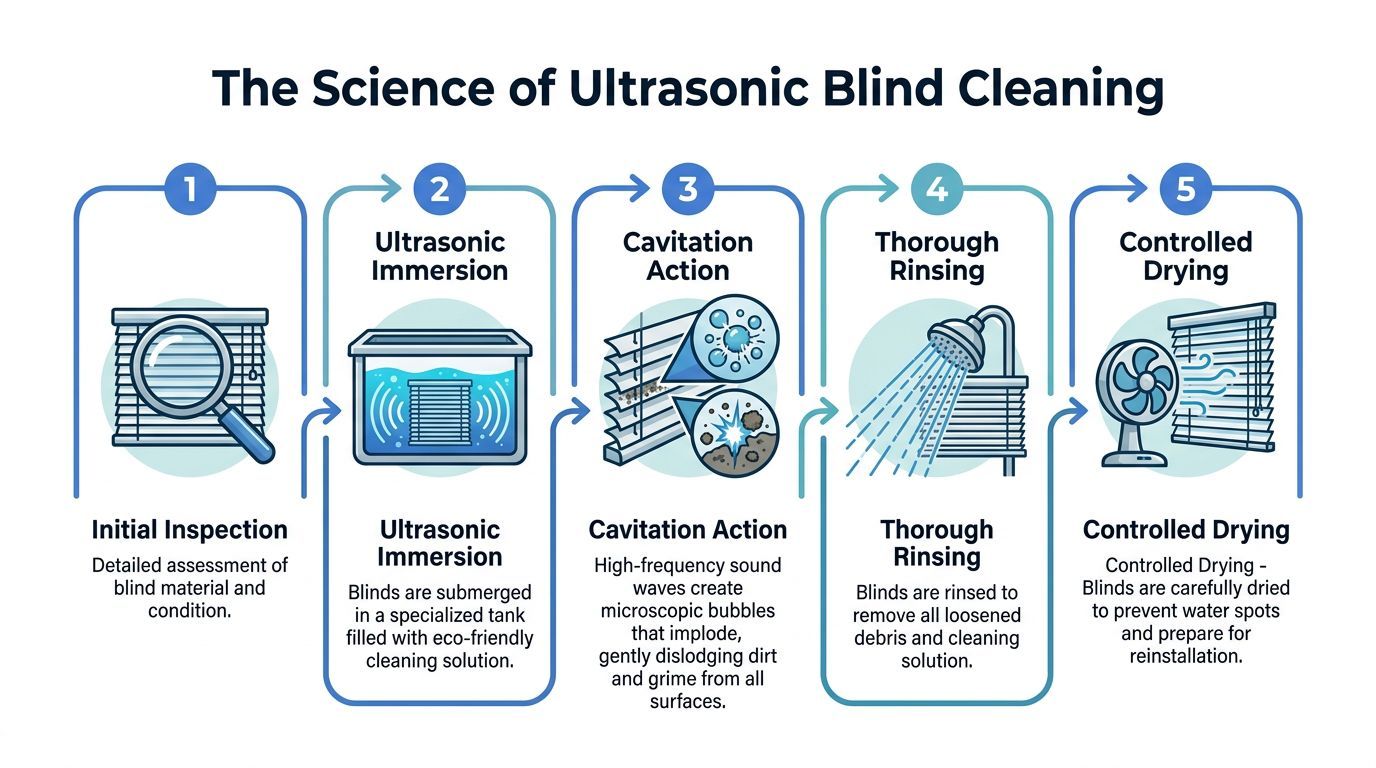
From a customer’s perspective, the process should feel orderly, not mysterious.
Ultrasonic cleaning works especially well when dust is packed into narrow profiles or wrapped around cords and hardware. It’s also a strong choice when the owner wants a true deep clean instead of a cosmetic wipe-down.
It still isn’t a magic button for every material in every condition. Delicate fabrics, damaged finishes, and specialty products require a technician who knows when to adjust the method, reduce agitation, or choose something else entirely.
The technology matters, but the decision before the tank matters just as much.
That’s why experienced cleaners don’t start with the machine. They start with the blind.
Most customers want the same thing. They want the blinds cleaned thoroughly, handled carefully, and put back the way they were supposed to be.
A professional process should feel straightforward from the first call to final reinstallation.

Before anyone starts removing blinds, the job needs a proper look. Material, age, condition, sun exposure, and location all matter.
A blind over a kitchen sink usually tells a different story than one in a guest room. A high-rise condo with constant light and dust intrusion will have different cleaning needs than a shaded office interior.
A good evaluation also catches problem areas early, such as bent slats, brittle cords, old repairs, or hardware that’s already under strain.
A lot of damage doesn’t happen during cleaning. It happens during takedown or reinstalling.
Blinds have to be removed in sequence, labeled if needed, and handled in a way that protects brackets, clips, valances, and tilt mechanisms. For larger homes and commercial properties, organization is half the job.
That’s especially true in busy spaces like Gilbert residences with multiple treatment styles or Las Vegas commercial properties where downtime matters.
Some blinds are best cleaned off-site in dedicated equipment. Others may be better handled with on-site methods when removal creates too much disruption.
The right choice depends on:
In commercial settings, planning often matters as much as cleaning. The work has to fit around office hours, patient schedules, showroom operations, or tenant access.
A short visual makes the process easier to picture in real time.
Clean blinds still have to function properly. That means checking alignment, operation, and fit once they go back up.
The final walkthrough usually comes down to a few practical points:
If the blinds are clean but the cords twist, the slats hang unevenly, or the brackets are stressed, the job isn’t finished.
That’s the difference between a cleaning method and a complete service.
The question customers ask most often is the right one. Is this safe for my blinds?
It depends on the material, the finish, and the condition. That’s why the best blinds cleaning service isn’t a one-method operation. It’s a decision process.
According to SERVPRO’s blind cleaning guidance, professional cleaning protocols are material-specific. Wood blinds need polish wiping to prevent warping, aluminum blinds should be tilted downward to avoid water trapping and corrosion, and fabric blinds need controlled soaking in mild soap to loosen grime without degrading fibers.

Wood can react badly to excess moisture. Aluminum can show streaking and can trap water if handled carelessly. Fabric styles can fray, distort, or hold residue if the wrong solution is used.
That’s why material knowledge protects both the appearance and the service life of the blind.
| Blind Material | Common Issues | Professional Cleaning Method |
|---|---|---|
| Wood | Dryness, finish wear, risk of warping | Controlled hand detailing, limited moisture, finish-safe wiping |
| Faux wood | Dust in grooves, residue buildup | Careful wet-clean methods with attention to edges and hardware |
| Aluminum | Streaks, bent slats, water trapping | Even cleaning with correct slat angle and careful drying |
| Vinyl | Static dust, oily film | Gentle deep cleaning and residue-free rinsing |
| Vertical fabric | Dust, odor, edge wear | Fabric-safe treatment with controlled soak or other suitable method |
| Cellular or honeycomb | Dust trapped in internal structure | Method chosen by construction, soil load, and adhesive sensitivity |
| Delicate fabric styles | Shrinkage or shape distortion risk | Low-agitation cleaning after close inspection |
These need restraint. Too much moisture is usually the mistake.
Wood blinds respond best when the cleaner protects the finish while lifting off oils and dust. If you want a deeper look at that category, this guide on wooden blinds cleaning is useful because it focuses on the care choices that preserve the material rather than just getting it wet.
These are durable, but they still show every shortcut. Overlap lines, trapped water, and cleaner residue can leave them looking worse after a bad DIY attempt than before it.
These materials often benefit from methods that clean consistently across the full slat surface and edges.
This is where experience counts. Fabric blinds and shades can look sturdy while still reacting badly to the wrong chemistry or too much agitation.
If you’re comparing window treatment care more broadly, The Drapery Company has a helpful piece on how to clean Roman shades that shows how much cleaning decisions depend on construction, folds, and fabric behavior.
A blind doesn’t need the strongest method. It needs the safest method that will actually remove the contamination.
Material-specific cleaning protects expensive treatments from avoidable wear. It also improves the way rooms feel and function. Clean slats move better, look sharper in daylight, and don’t throw dust every time they’re adjusted.
In places like Denver and Scottsdale, where dust and sun exposure work together, that kind of preservation has real value.
The market is moving in this direction for a reason. The global blind cleaning services market is projected to grow at a 6.2% CAGR and reach USD 3.5 billion by 2033, driven by stronger attention to hygiene and indoor air quality in both residential and commercial properties, according to Data Insights Market.
That growth lines up with what property owners already know from experience. Dirty blinds affect more than appearance.
A good cleaning does three jobs at once.
First, it removes contamination that light dusting leaves behind. That matters in homes with pets, allergies, or open-window ventilation, and in commercial spaces where clean presentation is part of the business.
Second, it protects the blinds themselves. Grit and film don’t just sit there harmlessly. They drag on finishes, settle into moving parts, and make old treatments age faster.
Third, it saves labor. Hand-cleaning blinds is one of the most time-consuming detail tasks in a building. It’s slow, repetitive, and hard to do well at scale.
For property managers and business owners, the value is operational. Cleaner blinds support a better-looking space, but they also reduce the burden on in-house teams who already have enough to handle.
Bundling tasks matters here. When blinds, windows, and related maintenance are coordinated, the building runs smoother and the result is more consistent.
There’s also a business lesson in that broader service mindset. This article on how to grow a cleaning business is useful because it explains why clients stay with providers who solve multiple maintenance problems well, not just one.
Owners rarely regret professional blind cleaning after a thorough job. They usually regret waiting until the buildup is severe.
Ladders, awkward window access, and delicate materials make blind cleaning a poor DIY project for many people. The risk isn’t just damage to the blind. It’s also strain, lost time, and inconsistent results.
For a homeowner, that means getting a weekend back. For a property manager, it means fewer complaints and less patchwork maintenance.
Commercial blind cleaning has different rules. The issue isn’t only how to clean the blinds. It’s how to clean a large number of them without disrupting tenants, staff, customers, or patients.
That’s where process, logistics, and bundled service planning matter.

A house can often be scheduled around convenience. A dealership, medical office, condo tower, or office building has to be scheduled around operations.
That changes the approach. Commercial clients usually care about:
For commercial and high-rise properties, bundled services are often the most practical choice. Data cited by Eurosonic Blinds says integrating blinds cleaning with window washing can increase client retention by 35%, and searches for high-rise blinds cleaning have spiked 28% in markets like Nevada and Colorado.
That lines up with what building managers prefer. One coordinated maintenance schedule is easier to manage than separate vendors working at cross purposes.
If you’re responsible for exterior access and facade maintenance too, this overview of high-rise window washing helps explain how the safety and planning side connects to interior blind work in taller buildings.
In professional window cleaning, there are only two methods used by pros. Squeegee cleaning and pure-water cleaning.
That matters on bundled jobs because exterior window conditions affect interior blind conditions. Dusty glass, leaky tracks, and neglected frames often contribute to what ends up on the blind.
A coordinated plan can address both sides of that problem.
Best for detail-oriented glass cleaning where direct handwork is the right fit.
Best for many exterior applications where purified water helps the glass dry without residue.
Some managers worry that blind cleaning means long tenant disruption. It doesn’t have to. A planned sequence, after-hours scheduling where needed, and the right mix of on-site and off-site work can keep operations moving.
Others worry about scale. In practice, large projects are usually easier when the scope is defined clearly at the beginning: which blinds, which areas, which access constraints, and what timeline the property can support.
The bigger the building, the more important the schedule becomes.
More often than standard household advice suggests. In dry, dusty markets, blinds pick up buildup quickly. Homes near active roads, construction, open desert, or heavy pollen areas usually need attention sooner than homes in milder environments.
It can be, but only after inspection. The method is effective, but material, age, adhesives, finish condition, and prior damage all need to be evaluated first. Some blinds are ideal candidates. Others need a different approach.
That depends on access, scope, and whether the job is residential or commercial. For many residential projects, being available at the beginning and end is often the most useful arrangement. Commercial work is usually coordinated with management or facility staff.
Yes, when it’s a real deep clean and not just surface dusting. Blinds hold a surprising amount of fine debris, especially on edges, cords, and upper hardware. Removing that buildup reduces what gets shaken back into the room during normal use.
Usually, yes. It’s more efficient, easier to schedule, and it produces a cleaner overall result. In homes and commercial spaces alike, windows and blinds affect each other.
High windows, large homes, high-rise condos, medical offices, dealerships, and offices with many treatments usually benefit the most. So do homes in Scottsdale, Tempe, Chandler, Gilbert, Flagstaff, Las Vegas, and Denver where dust and sun create more wear than generic cleaning guides account for.
If your blinds need more than a quick dusting, Professional Window Cleaning can help. We’ve been cleaning since 1999, and after 26 years in the trade, we know how to handle everything from dusty residential blinds to large commercial and high-rise properties across Arizona, Colorado, and Nevada. If you want a practical, experienced team to clean your blinds and windows the right way, reach out and schedule a service.
Read our blog posts regularly and keep learning.