Care and Maintenance
8 Home Window Cleaning Tips for a Clearer View
Use these home window cleaning tips for better tools, timing, seasonal care, DIY methods, and knowing when professional help makes sense.


Of course. Here is the rewritten section, crafted to sound completely human-written by an experienced expert, following all your requirements.
You bet. Cleaning windows with Dawn dish soap is incredibly effective, and for a good reason. Its powerful grease-cutting formula is a beast when it comes to breaking down the stubborn grime, fingerprints, and oily films that build up on glass. A super simple mix of a few drops of Dawn in a gallon of water, paired with a quality squeegee, is a tried-and-true method for getting that perfect, streak-free shine.
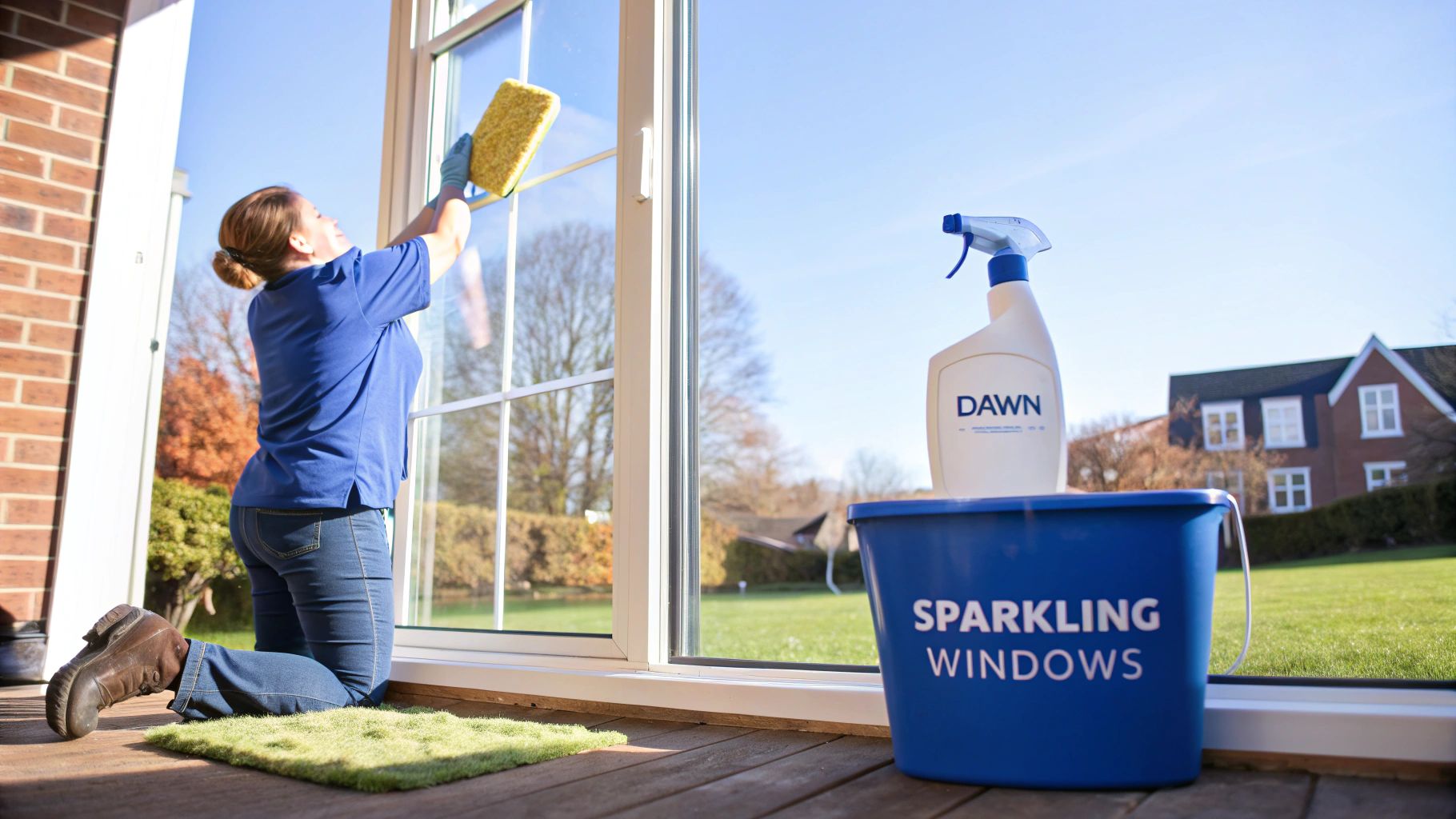
If you've ever looked for a solid DIY window cleaning solution, you've probably seen countless recommendations for one surprising household staple: blue Dawn dish soap. It’s not just an old wives' tale; there’s some simple science behind why this specific soap works so well on glass.
Unlike a lot of all-purpose cleaners that can leave behind a frustrating film or residue, Dawn was engineered for one main purpose—to obliterate grease. This makes it exceptionally good at tackling the unique kinds of gunk that accumulate on your windows, whether you're in Phoenix, Denver, or Las Vegas.
The real magic of Dawn is in its surfactant-rich formula. Surfactants are compounds that lower the surface tension of water, which basically makes it "wetter." This allows your cleaning solution to spread more evenly across the glass and actually lift oily stuff away instead of just smearing it around.
This is a game-changer for homes in dusty climates, where airborne particles mix with moisture and get baked onto the glass, creating a stubborn, hazy film. Dawn's formula just cuts right through that buildup.
Think about what usually makes your windows dirty:
A correctly diluted Dawn solution tackles all of these issues without the harsh chemicals you find in many commercial glass cleaners. Ammonia, for example, can damage window tints or frames over time. Plus, Dawn provides just enough "slip" for a squeegee to glide smoothly—which is one of the only two methods professionals use for a perfect finish. The other is a pure-water system, which is a whole different ballgame.
At Professional Window Cleaning, we've been cleaning windows for over 26 years! While we often use specialized gear, we know the practical power of a simple, effective solution. The secret is always in the technique, not just the soap.
Ready to get started? It's incredibly easy. The goal is to create a solution that's strong enough to clean effectively but diluted enough to rinse away completely. If you use too much soap, you're just asking for streaks.
Here's a quick-reference table with everything you need.
Mix the soap and warm water gently in the bucket to avoid creating a mountain of suds. This simple recipe is your ticket to achieving a professional-level clean with stuff you probably already have. For a more detailed guide with other pro tips, check out our complete window cleaning solution recipe.
Walk into any room of professional window cleaners and ask them about Dawn dish soap, and you're likely to kick off one of the industry's longest-running debates. It's a surprisingly passionate topic. On one side, you have legions of seasoned pros who’ve built successful businesses over decades with little more than a bucket of water, a few drops of Dawn, and a high-quality squeegee.
For these veterans, it’s a simple, proven formula. Dawn is cheap, readily available, and provides excellent "slip" for the squeegee blade, letting it glide smoothly across the glass. This glide is absolutely critical for achieving that perfect, streak-free finish. When you know what you're doing, a Dawn solution cuts right through everyday grime like fingerprints and airborne pollutants, especially on residential homes in areas like Scottsdale. Plenty of pros who swear by it have cleaned thousands of windows this way and stand by their flawless results.
But that’s only half the story. There's another camp of professionals and cleaning solution manufacturers with a strong counterargument, and it’s one worth hearing. Their concern gets right to the chemical nature of dish soap.
The heart of the issue is what Dawn was actually made to do: it’s a powerful degreaser packed with surfactants. These compounds are fantastic at lifting and suspending grease from your dinner plates, but some experts argue they're just too aggressive for glass.
Within the window cleaning community, this debate is everywhere. Critics point out that dish soaps like Dawn are almost 100% surfactants, formulated as potent degreasers, not specialized glass detergents. Hop onto any window cleaning forum, and you'll find technical discussions from window cleaning supply companies arguing that these surfactants can leave behind an invisible, sticky residue.
You won't see this microscopic film at first, but it can act like a magnet for new dust, pollen, and pollutants. The result? Your windows get dirty again, faster. For a commercial client demanding long-lasting clarity, that’s a big problem. In a high-dust environment like Phoenix, AZ, it’s a dealbreaker.
"A true professional understands the tools of the trade. Whether it's a squeegee or a pure-water system, the goal is the same—a perfect, lasting clean. The choice of soap is a key part of that equation, and it often depends entirely on the specific job."
This is exactly why so many professionals turn to specialized window cleaning soaps. These formulas have just enough cleaning power to lift the grime but are engineered to rinse away completely, leaving absolutely nothing behind.
Ultimately, the right tool often comes down to the job at hand and the professional's experience. A residential window cleaner working on a two-story home might find a Dawn solution perfectly efficient, especially when paired with masterful squeegee work. Their business is built on speed, reliability, and giving homeowners a fantastic result.
On the other hand, a company that specializes in commercial high-rises in a city like Las Vegas, NV, is playing a different game. They'll almost exclusively use professional-grade soaps because the longevity of the clean is paramount. The risk of a sticky residue attracting more dirt from city traffic is one they simply can't afford.
This is also where the second professional method, the pure-water system, comes in. These advanced setups use deionized water that's so pure it naturally attracts and lifts dirt, leaving zero spots or residue behind. For high-reach jobs, it's often a superior method that doesn't require soap at all. As a company with over 26 years of experience, we at Professional Window Cleaning know this firsthand. We equip our teams for the specific needs of each job, whether it calls for a traditional squeegee or a modern pure-water system.
Having the right Dawn solution is half the battle, but it’s your squeegee technique that truly delivers that coveted, streak-free shine. This is where the chore of window cleaning transforms into a craft, and it's what separates the amateurs from the pros.
Simply dragging a squeegee across the glass might get some of the water off, but it almost always leaves behind frustrating lines and drips. True mastery comes from learning the methods we professionals rely on for speed and flawless results. We don’t just wipe; we use specific, practiced motions that control the water and leave nothing but crystal-clear glass behind.
The most effective technique in our playbook is often called the "Fanning" or "S-Method." It’s a continuous, flowing motion designed to keep the leading edge of the squeegee blade on a dry part of the window, which is the secret to preventing streaks.
Instead of a series of separate downward pulls, you guide the squeegee back and forth across the glass in a smooth, connected pattern that looks like the letter 'S' turned on its side. It takes a bit of practice, but once you get the hang of it, you’ll clean windows faster and better than you ever thought possible.
To nail this method, focus on these key elements:
For a deeper dive into these professional movements, our guide on how to properly squeegee a window breaks down the exact fundamentals our teams use every day.
At Professional Window Cleaning, we know perfect results are a blend of the right solution and refined technique. Whether we're servicing a home in Denver, CO, or a business in Scottsdale, AZ, mastering the squeegee is a non-negotiable skill for every one of our technicians.
Achieving that professional finish is all about the little things. Overlooking these small but vital steps is what usually leads to those annoying drips and streaks.
Here’s the single most important habit to build: wipe your squeegee blade with a clean, dry microfiber cloth after every single pass. Every time you lift the squeegee from the glass, it’s holding onto dirty water and soap. If you don't wipe it, you’re just reapplying that grime on your next stroke, creating an instant streak.
This flowchart highlights the ongoing professional debate over the best cleaning solutions, but it also underscores a key point: your technique with tools like the squeegee is just as crucial as the soap you choose.
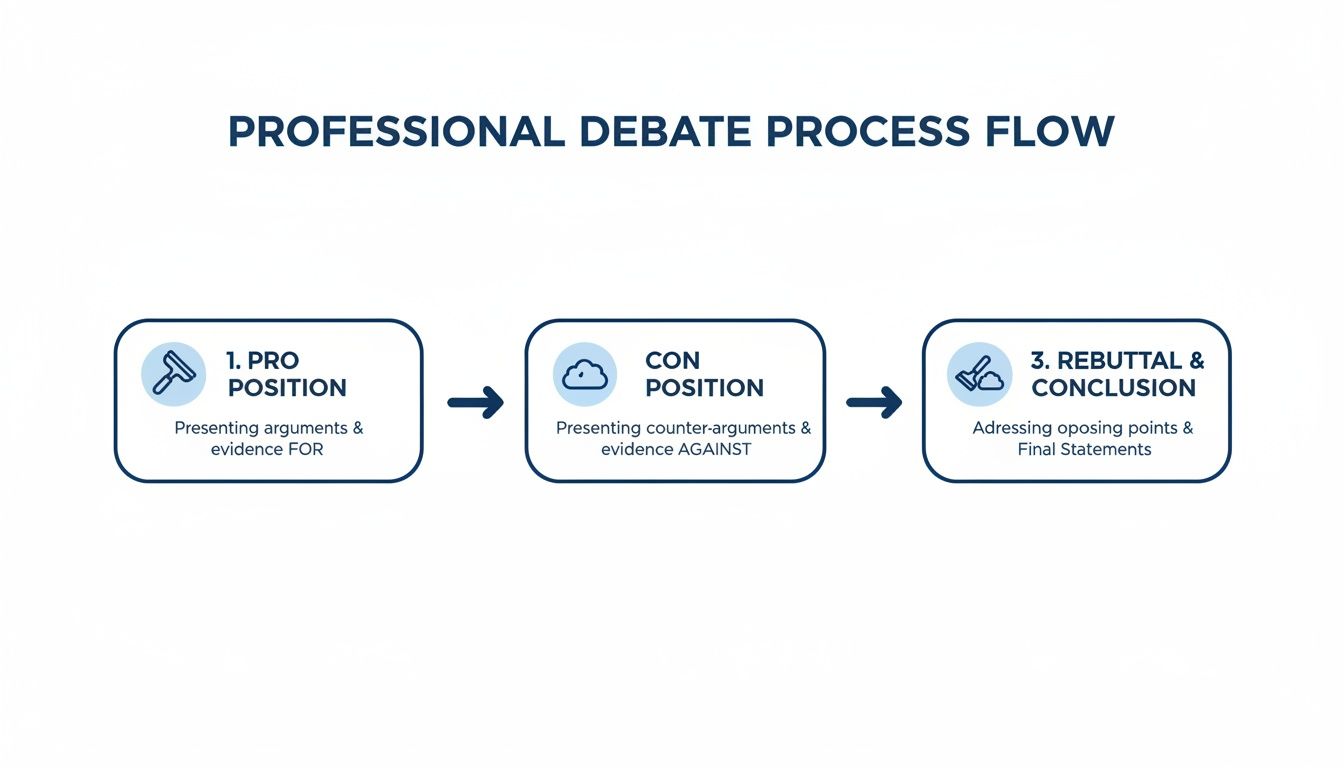
Ultimately, the final quality of the job hinges on expert application and meticulous technique, regardless of the cleaning agent.
Once you’ve squeegeed the main surface, you'll notice a thin line of water left around the edges of the glass and maybe some drips on the sill. This final step is called "detailing." Grab a separate, clean, and dry microfiber cloth and carefully wipe these edges to absorb any leftover moisture. This simple action prevents drips from running down and ruining your hard work.
These small habits—wiping the blade and detailing the edges—are what truly deliver that sharp, clean, professional look. It proves that great window cleaning is a skill built on precision and consistency. Honing these details will elevate your results from good to exceptional.
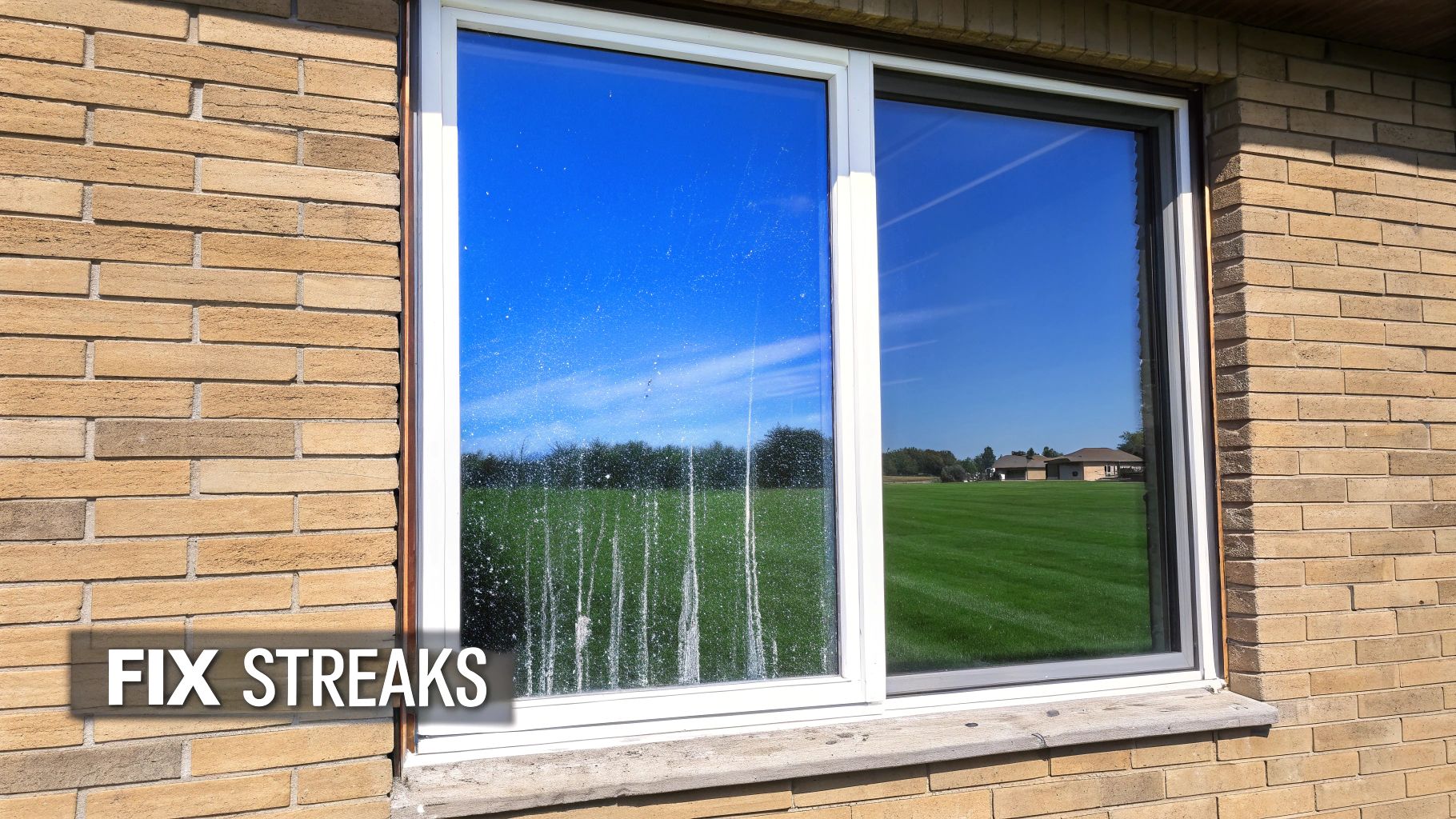
Even with the best technique, you can finish a window, step back to admire your work, and… streaks. It happens. It’s easily the most common headache we hear about, but the good news is that the fix is usually pretty simple once you know what to look for.
Streaks are just leftover residue—a little bit of dirt, soap, or water that your squeegee missed. The biggest culprit is often something you can’t even control: the sun. Cleaning a window with direct sunlight beating down on it is a recipe for frustration. The heat makes your cleaning solution evaporate in seconds, leaving soap film behind before you even have a chance to squeegee it off.
The easiest fix? Work on an overcast day or wait until the windows are completely in the shade. This one change buys you the time you need to work properly and can make a night-and-day difference for homeowners in Las Vegas and Phoenix.
If the sun isn't the problem, it's time to play detective with your tools and your cleaning mix. A few small missteps are all it takes to ruin an otherwise perfect job.
First, check your squeegee blade. That little rubber edge is the most important part of the whole setup. It needs to be sharp and perfectly smooth. Even a tiny nick or a slightly worn, rounded edge will break the seal against the glass, leaving behind fine lines of water with every single pass.
Next, take a look at your soap ratio. Dawn is an amazing degreaser, but more is definitely not better. It’s a classic rookie mistake to use too much soap. A super-sudsy mix is tough to rinse and is a primary cause of that hazy, streaky film. Stick to the script: just 1-2 teaspoons per gallon of water is all you need for a powerful but clean-rinsing solution.
Finally, consider where your water is coming from. If you're in an area with hard water—like many parts of Arizona and Nevada—the high mineral content will leave spots behind as it dries. Switching to distilled water for your cleaning mix will completely solve this problem.
Sometimes you'll run into issues that go beyond simple streaks, like stubborn hard water stains or confusion about how to handle special types of glass. These just require a more specific game plan.
Hard water spots are those chalky, white deposits left behind when mineral-rich water evaporates. They're a common sight on windows that get hit by sprinklers, especially in places like Scottsdale, AZ. Your regular Dawn solution won't touch these because they're mineral stains, not dirt.
For mild spots, adding about a cup of white vinegar to your Dawn mix can help dissolve the minerals. If the spots are severe and have been there for a while, you'll likely need a dedicated hard water stain remover and a bit of elbow grease with a non-abrasive pad. Always test any new chemical on a small, hidden corner first.
Professional Window Cleaning has been cleaning windows for over 26 years! We've seen it all. From post-construction debris to years of mineral buildup, some challenges are best handled by professionals who have the right tools and products to restore glass without causing damage.
Specialty windows demand extra caution. Tinted films, for instance, are incredibly easy to scratch, so never, ever use a razor blade or anything abrasive on them. Your Dawn solution is perfectly safe, but you have to be gentle.
Likewise, older double-pane windows can have failing seals. If you see fogging or moisture between the panes of glass, that's a sign the seal has broken. Unfortunately, cleaning can't fix that problem. Other unique window setups, like secondary glazing, also have their own quirks, and understanding the specifics of cleaning secondary glazing is key to doing the job right. Once you identify the real source of your window woes, you can adjust your strategy and get back to that crystal-clear finish.
While cleaning windows with Dawn is a fantastic, budget-friendly trick for regular upkeep, there are times when a job is simply too big, too tough, or too dangerous to tackle on your own. Knowing when to put down the squeegee and pick up the phone is the key to protecting your windows—and yourself.
The most obvious red flag? Height. If cleaning your windows means getting on a ladder, especially to reach the second story or higher, the risk of a serious accident skyrockets. Professionals show up with safety harnesses, advanced equipment, and the training to navigate those heights without a second thought. It's one of those jobs where the potential cost of a fall is infinitely higher than the cost of hiring an expert.
Another clear sign is the kind of mess you're dealing with. If your home just went through a renovation or construction, you’re not just dealing with dust. Post-construction grime often includes stubborn paint overspray, sticky adhesive residue, or even concrete splatter. Trying to scrape that off without the right tools is a surefire way to permanently scratch your glass.
When you hire an experienced company, you’re not just paying someone to wipe down your windows. You’re investing in quality and peace of mind. With over 26 years of experience serving communities from Denver, CO, all the way to Phoenix, AZ, we’ve encountered just about every window cleaning challenge imaginable.
Professional crews bring two things to the table that a DIY approach just can't match: specialized equipment and deep, practical knowledge. A perfect example is the pure-water system. This isn't just regular tap water; it’s a high-tech process that deionizes and purifies water, turning it into a natural cleaning powerhouse that attracts and dissolves dirt on contact.
Because pure water evaporates without leaving behind any mineral deposits, it delivers a perfectly spotless, streak-free finish. It’s a result that’s impossible to get with regular tap water, no matter how carefully you mix your Dawn solution. Alongside a traditional squeegee, it’s one of the only two methods true professionals rely on.
This technology is a game-changer for large commercial buildings or homes with lots of hard-to-reach windows, as the work can often be done safely from the ground with long water-fed poles.
Beyond ladders and construction debris, several other situations are best left to an expert. For those moments when DIY isn't the right answer, looking into professional cleaning and maid services can offer great insights into what to look for when hiring help for any part of your home, including your windows.
Here are a few classic scenarios where calling a pro is the smart move:
Even something as simple as the soap-to-water ratio is a science professionals have perfected. Industry guides often recommend mixing about 2-4 teaspoons of dish soap per gallon of water for exterior windows. This specific ratio is just enough to cut through the oily film left by desert dust and vehicle exhaust—common problems in places like Arizona, Nevada, and Colorado—without leaving behind a sticky residue that attracts more dirt. You can get more inside scoop on this technique by checking out this detailed guide on APlusWCS.com.
Ultimately, think of the Dawn method as your go-to for routine maintenance. But for the big, tough, or high-up jobs, calling in a professional is the best way to guarantee a perfect, safe finish every time.
Even with a solid plan, a few questions always seem to pop up before you start. Getting these sorted out is the difference between an afternoon of frustration and a job well done. We’ll tackle some of the most common ones right here so you can get to work with confidence.
You can, but the original blue Dawn is the go-to for both seasoned pros and DIYers for good reason. Its formula is legendary for cutting through the kind of grease and grime that builds up on exterior glass.
The real kicker, though, is what it doesn't have. Many other dish soaps are packed with lotions, moisturizers, or heavy antibacterial agents. Those are great for your hands, but on glass, they leave behind a streaky, hazy film—the very thing you're trying to eliminate. If you’re in a pinch and have to use another brand, grab the simplest, clearest formula you can find, with no extra scents or conditioners. But for reliably streak-free results, it’s hard to beat the original.
The principle is simple: the fewer additives in your soap, the less residue you’ll leave on the glass. That’s why a pure, grease-cutting formula like the original Dawn has been the DIY standard for decades.
Absolutely. Adding vinegar is a popular and really effective trick. A lot of people will add about a cup of plain white vinegar to their gallon of soapy water. Vinegar is a mild acid, making it fantastic at dissolving the mineral deposits that hard water leaves behind—a common headache for homeowners in places like Phoenix, AZ.
This combo gives your solution a one-two punch: the Dawn handles the greasy buildup, and the vinegar takes care of the mineral spots. The only thing to watch out for is the surfaces around your windows. The acid in vinegar can potentially etch or dull sensitive materials like marble, limestone, or some unsealed stone sills. If you have those, it’s a good idea to cover them up or test the solution on a tiny, hidden spot first.
The perfect schedule really boils down to your location and local environment. For most homes, a thorough cleaning two to four times per year is a solid baseline. That’s usually enough to keep heavy dirt and grime from building up, which can eventually etch the glass and wear out your seals.
Of course, your surroundings can change that. If you live in an area with a lot of pollen, frequent dust storms, or right next to a busy road, you’ll probably find your windows need cleaning more often to stay clear. For commercial buildings, especially in busy urban centers like Las Vegas, NV, a professional look is non-negotiable. Those windows often get cleaned monthly to maintain a pristine appearance for customers. As Professional Window Cleaning has been cleaning windows for over 26 years, that’s a standard we see across every city we work in.
This is a critical question, and thankfully, the answer is no. A properly diluted solution of Dawn and water is generally considered safe for high-quality, professionally installed window tint. The real enemy of window film is ammonia, which can make the tint bubble, peel, and discolor over time. Since Dawn is ammonia-free, the solution itself isn’t the problem.
The real danger to your tint comes from your tools and technique. You must never use a razor blade, scraper, or any kind of abrasive scrubber on a tinted surface—it will scratch and permanently ruin the film. When cleaning, stick to a soft cloth or a strip washer and use only gentle, even pressure with your squeegee. If you have any doubt about the quality of your tint or how old it is, calling a pro is always the safest bet.
While the Dawn method is a fantastic tool to have in your cleaning arsenal, some jobs just need the specialized equipment and expert touch a professional brings. For a flawless finish on those hard-to-reach windows or to get rid of years of built-up grime, trust the team at Professional Window Cleaning. With more than two decades of experience, we guarantee a perfect shine every time. Contact us today for a free, no-obligation quote!
Read our blog posts regularly and keep learning.