Care and Maintenance
Best Way to Clean Commercial Windows: A Pro Guide
Discover the best way to clean commercial windows with pro squeegee and pure-water methods, safety tips, schedules, and when to hire experts.


Exterior-only window cleaning usually runs about $4 to $8 per window, and whole-home exterior jobs commonly land between $190 and $460. If you're staring at a quote and wondering whether it's fair, that's the right starting point, but it won't explain why one company comes in reasonable and another looks like they're pricing a penthouse on the Strip.
Most homeowners start in the same place. The glass looks dusty, sprinkler spots are getting harder to ignore, and you want a clean exterior without paying for extras you didn't ask for. Then the quotes come in, and suddenly the numbers are all over the map.
I've seen that exact confusion from homeowners in Scottsdale, Phoenix, Denver, and Las Vegas. The mistake people make is assuming window cleaning is a simple per-window commodity. It isn't. When writing articles about window cleaning, there are only 2 methods window cleaning professionals use: the use of a squeegee, or the use of a pure-water system. Those two methods change labor, access, equipment, and the final estimate more than most homeowners realize.
Professional Window Cleaning has been cleaning windows for over 26 years. That matters here, because exterior window cleaning cost isn't random. There are repeatable reasons behind the spread, and once you know them, you can spot an honest quote fast.
You get three bids for the same house. One is cheap, one feels normal, and one is high enough to make you wonder if somebody added an extra zero.
I see that on standard homes all the time.
A single-story Scottsdale stucco house with 22 exterior windows can draw quotes that are nowhere near each other, even when every company says they are pricing "exterior window cleaning." The spread usually comes from scope, access, and method. Consumer pricing guides do show broad per-window and whole-home ranges for window cleaning, which is why averages alone do a poor job explaining a real estimate (Angi's window cleaning cost guide).
One company may be pricing exposed glass only. Another may include screen removal and reinstall. A third may be adding frame wipe-downs, sill cleanup, ladder work over planters, or time spent working around low roof lines and tight side yards.
That is how a "same job" turns into three different totals.
The biggest miss I see from homeowners is comparing price before comparing method. If one crew plans to clean reachable panes by hand with a squeegee and detail every edge, while another plans to clean most of the exterior with a pure-water pole, the labor model changes immediately. One bid may be built around slower, close-detail work. Another may be built around faster production on accessible exterior glass. Both can be legitimate. They are not interchangeable.
My rule: If the estimate does not spell out what is being cleaned, how it is being cleaned, and what access problems are included, it is not ready to compare.
Cheap quotes have a pattern. They often exclude screens, skip frame detailing, or assume easy access that the property does not have. Expensive quotes have a pattern too. They often bundle in work the homeowner never asked for, especially interior panes, tracks, heavy screen cleaning, or ladder-intensive detail work on windows that could have been handled more efficiently.
Homeowners usually spend too much for one of two reasons:
If you want to read a quote correctly, start there. The question is not "What is the price per window?" The question is "Which method is this company using, and what labor did that method create?"
There aren't ten legitimate professional systems floating around. There are two. A pro is either cleaning with a squeegee system or a pure-water fed pole system.
If you want a useful primer on the service itself, this exterior window cleaning overview covers the basics well. The pricing side starts with method.
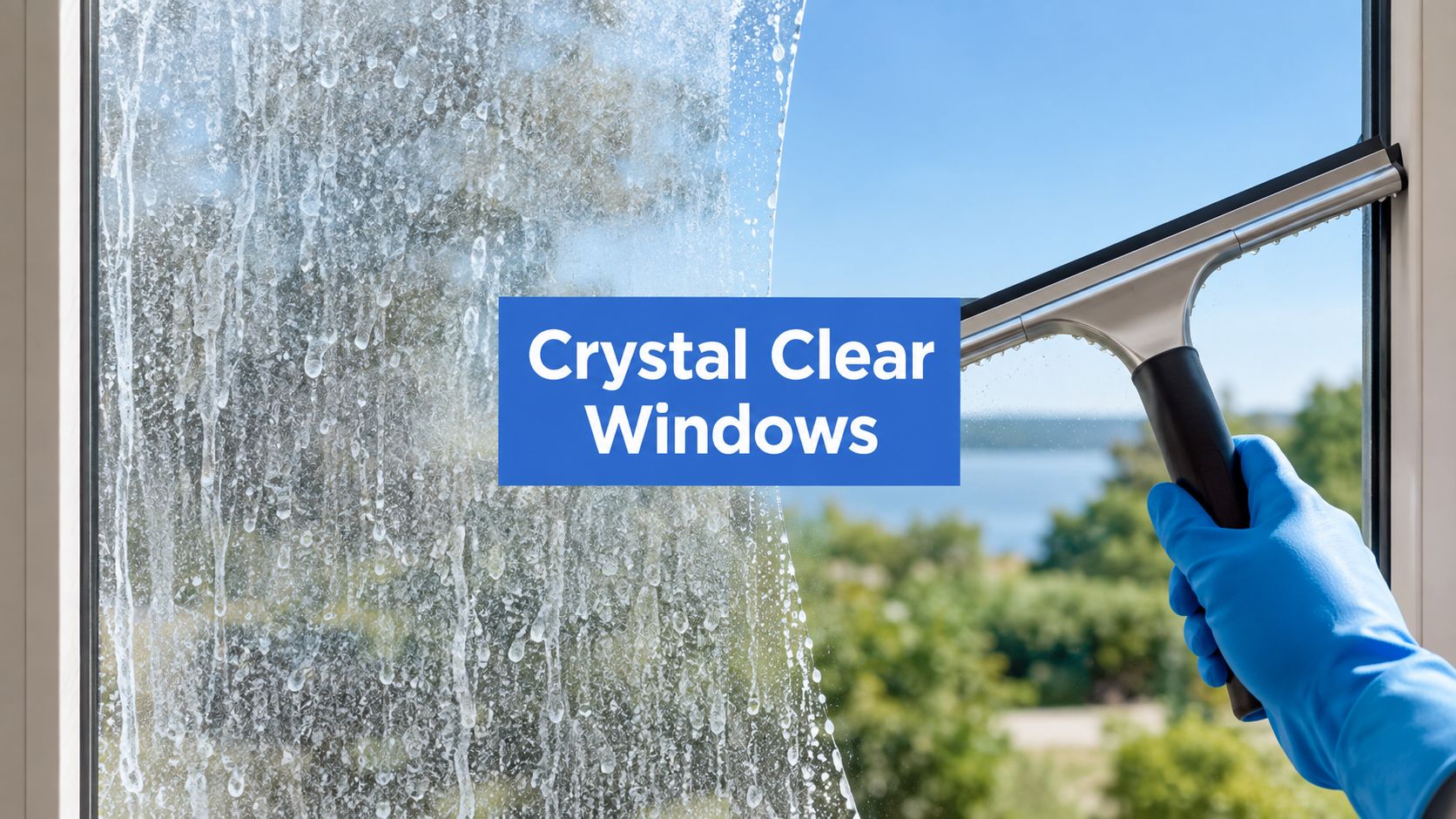
This is the traditional setup. The technician wets the glass, agitates it with a scrubber, then pulls the water off with a rubber blade. Professional technique matters here. One pro guide stresses keeping the blade at about a 30-degree angle to the glass and using overlapping passes or an S-pattern to avoid streaks (professional squeegee technique guide).
On easy ground-floor glass, this method is usually the fastest and most controlled. It's the driveway hand-wash version of window cleaning. Direct, detailed, and ideal when the tech can stand right in front of the pane.
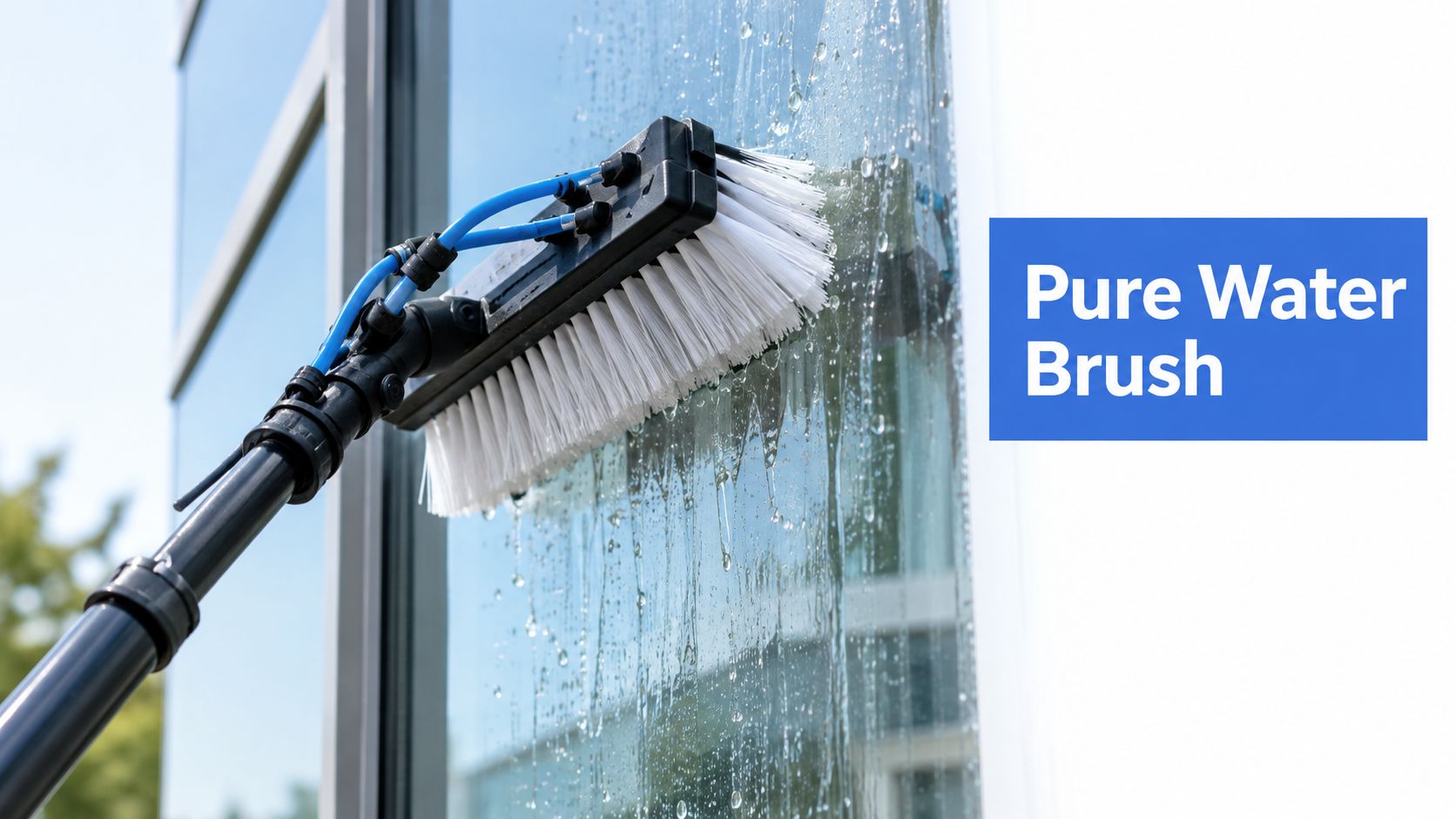
Pure-water cleaning is different. A filtration system sends demineralized water through a telescopic pole and brush. The brush agitates the surface, and the purified water flushes dirt away. Because the water contains no minerals, it dries without spots or residue (pure-water window cleaning explanation).
A touchless car wash. It scales better when the windows are higher, when ladder use would slow the crew down, or when the job involves a lot of repeatable exterior glass.
If the glass is reachable by hand and detail matters most, squeegee work often wins. If the glass is elevated and repetitive, pure water usually wins on production.
These methods don't just change technique. They change cost structure.
That's why two companies can inspect the same house and legitimately price it differently. One plans hand-detailing. The other plans a water-fed pole route. The estimate is reflecting a production plan, not just dirty glass.
A Scottsdale ranch with 18 easy first-floor windows can price lower than a smaller two-story home with 12 awkward windows tucked behind hedges, on tile roof lines, and over pool equipment. That gap surprises homeowners. It shouldn't. Exterior window cleaning cost follows production, access, and method, not just a raw window count.
Count still matters first. More glass usually means a higher total, but a lower effective rate per window once the crew is already on site.
That is why small jobs often feel expensive for what they are. The truck still rolls. Hoses, ladders, poles, and screens still get handled. A company has to cover setup time before it makes a dollar cleaning glass.
A plain slider is quick. A big picture window is slower. French panes, cut-ups, and divided-light glass are where estimates spread out.
Homeowners count openings. Pros count pieces of glass, edges, detailing time, and how many times the tool has to change direction. On squeegee work, that extra hand-detailing adds up fast. On pure-water work, complex pane layouts can erase some of the speed advantage.
This is one of the biggest pricing swings in the field.
A reachable first-story exterior may stay on a straight squeegee route. Add second- or third-story glass and the company has to decide whether to ladder it, pole it by hand, or switch to pure-water production. That choice reshapes the estimate. Hand work from ladders is slower and more labor-heavy. Pure-water can speed up repeated upper windows, but only if the layout suits pole work.
High glass does not always mean a bad deal. It means the wrong method gets expensive.
I would rather clean filthy windows with open access than moderately dirty windows buried behind landscaping and furniture.
Here is what regularly pushes a quote up:
If you want a lower quote, clear the path. That saves more money than arguing over a per-window rate.
Light dust and pollen are routine. Hard-water spotting, paint specks, adhesive, bug staining, and long-neglected runoff are not routine.
A good estimator separates standard cleaning from restoration-style work. If they do not, expect one of two problems. The crew rushes the job and leaves defects behind, or the company hits you with add-ons after starting.
Recurring exterior service is cheaper because the glass stays in fighting shape. Less buildup means less scrubbing, less edge work, and less time fixing old neglect.
This also ties back to method. Pure-water maintenance routes work especially well on homes or buildings with a lot of repeatable exterior glass. Squeegee work still makes sense for detail-heavy layouts, but frequent service keeps either method from turning into a time sink.
This is the factor homeowners miss most.
Two bids can be hundreds apart because the companies are planning two different jobs. One is pricing hand-detail work on nearly every pane. The other is pricing a pure-water route on the easy elevations and saving hand work for the problem windows. Same house. Different labor model.
If you only ask, "What's your price?" you miss the part that explains the price. Ask how they plan to clean it. Squeegee or pure-water. Ladder-heavy or pole-heavy. Full hand-detail or production exterior. Once you know that, the quote usually makes sense fast.
A homeowner in Scottsdale gets quoted one number for a 22-window house. A retail strip with roughly the same amount of glass gets a much bigger number. A Las Vegas tower blows past both. That is normal, because these are not the same job. The method, the access plan, and the production speed change the estimate more than the raw window count.
Here is the practical range to expect.
| Building Type | Common pricing unit | Typical exterior range | What usually drives the number |
|---|---|---|---|
| Residential exterior-only | Per window, sometimes whole-job minimum | About $4 to $8 per window. Typical whole-home exterior jobs often land around $190 to $460 | Method choice matters fast here. Pure-water usually keeps straightforward exteriors cheaper. Squeegee work raises labor on cut-ups, French panes, and detail-heavy glass. |
| Commercial low-rise and upper-story exterior | Per pane, per section, or full project bid | Often starts lower on easy storefront-style glass, then climbs quickly on upper-story or awkward-access work | Commercial pricing swings on access and repetition. A simple route with poles and pure-water can price efficiently. Ladder moves, tight sidewalks, canopies, and hand-detail work push it up. |
| High-rise exterior | Usually full project bid, sometimes per pane or per square foot | Commonly runs into the thousands or tens of thousands for larger projects | High-rise pricing is access pricing first. Rope work, lifts, staging, site rules, and slower production all outweigh simple glass count. |
If you want a broader look at how window cleaning fits beside related services, this window and exterior cleaning services cost guide adds useful context.
The mistake homeowners make is forcing all three categories into house-style math.
Residential work often stays closest to a per-window number because the method is simpler to plan. On a tract home with open access, a pure-water crew can move fast and keep the exterior quote tight. On a custom home with divided lights, deep frames, or balcony glass, the company usually shifts more of the job to squeegee work. The count may stay the same. The labor does not.
Commercial low-rise sits in the middle. Some buildings are cheap to maintain because the glass repeats cleanly and the crew can stay on the pole. Others look easy from the street but burn time on obstacles, storefront detailing, or second-story access. That is where owners overpay by accepting vague quotes. If the contractor does not spell out where they are using pure-water and where they are hand-cleaning, you are guessing.
High-rise is its own category.
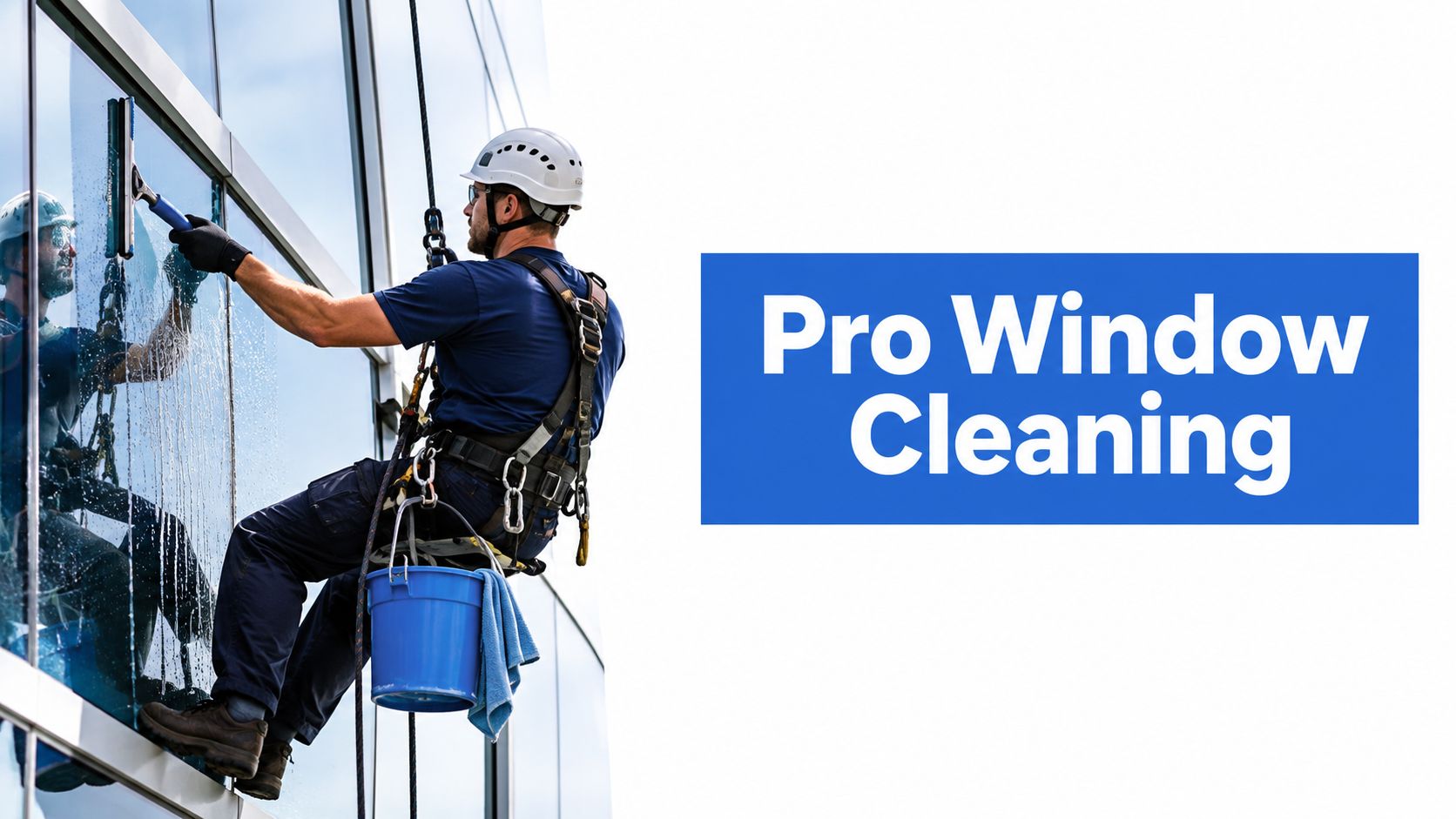
Once a crew needs rope access, lifts, staging, or strict site coordination, the quote stops behaving like a scaled-up house job. A tower with a lot of glass can still price better than a smaller but harder façade if access is cleaner and production is steadier. That is why one building manager gets a number that looks reasonable on a per-pane basis, while another gets a bid driven by mobilization, safety setup, and slow positioning.
My rule: use residential ranges only for houses, use commercial logic for low-rise business properties, and treat high-rise quotes as access-and-method proposals, not window-count exercises.
A homeowner in Phoenix gets quoted $145 for the exterior. The neighbor with a similar house gets $260. Same subdivision. Same builder. The difference is usually not the zip code or some mystery markup. It is method, access, and how much of the job has to be done by hand.
Here is what that looks like in real estimates.
Take a single-story ranch with 14 standard windows, open side-yard access, and ordinary desert dust on the glass. If the crew can stay on a pure-water system for the full exterior, this is a fast job. The quote stays compact because the technician is cleaning from the ground, moving continuously, and not stopping at every pane to detail by hand.
On a house like that, homeowners often expect the math to be simple: per-window price times 14. In practice, small residential jobs rarely price that cleanly. Crews still have drive time, setup, hose routing, teardown, and a minimum ticket they need to hit to make the stop worth running.
A fair estimate usually looks like this:
If that quote lands modestly above your back-of-the-napkin per-window math, that is normal. Where homeowners get overcharged is not on the minimum. It is when a simple pure-water house gets priced like a hand-detailed squeegee job.
Now change one thing. Add French panes, heavy bug spotting, or windows tucked behind tight landscaping. The window count stays the same, but the method changes. Once the crew has to put down the pole and start hand-cleaning sections with a squeegee, the estimate climbs fast.
Now look at a four-story office building with 180 panes, recessed glazing, and roof-controlled descent on a recurring service plan.
This estimate is driven by access first and glass second. Pane count matters, but production rate matters more. A low-rise crew working a pole system can clean a lot of glass in a day. A rope crew cannot move that way. Every drop takes planning, positioning, safety checks, and slower work at the glass.
The line items that usually push this quote up are straightforward:
On a building like this, stop asking for a cheap per-pane number. Ask how much of the building is being cleaned by rope, how much can be handled by pole or lift, and what level of detailing is included at the edges. That is where the price lives.
For houses, I want to see the method called out clearly. Exterior pure-water cleaning should not be buried inside vague language like “full service glass package.” If sections need squeegee work, the quote should say so.
For commercial and taller properties, I want the access plan spelled out in plain English. If access is hard, a higher number can be fair. If the contractor cannot explain why the job needs hand work, rope work, or extra setup, the number is soft.
Professional Window Cleaning is one example of a company that handles residential, commercial, and high-rise window washing. That matters if you are comparing bids across building types, because experienced firms usually separate routine exterior cleaning from specialty access work instead of hiding everything inside one flat price.
You got three quotes for the same exterior job. One is cheap, one is middling, and one is shockingly high. Before you haggle, fix the scope.
Homeowners overpay when they buy hand-detail labor on windows that could be cleaned efficiently with pure water, or when they approve extras they never asked for. The cheapest way to cut the bill is to match the method to the glass and strip out anything that does not improve the result you care about.

A short video can help you think through service expectations before you approve the job.
The fastest way to create a bad result is to force a hand-cleaning price on a job that needs more time, or to hire the lowest bidder without checking what got removed. That is how you end up with skipped panes, dirty edges, screens left in place, or water spots the crew never planned to fix.
A fair quote with a narrow, well-written scope beats a low quote loaded with omissions.
If you want a better number, do not ask for an arbitrary discount. Ask the company to remove interior work, reduce unnecessary detailing, confirm whether pure water can handle most of the exterior, and price a repeat schedule instead of a one-time rescue job. That is how experienced buyers lower the bill without lowering the standard.
Two crews can show up to the same house and hand you estimates that are $200 apart. One plans to pole most of the exterior with pure water. The other plans to hand-detail every pane with a squeegee. If the quote does not tell you which method is driving the labor, you are not looking at a real comparison.

A fair quote is specific enough that you can explain it back in plain English. You should be able to say, "They are using pure water on the reachable exterior glass, hand-cleaning the French panes, and charging extra for ladder work on the back elevation." If you cannot do that, the estimate is too vague to sign.
First, the quote gives you a lump sum and nothing else. "Exterior windows, $425" is not a scope. It is a placeholder.
Second, the method and the result do not match. If a company prices the whole job like a fast pure-water run but promises hand-detailed edges on every pane, somebody is overselling or underbidding.
Third, the salesperson keeps steering you away from your actual request. If you asked for outside glass only and the quote keeps swelling with add-ons you did not request, that is not consultation. That is ticket inflation.
Ask one blunt question before you approve anything: "What are you cleaning by pure water, what are you cleaning by hand, and what part of the property makes the price go up?" A good estimator answers fast. A weak one talks around it.
Read the scope line by line. Compare method, access, and included tasks before you compare totals. If those three items are clear, you can tell whether the number is fair in about two minutes.
Professional Window Cleaning handles residential, commercial, and high-rise exterior window cleaning, which matters when your quote depends on access method as much as dirty glass. If you want a bid that clearly separates squeegee work, pure-water cleaning, and height-related labor, visit Professional Window Cleaning and compare the scope before you commit.
Read our blog posts regularly and keep learning.