Care and Maintenance
Best Commercial Glass Cleaner: How to Choose
Compare the best commercial glass cleaner options, from ammonia formulas to pure-water systems. Find the right cleaning method for your building type.


Professional gutter cleaning usually costs $163 to $333 per service, and most homeowners land around $233. If your gutters are overflowing, that range is a solid starting point for budgeting before anyone steps onto a ladder.
The urge to look up gutter prices often strikes the moment water spills over the front edge during a storm, a corner downspout stops draining, or you notice dark streaks and wet soil near the foundation. At that point, you don't want theory. You want to know what a fair price looks like and why one quote comes in much higher than another.
That price gap is usually explainable. Home size, gutter length, roof shape, debris load, access, and whether the crew also has to clear downspouts all affect the final number. The good news is that gutter cleaning services cost is more predictable than many homeowners expect once you know how contractors build the estimate.
A common call goes like this. Water is spilling over the front gutter during a storm, the downspout at one corner has stopped draining, and the homeowner wants to know whether this is a quick maintenance visit or a bigger service call. For a typical home, the starting budget is usually $163 to $333 per service, with many jobs landing around $233, based on Thumbtack gutter cleaning pricing data.
That baseline helps, but real quotes are built on labor, access, and risk.
A standard one-story home with simple rooflines and regularly cleaned gutters usually stays near the lower end of the range. A taller house with second-story runs, tight side-yard access, heavy debris, or clogged downspouts moves up fast. On site, those are the first things I look at because they change how long the crew will be there and how much ladder work is involved.
National averages are useful for setting expectations. They do not tell you what your house will cost. A crew is pricing your gutter layout, your roof height, your drainage issues, and the amount of cleanup required on that day.
That is why two houses with similar square footage can still price differently. One may have short, open gutter runs over concrete. The other may have upper gutters above flower beds, screens that need removal, and packed sludge in every outlet. The square footage is similar. The work is not.
Here is the practical rule I give homeowners during estimates. If the home is easy to reach and the gutters are cleaned on schedule, pricing usually stays in the lower half of the market range. If the system has been neglected for a few seasons or the roofline is tall and cut up, expect the quote to climb.
Some companies price a basic debris removal. Others include bagging, downspout flushing, minor reseating checks, and a visual look at how the whole drainage path is performing. Both quotes may be fair. They are just pricing different scopes.
That same budgeting logic shows up in other exterior trades. If you're also planning outdoor upgrades, this guide to understanding landscaping budget in Prescott AZ is useful because it shows how scope changes price in a very similar way.
Local conditions matter too. Homeowners in markets like Denver, CO and Las Vegas, NV can see pricing shift based on roof design, seasonal debris, sun exposure, storm runoff patterns, and how easy it is to set ladders safely. That is one reason this guide ties costs to real service areas instead of leaving the numbers at a broad national average.
Contractors usually price gutter cleaning in one of three ways. Per linear foot, by the hour, or as a flat project rate. If you don't know which model you're looking at, comparing estimates gets messy fast.
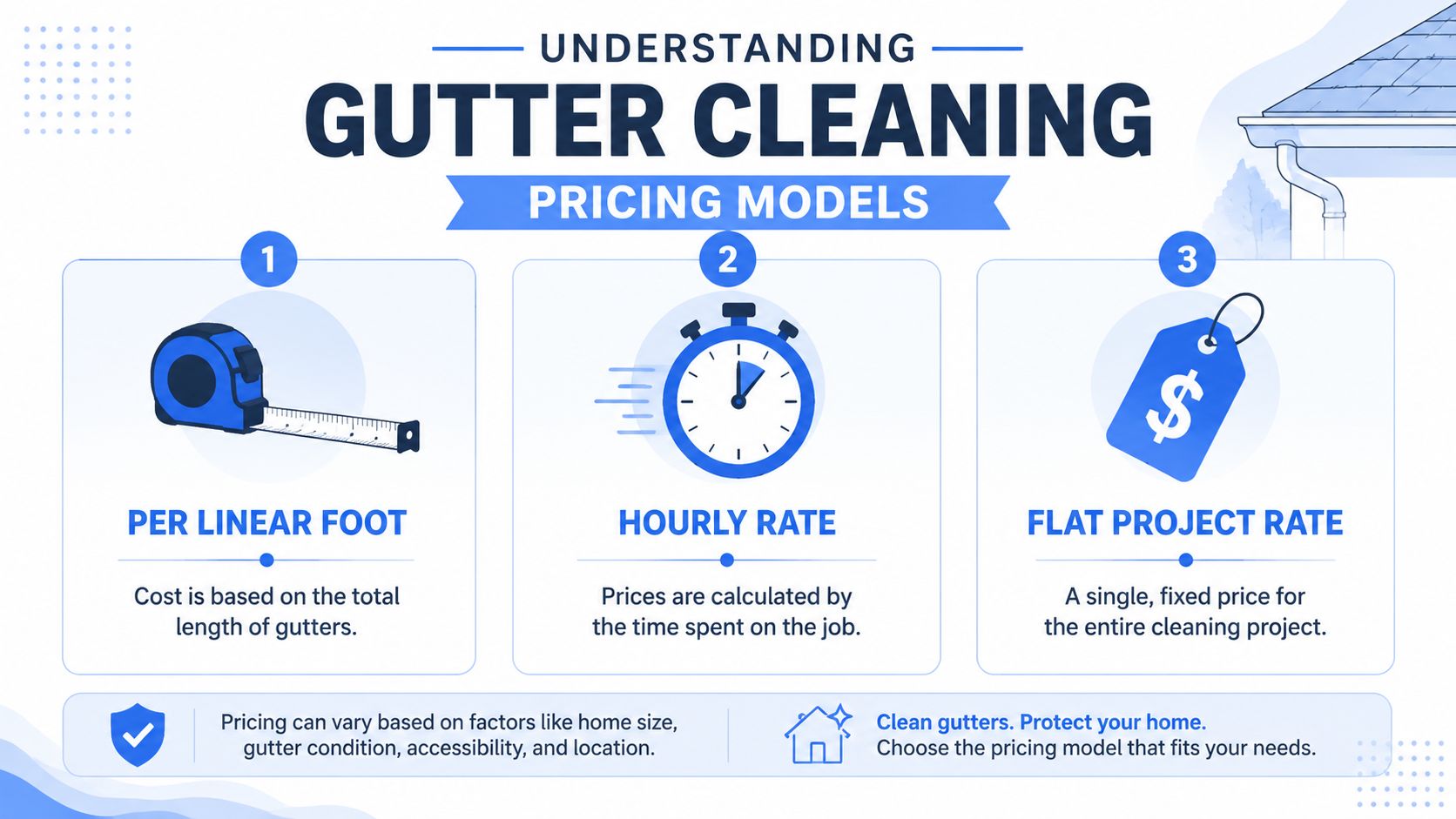
This is the most common model because it ties price to something measurable. The contractor adds up the total gutter length and applies a rate. Leafguard says professional gutter cleaning is often priced at about $0.80 per linear foot nationally, with single-story homes starting at $0.40 per linear foot and multi-level homes exceeding $2.00 per linear foot in its gutter cleaning cost guide.
Think of this like buying fabric by the yard. More footage means more material to handle, more ladder moves, and more time clearing debris.
What works well with this model
What doesn't work as well
Some contractors use an hourly structure when the job is less predictable. Angi reports labor generally ranges from $40 to $80 per hour in its gutter cleaning cost article. This model makes sense when debris volume is uncertain or when the home has tricky setup conditions.
Hourly pricing can be fair, but only if the scope is explained. Homeowners should ask what the crew expects to do during that time. Are they just scooping gutters, or are they also checking flow through each downspout and hauling debris away?
A flat rate is simple on paper. One price for the whole job. Many homeowners prefer it because there's no need to decode math after the fact.
A flat quote is easiest to live with when the company clearly states what's included and what triggers an extra charge.
A contractor may still use linear footage and expected labor in the background to build that number. You just don't see the formula. That's common in service businesses. If you're curious how pricing logic works behind the scenes in another trade, this article on pricing for repair shop owners gives a good look at the difference between gut-feel quoting and structured estimating.
Use this quick lens when reviewing an estimate:
| Pricing model | Best for | Watch for |
|---|---|---|
| Linear foot | Standard homes with predictable access | Separate charges for clogs or extra height |
| Hourly | Uncertain debris or difficult layouts | Open-ended labor without scope detail |
| Flat rate | Homeowners who want one firm number | Vague wording about what's included |
The best model isn't universal. The best model is the one that matches the actual job and makes the scope easy to understand.
The formula is only part of the story. The bigger driver is the condition and design of the house itself. Two homes with similar gutter length can price very differently if one is a simple one-story layout and the other has upper roof sections, steep pitch, or packed valleys dropping debris into the troughs.
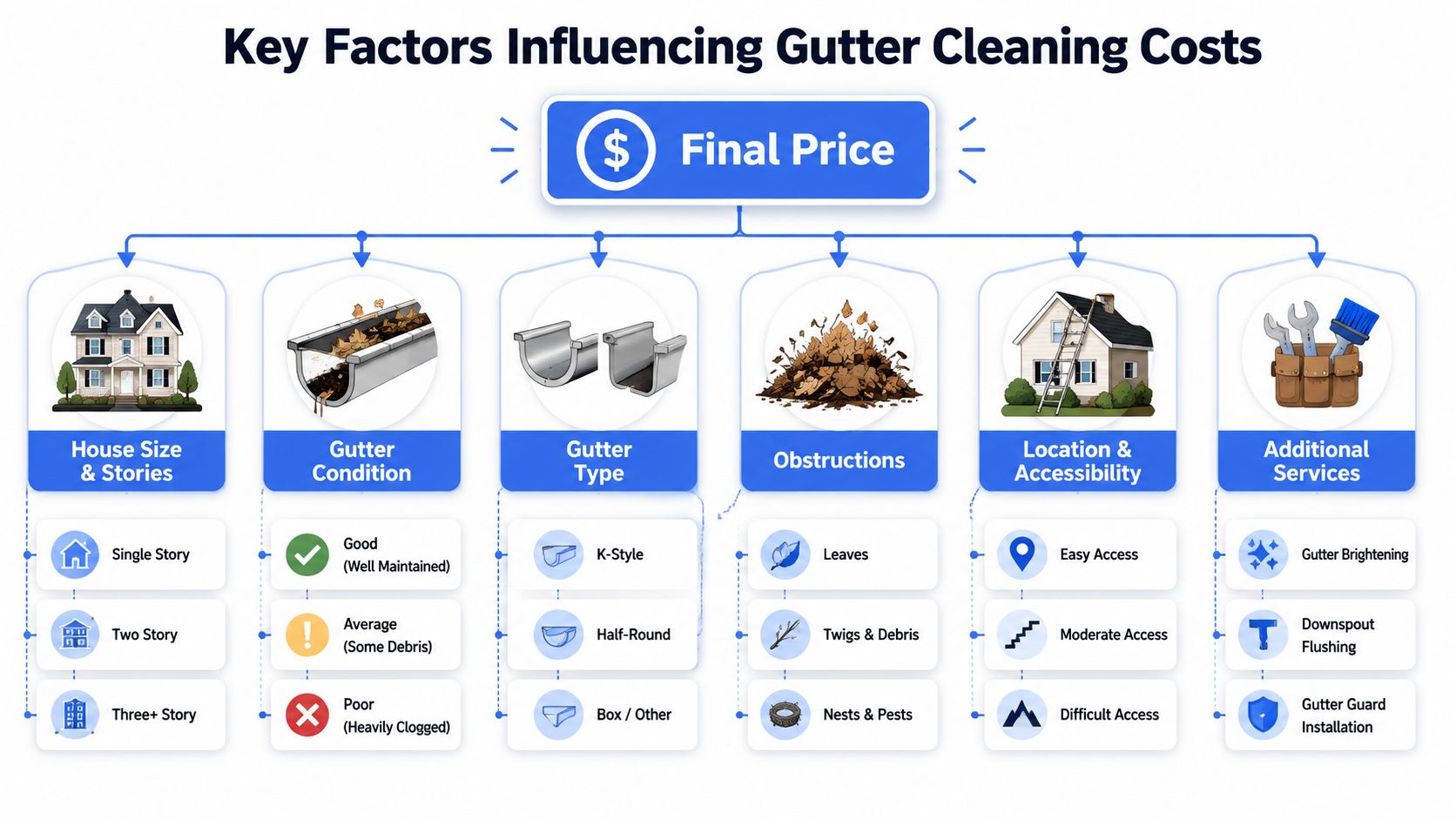
Height changes everything. More stories mean more ladder work, more repositioning, slower movement, and tighter safety margins. That's why tall homes nearly always cost more than low, open ranch homes even when the footprint isn't dramatically bigger.
Roof shape matters too. A basic gable roof is one thing. A roofline with multiple peaks, returns, dormers, and valleys creates more collection points for debris and more awkward work zones for the crew.
Some pricing guides stay too static. In the field, debris load changes labor in a real way. Data discussed in a professional pricing thread on Reddit notes that jobs requiring roof blowing add $50 to $200, and steep roofs can increase job time by 40% to 60%.
That matches what experienced crews already know. Dry leaves that scoop out easily are one kind of job. Wet sludge, granules, sticks, seed pods, and roof valley buildup are another.
Heavy debris doesn't just slow the clean. It changes setup, disposal, and how carefully the technician has to move around the roof edge.
Access sounds minor until it isn't. Fences, dense shrubs, patio covers, solar panels, pool enclosures, and tight side yards all affect setup time. A home may look easy from the curb and still be difficult once the crew starts moving ladders around the property.
Common access issues include:
Gutters aren't really clean if water still can't move through the system. Downspouts often separate a basic cleaning from a more involved one. Leafguard notes that clearing clogged downspouts typically adds $50 to $100 in its earlier-cited cost guidance. That charge makes sense when the crew has to disassemble elbows, flush blockages, or work through compacted debris.
Gutter guards complicate things too. Some guards help. Some slow the job because technicians need to remove sections, clean underneath, and reinstall them carefully. Homes that haven't been serviced in a while also tend to reveal hidden issues. Loose spikes, separated seams, standing water, and sagging sections don't always increase the cleaning price directly, but they can expand the scope.
Before requesting a quote, look at your property and note:
Homeowners in places like Scottsdale, AZ often see how roof shape and access drive pricing more than square footage alone. That's why the final number is rarely about one factor by itself.
You call for a quote after the first heavy rain, and the price range feels wide. In practice, that usually comes down to house type, access, and how much extra work is hiding in the system. Sample scenarios make that easier to judge before anyone sets a ladder.
The numbers below are not flat rates. They are working examples based on the pricing ranges already covered earlier in this guide, then adjusted the way a field estimator would adjust them in cities we serve. That local context matters because a simple one-story home in Denver does not price the same way as a taller home in Phoenix with harder access.
| Home Type | Linear Feet | Stories | Estimated Cost Range |
|---|---|---|---|
| Small ranch home | 150 to 180 | 1 | $145 to $250 |
| Standard family home | 180 to 220 | 2 | $180 to $360 |
| Large complex home | 220+ | 3 or complex multi-level | $240 to $500 |
A smaller single-story home in Denver with straightforward ladder access and moderate seasonal debris usually lands near the lower end of the range. If the gutter system measures about 150 to 180 linear feet, a realistic estimate often falls between $145 and $250.
A sample calculation might look like this: basic one-story cleaning in the lower range, no guard removal, and downspouts that are already draining. That is the kind of job crews can price with confidence because the labor is predictable. Access is simple. Cleanup is usually quick.
If I saw the same house with packed corners, one clogged downspout, and tight ladder placement over shrubs, I would expect the quote to move up within that same range or slightly beyond it.
A standard two-story home in Phoenix, AZ usually costs more because upper-level work slows everything down. For a home with 180 to 220 linear feet of gutters, many quotes land around $180 to $360.
Here is a practical way to read that range. A cleaner two-story home with open access may come in near the lower half. Add second-level downspout flushing, heavier roof grit, or sections above patios and garage roofs, and the labor climbs fast. That is why two quotes can differ even when the homes are similar on paper.
Homeowners should compare scope, not just price. Ask whether the crew is clearing all downspouts, removing debris from problem roof transitions, and hauling away the waste. A more detailed guide to choosing the best gutter cleaning services can help you spot the difference between a basic visit and a thorough one.
A larger home with multiple levels, roof valleys, and heavier buildup rarely prices like a standard linear-foot job. If the property has guard sections, steep areas, or debris packed into upper runs, the estimate can push toward the top of the common range, often around $300 to $500 on more involved jobs.
A sample calculation here is less about footage alone. A 220-plus-linear-foot home may start with the base cleaning cost, then rise because the crew needs more ladder moves, more time on upper sections, and extra flushing to restore flow. Guard removal and reinstallation can add more labor. So can neglected areas where debris has turned into compacted sludge.
Size matters. Complexity often matters just as much.
That is why the cheapest headline number can be misleading on a bigger property. If a quote looks unusually low, check whether it includes the upper runs, the downspouts, and the time needed to deal with guards or heavy buildup.
A homeowner in Denver might spend a Saturday clearing a one-story ranch and finish with little more than time, a ladder, and a bag of debris. That same DIY plan looks very different on a two-story home in Phoenix with tile roofing, tight side yards, and packed downspouts. The key question is not just who cleans the gutters for less. It is what the job involves, and what can go wrong if parts of it get missed.
On a simple, single-story home, DIY can make sense if you already own the equipment and the gutters are easy to reach. On taller or more complex homes, labor is only part of what you are paying for. You are paying for safe ladder setup, efficient access, full downspout testing, and an experienced eye that catches issues before they turn into siding stains, fascia rot, or drainage problems around the foundation.
Here is the practical trade-off:
Professional service
DIY cleaning
If your gutters sit above a second story, above delicate landscaping, or behind guards, the price gap between DIY and pro service usually narrows once you count your time, equipment, and risk.
Gutter guards also change the equation. Guards reduce the amount of debris that gets in, but they do not eliminate service. Fine shingle grit, seed pods, and sludge still collect, and some guard styles add labor because sections must be lifted or worked around carefully. Homeowners who want a clearer picture should read this guide on how to clean gutters with gutter guard.
Bundling can lower the effective visit cost, especially if the crew is already onsite with ladders and exterior access set up. In practice, homeowners often pair gutter cleaning with window cleaning or a light exterior checkup to avoid paying for separate trips.
That approach is common in our service areas because exterior maintenance problems tend to show up together. Gutters overflow, windows collect hard water or dust, and runoff starts marking trim and siding in the same season. Companies that already estimate multiple exterior services often use tools such as Exayard landscaping estimating software to organize scope and pricing efficiently across property service work.
The main point is simple. DIY works best on easy homes with safe access and light buildup. Professional service earns its price faster on taller homes, guarded systems, neglected gutters, or any property where a missed clog can cause expensive water issues.
The easiest way to get a bad quote is to give bad information. Most price surprises happen before the work starts, not after. If a contractor is estimating from limited details, the scope will either come in too low and get revised later or come in padded to cover unknowns.
When you request pricing, give the estimator useful details up front:
Leafguard reports that scheduling during off-peak seasons like early winter or summer can reduce costs by 10% to 50% in its earlier-cited pricing guidance. That won't apply to every market or every company, but the principle is sound. If you wait until the busiest cleanup window, pricing usually gets less flexible.
A few cost-control moves tend to work well:
There's a lesson here that applies across service businesses. Better estimating usually comes from better inputs, not guesswork. That's one reason tools like Exayard landscaping estimating software are useful examples of how contractors structure scope before pricing.
A solid estimate should be clear about scope, not just price. It should tell you whether the service includes debris removal, downspout clearing, and any extra charge triggers tied to heavy buildup or difficult access.
Professional window cleaning companies have been operating since 1999, with over 26 years of experience serving residential, commercial, and high-rise properties across Arizona, Colorado, and Nevada. Experience doesn't replace a clear quote, but it usually improves it. Crews that have seen more homes tend to ask better questions before they price the job.
If you want a clear, no-surprise estimate for gutter or exterior cleaning work, Professional Window Cleaning is a strong place to start. Since 1999, the company has provided residential, commercial, and high-rise service across Arizona, Colorado, and Nevada, with the practical experience to assess access, scope, and cleaning needs accurately.
Read our blog posts regularly and keep learning.