Care and Maintenance
How to Restore Window Glass and Frames the Right Way
Learn how to restore window glass, frames, and seals with pro methods, real tools, and honest trade-offs. A practical guide


Thinking about a career in high rise window washing? Let's be clear: this isn't just a job. It's a serious commitment to a skilled trade that demands physical strength, intense mental focus, and a profound respect for safety. If you're looking for a real-world guide to breaking into this demanding—and rewarding—field, you've found it.
Becoming a high rise window washer is unlike getting into almost any other trade. It's a unique blend of technical skill and raw physical grit, offering incredible views and a feeling of accomplishment that few other jobs can touch. But the path to landing those high rise window washing jobs is paved with tough training, absolute safety standards, and a distinct set of physical requirements.
This isn't a field you just wander into. You have to be deliberate. You'll need to invest in the right certifications, build up your physical endurance, and adopt a safety-first mindset that guides every single move you make hundreds of feet in the air.
At its heart, professional window cleaning comes down to two main methods. Getting a handle on these is your first step. A great technician knows exactly when to use each one to get a flawless, streak-free shine.
This guide is designed to give you a clear, honest look at what it really takes to make it. We’re going beyond the basics to give you a complete roadmap. We'll cover the essential physical shape you need to be in to handle the gear and the environment, plus the critical safety certifications that hiring managers look for above everything else.
Getting a job in this industry isn't just about proving you can clean a window. It’s about proving you can do it safely and efficiently while hanging at serious heights. Your certifications are your ticket in.
We're going to break down everything you need to know, from the ground up. That means a detailed look at the job market in key areas, what you can realistically expect to earn, and the very first steps you can take to launch a career you can be proud of. Whether you're eyeing the booming skylines of Phoenix, the high-altitude towers of Denver, or the dazzling resorts of Las Vegas, this blueprint is your starting point.
Before diving into the specifics, it's helpful to see the big picture. This table summarizes the core components you'll need to address to become a qualified high rise window washer. Think of it as your checklist for getting started in the industry.
This table lays out the non-negotiables. As we go through this guide, we'll expand on each of these points, giving you the detailed, actionable advice you need to turn your ambition into a career.
In the world of high-rise window washing, your resume is built on certifications, not just a list of past jobs. Your success—and more importantly, your safety—hinges entirely on the quality of your training. Think of these credentials as your license to operate safely hundreds of feet in the air. Without them, you're not just unqualified; you're a liability.
This isn't a field where you can just "wing it." These certifications are proof that you understand the physics, the gear, and the life-saving procedures that define this industry.
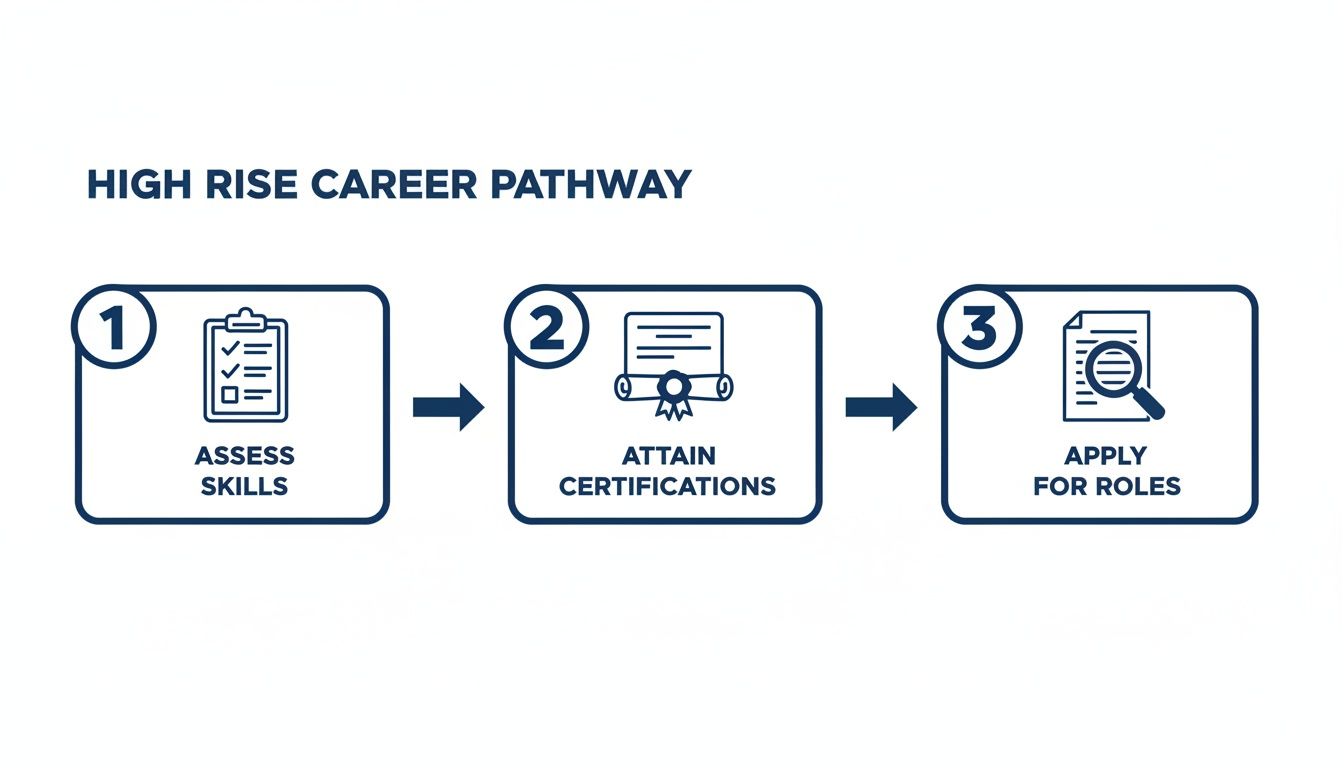
The path is straightforward: start with a realistic self-assessment, get the right training, and then you'll be ready to apply for the real-deal roles.
The absolute core skill for most high-rise window washing jobs is rope access—the ability to safely climb up, rappel down, and move across ropes to get to your work area. Two main organizations set the global standard for this training. You'll need a certification from one of them.
Both groups use a similar three-level system to mark your progress:
For most people breaking into the industry, a SPRAT Level 1 course is the perfect ticket. These courses are intense, usually lasting about five days and capped off with a tough, hands-on assessment.
Beyond just rope skills, you need a solid foundation in general workplace safety. That’s where OSHA comes in.
An OSHA (Occupational Safety and Health Administration) 10 or OSHA 30 card is often a non-negotiable prerequisite for getting hired. This government agency sets the safety standards for workplaces across the country.
The OSHA 10-hour course covers the basics of recognizing and avoiding job site hazards. The 30-hour course is much more in-depth and is typically required for anyone in a supervisory role. Given the obvious risks of the job, a deep understanding of an essential safety guide for working at heights is critical for every single technician.
Not every skyscraper job involves rappelling down the side on ropes. Many buildings are set up with different kinds of access equipment, and each requires a unique set of skills.
Most reputable companies will provide on-the-job training for their specific platforms, but it's your core rope access and OSHA certifications that will get your foot in the door. Over the past twenty years, tighter safety standards have completely reshaped the industry. This intense focus on rope-access protocols, regular equipment inspection, and documented rescue plans has pushed companies to invest heavily in certified training programs.
These stringent requirements are a huge reason why specialized high-rise technicians earn a significant premium. You can learn more about the connection between these safety standards and higher pay in our detailed article on how high-rise window cleaning works.
Landing a job in high-rise window washing takes more than just getting certifications and being okay with heights. Think of this career as an athletic endeavor—it demands peak physical condition and a deep, trusting relationship with your equipment. You’re not just cleaning glass; you’re a skilled technician suspended hundreds of feet in the air, relying on your own strength and gear to stay safe and work efficiently.
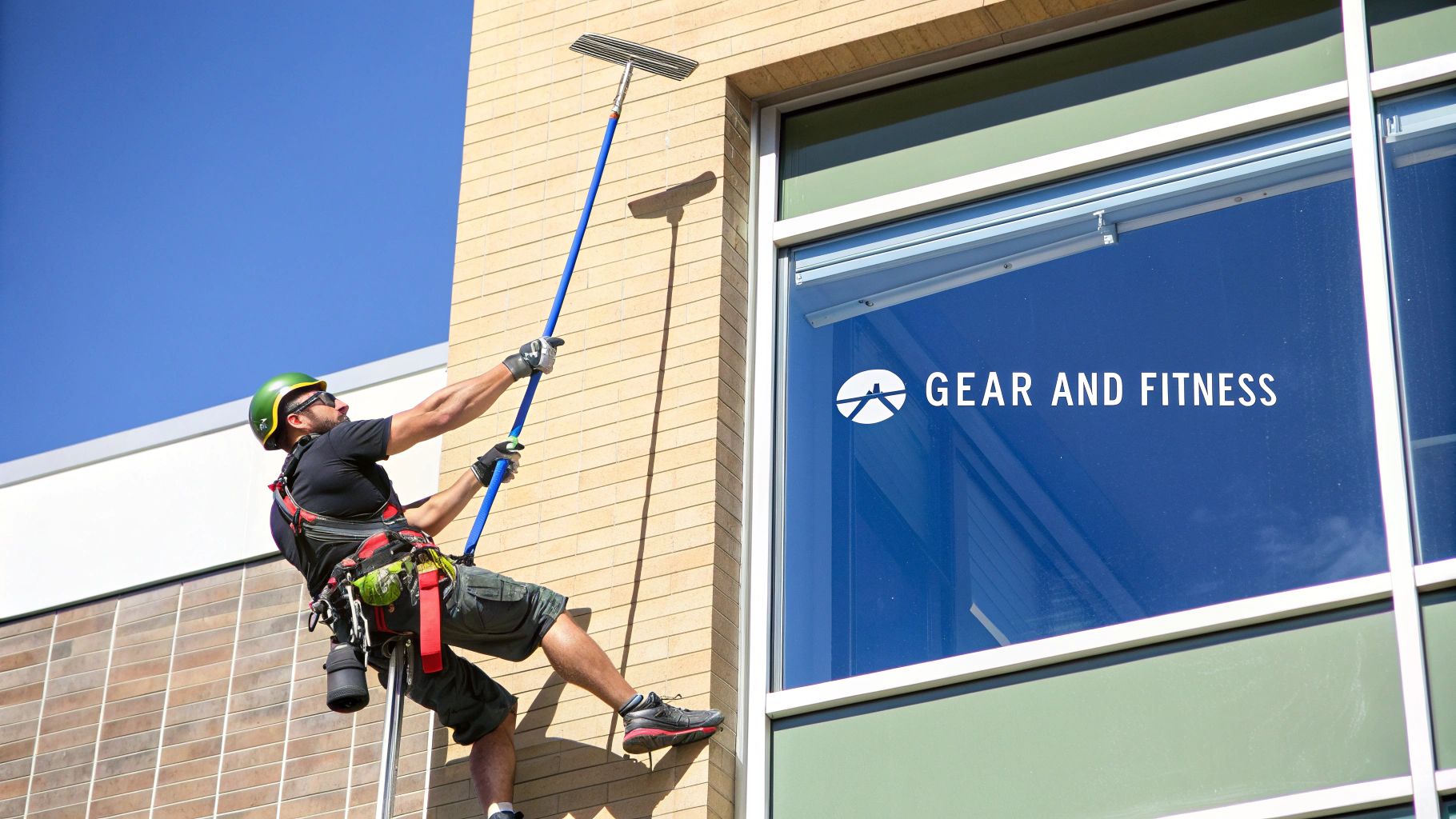
Before you ever clip into a single rope, you need to be honest with yourself about your physical readiness. The demands of this job are way beyond what most people experience in a typical workday.
The physical toll of hanging in a harness for hours is no joke. It fires up muscles you might not even know you have and tests your endurance in a way that’s hard to replicate. A strong core is absolutely non-negotiable; it’s what gives you the stability to control your movements and keep your balance while suspended.
Likewise, you’ll need a powerful grip and serious upper body strength to maneuver ropes, handle your tools, and get the cleaning done right. You’ll be pulling, pushing, and holding positions that demand a ton of muscular endurance. To get your body ready, here are a few things I recommend:
A rookie mistake is underestimating the mental and physical drain of this job. It’s not about being strong for a few minutes; it’s about having the endurance to stay strong and focused for a full eight-hour shift.
Your gear is literally your lifeline, and every single piece plays a critical role in your safety and performance. While most companies provide equipment, it’s crucial to understand what goes into a standard kit. Quality and routine, meticulous inspection are everything—there is zero room for compromise here.
At its heart, professional window cleaning comes down to one of two methods: the classic squeegee or a modern pure-water system. Your toolset will depend on which one the job calls for.
Beyond the cleaning tools, your personal protective equipment (PPE) is what keeps you alive. A standard rope access kit includes a full-body harness, ropes, ascenders, descenders, and a variety of carabiners and lanyards.
If you're thinking about starting your own high-rise window washing business, figuring out how to get all the necessary gear is a big step. You can learn more about your options for securing capital through a complete guide on Equipment Financing for Small Business. Just remember, investing in certified, top-tier equipment isn't just a business expense—it's an investment in your life.
Alright, you've got your certifications and your gear is ready to go. Now for the real challenge: breaking into the industry. Finding and landing a high rise window washing job takes a bit more finesse than just scrolling through generic job boards. You need to know where the real opportunities hide and how to frame yourself as the safe, skilled professional they're looking for.

The good news? Demand is solid. With urban construction booming and facility management increasingly outsourced, commercial high-rise contracts are what keep this market humming. This isn't a small niche, either. One analysis valued the global window-cleaning services market at around $141.0 billion in 2024, with projections hitting $257.27 billion by 2032. You can dig into the numbers yourself in the full industry report from Fortune Business Insights.
Your resume is your foot in the door, and in this line of work, it needs to be laser-focused. Hiring managers are scanning for one thing above all: safety credentials. Don't bury your certifications on the second page. Put them right at the top, immediately under your name and contact info.
Create a dedicated "Certifications and Qualifications" section that leads the charge.
This approach immediately signals to an employer that you meet the non-negotiable requirements for working safely at height. Everything else, including your work history, is secondary.
Forget spending hours on those massive job sites. The best high rise window washing jobs are often found through more direct, old-school channels. You have to go where the specialized contractors and building managers are looking.
Don't just fire off applications into the void and wait. This is a hands-on industry. Showing the initiative to call or even visit a company's office can make a huge difference. It proves you have the proactive attitude that's so valuable on a job site.
The interview for a high rise window washing job isn't about your personality—it's about confirming your technical knowledge and your absolute commitment to safety. Be ready for questions that test how you'd solve problems under pressure.
You'll likely get hit with scenario-based questions like, "What would you do if you noticed a fray in your rope during a descent?" or "Walk me through your process for a pre-use equipment inspection." Your answers should always circle back to safety protocols, clear communication with your supervisor, and sticking to established procedures. To get a better sense of what the job demands, take a look at our guide on what a career in high-rise window washing really entails.
Some cities just have more glass. If you're open to relocating or want to focus your search, certain metropolitan areas are packed with opportunities due to a high concentration of commercial skyscrapers.
The sprawling urban landscapes of Phoenix, AZ, offer a steady flow of commercial contracts. Likewise, the constant vertical growth in Denver, CO, means there's always a need for qualified technicians. And, of course, the iconic hotels and resorts of Las Vegas, NV, require year-round facade maintenance, making it another prime market to break into.
Let's be honest: the earning potential is a huge draw for high-rise window washing. This isn't your typical flat-salary job. It's a skilled trade where your income is directly tied to your experience, certifications, and the guts to take on more complex projects.
So, let's break down what you can actually expect to make and what a career path really looks like in this industry.
When you're just starting out with a Level 1 certification, you'll likely begin as an apprentice or junior technician. Your pay will probably be hourly, and your main job is to learn the ropes—literally—from a senior tech. This phase is all about clocking hours and proving you're serious about safety.
But once you've put in the time and moved past the apprentice stage, your earning potential jumps. The pay gap between a standard window cleaner and a high-rise specialist is massive for a reason. You're paid a premium for the specialized skills, rope access training, and the inherent risks of the job.
While a general window cleaner might pull in between $29,000 and $61,000 a year, a certified high-rise tech in a major city can expect anywhere from $60,000 to over $100,000 annually. That higher paycheck is a direct reflection of the investment you've made in certifications and the liability your employer takes on. You can get a more granular look at these salary differences by reviewing window cleaning pay data.
Several things will directly impact your paycheck:
A high-rise window washing job isn't a dead end. It’s the start of a real career with multiple paths for advancement. The skills you pick up—rope access, safety supervision, project management—are incredibly valuable and transferable across the industry.
Your career path is built on logged hours and advanced certifications. Each level you achieve opens up new roles with more responsibility and significantly higher pay.
The progression is pretty straightforward. After you’ve proven you’re a reliable technician, you can start aiming for senior roles. The ladder usually looks something like this:
Typical Career Advancement Path
Of course, you don't have to climb the corporate ladder. Many seasoned technicians eventually decide to strike out on their own. They take their years of expertise and build their own high-rise window washing company from the ground up.
This route demands a whole new set of skills—business management, marketing, and sales—but the payoff can be huge. As the boss, you call the shots. You pick the projects, set the rates, and build a team that meets your standards. For anyone with an entrepreneurial streak, it’s the ultimate way to turn a high-flying job into a thriving business. Booming markets like Las Vegas and Phoenix offer plenty of opportunities for new ventures to succeed.
Thinking about a career in high-rise window washing? You’re not alone. It’s one of those jobs that looks both terrifying and thrilling from the ground, so it’s smart to get the real story before you even think about gearing up. Here are some no-nonsense answers to the questions I hear most often from people looking to break into this field.
Let's be blunt: the job has inherent risks. But the modern industry is built on one thing above all else: safety. With certified training, daily equipment checks that become second nature, and a strict commitment to safety protocols, the danger is managed professionally. The old days of cowboys taking chances are long gone.
Reputable companies live and breathe safety, which makes serious incidents incredibly rare for qualified technicians. A look at the data from the Occupational Health and Safety Administration (OSHA) shows that most accidents are linked to a lack of proper training or a failure to follow the rules. For a trained pro, your safety comes from expertise, not luck.
The most important skill you'll ever learn in this industry is a deep, unwavering respect for your safety procedures. Every knot you tie and every piece of gear you inspect is part of a system designed to bring you home safe.
That professional mindset is what separates a certified technician from an untrained worker.
You can get your foot in the door relatively quickly, which is a huge perk. A SPRAT or IRATA Level 1 rope access course usually takes about a week to complete, and that includes the final hands-on assessment.
Once you have that main certification and a basic safety credential like OSHA 10, you're ready to start applying for apprentice positions. It’s a fast track to getting on the ropes, but keep in mind that moving up takes time and dedication. To even test for a Level 2 certification, you'll need to log at least 1,000 hours of documented work experience.
Honestly, not really. While it doesn't hurt, most companies looking for entry-level technicians don't expect you to be a window cleaning wizard. They are far more interested in your physical fitness, your attitude toward safety, and most importantly, your rope access certifications.
They'll teach you their specific window cleaning methods on the job. Whether a company prefers a traditional squeegee or a modern pure-water system, those are skills you'll pick up during your apprenticeship. Your safety credentials and ability to work comfortably at height are what get you hired. The cleaning part just takes practice.
Beyond getting the hang of complex rope work, the biggest challenge for most newcomers is building mental endurance. This job demands intense, sustained focus for hours at a time while you're hanging hundreds of feet in the air, exposed to wind, sun, and changing temperatures.
Learning to manage your personal comfort—staying hydrated, handling the weather, and maintaining concentration without getting distracted—is a skill all on its own. The physical tasks, like pulling ropes and squeegeeing, eventually become muscle memory. It's the mental resilience to stay sharp and focused all day long that often proves to be the bigger hurdle.
Finding your way into the world of high-rise window washing is all about getting the right information. At Professional Window Cleaning, we don’t just offer top-tier services in cities like Las Vegas, Phoenix, and Denver; we’re also passionate about supporting the next generation of skilled technicians. If you're a building owner or property manager looking for a team that puts safety and excellence first, learn more about us at https://www.professionalwindowcleaning.com.
Read our blog posts regularly and keep learning.