Care and Maintenance
How Long Does Window Cleaning Take
Wondering how long does window cleaning take? Get realistic time estimates for homes, offices, and high-rises, plus the factors that change every job.


Staring up at a huge expanse of glass can feel pretty intimidating. You might think getting a perfect, streak-free finish is out of reach, but it’s actually simpler than you imagine. When it comes to professional window cleaning, there are only two methods that deliver a flawless finish: the classic squeegee method and the modern pure-water system.
The squeegee method involves scrubbing the glass with a pro-grade applicator and a simple cleaning solution, then pulling all the water off with a squeegee using an overlapping pattern. The pure-water system uses a special water-fed pole to scrub and rinse high windows with deionized water that dries spot-free. This methodical approach is what separates a frustrating, streaky mess from a flawless, even clean.

When it comes to getting that perfectly transparent, envy-of-the-neighborhood shine on large windows, the pros don’t reach for paper towels or gimmicky sprays. At Professional Window Cleaning, we've been cleaning windows for over 26 years and have perfected our craft. The truth is, there are only two proven methods that deliver consistent, high-quality results: the traditional squeegee and the modern pure-water system.
Understanding why these two methods dominate the industry is the first step toward transforming your own large windows, whether they're picture windows in a Denver, CO home or towering commercial glass in downtown Phoenix, AZ.
The squeegee isn't just a tool; it's the heart of a systematic process that professionals rely on. When you pair it with a professional scrubber and a basic soap solution, it physically lifts and removes dirt, grime, and residue from the glass.
The technique is what truly separates an amateur from a pro. A proper stroke ensures every drop of water is removed without leaving behind frustrating drips or streaks. It’s still the go-to method for most interior windows and any ground-level exterior glass.
For high exterior windows, the pure-water system is a complete game-changer. This method uses a water-fed pole to deliver highly purified, deionized water directly to the glass from the ground.
Because pure water is free of the minerals and sediments found in regular tap water, it evaporates without leaving any spots or residue. This means windows can be scrubbed and rinsed from the ground, often eliminating the need for ladders entirely.
This technology isn't just about working faster; it's about a commitment to a flawless finish on every single pane. It’s a core reason why homeowners and businesses in cities like Scottsdale, AZ, and Las Vegas, NV, trust professionals for their window care needs.
To help you see how these methods stack up, here’s a quick comparison.
| Method | Best For | Key Advantage |
|---|---|---|
| Traditional Squeegee | Interior windows and ground-level exterior glass. | Provides a hands-on, detailed clean that physically removes all dirt and residue. |
| Pure-Water System | High exterior windows (up to 5-6 stories) and hard-to-reach areas. | Allows for safe, ladder-free cleaning from the ground and leaves a spot-free finish. |
Each method has its place, and a true professional knows when to use which for the best possible outcome. For our teams at Professional Window Cleaning, having mastered both techniques is essential to serving clients in Denver and Phoenix.
For property managers and high-rise condo owners, the value goes beyond just aesthetics. In fact, consistent professional cleaning can boost tenant satisfaction by as much as 30%, tying directly to a property's brand image and perceived value. You can explore more data on the impact of professional maintenance in the window cleaning services market outlook.
If you’ve ever spent an afternoon battling streaks with paper towels, you know that frustration well. After our 26+ years of experience at Professional Window Cleaning, we can tell you the biggest mistake people make isn’t a lack of effort—it’s using the wrong gear.
The secret to a crystal-clear, professional finish isn’t some miracle spray you see on TV. It’s all about having the right tools for one of the two proven methods professionals use. A master carpenter wouldn't build a house with just a hammer, and you can't get a perfect shine with flimsy, all-in-one gadgets. Your path to streak-free glass starts with building a small but effective toolkit.
This is the bread and butter of professional window cleaning. It’s a timeless technique that relies on a few high-quality, durable pieces of equipment. This is the setup you'll want for most of your interior windows and any exterior glass you can safely reach from the ground.
Here’s your shopping list for a pro-level kit:
Pro Tip: Your cleaning solution doesn’t need to be fancy or expensive. Seriously. A few drops of a simple dish soap (like Dawn) in a bucket of clean water is all the pros use. It provides just enough slip for the squeegee to glide smoothly without leaving behind a film.
When it comes to high, out-of-reach exterior windows, safety and efficiency call for a different approach. This is where a pure-water system, often called a water-fed pole system, completely changes the game. It’s become a standard for professionals working on homes in Denver, CO, and commercial buildings in Phoenix, AZ.
These systems use a water-fed pole—a long, extendable pole with a specialized brush on the end that sprays purified water. Before it gets to the brush, the water runs through a deionization or reverse osmosis filter, which strips out all minerals and total dissolved solids (TDS).
Because the water is 100% pure, it dries without leaving a single spot or mineral deposit behind. This allows a technician to scrub and rinse windows from the safety of the ground, often eliminating the need for ladders entirely. The industry has been quick to adopt it; in fact, it's now used by 68% of firms for residential work and its popularity is growing for commercial jobs. It's also better for the environment, reducing water usage by up to 90% compared to traditional hosing methods. You can learn more about these industry trends and statistics to see how the pros are working smarter.
If there's one secret to professional window cleaning, it's mastering the squeegee. With over 26 years of experience, our team at Professional Window Cleaning can tell you it’s less about brute force and more about finesse. With the right technique, you can get that perfect, streak-free shine that makes a whole room feel brighter.
Think of it as a practical skill. Once you get the hang of the smooth, continuous motion that pulls away every bit of dirt and water, you'll never go back to paper towels again. Let's walk through the exact process we use to get flawless results every single time for our clients in Las Vegas and Scottsdale.
Before a squeegee even gets near the glass, a little prep work goes a long way. If you're working inside, always start by laying down a few old towels or a drop cloth at the base of the window. This simple move saves your floors, sills, and paint from any drips.
Next, it's time to soap up the window. Dip your T-bar scrubber into your cleaning solution and give it a gentle squeeze—you want it saturated, but not dripping everywhere. Work the scrubber across the entire pane, using light, even pressure to break up all the built-up dirt and grime.
This infographic breaks down the essential tools that are the foundation of any professional job.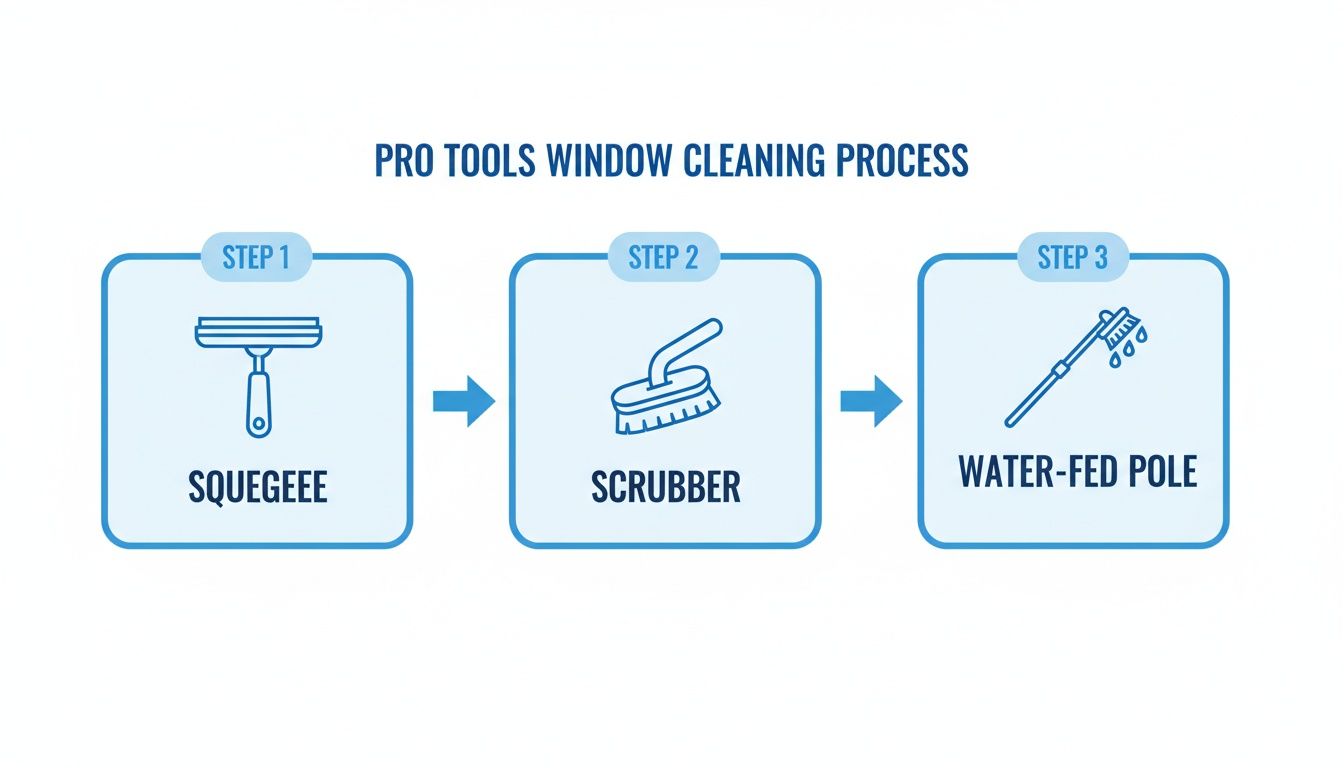
As you can see, the process is straightforward: a scrubber and squeegee for standard work, and a water-fed pole for those high-reach spots. These are the only two methods a true professional uses.
Now for the main event. First, create a "dry edge." Just take a clean microfiber cloth and wipe a one-inch vertical strip down one side of the glass. This simple trick prevents water from sneaking around the edge of your blade and causing streaks.
Position your squeegee at the top of the glass, overlapping that dry strip by about an inch. Tilt the squeegee slightly toward the wet part of the window, then pull it straight down in one smooth, confident motion.
Here's the most important tip I can give you: Wipe your squeegee blade with a clean, dry microfiber towel after every single pull. This removes the dirty water you just collected so you aren't dragging it back across the glass.
For the next stroke, overlap your last one by about an inch. Repeat this all the way across the pane. That tiny overlap is what guarantees a seamless, streak-free finish. On bigger windows, you might see pros use an "S-stroke" or fanning motion. It's a more advanced technique but incredibly efficient once you get it down.
The squeegee technique doesn't change whether you're inside or out, but the prep work might. Exterior windows in cities like Phoenix and Denver tend to have a tougher layer of grime from dust, pollen, and rain. You may need to give them a more thorough scrub or even a second pass with the T-bar before you start squeegeeing.
And whatever you do, try to avoid these common mistakes:
Follow these steps, and you'll be well on your way to cleaning large windows like a pro. The results are more than worth the effort.

When you're dealing with massive windows, especially those that soar out of reach, safety isn't just a suggestion—it's everything. A sparkling window is worthless if you end up hurt. This is where you have to stop thinking like a DIYer and start thinking like a pro, where managing risk is always the first step.
For windows just a bit beyond your arm's reach, an extension pole is a fantastic tool. You can attach a scrubber and squeegee, keeping your feet firmly on the ground while getting the job done. But once you start looking at second-story windows or higher, many people’s first instinct is to grab a ladder. At Professional Window Cleaning, we've learned over 26 years that ladders are often an unnecessary risk.
If you absolutely must use a ladder, you have to follow strict safety protocols. Not all ladders are the same, and picking the right one is your first line of defense. Make sure it's tall enough so you aren't tempted to stand on the top few rungs.
Always follow these critical rules:
When you're dealing with towering windows, understanding proper safety strategies for working at heights is paramount. It’s the only way to prevent serious falls and injuries.
Expert Insight: The professional window cleaning industry has come a long way. Since the high-rise boom of the post-1950s, a focus on specialized teams and rigorous safety protocols has helped cut accident rates by an impressive 40% over the last decade.
Honestly, the best way to avoid ladder-related risks is to get rid of the ladder entirely. This is exactly why professionals, including our own teams serving Phoenix, AZ, and Denver, CO, so often rely on pure-water systems.
A modern water-fed pole can extend several stories high, allowing the entire job to be done safely from the ground. This system doesn’t just deliver a superior, streak-free clean; it completely changes the safety equation for homeowners.
Ultimately, the smartest move you can make is knowing your limits. If a window feels too high, too awkward, or just plain too risky, it is. That's the perfect time to call in professionals who are insured, equipped, and trained to handle the job without putting anyone in harm's way.
There's a special kind of satisfaction that comes from a successfully completed DIY project. But when it comes to large or high windows, some jobs demand a level of skill—and equipment—that goes far beyond the average homeowner’s reach.
Knowing your limits isn’t about admitting defeat. It's about making a smart call that protects you, your property, and guarantees a truly flawless result. Hiring a pro service like Professional Window Cleaning is an investment in quality, safety, and the long-term health of your windows.
The most obvious sign you need a professional is height. If your windows are on the third story or higher, or if they’re located over sloped or uneven ground, the risks of using a ladder just aren't worth it.
Professionals show up with the right gear: safety harnesses, specialized lifts, and water-fed pole systems that keep our feet safely on the ground. With over 26 years of experience, our teams at Professional Window Cleaning have the training and insurance to handle high-work safely—a critical factor you just can't replicate on your own.
Hiring a professional service with comprehensive insurance and a long track record means you're protected. It transfers the risk from you to a team that is trained and equipped to manage it effectively.
That peace of mind is priceless, especially when you’re dealing with the beautiful architectural glass found in complex home designs. It’s why residents with stunning, hard-to-reach windows in cities like Phoenix, AZ, and Denver, CO, consistently turn to us for help.
Sometimes, the problem is more than just dirt and dust. If your panes are covered in severe hard water stains, paint overspray, or debris left over from construction like concrete or silicone, a standard cleaning approach simply won’t cut it.
Our technicians use the only two methods professionals trust: the time-tested squeegee for a perfect interior clean and advanced pure-water systems for a flawless exterior finish. We have the specific compounds and fine-grade materials needed to safely restore glass that a DIY attempt would likely ruin.
The demand for expert window cleaning has grown, especially with all the new high-rise condos, stadiums, and offices being built. For our business, which has been serving Las Vegas, Phoenix, Denver, and Scottsdale for over 26 years, this boom means we’re constantly tackling new and exciting challenges. You can dig into more details on this trend in the latest window cleaning industry statistics. This large-scale project experience gives us the know-how to handle any job, big or small.
With over 26 years of experience making homes and businesses in Las Vegas, Phoenix, Denver, and Scottsdale sparkle, we at Professional Window Cleaning have heard just about every question in the book. Here are the answers to some of the most common ones we tackle when it comes to cleaning large windows.
This is a question we get all the time, and the answer is refreshingly simple. For most interior glass and any exterior windows you can safely reach, a few drops of basic dish soap in a bucket of clean water does the trick perfectly. The real secret is the squeegee technique.
For high, out-of-reach exterior windows, however, a pure-water system is the industry's gold standard. Professionals swear by this method because the deionized water dries completely spot-free on its own. These are the only two methods professionals use because they guarantee a streak-free result.
The perfect cleaning schedule really comes down to your location and what kind of property you have.
And while you're focused on the glass, don't forget your screens! Sometimes they need more than just a quick wipe-down. That's when calling on expert window screen repair services can make all the difference.
The window cleaning industry is a testament to the fact that results matter. In 2023, U.S. firms averaged $620,000 in revenue with 6.5% profit margins, proving that providing a consistent, streak-free service pays off handsomely. You can discover more insights about the window cleaning industry and its growth.
Ah, the classic household "hacks." While they're popular on the internet, we professionals steer clear of them for very good reasons. We stick to the only two methods proven to work: a squeegee or a pure-water system.
Vinegar is acidic, and with repeated use, it can actually damage the rubber seals and gaskets around your window panes. Over time, that can lead to some surprisingly costly repairs.
As for newspaper, while it seems absorbent, it often leaves behind a frustrating amount of ink, lint, and smudgy residue on both the glass and the frame. If you want a truly streak-free finish without risking damage, stick with a high-quality squeegee, a soft scrubber, and a few clean microfiber cloths. They're the tools proven to deliver a perfect shine, every time.
When the job is too big, too high, or just too risky, don't hesitate to call in the experts. For a flawless finish on your residential or commercial windows, trust the team at Professional Window Cleaning. Get your free, no-obligation quote today!
Read our blog posts regularly and keep learning.