
Care and Maintenance
Window Cleaning for Business: A Complete Property Guide
Window cleaning for business boosts curb appeal and tenant satisfaction. Learn practical tips to keep commercial properties spotless and safe all year.


You're looking at a second-storey bedroom window that hasn't been cleaned in two seasons, or perhaps a ground-floor pane marked by soil, pollen, and bird droppings. The obvious solution is to buy an outside window cleaning kit, extend the pole, and get the glass clear again. The less obvious question is whether the kit matches the height, water quality, access, and risk involved.
Professional Window Cleaning has been cleaning windows for over 26 years, and the same principle keeps proving itself: the right tool depends on the method. Professionals use only two window-cleaning methods, the traditional squeegee method and the pure-water system. Retail kits don't create a third method. They package one of those workflows for homeowners and maintenance teams, with varying compromises in reach, finish, setup, and safety.
An outside window cleaning kit is a bundled collection of tools that lets you wash the exterior face of glass without bringing in a full professional crew. Depending on the design, it may include a squeegee, scrubber, bucket, cleaning solution, scraper, extension pole, hose, brush, pump, or water-purification equipment.
The first professional workflow is the traditional squeegee-and-scrubber method. You wet the glass with a cleaning solution, loosen the soil with an applicator, and pull the water away with a rubber-bladed squeegee. A retail kit copies that process in a smaller package. It works well for ground-floor windows, patio doors, shopfront glass, and panes reachable from a secure position.
The second is the pure-water, water-fed pole method. A soft brush on a telescopic pole agitates the glass and frames, while purified water rinses away loosened dirt. Because the operator stays on the ground, this approach is particularly useful for upper exterior glass where ladder use would add unnecessary exposure.
Practical rule: Buy the kit that reproduces the method suited to your windows, not the kit with the longest-looking feature list.
The category has become a substantial commercial product market. One market report valued the global window cleaning kit market at $2.1 billion in 2025 and projected it to reach $3.1 billion by 2034, with squeegee kits representing the largest segment share at 32.5% and spray kits accounting for 24.8%. The same report estimated residential use at 48.3% of revenue, or roughly $1.014 billion in 2025, as documented in this window cleaning kit market report.
That commercial presence gives buyers plenty of choice, but it also creates confusion. The useful questions are practical: which tools reach your glass, which finish can you produce, and at what point does the kit stop being a safe substitute for trained access equipment?
The classic squeegee kit is the simplest starting point. It usually combines a channel and handle, a T-bar applicator or sleeve, a bucket, a scraper, and a small amount of professional detergent. It's the strongest choice for ground-floor panes and patio doors, and it can handle glass reached from a stable step. Its weakness is height. Once you're leaning, stretching, or balancing to make the tool reach, the kit has already exceeded its sensible use.
A water-fed pole kit uses a telescoping aluminium or carbon-fibre pole, an angled soft brush head, and a hose connected to either a tap-fed supply or a purified-water system. Some systems add an on-board pump, while others rely on external equipment. On standard residential glass, a properly configured pole can clean from the ground across several storeys, but the practical reach depends on pole stiffness, the building layout, wind, brush control, and the operator's ability to keep the brush face against the glass.
The third common option is a hybrid starter kit. This pairs a small hand squeegee set with a short extension pole, making it useful for single-storey homes, conservatories, porch glazing, and awkward panes that sit just beyond comfortable arm's reach. It's convenient, but it isn't a replacement for a full water-fed system on a two-storey facade.
Speciality products deserve a brief warning. Magnetic two-sided cleaners can help with some double-glazed arrangements, yet they may struggle with thick or uneven units and can trap grit against the glass. Robotic cleaners can reduce manual work on compatible panes, but they still depend on reliable adhesion, suitable glass, and careful edge management.
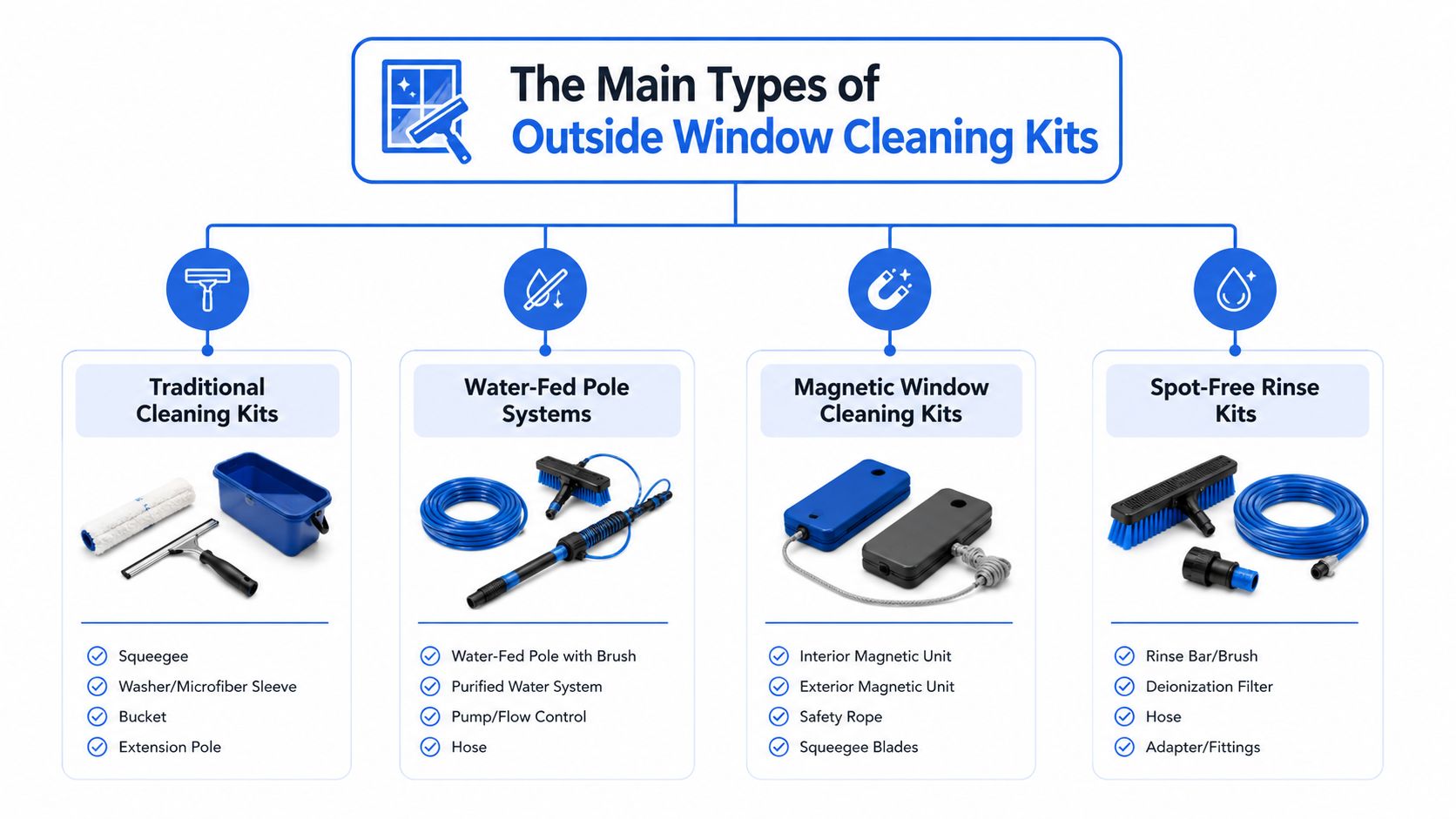
Your self-selection comes down to two checks. How high is the glass, and how pure is the available water? Those answers eliminate most unsuitable kits before you spend money.
A squeegee gives you direct control over the finish. The rubber blade removes the solution rather than leaving the glass to dry, so an experienced operator can produce a crisp, dry result with sharp edge detail. The trade-off is technique. Poor blade condition, an inactive wet edge, or inconsistent pressure creates lines and missed water.
A pure-water pole is more forgiving on upper glass. Purified water dries without the mineral residue that ordinary tap water can leave behind, but only when the water has been treated. Industry guidance describes water-fed systems as generally using deionized or reverse-osmosis-treated water below 10 ppm TDS, preferably below 5 ppm for the best result, according to the National Window Cleaning Authority's guidance on window-cleaning methods.
| Factor | Squeegee Kit | Pure-Water Pole Kit |
|---|---|---|
| Finish | Dry, highly controlled finish when technique and rubber are good | Spot-free finish after drying when purification is adequate |
| Reach | Best for ground-floor and safely reachable glass | Suitable for upper exterior glass from the ground |
| Effort | Fast per pane, but demanding across a whole property | More passes, though less climbing and less physical strain |
| Setup | Bucket, applicator, squeegee, and solution | Pole, brush, hose, pump, and purified-water supply |
| Skill | Requires practice to avoid lines and water trails | Easier to learn, but brush control and rinsing still matter |
| Cost | Lower entry cost | Higher equipment and filtration cost |
A basic squeegee kit is ready quickly and remains the better choice for someone who values hand-finished ground-floor glass. A pole system takes more preparation, but it removes the ladder from many upper-window jobs and reduces the temptation to overreach. The pure-water window washing method explains why the rinse stage matters as much as the brush stage.
Choose the squeegee when the glass is low and accessible. Choose pure water when height is the main obstacle.
Exterior glass carries more than ordinary dust. Soil splashes, pollen, hard-water drips, bird droppings, and airborne grime collect along frames and lower edges, so rushing straight to the final wipe usually spreads the mess instead of removing it.
For hand work, set out a clean bucket with a mild surfactant or a vinegar-based solution. Keep the applicator damp, not dripping. Excess water creates uncontrolled runoff, while too little solution leaves the sleeve dragging across dry contamination. Start at the top of each pane, allowing dirty water to travel downward rather than sit on glass you've already finished.
Load the rubber blade before the first pull and keep the wet edge active. Pull in overlapping strokes, maintaining steady pressure, then wipe the blade after each pass. A squeegee that carries dirty water into the next stroke will leave trails even when the glass looked clean at the start.
Water-fed pole work follows a different rhythm. Rinse the frame first, then work from the top corner down with the brush face flat against the glass. Agitation loosens the soil, but the final rinse must carry it away. Give extra attention to frame joints, seals, and the lower edge, where grime often returns to the pane during rinsing.

Let the glass dry before judging the rinse. A pane can look clear while wet and reveal mineral marks or remaining soil only after the water disappears.
Finish hand-cleaned panes by detailing the edges with a microfiber cloth. With a pole system, inspect the glass after dry-down and look for spots, missed corners, or residue dragged from the frame. Correct one panel before moving to the next. That habit prevents a small setup error from being repeated across the whole house.
Reach safety determines whether an outside window cleaning kit is useful or dangerous. Start by identifying the highest point you need to clean, then choose a method that keeps your body stable while the tool does the reaching.
A telescopic pole is the safest practical option for many ground-level jobs and some upper glass that can be reached without leaving firm ground. A step ladder may suit low, single-storey eaves or porch overhangs, but it isn't a platform for leaning sideways. Extension ladders require level footing and firm ground, and the operator must avoid stretching beyond the rails.
Never treat wet grass as reliable footing. Don't use a gutter as a step, don't lean from a step ladder to gain a few extra inches, and don't overreach from an extension ladder because moving it feels inconvenient. These are common ways a manageable cleaning job becomes a fall.
CDC/NIOSH safety guidance recommends eliminating ladder use for exterior window cleaning by using an extender-pole squeegee system or an aerial lift. Its recommended approach is to work from the ground whenever reach allows, while still training workers in correct ladder use when ladders cannot be avoided, as outlined in this CDC/NIOSH exterior window-cleaning safety material.
For roofs, ledges, or high-rise access, tool selection isn't enough. An occupational-hazard review of window-cleaning patients found that failure to use safety belts and lack of suitable anchorage points contributed to all 20 patients reviewed, according to the NIOSH occupational hazard report. Anchored restraint planning must come before the pole, brush, or squeegee.

Use an intact ladder, keep the angle correct, have a spotter where appropriate, and wear gloves and eye protection. Wind, rain, and ice are stop conditions, not inconveniences to work around.
A DIY kit makes sense when the glass is low, the ground is stable, and you can maintain a balanced stance throughout the job. Ground-floor windows, accessible single-storey panes, deck-level glass, and low conservatory glazing are reasonable candidates, particularly when a water-fed pole lets you stay on the ground.
The same equipment becomes the wrong answer when access creates the main hazard. Third-storey glass, sloped or glazed roofs, atrium panels without safe footing, and windows above a conservatory can require roof systems, scaffolding, lifts, or rope access. A long pole doesn't make an unsafe position safe. It may also become difficult to control in wind, especially near fragile frames or overhead services.
Regulatory materials treat exterior window work as a fall-risk activity in multiple jurisdictions, with requirements that can include safety equipment, maintained gear, and commercial-grade standards. Washington's exterior window-cleaning safety rules illustrate why professional work involves more than buying a brush and pole.
Established crews operate across Las Vegas, Phoenix, Denver, Scottsdale, Tempe, Chandler, Gilbert, and Flagstaff. Hiring isn't an admission that the kit failed. Compare the cost of equipment, access preparation, time, possible damage, and personal risk against the cost per completed clean. For difficult glass, professional access is often the more economical tool.
Begin with one question: how high and how far from safe ground does the glass sit? If you can reach single-storey glass with both feet planted, choose a 6- to 10-inch channel squeegee, a quality applicator, and mild detergent. That setup gives you control without paying for equipment you won't use.
For two-storey facades, conservatories, and panels above porches where climbing would be the only option, a water-fed pole with pure-water filtration is the more sensible match. Confirm the rinse water with a TDS meter rather than assuming a clear-looking tap supply will dry spot-free.
Prioritize the handle and head, then the channel rubber, then the soap. Cheap poles can whip and shake at full extension, while a solid tapered handle remains balanced at 30 feet, a product-selection point discussed in this professional window-cleaning equipment guide. A quick-release handle that accepts both squeegee and brush heads is a worthwhile upgrade, as is a TDS meter that verifies the water is pure.
The best pre-purchase check beats any specification sheet: stand on the ground and identify every pane you intend to clean. If the kit can't reach the glass without leaning, climbing onto an unsafe surface, or working beyond your control, it isn't the right kit.
Professional Window Cleaning offers residential, commercial, and high-rise window cleaning for properties that need more than a DIY outside window cleaning kit can safely provide. With more than 26 years of exterior-glass experience across Arizona, Colorado, and Nevada, the team can help you choose the safest practical approach for your windows. Visit Professional Window Cleaning to request service and get the job handled with the right equipment.
Read our blog posts regularly and keep learning.