Care and Maintenance
How to Clean Tinted Window Film Safely
Learn how to clean tinted window film without scratching or peeling. Discover safe tools, approved cleaners, and pro techniques for spotless results.


You've got a clean pane in front of you, a fresh scrubber in your hand, and the first pull leaves a thin line of water behind. The channel is straight, the handle feels fine, and your technique hasn't changed. In most cases, the problem is the small strip of rubber for squeegees riding against the glass.
Professional window cleaning has only two methods: the use of a squeegee, or the use of a pure-water system. A squeegee depends on a replaceable blade that makes continuous contact with the glass. A pure-water system uses purified water delivered through a telescopic pole and brush, allowing technicians to clean from the ground while reducing the need for ladders or scaffolding. The water dries without leaving limescale or hard-water stains, as described in this commercial window-cleaning guidance.
After 26 years working across Arizona, Nevada, and Colorado, the practical lesson is simple: rubber selection has more influence on the finish than many expect. A blade that suits shaded Denver glass may drag on sun-baked storefronts in Las Vegas or Phoenix. The right choice comes down to material, hardness, profile, fit, and how quickly the edge is wearing.
The rubber blade is the only part of a traditional window squeegee that should touch the glass. The handle gives you control, the channel supports the blade, and the T-bar or washer loosens soil. But the rubber does the final work. It gathers the water film and carries it cleanly away from the pane.
That makes a fresh blade more important than an expensive handle. A perfectly scrubbed window can still show a line if the rubber has a nick, a curled tip, embedded grit, or a flattened section. The defect may be small enough to miss during a quick inspection, yet large enough to leave a visible trail across the glass.
Residential panes often have frames, divided sections, screens, and changing angles. A flexible edge can help the technician maintain contact while working around those interruptions. Large commercial storefronts are usually more repetitive, so a blade with a stable contact line can remove water quickly across broad, smooth sections.
Glass condition also changes the result. Tempered glass and annealed glass can respond differently to pressure, contamination, and surface irregularity. The important field rule is to avoid assuming that one rubber grade will behave the same way on every pane. Test the edge on a wet section, watch for chatter, and adjust pressure before blaming the channel or handle.
Practical rule: If the blade doesn't maintain an even, continuous line on clean wet glass, change or inspect the rubber before changing your technique.
Pure-water cleaning has a different workflow, but it still depends on matching the method to the building and surface. Squeegee work remains the better fit when a technician needs tight detailing, controlled water removal, or direct inspection of the glass. In either method, the technician should choose the tool around the surface, not force every job into one setup.
A clean pane can still finish badly if the tool leaves fibers, residue, or a rough trail. That practical problem shaped the modern window squeegee. Early deck-cleaning tools were associated with maritime work, and squeegee use for windows is documented by 1918, when an American Navy jargon book described a deck-cleaning tool also used in civil life to clean windows. The history of the squeegee records the later move toward a lighter, standardized window-cleaning design.
In 1936, Ettore Steccone patented a lighter brass squeegee with one flexible rubber blade. It replaced the earlier Chicago squeegee, which used two thick rubber blades secured by 12 screws. Removing weight was only part of the improvement. The design concentrated the pull on one controlled edge, making contact more predictable across the glass.
Fibrous or absorbent materials would hold water, shed particles, or lose their shape during a pull. Rubber provided a flexible working edge that could press against the pane and shear away the water film.
The 1936 patent also described testing rubber compounds for better performance. That principle still guides field selection. Elasticity, resilience, hardness, and surface smoothness determine whether the edge stays in contact with the glass, particularly when hot, dry conditions in Las Vegas or Phoenix stiffen the work and high sun exposes weak storage habits. Denver adds colder conditions and changing weather to the decision.
The professional form developed by moving from heavy, multi-blade tools to a lighter single-blade design. The Pulex window-cleaning catalog describes vulcanized natural rubber that is compression molded for consistent elasticity, snap, resilience, hardness, chemical resistance, atmospheric resistance, and surface smoothness.
That history explains the hard-versus-soft choice technicians still make. A harder edge can hold a stable line on broad, clean glass, while a softer edge can conform better when conditions demand flexibility. The channel and holder support the system, but the compound and edge determine the finish.
Professional blades commonly use natural rubber, synthetic rubber, polyurethane, silicone, or a blend of materials. A 2025 academic paper described in current market reporting classifies common squeegee blade materials into natural rubber, synthetic rubber such as neoprene, and polyurethane. Recent market reporting estimates rubber-based squeegees at about $1.232 billion, representing 44.0% of global demand, in its 2025 market estimate. Those figures come from the squeegee market report, and they show that rubber remains a major product segment rather than a leftover material from older tools.
Natural rubber usually gives a smooth, controlled pull and a crisp edge when it's fresh. Its weakness is environmental exposure. Direct sunlight, dry air, ozone, abrasive grit, and poor storage can shorten its useful working life. In the field, that means a natural-rubber blade may feel excellent at the start of a route but require closer inspection on high-sun jobs.
Synthetic compounds can be formulated for different balances of resilience, chemical resistance, flexibility, and cost. They don't all feel alike, so the label alone isn't enough. The technician should judge the edge by how evenly it flexes, whether it recovers after pressure, and how cleanly it releases water.
Silicone has a different profile. It generally tolerates heat, sunlight, and moisture well, and it can feel more forgiving on curved or irregular surfaces. On flat window glass, some technicians prefer the firmer control of fresh rubber. A product labeled silicone may also be a coated or blended construction rather than a simple solid silicone strip, so read the product specification instead of assuming the label tells you everything.
| Material | Glide feel | UV and ozone resistance | Best climate fit | Relative cost |
|---|---|---|---|---|
| Natural rubber | Smooth, precise, controlled when fresh | More vulnerable to exposure and aging | General window work with regular inspection | Usually economical |
| Synthetic rubber | Varies by formulation, often balanced | Depends on compound | Mixed routes and varied conditions | Low to medium |
| Polyurethane | Firm and wear-oriented in suitable designs | Depends on formulation | Specialized or demanding applications | Medium to high |
| Silicone | Flexible and often smooth on irregular surfaces | Strong resistance to heat and sunlight | Hot, sunny, damp, or curved-surface work | Often higher |
The practical choice isn't “rubber always” or “silicone always.” For flat architectural glass, a fresh rubber edge often provides the direct control technicians want. For severe sun exposure or situations where replacement is difficult, a more exposure-resistant compound may justify its cost. Judge the total labor, streak risk, and replacement routine rather than the package claim.
Durometer is the Shore A hardness scale used to compare flexible blade materials. A lower reading means a softer blade that conforms more readily. A higher reading means a stiffer edge that holds its shape under pressure.
Industry guidance commonly separates window-cleaning rubber into soft, medium, and hard variants. Adjacent blade industries treat 70A as an all-purpose starting point, favor 60 to 70A when more conformability is needed, and use 80 to 90A when a stiffer, more controlled edge is required. A major manufacturer's window squeegee rubber range also distinguishes soft, medium, and hard Shore rubber.
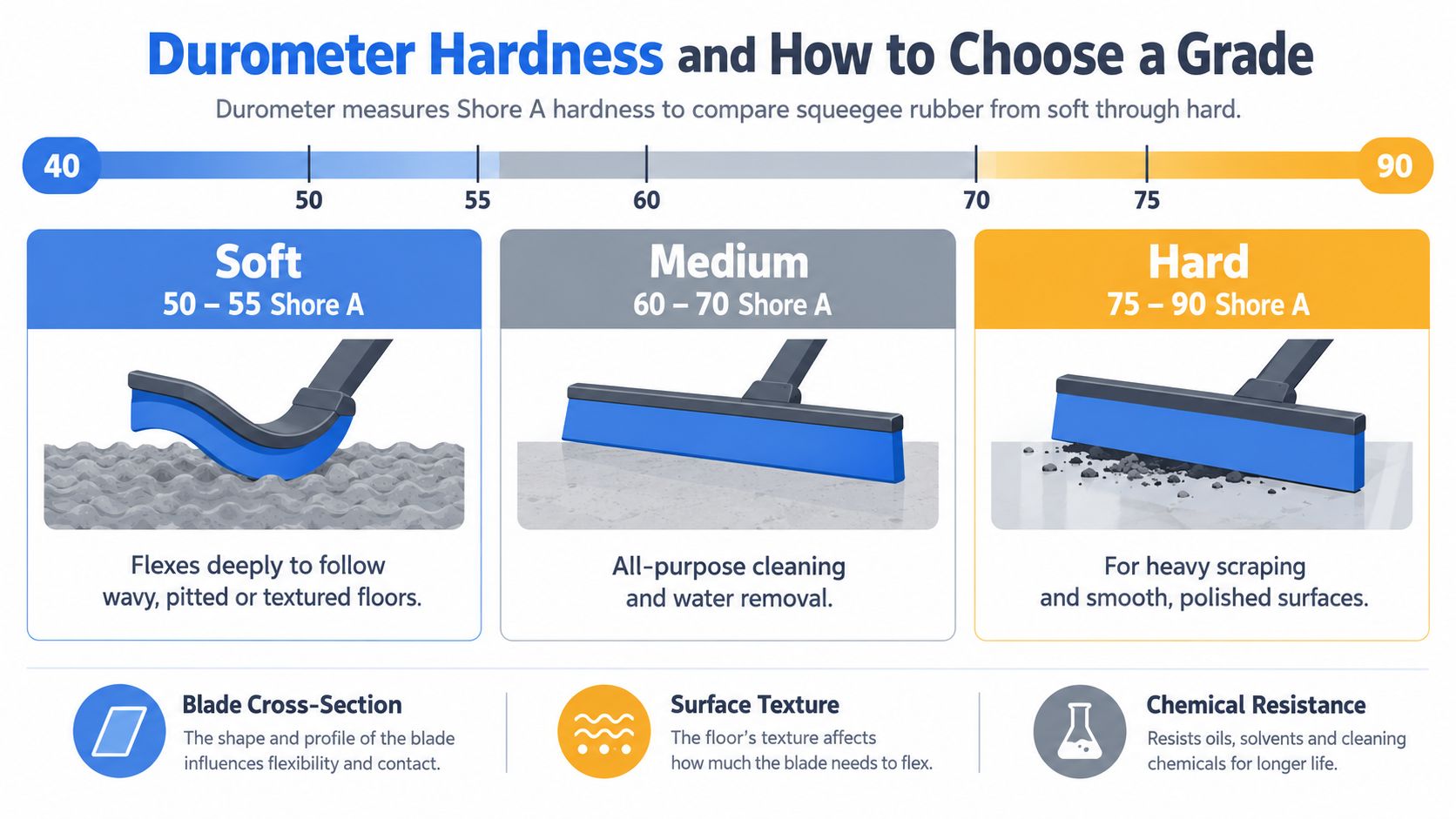
Choose softer rubber when the glass is textured, lightly curved, wavy, old, or cold enough to make a stiff edge skip. The blade flexes into minor variation and maintains contact with less force. That doesn't make soft rubber automatically better. Too much flex on smooth glass can make the edge curl, fold, or lose water-control precision during a fast pull.
Medium rubber is the practical route standard for many ordinary jobs. It offers a balance between conformity and control, particularly when the glass is reasonably smooth and the weather is neither especially cold nor intensely hot.
Hard rubber holds a straighter contact line. It can work well on smooth glass, fast pulls, and hot conditions where a softer edge may chatter or curl. It can also feel unforgiving on pitted or damaged glass because it doesn't follow every change in the surface.
For broader guidance on matching the tool to the window, use this guide to choosing a squeegee for cleaning windows. On a route through Denver, keep in mind that a shaded pane can behave like a cold surface even when nearby sunlit glass is warm. Carrying more than one grade is often more useful than trying to make one blade handle every exposure.
Professional window-cleaning rubber is commonly supplied at 2 inches wide and 3/8 inch thick, according to the technical product listing in the Pulex catalog. These dimensions affect how the rubber flexes, seats in the channel, and holds its edge under pressure. They are working dimensions, not interchangeable strip sizes.
Width changes both coverage and control. A narrower blade flexes more easily and suits small panes, divided lights, and areas interrupted by frames. A wider blade removes more water per pass and stays steadier across large, flat glass. Match the width to the holder and the job. In Las Vegas and Phoenix, where direct sun can heat glass quickly, a wider, stable blade can help during fast pulls, provided the edge is not overloaded with water.
Thickness changes pressure response. A thicker blade usually feels steadier when you apply firm pressure. A thinner blade reacts faster to small wrist-angle changes and may suit lighter work. Fit takes priority over preference. A heavy blade that sits poorly can leave gaps, while a standard blade seated evenly can wipe cleanly.
| Dimension | Common size | Typical use |
|---|---|---|
| Blade width | 2 inches | Professional channels and controlled water removal |
| Blade thickness | 3/8 inch | Standard professional blade geometry |
| Edge profile | Fine, continuous wiping edge | Smooth architectural and residential glass |
| Channel length | Matched to holder | Full contact without excess movement or curl |
Profile determines how the edge meets the glass. A fine, continuous tip shears water from smooth panes. A blunt, nicked, or mineral-damaged edge pushes water and leaves lines. On rough or aging glass, a slightly softer profile may maintain contact. On hot, smooth glass, harder rubber generally holds a straighter line and resists curl.
Cut replacement rubber squarely. A crooked end changes seating and can create a streak at the frame. Inspect the full edge under good light before the first pull, including both ends rather than only the center.
Rubber has to sit evenly in the channel. If the blade is too loose, it can shift during a pull. If the fit is too tight or the rubber is curled lengthwise, the edge may not contact the glass uniformly.
Ettore, Sorbo, and many European systems use slim channels that accept standard professional rubber. Unger and Pulex Professional tools can use channels with tighter tolerances and top-loading arrangements, so the replacement should match the holder design rather than merely matching the advertised width.
Quick-release and swivel-lock systems from Imtekal and Wagtail may use a deeper pocket that grips thicker rubber securely. Brass and aluminum channels can accept the same stock, yet they don't feel identical because the metal flexes differently under pressure.
A technician with mixed handles on a truck should remove one blade from every channel style and compare the pocket depth, retaining slot, and end clips. Check whether the rubber loads from the side or top, and confirm that the leading edge faces the glass side after installation.
| Handle system | Channel style | Rubber fit notes |
|---|---|---|
| Ettore | Slim professional channel | Confirm length and even seating |
| Sorbo | Slim or heavy-duty channel | Match the blade thickness to the channel |
| Unger | Tighter-tolerance, top-loading styles | Check edge orientation and lengthwise curl |
| Pulex Professional | Tighter-tolerance professional styles | Seat the rubber fully before trimming |
| Imtekal and Wagtail | Deeper quick-release or swivel pockets | Confirm that the pocket grips the selected thickness |
| Brass and aluminum channels | Metal channels with different flex | Expect a different pressure response even with similar rubber |
Don't bulk-order by brand name alone. Use the actual tool in your hand as the reference. A replacement that fits one channel may bind, shift, or sit unevenly in another.
A clean changeout prevents many streaking problems. Work on a stable surface, keep the blade edge away from your fingers, and don't force rubber past a burr.
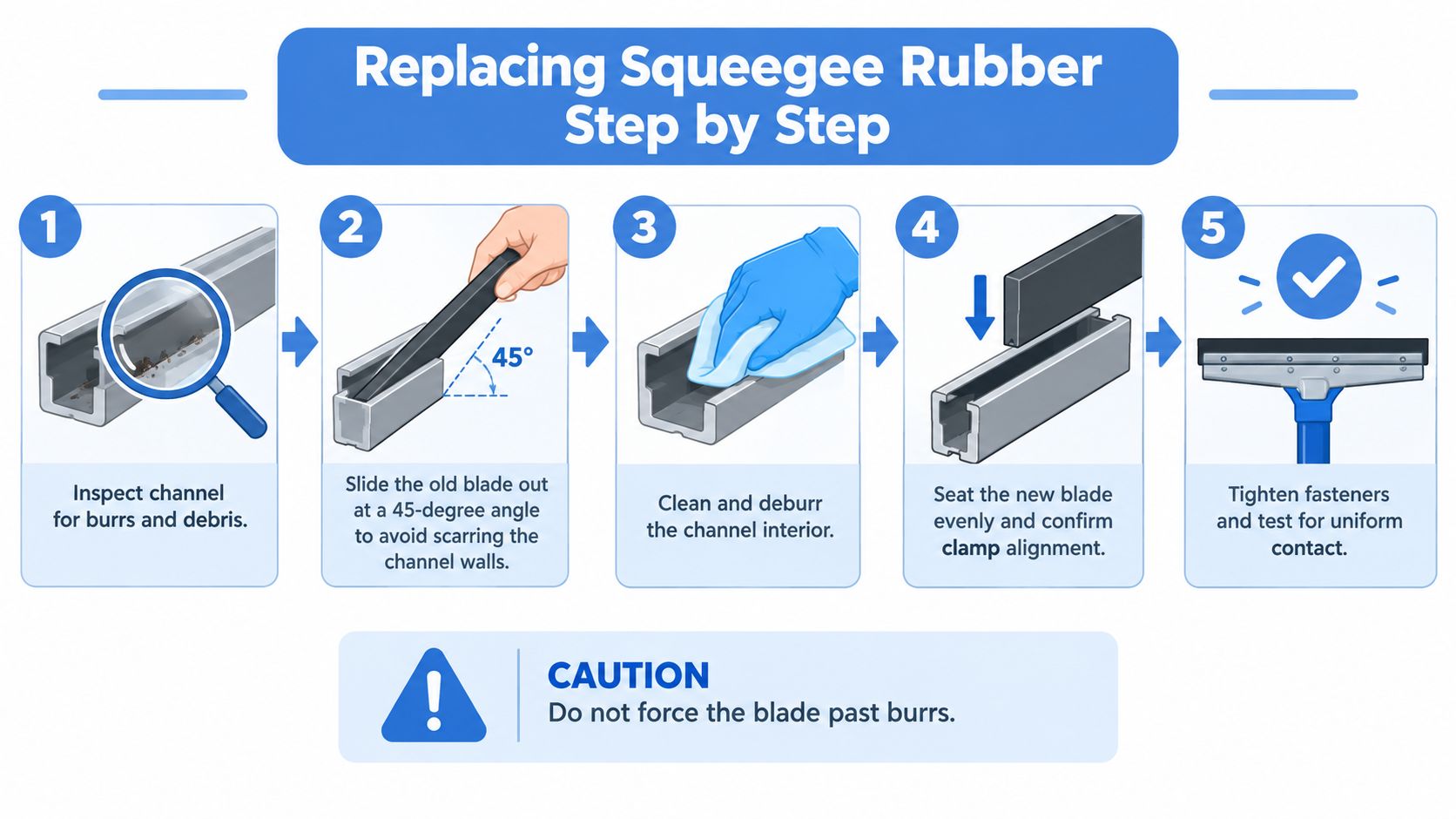
Ettore, Unger, and Pulex-style holders can differ in how the blade sits against the channel side. Follow the holder's intended loading direction and compare the old blade before removing it. The most common mistake is installing the rubber upside down, leaving a flat edge against the glass instead of the fine wiping edge.
Don't reuse a dull razor for trimming. A rough cut can deform the end and leave a small flap that catches water at the frame. After the test pull, wipe the edge and inspect it again before putting the tool into production.
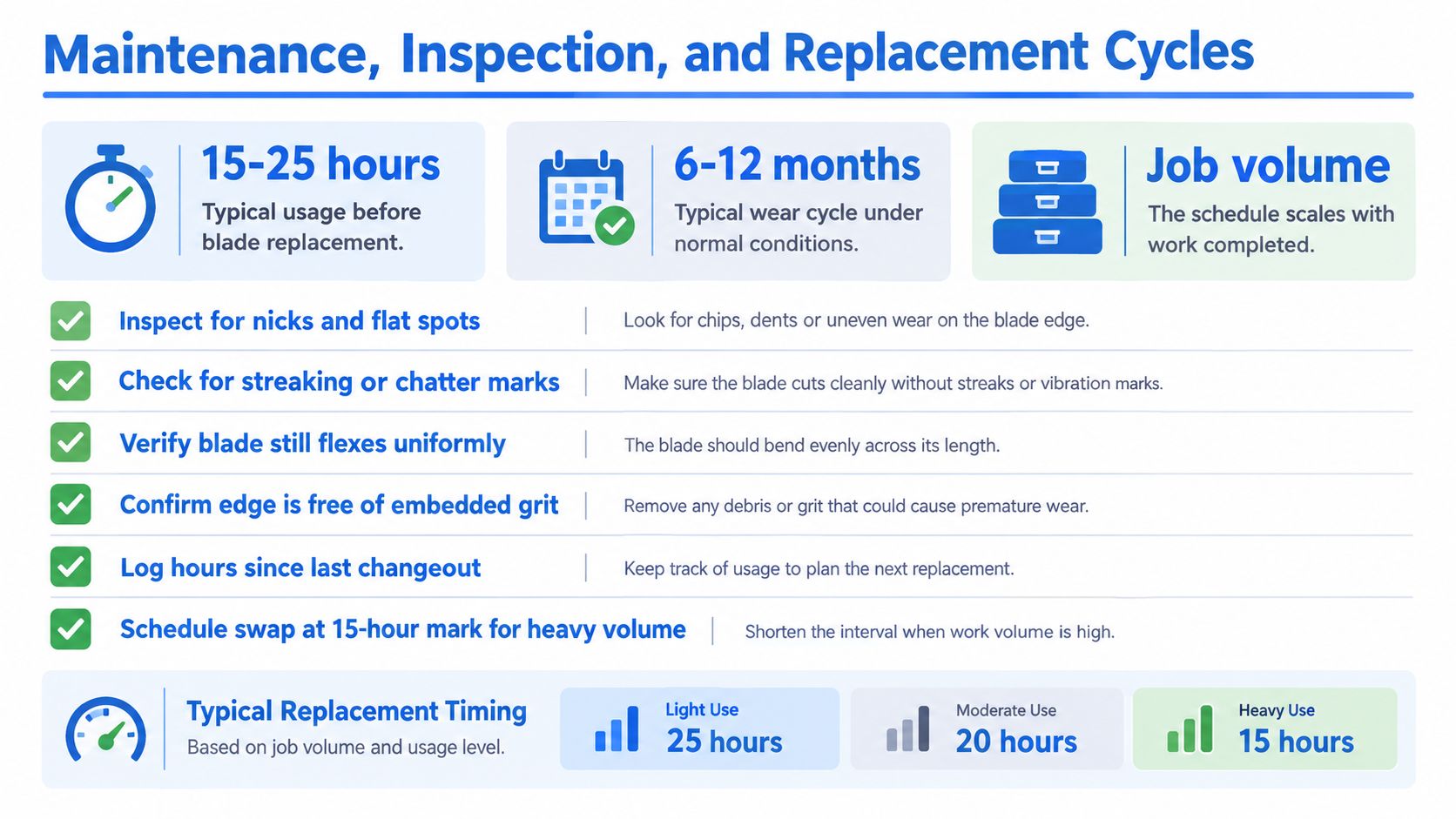
Replacement should follow workload and edge condition, not a calendar reminder alone. One independent industry guide recommends replacing squeegee rubber after 15 hours of use, or sooner if streaking or nicks appear. Another professional rule of thumb places the working range at 15 to 25 hours, depending on the brand and conditions, as summarized in this replacement-blade guidance.
Separate market material estimates that rubber or silicone blades may wear out on cycles of roughly 6 to 12 months, while replacement purchases make up 60% to 70% of unit demand. Those figures appear in this 2026 squeegee selection guide. Treat them as planning context, not permission to keep a blade that is already streaking.
After each working pass, look for a nick, curl, flat spot, or memory set. A blade can appear clean yet still have a rounded edge that no longer flexes uniformly. Wipe it with a dry microfiber cloth between windows, and deep-clean it with mild detergent when residue builds up. Let it air-dry away from direct sun.
Swap immediately when you see visible curling, persistent streaking on wet glass, chatter marks, or damage from an abrasive film edge. Keep one spare blade for each channel size needed on the day's route. Log approximate working hours if the crew is busy enough that visual inspection alone becomes inconsistent.
For a broader look at replaceable blades and professional tool care, see this professional window squeegee guide. Store unused rubber flat, clean, and protected from direct sunlight. A hot truck cab can age exposed material before it ever reaches the glass.
“Soft for cold, hard for heat” is a useful starting point, but it isn't a complete jobsite rule. Glass temperature, surface texture, mineral buildup, and pulling speed all affect the result.
Soft rubber can conform better to older or uneven glass, especially when the pane is cold. Harder rubber can maintain a straighter contact line on smooth glass and in hot conditions. On dusty, sun-baked storefronts, the harder edge may give better control, but pitted glass can still demand a softer blade because stiffness prevents the edge from following the surface.
Don't switch grades based on outdoor air alone. A north-facing pane in Scottsdale may remain cooler than a south-facing pane nearby. A shaded window in Denver can require softer rubber even during summer, while direct sun can make another pane reject the same blade through chatter or curl.
| Glass condition | Cold glass | Temperate glass | Hot glass |
|---|---|---|---|
| Smooth, clean glass | Medium or soft if the edge skips | Medium, with 70A as a practical starting point | Harder grade for a stable contact line |
| Textured or pitted glass | Soft for conformity | Softer grade if chatter appears | Test softer rubber before increasing pressure |
| Mineral film or heavy residue | Soft enough to maintain contact | Medium with careful cleaning | Harder grade may control the film, provided the glass is smooth |
| Dusty storefront glass | Soft if the surface is uneven | Medium for general work | Harder grade can suit fast pulls on smooth sections |
The best mid-job test is short and controlled. Clean the blade, wet a representative pane, make a normal pull, and watch whether the edge curls, chatters, or leaves a continuous line. If it does, move one grade softer or harder based on the failure, then retest rather than changing pressure repeatedly.
A truck-side decision matrix should answer five questions quickly: what surface are you cleaning, how hot or cold is the glass, how smooth is the pane, what channel accepts the rubber, and how much working time remains on the edge?
The matrix below keeps the choice practical. Service hours are planning ranges from professional replacement guidance, not guarantees. Abrasive grit, mineral residue, direct sun, poor storage, and heavy route volume can shorten them.
| Job condition | Rubber type | Durometer | Width | Service hours |
|---|---|---|---|---|
| Cold, uneven residential glass | Natural or synthetic rubber | Softer grade, within the conformable range | 2 inches | Inspect early, replace around the 15 to 25 hour guidance |
| Hot, smooth sunlit storefront | Rubber or suitable heat-resistant compound | Medium to hard, test on the pane | 2 inches | Inspect for curl and chatter before each route |
| Pitted tempered glass | Flexible rubber | Softer grade | 2 inches | Condition-dependent, replace at the first persistent streak |
| Smooth polished low-E glass | Fresh rubber | Around 70A as a starting point | 2 inches | Use the edge condition, not the calendar, as the trigger |
| Dusty post-construction glass | Rubber selected after debris removal | Medium or hard on smooth areas | 2 inches | Inspect after abrasive exposure |
| Mixed fleet across Arizona, Nevada, and Colorado | Standardized rubber plus a softer spare | Around 70A standard, softer backup | Match each channel | Log use and carry replacements by channel size |
Before loading a case, confirm the channel style, cut length, thickness, packaging quantity, and storage condition. The common professional geometry is 2 inches wide and 3/8 inch thick, but the holder still determines whether the rubber seats correctly.
When climate is uncertain, step down one grade, test the first window, and only move harder if the edge loses control.
Is silicone-treated rubber worth the premium?
It can be worthwhile where heat, sunlight, or storage conditions accelerate deterioration, but the label doesn't guarantee a better finish. On flat architectural glass, fresh rubber may still provide the firmer edge control a technician prefers, so compare the total replacement routine rather than buying on the word “silicone” alone.
How do I stop a new blade from streaking on the first pass?
Inspect both edges for a factory defect, clean the blade, and confirm that it sits evenly in the channel. Pre-conditioning isn't complicated. Wipe the blade clean, wet it, and make a short test pull before starting the route, especially after the rubber has been stored in a hot truck.
Does thicker rubber last longer than standard rubber?
Not automatically. Thickness changes stiffness and pressure response, while service life depends on the compound, edge quality, grit, sunlight, storage, and workload. A thicker blade that doesn't match the holder can perform worse than standard rubber that seats correctly.
What should I do with old blades?
Don't put a streaking blade back into production, but you can keep sound offcuts for non-glass cleanup, masking support, or testing channel fit. Discard pieces that are contaminated with abrasive grit or have a damaged edge, and use the selection matrix above to choose the replacement for the next route.
Professional Window Cleaning provides residential, commercial, and high-rise window cleaning, with crews working across Arizona, Nevada, and Colorado. If your glass conditions keep exposing weaknesses in your rubber selection, visit Professional Window Cleaning to arrange service and discuss the right cleaning method for the building.
Read our blog posts regularly and keep learning.