Care and Maintenance
Concentrate Window Cleaner: Professional Guide
Learn how to dilute and apply concentrate window cleaner like pros. Master ratios, safety, and streak-free results for residential and commercial glass.


When you think of protecting your home from the sun, blinds and curtains probably come to mind. But what if there was a better way? Enter solar screens for windows—a powerful, exterior solution designed to stop a massive amount of the sun's heat and harsh UV rays before they even have a chance to touch your glass.
Think of them as a set of high-performance sunglasses for your entire home. They cut the heat, kill the glare, and protect everything inside from sun damage.
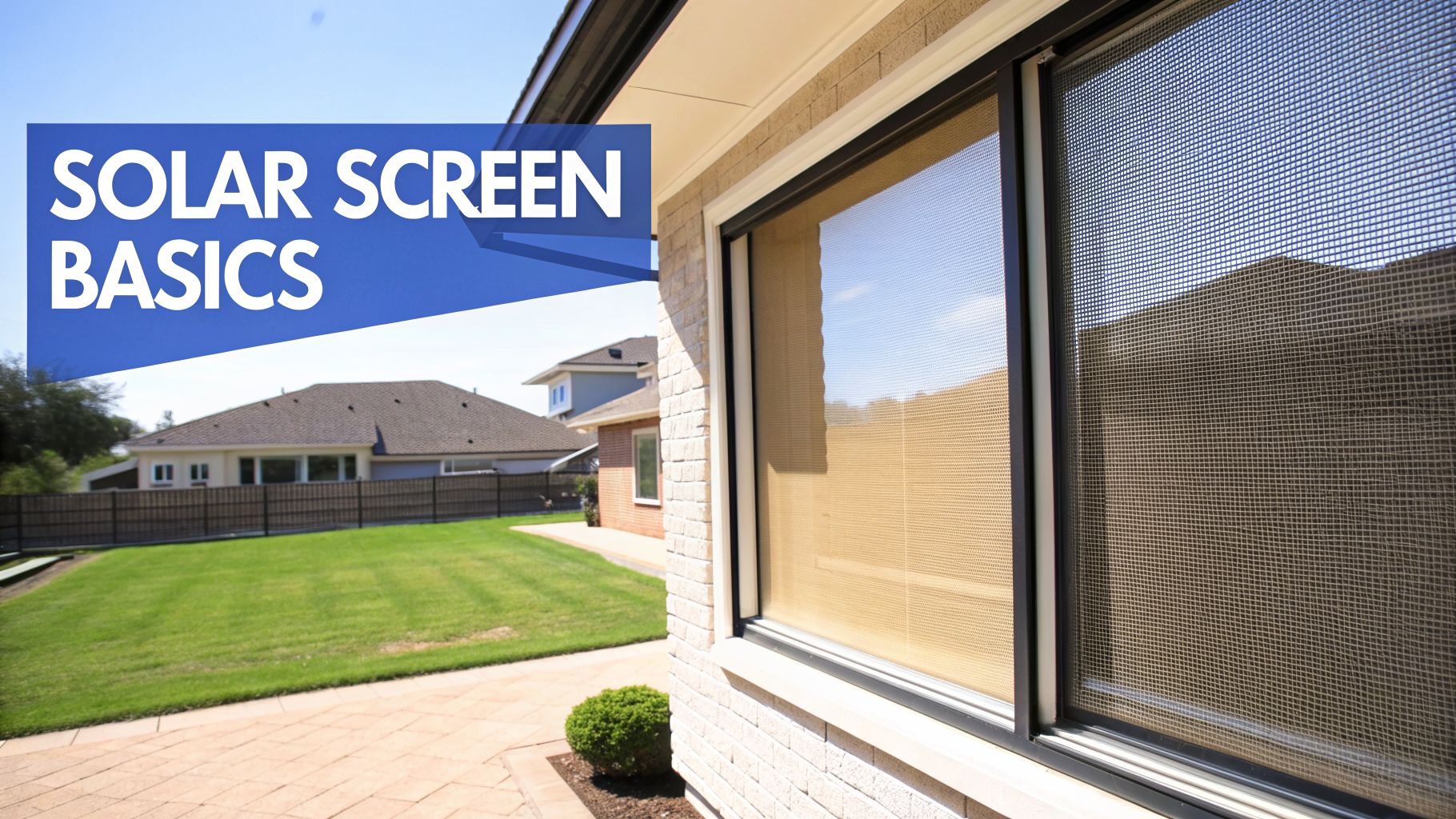
Picture yourself standing in the direct sun on a blistering hot day. You feel the heat soak into your clothes, right? Now, imagine stepping under a big shade tree. The leaves block the sunlight, creating a cool, comfortable pocket of air. Solar screens work in much the same way, acting as that essential shade tree for your home's most vulnerable heat traps—its windows.
Their magic lies in a simple but brilliant concept: stop solar heat gain at the source. Unlike blinds or curtains inside, which only block sunlight after it’s already passed through the window and superheated the glass, solar screens are mounted on the outside. This placement is what makes all the difference.
The specially designed mesh, usually a tough PVC-coated polyester or fiberglass, is engineered to do two things at once. It absorbs a chunk of the sun's energy while reflecting the rest away from your house. This simple process prevents your window glass from ever heating up in the first place, dramatically cutting down how much heat gets transferred inside.
If you live in a sun-drenched city like Phoenix or Las Vegas, this isn't just a minor perk—it's a game-changer for your energy bills. By blocking anywhere from 80% to 95% of the sun's thermal energy, solar screens give your air conditioning system a much-needed break. That means real, tangible savings on your monthly utility bills all summer long.
Beyond the cost savings, you'll notice the practical benefits right away:
For a quick reference, here's a simple breakdown of what solar screens bring to the table.
This combination of features is why solar screens are such a popular and effective solution, especially in sunny climates.
Sure, options like window film and interior blinds have their place, but when it comes to raw heat control, solar screens are in a league of their own.
Solar screens are far more effective at reducing heat gain than window tint. The best way to prevent heat from coming through a window is to prevent the heat from hitting the glass in the first place. That is precisely why solar screens are so effective.
Because they’re on the outside, they create a buffer of air between the screen and the glass, adding an extra layer of insulation. This proactive approach is what sets them apart, making them a must-have upgrade for any homeowner serious about beating the summer heat and saving money.

Not all solar screens are created equal. Their real power to block the sun's intense heat and glare comes down to two things: the material they’re made from and the tightness of their weave. Getting this right is a balancing act between cutting your energy bills, keeping your beautiful views, and making sure they last for years.
This choice is a huge deal for homeowners in sunny climates, whether it's the dry desert heat of Scottsdale or the high-altitude sun in Denver. The right screen can turn a hot, glaring room into a cool, comfortable retreat. To do that, you first need to understand a little something called "weave openness."
Weave openness is just a fancy term for how much light and air can get through the screen's mesh, measured as a percentage. Think of it like this: a lower percentage means a tighter weave, which blocks more sun but offers slightly less visibility. A higher percentage means a more open weave, letting in more light and a clearer view while blocking a bit less heat.
The most common densities you'll see are 80% and 90%. This number tells you roughly what percentage of solar rays the screen blocks. So, an 80% screen stops about 80% of the sun's heat, while a 90% screen stops about 90%.
And people are catching on. The global market for solar windows was valued at USD 138.4 million in 2023 and is expected to jump to USD 362.3 million by 2033. North America is leading the charge with a 32.3% market share, all thanks to a huge push for energy efficiency in homes and businesses.
The fabric of your solar screens is your first line of defense against the sun. Two materials really stand out in the market because of their strength and resilience.
PVC-Coated Fiberglass: This is a fantastic all-around option that’s both durable and budget-friendly. The fiberglass at its core gives it strength, while the PVC coating protects it from UV rays and moisture. That means it resists fading, fraying, and mildew—a real workhorse.
PVC-Coated Polyester: If you're looking for top-tier strength, polyester is the way to go. It’s known for its incredible tear resistance, making it a premium choice for large windows or areas that get hit with high winds.
When you’re choosing, getting to know the properties of different window screen material types can make all the difference.
So, which density makes sense for your home? It all comes down to what you’re trying to achieve.
Choose 80% Density If:
Choose 90% or 95% Density If:
At the end of the day, the perfect solar screen is the one that strikes the right balance for your specific needs—whether it’s heat control, natural light, or a clear view—to keep your home comfortable all year long.
It’s one thing to understand the technical details of solar screens, but it’s another to see the real, everyday difference they make. Installing solar screens for windows isn’t just a cosmetic tweak; it's a smart investment that pays you back in ways you can actually feel and measure. We're talking substantial energy savings, serious UV protection for your stuff, and a huge boost in daily comfort. These aren't just abstract perks—they're real-world results you'll notice right away.
For anyone living in sun-drenched cities like Las Vegas, the effect on cooling costs is nothing short of dramatic. The right solar screens are your first line of defense, stopping the sun's heat before it even gets a chance to bake your window glass.
Let's be honest, the biggest draw for most people is the promise of a lower energy bill, and solar screens absolutely deliver. By blocking up to 95% of the sun's thermal energy, they take a massive load off your air conditioning system. Think about it: on a hot afternoon, an unprotected window basically works like a giant space heater, forcing your A/C to run nonstop just to maintain a comfortable temperature.
Once solar screens are up, that heat transfer is stopped in its tracks. Your A/C unit runs less often and for shorter cycles, which can knock your cooling costs down by as much as 30%. In a place where summer temps are relentless, that can easily add up to hundreds of dollars every year. Before you know it, the screens have paid for themselves.
And it’s not just about the screens. Understanding the bigger picture of how energy-efficient windows work can really drive home their value. You can learn more about the complete benefits of energy-efficient windows and see how all these upgrades team up to make your home smarter and more efficient.
The sun’s ultraviolet (UV) rays are silent but destructive. Over time, they’re the culprit behind the fading and breakdown of just about everything inside your home—hardwood floors, expensive rugs, leather furniture, artwork, you name it. Solar screens are a powerful shield against that slow-motion damage.
A high-quality solar screen can block up to 99% of damaging UV radiation. Think of it as applying a powerful, broad-spectrum sunscreen to your entire home, preserving the color and life of your valuable furnishings for years to come.
This protective benefit is huge but often gets overlooked. Instead of watching your favorite things slowly fade away, solar screens keep them looking vibrant, saving you the headache and high cost of replacing or reupholstering them down the road. This is especially key for any room that gets blasted with direct sun for hours each day.
The change you'll feel immediately is in the overall atmosphere of your home. Solar screens get rid of that harsh, blinding glare that makes it impossible to watch TV, work on a computer, or even read a book near a window without squinting.
Here’s how they make your day-to-day life better:
At Professional Window Cleaning, we've spent over 26 years helping homeowners keep their views pristine. While our job is to get your glass crystal clear with professional squeegee or pure-water system methods, we know that what's on the outside of your window—like a solar screen—is just as crucial for your comfort inside. These screens offer hard proof of a solid return on investment through lower bills, protected belongings, and a more enjoyable home.
When it comes to cooling your home, you have options. But picking between solar screens, window film, and traditional blinds can get confusing if you don't know the key differences. This comparison will break down the most popular choices to help you figure out which solution is best for protecting your home and slashing those energy bills.
The most critical distinction is where each one does its job. Solar screens work from the outside, creating a protective barrier that stops the sun's heat before it ever reaches your window glass. This proactive approach is a game-changer, especially in high-heat areas like Phoenix, where every single degree of cooling counts.
Let's be honest, the main reason to invest in any window treatment is to control heat. Solar screens are the undisputed champs here because they block a whopping 80% to 95% of the sun's heat from the exterior. By keeping the glass itself from getting hot, they dramatically cut down on the thermal energy transferred into your home. That takes a massive load off your air conditioner.
Window film, which is applied to the inside of the glass, reflects some solar energy back out. It's effective, but it allows the glass to heat up first, meaning some of that heat is still going to radiate indoors. Blinds and drapes are the least effective for heat control; they only block sunlight after it has already passed through the window, heating both the glass and the air trapped between the window and the blind.
Durability is another huge factor. High-quality solar screens for windows are built tough to withstand the elements. They’re crafted from rugged, PVC-coated materials that resist fading, fraying, and weather damage for 10 years or more.
Window film is applied indoors, so while it's protected from the weather, it can be susceptible to bubbling, peeling, or scratching over time. Interior blinds and curtains vary wildly in quality but are often prone to breaking, bending, or fading from constant sun exposure.
This quick infographic really drives home the core benefits you get when you invest in a durable solution like solar screens.
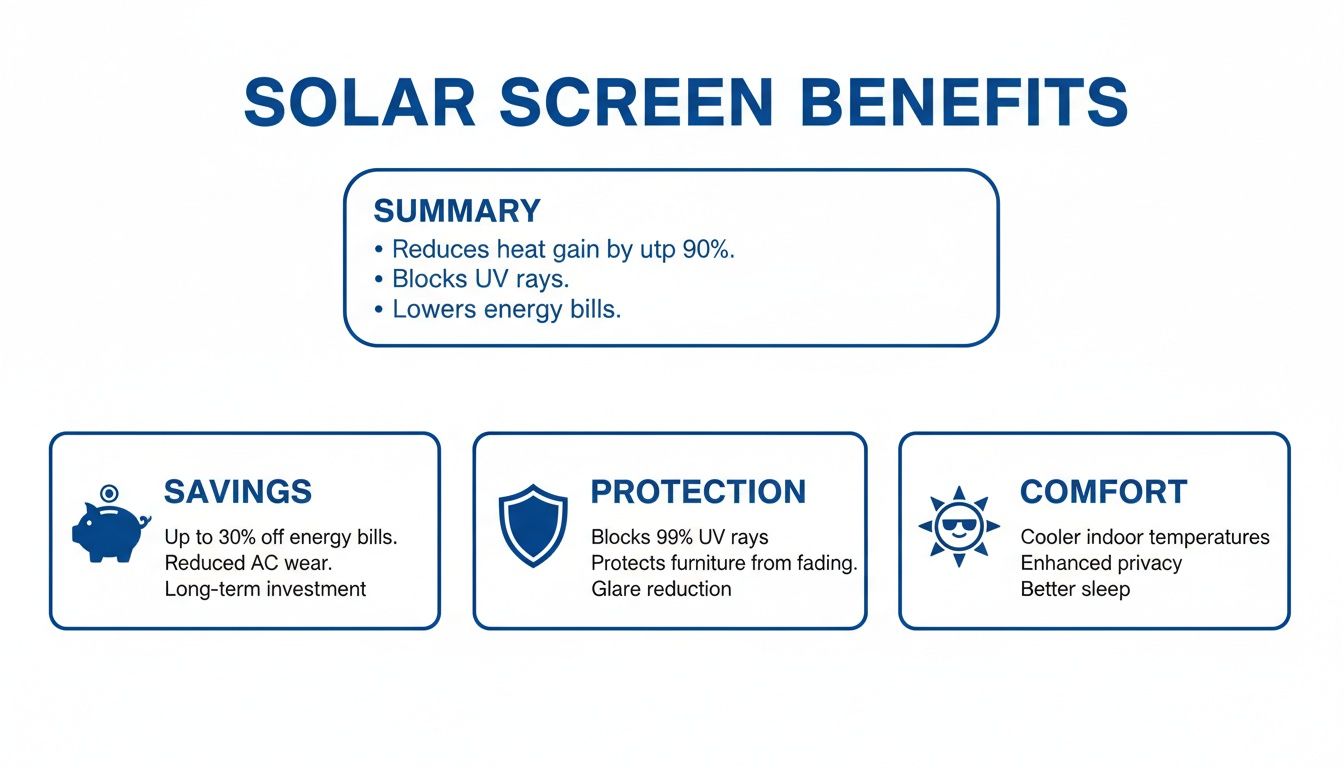
As you can see, it’s a powerful summary of how these screens deliver savings, protection, and comfort all in one package.
Each option affects your view and your home’s exterior look in a different way. Solar screens offer excellent outward visibility during the day while providing solid daytime privacy—it's surprisingly difficult to see inside from the street. They also add a clean, uniform look to your home’s exterior.
Window film offers a clear view out, but its reflective or tinted appearance can definitely alter your home's aesthetic. Blinds and drapes give you complete privacy when closed but completely block your view. And when they’re open, they offer no privacy at all.
To make the choice crystal clear, let's stack these three popular solutions up against each other in a head-to-head comparison.
This table offers a quick, side-by-side analysis of how solar screens, window film, and traditional blinds perform across the metrics that matter most.
The takeaway here is that each solution has its strengths, but they are far from equal when it comes to pure performance.
The market for solar control window films is booming, which shows a strong trend toward energy-efficient window solutions. Forecasts project the market to hit USD 2.26 billion by 2033, with the construction industry making up 54.10% of that revenue. For us at Professional Window Cleaning, this growth in advanced window products highlights an increasing need for specialized cleaning. Our squeegee and pure-water system methods are perfectly suited for maintaining these modern surfaces without causing damage. You can find more details about these industry trends and discover more insights about the solar films market.
Ultimately, while every option has its place, solar screens for windows provide a more powerful and direct method of heat control by stopping the sun before it even starts warming up your home.
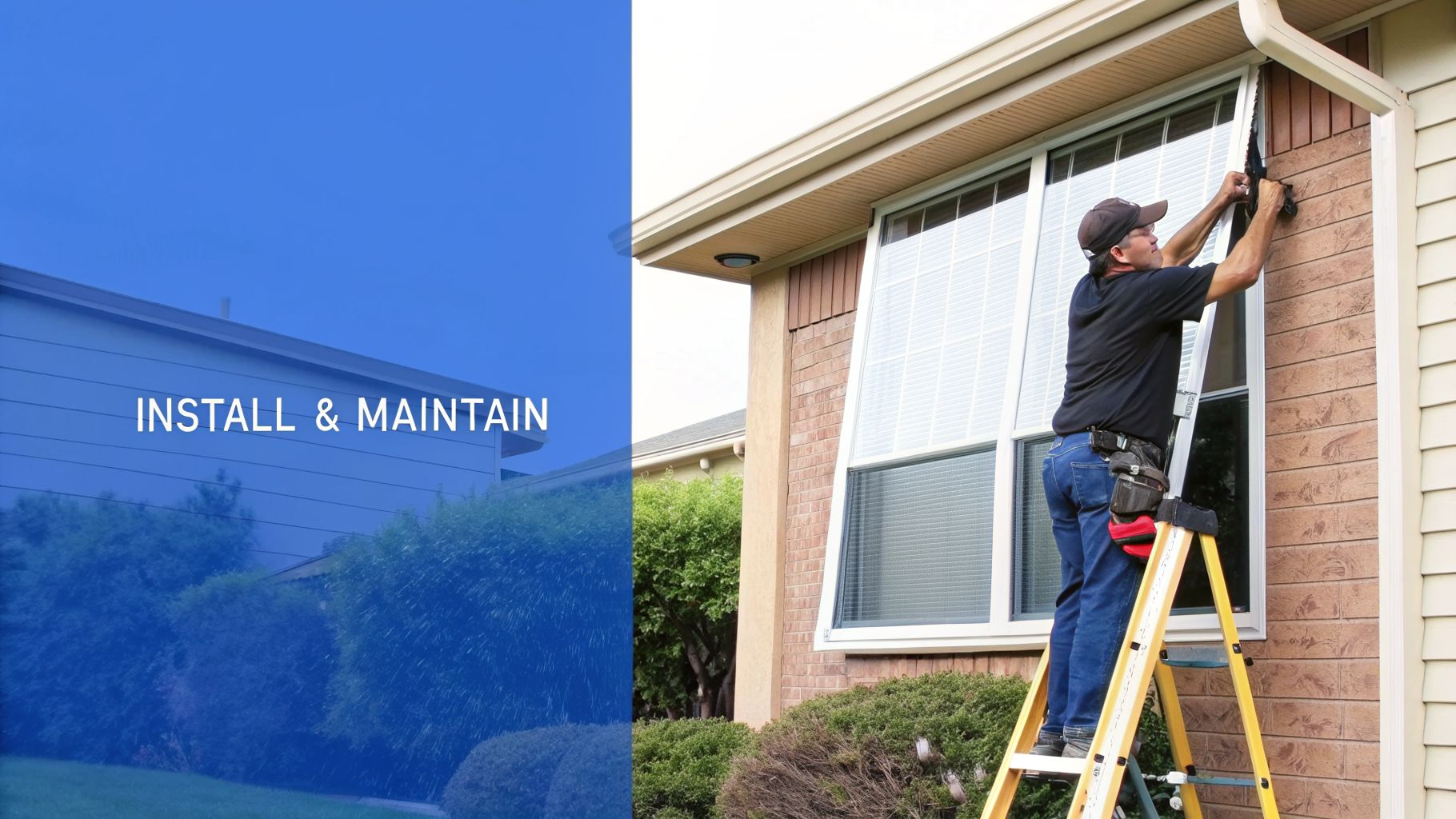
To really get the most out of your solar screens for windows, two things are non-negotiable: a solid installation and regular upkeep. When a screen is installed correctly, it works like a charm. And when you keep it clean, it stays that way for years, looking good and blocking heat just like it’s supposed to.
It's clear that energy-saving features are becoming standard, not just an add-on. Projections show that by 2025, new construction will make up a staggering 84.20% of the solar control window films market. This means builders are thinking about efficiency from day one instead of adding it later. As you can learn more about these construction trends, this shift creates a huge need for experts who know how to maintain these modern window systems.
When it's time to put your solar screens up, you’ve got two paths: roll up your sleeves and do it yourself, or bring in a professional. Your choice really boils down to your comfort with DIY projects, the kind of windows you have, and most importantly, safety.
DIY Installation: If you're pretty handy and your windows are on the ground floor, a DIY install can definitely save you some money. Most kits include all the hardware you’ll need, like clips or screws, along with instructions. The trick is to measure perfectly so you get that tight, secure fit.
Professional Installation: Now, for any windows on the second story, funky custom shapes, or if you just want it done right without the headache, hiring a pro is the way to go. They have the right tools, the safety gear, and the know-how to mount the screens perfectly. They'll also ensure there's that crucial air gap between the screen and the glass, which is key for maximum heat-blocking power.
For any windows on a second story or higher, professional installation isn't just a recommendation—it's a safety essential. Experts are equipped to handle the risks of working at heights, protecting both themselves and your property.
Think of your solar screens as the first line of defense against the sun, dust, and pollen. Over time, they're going to get dirty, and that layer of grime can make them less effective while blocking your view. This is especially true in places like Denver with its changing seasons, or in dustier spots like Scottsdale.
For routine cleaning, a quick spray with a garden hose can usually knock off the loose dirt. If they need a little more help, a soft-bristled brush and some mild, soapy water will do the trick. Just be gentle. Never use a pressure washer or harsh chemicals—you’ll risk damaging the mesh fabric.
But for a deep clean that gets rid of stubborn hard water spots and makes your view crystal-clear again, nothing beats calling in the pros. Professional Window Cleaning has been cleaning windows for over 26 years!
We rely on two proven methods to care for windows and screens. For many jobs, the classic squeegee technique gives a perfect, streak-free shine. But for screens and the windows hiding behind them, our pure-water system is the real game-changer. This advanced system uses highly filtered water that dries without leaving a single mineral spot behind. It rinses away all the grime for a flawless finish that lasts, all without any harsh chemicals.
You can dive into our expert methods and find out more about our professional screen cleaning services to see exactly how we keep your investment in top shape.
As you get closer to making a decision, a few questions are bound to pop up. It’s completely normal. To help you feel confident about this home upgrade, we've put together answers to the most common queries we hear from homeowners.
This is usually the first question on everyone's mind, and the answer can vary. On average, you can expect to pay between $7 and $15 per square foot for a professional, turnkey installation. That price typically rolls in the custom-built screen, the frame, and all the hardware needed to get the job done right.
A few things can nudge that price up or down:
While it’s an upfront investment, keep the big picture in mind. The savings on your cooling bills, especially in sun-drenched cities like Phoenix, mean these screens start paying for themselves from day one.
This is a fantastic question because it gets right to the physics of how these screens work. During the day, they offer incredible privacy. The dark, tight mesh acts a lot like tinted car windows, making it nearly impossible for anyone outside to peer in.
But at night, that effect flips. It all comes down to a simple rule: your eyes are drawn to the brighter side.
When you have lights on inside your home after dark, the interior becomes the "bright side." This makes the screens more transparent from the outside, allowing people to see in. For total nighttime privacy, you’ll still want to pull your blinds or draw your curtains.
Think of it as a one-way mirror that works with the sun. Solar screens are masters of daytime privacy, but they don't replace your traditional window coverings once evening arrives.
Durability is where high-quality solar screens really shine. With proper installation and a little care, you can expect them to last for 10 years or more, even when facing harsh sun and weather year after year. The best screens are made from tough, PVC-coated polyester or fiberglass—materials engineered to fight off fading, tearing, and mildew.
Reputable manufacturers stand by their products, often offering warranties of around 10 years on the fabric. This gives you peace of mind that your investment is built to last. Of course, a little cleaning now and then goes a long way. If you ever need to take them down for a deep clean, our guide on how to properly remove window screens shows you how to do it without causing any damage.
It's a fair question, especially for those of us who live in places with four distinct seasons. Solar screens are designed to block solar heat, which is a lifesaver in the summer. In the winter, you might actually want some of that free solar warmth.
Even so, they still offer plenty of year-round value. Here's how:
For homeowners in colder climates who really want to maximize that passive solar heat during winter, the screens can be removed and stored. Many modern mounting systems use simple hardware like leaf springs or brick clips, making it a quick and easy seasonal task.
With over 26 years of experience, Professional Window Cleaning has seen firsthand how well-maintained windows and screens can transform a home. Whether you need a perfect, streak-free shine using our professional squeegee or pure-water system methods, we ensure your view is always at its best.
Ready to see the world more clearly? Visit us online to get a free estimate for your home or business.
Read our blog posts regularly and keep learning.