Care and Maintenance
Hand Held Brush Types for Window Cleaning Compared
Compare hand held brush bristle types, stiffness, shapes and handles for window cleaning, plus which brush suits homes, commercial sites and high-rises.


If you’ve got a stack of window cleaning business cards sitting in your truck, office drawer, or center console, and they aren’t bringing in calls, the problem usually isn’t printing. It’s strategy.
Most cards get treated like a formality. Name, number, logo, done. Then the cards get handed out to anyone with a pulse and nobody knows whether they produced a single paying job. In a trade as competitive as window cleaning, that approach burns money.
A business card should do one of two things. It should either make a homeowner trust you fast, or make a property manager take the next step without hesitation. If it doesn’t do one of those jobs, it’s just paper.
Window cleaning has only two real professional methods. You’re either cleaning with a squeegee or with a pure-water system. That kind of clarity should show up in your marketing too. After more than 26 years in this business, that’s what separates cards that get kept from cards that get tossed.
You finish a residential estimate in Denver, hand over a card, and the homeowner sets it on the kitchen counter next to three others. Later that week, a property manager in Las Vegas asks for your info after a walkthrough, and your card ends up in a desk drawer with every cleaner who called that month. In both cases, the card gets one job. Move the prospect to the next step.
A lot of window cleaners still treat business cards like a box to check. Print them cheap, keep a stack in the truck, pass them out, hope the phone rings. After 26 years in this trade, I can tell you that approach rarely holds up in a competitive market.
The better approach is to build cards as small, trackable sales pieces. One card can be aimed at high-end residential work. Another can be built for storefront and office managers. A third can speak to high-rise and facilities contacts who care about safety, documentation, and bid follow-through. If you cannot tell which version produced the call, you are guessing instead of marketing.
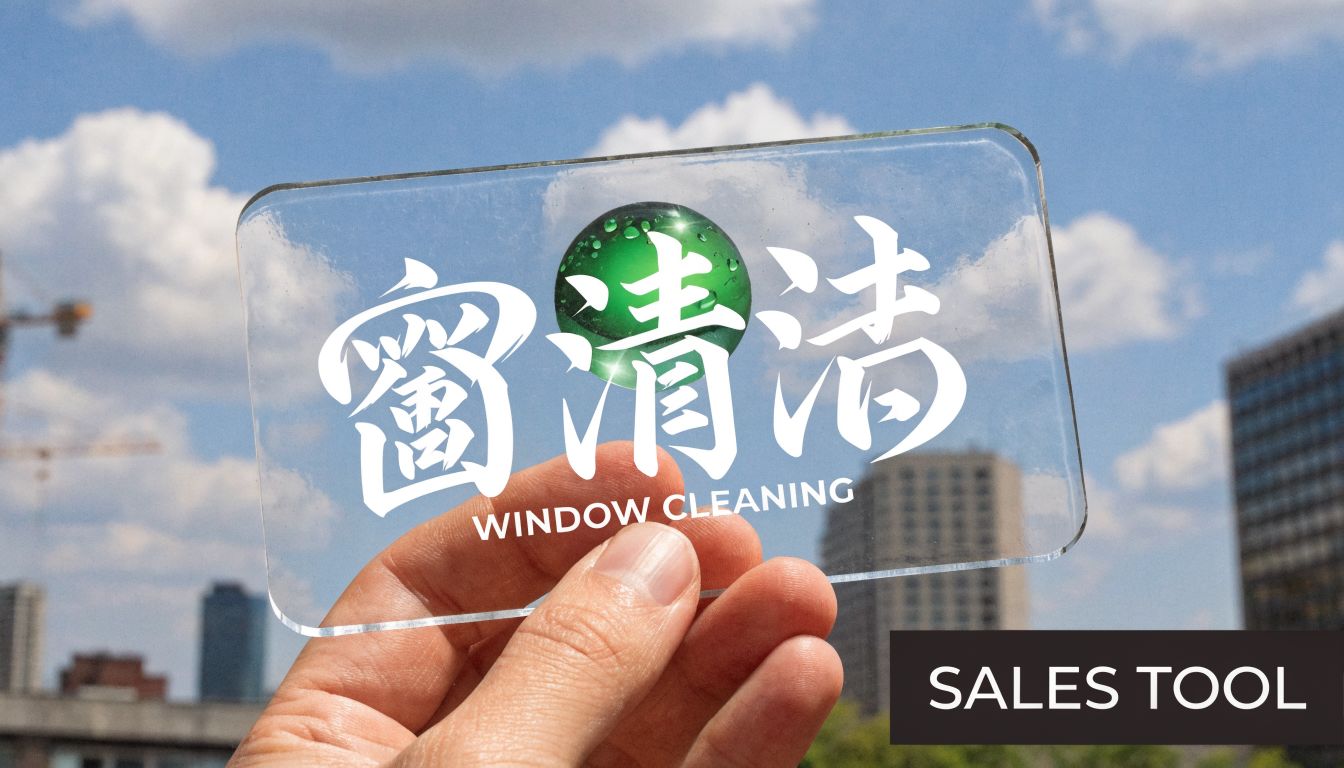
In my experience, window cleaning cards usually underperform for four practical reasons:
That last point matters more than many owners realize. If 500 cards go out over 60 days, you should be able to tell which route produced estimates, which version brought in repeat work, and which audience ignored you. A card that cannot be measured is hard to improve.
A strong card works like a field rep you leave behind. It gives the prospect a reason to trust your company, a reason to remember it, and a clear action to take.
In Phoenix, Denver, Scottsdale, and Las Vegas, clients see plenty of cleaners. The card that gets kept usually signals something specific. Better systems. Better communication. Better proof that the company is legitimate. For commercial and high-rise prospects, even a short line about being bonded vs insured for window cleaning work can separate a serious operator from a cheap bidder.
Design matters, but context matters more. A luxury residential card can justify thicker stock, cleaner branding, and a QR code that goes straight to a quote page with before-and-after photos. A commercial card should push toward credentials, service areas, and account setup. A high-rise card needs to support a safety-first sale. That is closer to the discipline used in branding for remodelers, where the printed piece has to match the price point and the buyer’s expectations.
Practical rule: If your card cannot be tied to a lead source and a client type, it is not a sales tool yet.
The window cleaning companies that get results from cards do not print one version and call it done. They build cards by audience, connect them to a measurable next step, and judge them by calls, estimates, close rate, and job value.
Trust starts with what you say on the card and what you leave off.
A crowded card looks amateur. A vague card looks forgettable. The sweet spot is a clean front, a useful back, and a message that tells the prospect what kind of operator you are.
Your card needs a USP, not just a business name. One proven approach is to feature a promise like “Streak-Free Guarantee with Pure Water RO/DI Systems” and put a referral incentive on the back, because referred leads can convert at 3 to 5 times the rate of cold leads, as noted in this window cleaning business growth guide.
That kind of language does real work. It tells the customer you use professional methods, not a bucket-and-rag approach.
For this trade, your card should make it obvious that you clean windows with one of the two methods that matter:
The front of the card should answer three questions quickly: who you are, what you do, and why your work is different.
Use this short checklist:
If you want the card to feel credible, don’t stuff every service you’ve ever offered onto it. Focus matters.
A strong card doesn’t try to say everything. It says the one thing the right buyer needs to hear.
The back side is where many cleaners waste space. They leave it blank or repeat the front. Use it instead for a referral offer, a short service list, or a booking prompt.
A practical back side might include:
This is also where trust details can help. If you’re trying to explain credibility to a client who doesn’t know the difference between coverage types, a plain-English resource on bonded vs insured window cleaners can support the same trust message your card should start.
Home service owners often overlook this part. Branding isn’t decoration. It’s expectation-setting. If your vans, shirts, website, estimates, and cards all look unrelated, the client feels uncertainty even if they can’t explain why.
That’s why it helps to study how other service trades think about identity systems. Good guidance on branding for remodelers applies here too, especially the idea that every customer touchpoint should reinforce the same standard of workmanship.
A polished card doesn’t make up for bad service. But bad presentation can absolutely cost a good operator the job.
One card design won’t do the same job for a homeowner and a facility manager.
The homeowner is deciding whether to trust you around the property. The commercial contact is deciding whether you look organized enough to handle access, insurance, scheduling, and safety without creating headaches.
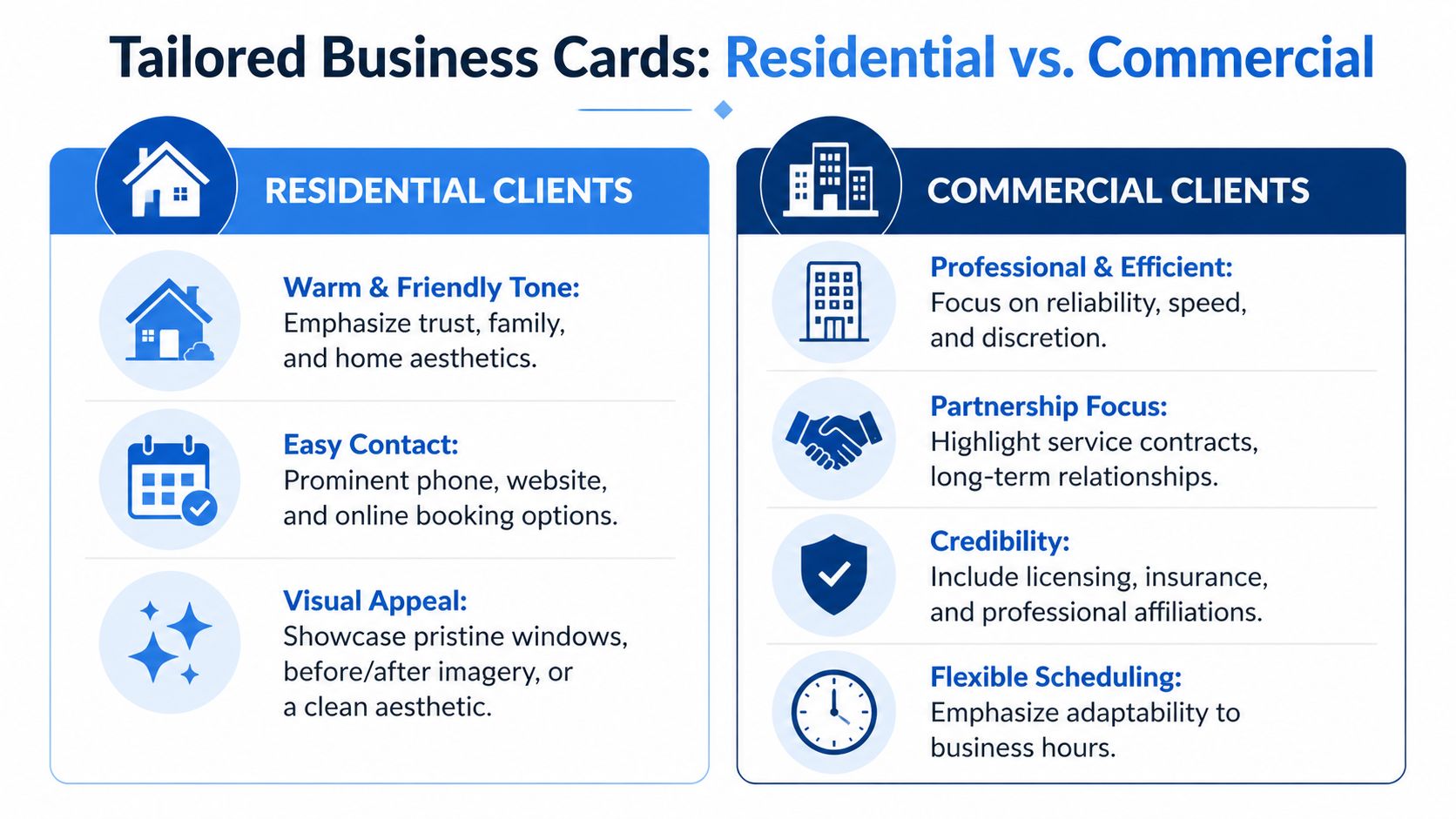
For residential work, the card should feel approachable. People hiring for their home want confidence, but they also want a sense that you’ll respect the property and communicate well.
A residential card usually works better when it includes:
If you work neighborhoods where referrals move quickly, it can also help to design cards with enough breathing room that clients feel comfortable handing them to neighbors.
Commercial buyers think differently. A property manager, dealership manager, medical office administrator, or high-rise contact usually cares less about a soft visual style and more about whether your operation looks dependable.
For those clients, the card should highlight things like:
| Client type | What they want to see on the card | What to avoid |
|---|---|---|
| Homeowner | trust, ease of contact, clean appearance | too much technical wording |
| Commercial manager | reliability, scheduling, proof of professionalism | playful or cluttered layouts |
| High-rise contact | safety language, credentials, fast verification path | generic “we clean windows” messaging |
A commercial card should feel tighter and more deliberate. If you do larger properties, the design has to communicate that you can handle organized service, not just one-off house calls.
If a building manager has to guess whether you’re set up for commercial work, the card has already made the sale harder.
Audience thinking is key. The best card isn’t the prettiest one. It’s the one built for the person holding it.
If you want a useful outside perspective on segmenting the message before you print, this guide to unlock business growth strategies through audience analysis is worth a read. The same principle applies in window cleaning. Different buyers respond to different proof.
Residential cards should feel personal. Commercial cards should feel operational.
That doesn’t mean you need ten different versions. It means you should stop forcing one generic design to carry every kind of sale.
The physical card matters more than many cleaners want to admit.
If a card feels flimsy, bends in a pocket, fades in the truck, or gets soft around the edges after a week, it sends a message. Clients may not say it out loud, but they connect the finish of the card to the standard of the company.

A practical recommendation is 16pt cardstock with a UV coating. According to this guide on starting a window cleaning business, choosing a durable, weather-resistant stock like that can prevent the 50% degradation commonly seen in cards stored in vehicles, especially in sunny markets like Arizona and Nevada.
That matters if your techs keep cards in the truck, in a door pocket, or in a pouch all day. Heat, sun, and handling wear cheap cards out fast.
The right stock does more than feel nice.
There’s also a trade-off here. High-gloss UV coating looks crisp and durable, but some brands fit better with matte if you want a softer, premium look. Both can work. The key is choosing on purpose.
Window cleaning is detail work. Whether you clean with a squeegee or a pure-water system, the customer expects precision.
Your card should reflect that. Crisp edges. Readable type. No muddy photos. No thin paper that feels like junk mail. If you’re asking someone to trust you with expensive glass, storefront visibility, or a high-rise property, the card should feel like it belongs to a serious operator.
Cheap cards can be useful for mass handouts. But if you’re targeting quality clients, premium stock usually earns its keep.
A standard business card can start the conversation. A smart card can move the buyer to the next step right there on the spot.
That matters most with commercial and high-rise work, where the person taking your card often isn’t ready to call immediately. They want to verify that you’re legitimate, review credentials, and share your info with someone else inside the organization.
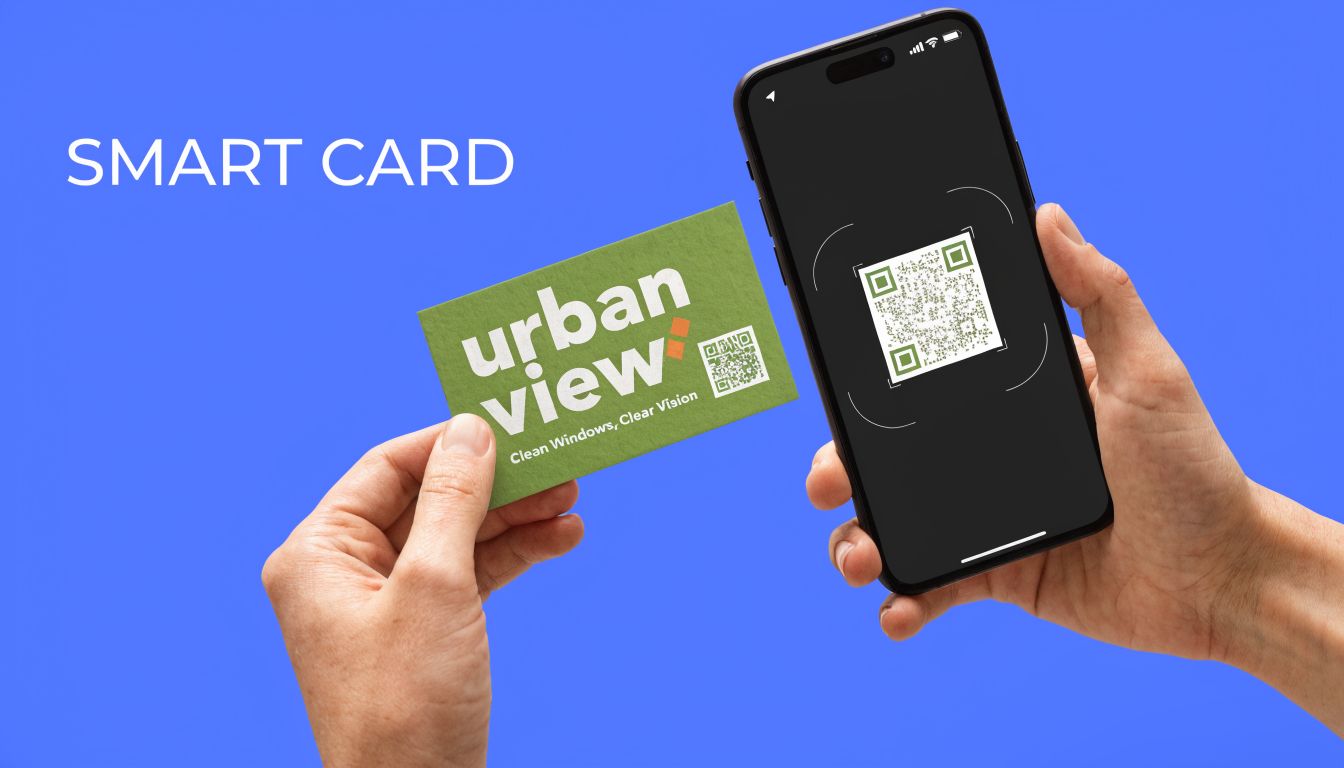
The QR code should not send people to a generic homepage if you can avoid it.
For a commercial card, the better move is a focused landing page with the exact proof that buyer wants. Good options include:
For commercial and high-rise buyers in Nevada and Arizona, hybrid cards with scannable links matter because these clients convert 3x higher with hybrid cards, and 65% of facility managers scan cards to verify credentials before awarding a contract, according to Professional Window Cleaning’s guidance on hybrid cards for commercial clients.
NFC cards are the next step up. Instead of asking the buyer to open a camera and scan, the card can trigger a phone action with a tap.
That’s useful in settings where the contact is moving fast, such as:
You don’t need NFC for every card run. For residential routes, a QR code may be enough. For higher-value commercial outreach, NFC can make the process cleaner.
A quick demonstration helps more than a long explanation:
Most smart cards underperform because they send traffic to a cluttered page with too many choices.
Use a dedicated page that matches the card. If the card says high-rise and commercial, the landing page should show high-rise and commercial proof. If the card targets homeowners, the page should make scheduling easy and show residential work.
Field note: The fewer clicks between the card and the proof, the better the card performs.
A smart card doesn’t replace a strong printed card. It finishes the job the printed card starts.
A card does not produce much sitting in the glove box. It produces when it reaches the right person, with the right message, and you can trace the response back to that version of the card.
That part gets missed all the time. I have seen cleaners spend good money on design and print, then hand the same card to a homeowner, a property manager, and a high-rise contact as if those buyers make decisions the same way. They do not. If you want measurable return, distribution has to match the client type, and tracking has to be simple enough that your crew and office will use it.
Residential cards work best after trust is already earned. Hand two or three to a homeowner right after a strong job, especially when the windows look sharp and the customer is happy enough to talk. That card should point to a residential page, a fast quote form, or a booking option.
Commercial cards belong in tighter circles. Property managers, real estate contacts, office admins, and facility people pass good vendors around when the service holds up. A commercial card should go out during walk-throughs, bid meetings, vendor introductions, and follow-up visits. If you clean storefronts, dealerships, medical offices, or condo properties, keep cards available where appearance matters and the decision-maker may ask for one on the spot.
High-rise cards are different again. Those should be reserved for buyers with real authority, building engineers, asset managers, chief engineers, operations directors, and general managers. A high-rise card that includes NFC or a QR code tied to a page with safety documentation, insurance proof, and relevant project photos can save back-and-forth later.
If every card sends people to the same phone number and the same homepage, you lose the trail.
Use separate QR codes for each audience. Use separate landing pages when the work type justifies it. Print a small code on the card batch, something as simple as RES-DEN-APR or COM-LV-Q3. Then ask every inbound lead one question and log it right away: "Which card did you get?" or "Where did you find us?"
A basic tracking setup looks like this:
That is how a business card becomes a marketing tool instead of a pocket reminder.
A thousand cheap handouts can look productive and still bring in weak jobs. Fifty well-placed cards can outperform them if they reach better buyers.
Residential cards often produce faster response, but average ticket and repeat value vary by neighborhood. Commercial cards may take longer to convert, yet one good account can cover a print run many times over. High-rise cards usually move the slowest, but the upside is larger and the buyer expects a more polished presentation. Those trade-offs matter. They tell you where to spend on premium stock, NFC features, or a dedicated follow-up page.
As noted earlier in the article, business cards can still drive real revenue when they are distributed with intent. The mistake is treating every card as equal.
Once you know which card version brings in profitable work, decisions get easier. You can spend more on the card that lands higher-value homes in the right ZIP codes. You can stop reprinting the version that gets price shoppers or bad-fit calls. You can also see whether your close rate is a card problem, a sales problem, or a pricing problem.
That last point matters. A cleaner who tracks acquisition source usually gets sharper about estimating too. If you want a customer-side reference for how buyers compare pricing, review how window cleaning service costs are typically explained. It helps you see what prospects are weighing before they ever call back.
For a straightforward framework on the math side, this guide on measuring marketing ROI for Prescott businesses is a useful reference.
The best card programs are simple. Print different cards for different buyers. Put them in the right hands. Track the lead source, the quote, and the closed work. Then keep the versions that produce real profit in markets like Denver and Las Vegas, where sloppy marketing gets ignored fast.
Read our blog posts regularly and keep learning.