Care and Maintenance
Window Cleaning Mesa AZ: Methods, Pricing, and Booking Tips
Learn how Window Cleaning Mesa AZ services work for homes, offices, and high-rises, from squeegee vs pure-water methods to booking.


A window cleaning business owner can spend an hour staring at a blank Services page and still end up with a sentence like “We provide quality service at affordable prices.” That wording doesn't answer the visitor's real question: Can this company solve my specific window-cleaning problem safely and reliably?
A useful window cleaning service description gives the answer quickly. It identifies the customer, names the glass or access problem, explains whether the crew uses a squeegee or pure-water system, states what the service includes, and gives the reader one clear next step. That structure works for homeowners, storefront managers, office administrators, property managers, and high-rise building owners.
A service description isn't decoration for a website. It functions as a compact sales conversation for people who may already be comparing providers. A homeowner may be looking for streak-free interior glass, a retail manager may need recurring storefront cleaning before opening, and a property manager may need a documented plan for work.
The strongest copy matches one of those intents instead of trying to speak to everyone at once. “Residential window cleaning in Scottsdale” creates a different expectation from “commercial high-rise window washing in Denver.” Both pages can explain clean glass, but the first should reduce concerns about floors, furnishings, screens, and privacy, while the second should address scheduling, access, safety, and disruption.
A practical service description should answer these questions in a natural order:
Search visibility follows clarity. Use the primary phrase in the page title, opening copy, and a relevant heading, then use natural variants such as residential window cleaning and commercial window cleaning. For broader guidance on structuring local cleaning pages, Prescott cleaning company SEO advice offers useful context without relying on keyword stuffing.
Trust signals should support a specific concern. Years in business can establish experience, insurance can address risk, and written safety procedures can matter more than a generic “professional” label for high work. Professional Window Cleaning has been in business since 1999, and its public company presence can be reviewed through its LinkedIn company listing.
Practical rule: Every sentence should either identify the customer, reduce uncertainty, explain the service, or move the reader toward contact.
A high-converting description works like a small conversion system. It doesn't need inflated adjectives. It needs the right information in the order a buyer uses it.
The headline should identify both the service and the audience or location. “Crystal-Clear Commercial Windows in Phoenix” is more useful than “Quality You Can See.” The first version gives a searcher immediate relevance, while the second could describe almost any maintenance company.
The opening sentence should name the condition that brought the visitor to the page. Try language such as:
Dust, fingerprints, and mineral residue can make otherwise well-maintained storefront glass look neglected.
That opening recognizes the customer's frustration before introducing the company. It also gives the page useful language for searchers who aren't using the exact phrase “window cleaning service description.”
Traditional squeegee cleaning uses a cleaning solution and a rubber blade to remove it from the glass. Pure-water systems use treated water and a brush on a telescoping pole, a process suited to many exterior surfaces and challenging access conditions. The description should explain which method applies instead of hiding the process behind “advanced technology.”
Then define the scope. A residential page might list interior and exterior glass, screens, tracks, frames, and sills. A commercial page might focus on storefronts, offices, recurring schedules, and minimal disruption. A post-construction page should distinguish ordinary cleaning from residue or restoration work.
“Safe high-rise service” needs more support than “friendly technicians.” If accurate, place insurance, training, years in business, certifications, supervision, or a documented safety process directly beside the relevant service statement. Don't stack badges at the bottom and expect readers to connect them to the risk they care about.
A useful description also avoids promising work the provider doesn't perform. Guidance on property description writing advice reinforces the value of concrete, visual language. Apply that principle to glass, access, finish, and scope.
Finish with a direct CTA. “Get a fast residential quote,” “Request a storefront cleaning plan,” and “Schedule a high-rise site assessment” tell the visitor exactly what happens next.
Professional window cleaners use two methods: a squeegee or a pure-water system. The right description doesn't present one as universally superior. It connects the method to the building, the surface, the access challenge, and the result the crew can consistently deliver.
A squeegee method is a strong fit for interior glass, residential detailing, screens, frames, sills, and areas where the technician needs close control. The crew applies a solution, agitates the glass as needed, and removes the water with a rubber blade. Guidance commonly places the blade at about a 30° to 45° angle, with the blade wiped after each pass to help reduce streaking, as described by This Old House's professional window-washing guidance.
Copy for this method should emphasize controlled application, edge work, careful handling, and protection for floors and furnishings. It shouldn't imply that a squeegee is automatically the right choice for every upper-level exterior window. Difficult access may change the safe and efficient approach.
A pure-water system purifies water through deionization or reverse osmosis. Some industry descriptions specify water below 10 ppm total dissolved solids, then deliver it through a telescoping pole to a brush that scrubs and rinses the glass from the ground, as explained by Orloff's comparison of water-fed poles and traditional squeegees.
This method can fit recurring exterior maintenance for homes, storefronts, solar panels, and buildings with difficult access. Describe purified water, reach, efficient exterior work, and reduced chemical use only when those features are part of the service.
Don't promise that pure water removes bonded mineral deposits, paint, cement film, or restoration-level contamination unless the company offers that work separately. Mineral stains may require specialized treatment. The IWCA field guide for water-fed cleaning and stain work recommends a wet-chemical-first process and cautions against routine use of metal scrapers and razor blades because they can damage glass.
Some providers combine the methods, using squeegee detailing indoors and pure-water cleaning outside. Professional Window Cleaning describes residential, commercial, and high-rise services publicly, while its best window washing techniques resource can support method-focused educational copy without turning the service page into a technical manual.
The same company may serve a homeowner in Tempe, a dealership in Chandler, and a high-rise condominium in Las Vegas. Those buyers don't need identical copy. They need the same basic conversion sequence adapted to different risks, schedules, and definitions of success.
| Audience | Lead With | Emphasize | Best CTA |
|---|---|---|---|
| Residential | Streaks, dust, hard-to-reach glass, or preparation for an event | Interior care, exterior glass, screens, tracks, sills, floors, and furnishings | Request a residential estimate |
| Commercial | Appearance, recurring maintenance, and minimal disruption | Storefronts, offices, schools, medical facilities, scheduling, and documented procedures | Request a recurring cleaning plan |
| High-rise | Height, access, compliance, and occupant safety | Site assessment, access systems, trained crews, supervision, insurance, rescue planning, and scope | Schedule a high-rise site assessment |
“Dust, fingerprints, and water spots can make your home feel darker and less finished. Our residential window cleaning service combines detailed squeegee work for interior glass with pure-water cleaning where exterior reach makes that method more practical. Service can include glass, screens, tracks, frames, and sills, with care taken around floors and furnishings. Request an easy estimate for your home.”
This version sounds reassuring because it answers household concerns without making unsupported guarantees.
“Clean storefront and office glass supports a maintained, professional setting for visitors and staff. We provide scheduled commercial window cleaning for storefronts, offices, dealerships, schools, medical offices, and property portfolios, with the method selected for the glass and access conditions. Ask for a recurring cleaning plan that fits your operating schedule.”
The buyer wants dependability and disruption control, not a long personal biography.
“High-rise window cleaning requires more than a pole and a promise. Before work begins, the provider should assess the site, confirm suitable access hardware, plan fall protection, control dropped-object risks, and document the work method. OSHA-linked guidance treats window cleaning as high risk and references recognized practice under ANSI/IWCA I-14.1 through the HSE window-cleaning safety guidance. Request a site assessment to review access, scope, documentation, and scheduling.”
Never add rope access, certifications, or equipment to a description unless the company can verify those qualifications.
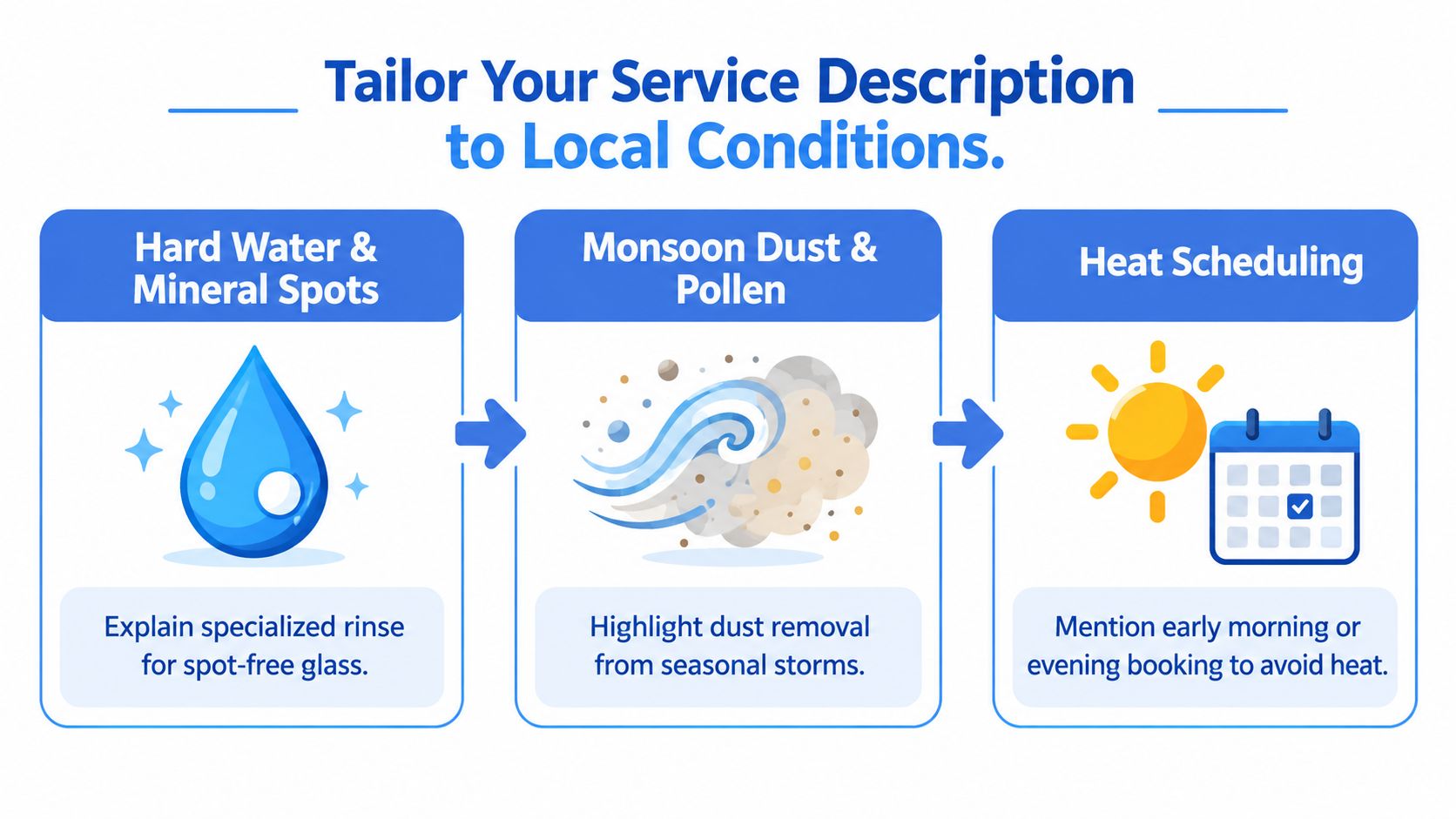
Local copy works when it reflects a real customer concern, not when it repeats a city name until the page sounds mechanical. A useful city page names the local condition, connects it to a cleaning method, identifies the property type, and offers a location-specific next step.
For example, a Phoenix page could open with mineral spotting, desert dust, or scheduling concerns during hot weather:
“Phoenix homeowners and businesses may deal with dust and mineral residue that dulls exterior glass. Our technicians assess the condition first, then select detailed squeegee work or a pure-water system for the surface and access requirements. Request a Phoenix window cleaning estimate for residential, commercial, or high-rise service.”
That copy stays specific without claiming every property has the same buildup. If hard-water deposits are bonded to the glass, the page should explain that removal may require a separate treatment rather than implying ordinary maintenance will solve every stain.
The publisher's stated service area also includes Flagstaff, Tempe, Chandler, and Gilbert. Each location deserves original wording based on the property types and conditions customers mention. A page for a medical office should sound different from one for a home, even when both are in the same city.
The following video can help visual readers understand how method and access affect the service description:
SEO and conversion copy should support the same path. A searcher lands on the page, recognizes the problem, confirms that the provider serves the right property, sees evidence of safe and capable work, and knows how to begin.
Use the primary phrase in the title tag, H1, introduction, and one relevant subheading. Add close variations such as residential window cleaning, commercial window cleaning, local window cleaning services, and high-rise window washing only where they describe the actual page. Keep one H1, use descriptive H2s, and link to related service and city pages.
Place each trust signal beside the claim it supports:
High-rise work requires particular care. Historical skyscraper maintenance involved crews using leather harnesses while attached to building sides, and modern cleaning remains safety-critical. Hong Kong labor records reported four fatal employee accidents from falls during window cleaning between 2010 and 2014, as documented by Bloomberg's reporting on skyscraper window washing. That history supports careful planning, not dramatic marketing.
For wording ideas that keep a CTA direct and low friction, review these effective call to action formulas. Then make the action concrete: request a Phoenix estimate, schedule an office consultation, or book a high-rise site assessment. Add a phone link, short form, service-area field, business hours, and consistent contact details. For buyers comparing financial and legal protections, explain the distinction in bonded versus insured service businesses.
Read the page aloud. If the first sentence starts with the company instead of the customer's problem, rewrite it. A visitor should quickly recognize the glass condition, access challenge, property type, or scheduling need that brought them to the page.
Run this short checklist before publishing:

A strong description doesn't need to claim everything. It needs to state the right method, scope, safety expectations, and next step with confidence. Professional Window Cleaning brings more than 26 years of window-cleaning experience to that offer, giving the page a credible foundation when the service details match the work performed.
Professional Window Cleaning provides residential, commercial, and high-rise window cleaning with methods selected for the property, glass, and access conditions. Visit Professional Window Cleaning to request an estimate or start a conversation about a recurring service plan or high-rise site assessment.
Read our blog posts regularly and keep learning.