
Care and Maintenance
Residential Window Cleaning Phoenix: What to Know
Residential window cleaning phoenix - Looking for expert residential window cleaning in Phoenix? Get streak-free results and local tips that keep your home


Buying an expensive window washing cloth won't guarantee streak-free glass. A premium textile can still smear, shed lint, or leave a hazy film if it's used with the wrong method or washed beside cotton towels. In professional work, the cloth is only one part of the result. Water quality, squeegee control, timing, and laundry discipline matter just as much.
The practical question isn't just which cloth you should buy. It's whether that cloth is still clean, absorbent, low-lint, and suited to the job when you reach for it. The following guide focuses on that operational reality, where many otherwise good window washing cloths fail.
Property owners and facility managers often blame the glass or cleaning solution when streaks appear. Those can be factors, but the cloth itself is frequently the overlooked cause. A cloth that has picked up detergent residue, lint, grease, or fabric-softener film can spread contamination across a pane instead of removing it.
Microfiber works because its split, ultrafine fibers create a large surface area and capillary action. The structure helps attract dust and hold moisture, rather than pushing soil around the glass. If those fibers become clogged or coated, the physical advantage disappears. The label may still say microfiber, but the working surface no longer behaves like a precision tool. Independent testing of window-cleaning methods found microfiber more effective than paper towels and newspapers for final streak-free wiping.
A good window washing cloth has a specific job. One cloth may remove loose moisture from a frame, another may polish a mirror, and a third may catch water at the edge after a squeegee pass. Treating every textile as a general-purpose rag creates avoidable problems.
Common failure points include:
The advice in this guide to cleaning windows without leaving streaks is useful only when the cloth supports the process. A squeegee can remove the main film of water, but the cloth still has to detail corners, frames, seals, and edges without recontaminating the glass.
Practical rule: If a cloth starts dragging, shedding, or leaving a greasy-looking haze, remove it from glass-finishing duty. Don't compensate by adding more spray.
The best operators rotate cloths before they become overloaded. They also separate cloths by task. A cloth used on frames or screens shouldn't automatically become the final polishing cloth for interior glass. That simple distinction prevents much of the streaking blamed on “bad” glass cleaner.
Material choice changes how a cloth handles moisture, dust, and residue. The most useful window washing cloths aren't necessarily the thickest or softest. They're engineered for a particular stage of the work.
Microfiber is the specialist for glass finishing. Its fibers are about 1/100 the thickness of a human hair, or roughly 1 micrometer in diameter, according to a technical history and guide to microfiber window cloths. Split polyester and polyamide fibers create channels that collect dust and liquid. That's why a properly laundered microfiber cloth can polish a pane with little or no visible lint.
The blend matters. Guidance for glass commonly favors approximately 80/20 or 70/30 polyester/polyamide, with the polyamide component supporting absorbency and the polyester contributing structure and durability. For finishing passes, practical guidance places many window cloths around 220 to 320 GSM, while wetter applications may benefit from approximately 280 to 560 GSM. These ranges are discussed in professional guidance on window-cloth construction.
A waffle weave offers a structured surface that can hold moisture without presenting a loose, fluffy pile to the glass. It's useful when you need a controlled polishing texture and a cloth that stays manageable in the hand. A dense, short-pile microfiber is often better for final detailing because it leaves fewer fibers and doesn't retain excessive solution.
Chamois has a different feel and working behavior. It can be useful for absorbing water and polishing, but it requires careful cleaning and storage. It may also become less convenient when a job demands repeated washing, color separation, or predictable performance across a large cloth inventory.
Cotton is familiar, durable, and absorbent, but it isn't automatically the right choice for final glass. Cotton fibers can shed lint, particularly when the cloth is old, overdried, or washed with materials that release loose fibers. It remains useful for rougher work, frames, and heavy moisture, provided it stays away from the final polishing stage.
| Material Type | Best Use Case | Key Characteristic |
|---|---|---|
| Microfiber | Final glass and mirror detailing | Split fibers attract dust and retain moisture |
| Waffle-weave microfiber | Polishing and controlled drying | Structured surface balances absorbency and low lint |
| Chamois | Water absorption and traditional polishing | Smooth handling, but more demanding care |
| Lint-free cotton | Frames, sills, and general wiping | Durable and absorbent, with greater lint risk |
| Cotton terry | Heavy wet work and non-glass surfaces | Looped construction holds substantial moisture |
GSM is useful, but it isn't a quality score by itself. A very thick cloth can be awkward for edge work, while a light cloth may saturate quickly. Read GSM alongside the weave, blend, and intended use. The right label describes a tool. It doesn't replace inspection after laundering.
A homeowner cleaning a bathroom mirror has a different problem from a crew detailing a commercial glass entrance. The first task may need a clean, medium-weight finishing cloth. The second demands a system that handles repeated wetting, frame contact, traffic dust, and fast handoffs between workers.
For residential work, keep a small group of dedicated microfiber cloths for interior glass and mirrors. A medium-weight, short-pile cloth is versatile and easier to control around handles, seals, and corners. A separate, more absorbent cloth can handle sills and frames, where dust and moisture are heavier.
Commercial work needs clearer separation. High-traffic entrances and large panes often load cloths with grit quickly. Use a washing or scrubbing textile for soil removal, then switch to a clean finishing cloth. On larger jobs, the supply process matters as much as the material. Cloths should be sorted by task, kept dry between use, and removed from service when they no longer release soil during laundering.
The cloth that handles a dirty frame shouldn't be the cloth that finishes a customer-facing pane.
Pure-water work creates another distinction. Filtered water removes dissolved minerals before it reaches the glass, but the volume of water can still make edge detailing demanding. A higher-GSM structured cloth can retain more moisture when a technician needs to catch drips at frames or sills. That doesn't mean the heaviest cloth is always better. A saturated textile can create its own streaks if it's used for the final polish.
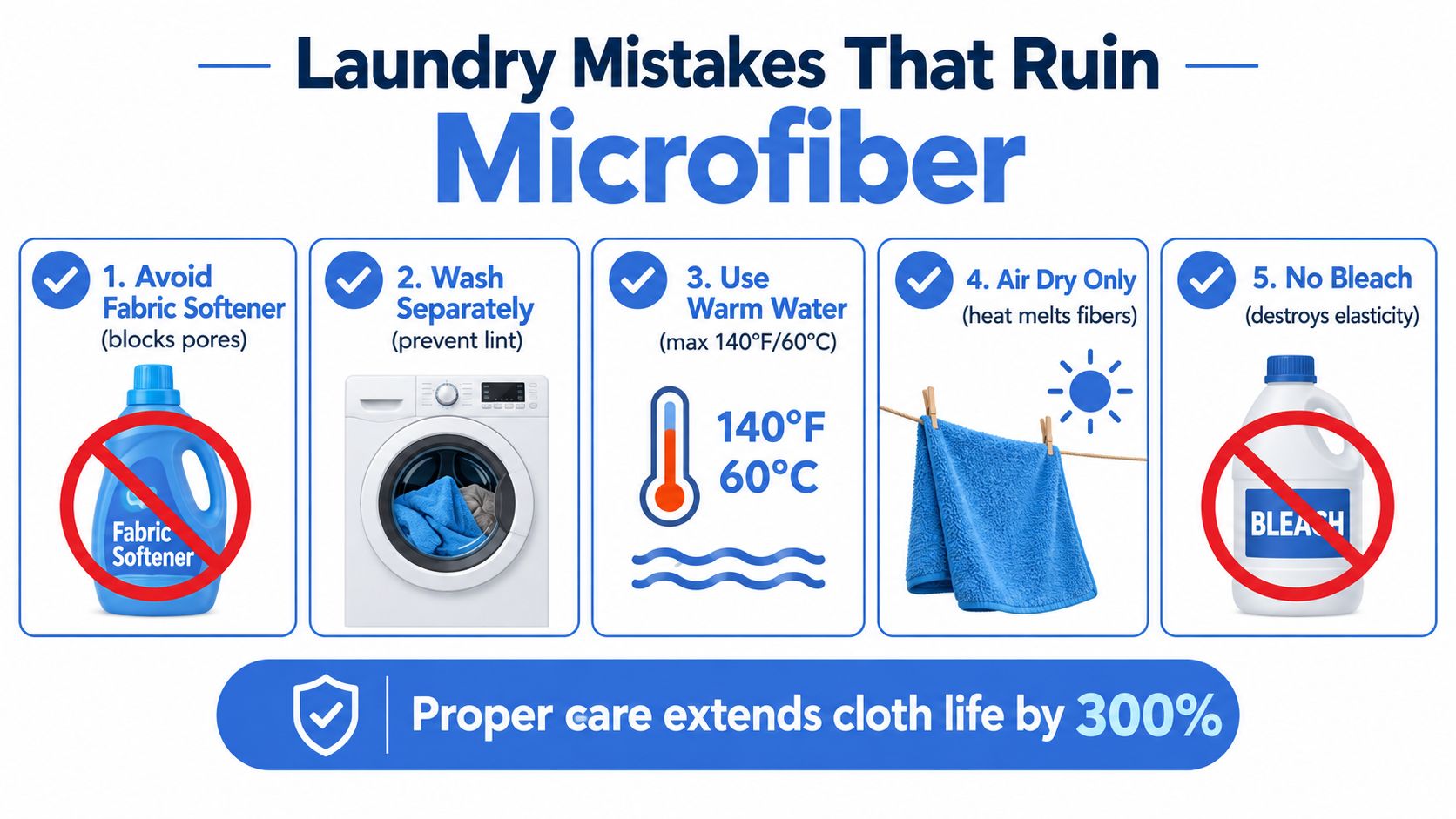
Use the supplied care checklist as an operating standard, but don't treat a graphic promise as a performance guarantee. The claim that proper care extends cloth life by 300% isn't supported by the verified data available here, so replacement decisions should be based on observed absorbency, lint release, odor, fiber condition, and finishing results.
The practical buying decision is simple. Match absorbency to water volume, match pile and weave to the finishing stage, and maintain a strict boundary between glass cloths and lint-producing textiles. That approach works for a home, a medical office, a dealership, or a high-rise operation.
Professional window cleaning uses two methods, the traditional squeegee method and the pure-water system. Cloths support both methods, but they don't replace the main water-removal process.
With a squeegee, begin by removing loose grit and heavy soil so the blade doesn't drag contamination across the glass. Apply the cleaning solution, agitate the pane, and use the squeegee to remove the working film. A cloth then handles the perimeter, corners, frame contact, and the moisture left at the blade's starting or ending point.
Blade control matters. One published professional guide specifies a consistent 30-degree blade angle and approximately one inch of overlap between strokes to reduce streaking and maintain a clean finish. You can review the method in this professional squeegee and bucket guide.
Use a separate dry or nearly dry detailing cloth for the final edge pass. Fold it into a manageable section, turn to a clean face as it picks up moisture, and avoid polishing the whole pane once the squeegee has already done that work. The cloth's job is precision, not repetition.
Finishing rule: Detail the edges with the cleanest cloth available, and never use a cloth that has touched a dirty sill as the final glass textile.
A pure-water system uses filtration, including reverse osmosis and/or deionization, to remove dissolved minerals before water reaches the glass. The water is applied, agitated with the appropriate brush, and allowed to carry loosened soil away. Cloths are most useful for interior detailing, frame work, splash control, and areas where water must be collected rather than left to dry.
A cloth can also help identify a workflow problem. If pure-water glass repeatedly needs heavy polishing, check the rinse, brush condition, frame contamination, and drying environment before blaming the textile. If squeegee work leaves lines, inspect blade condition, angle, overlap, solution load, and cloth contamination in that order.
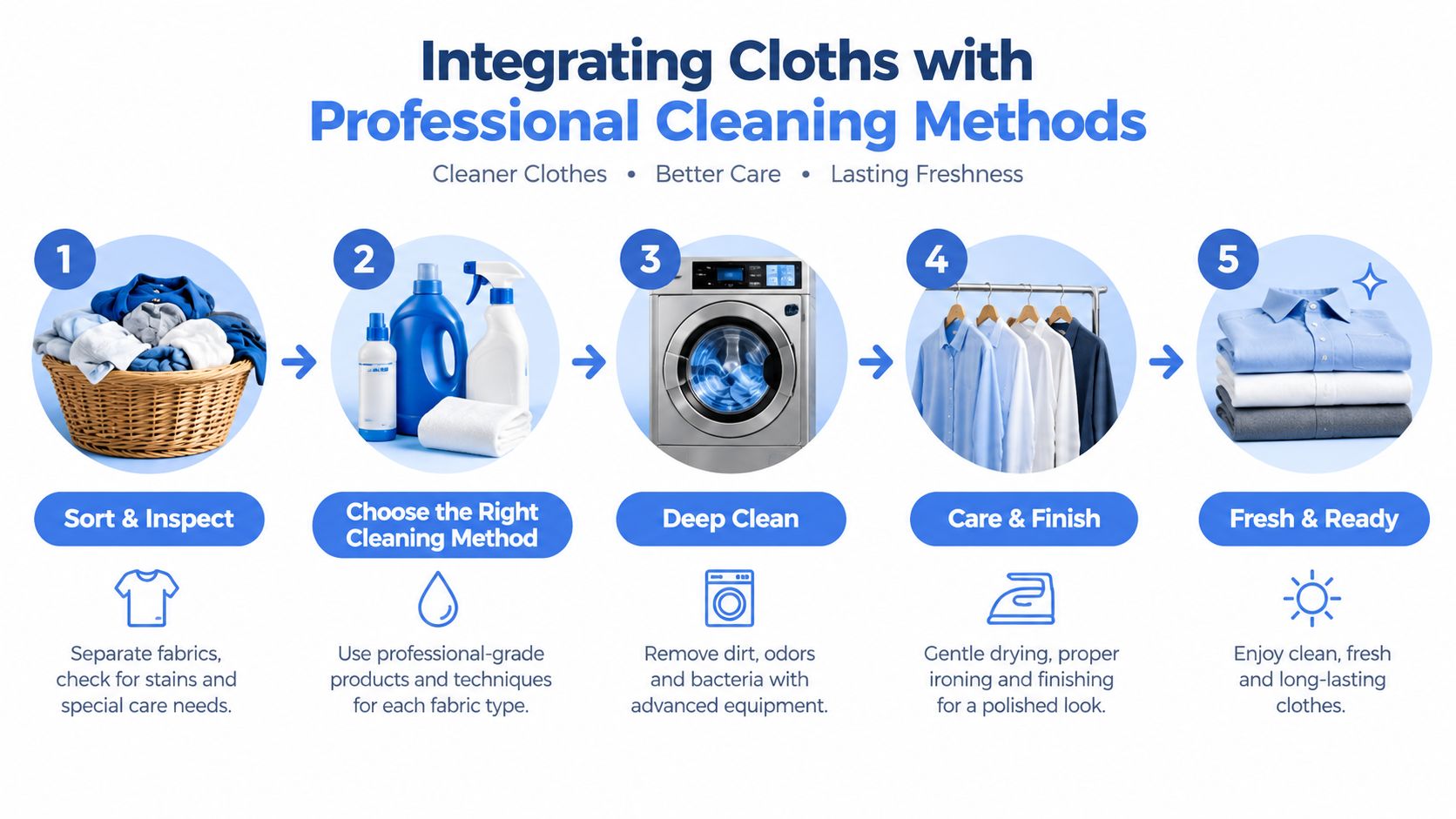
The cloth is the final control point. It catches what the main method leaves behind, but it can't rescue careless technique or contaminated water.
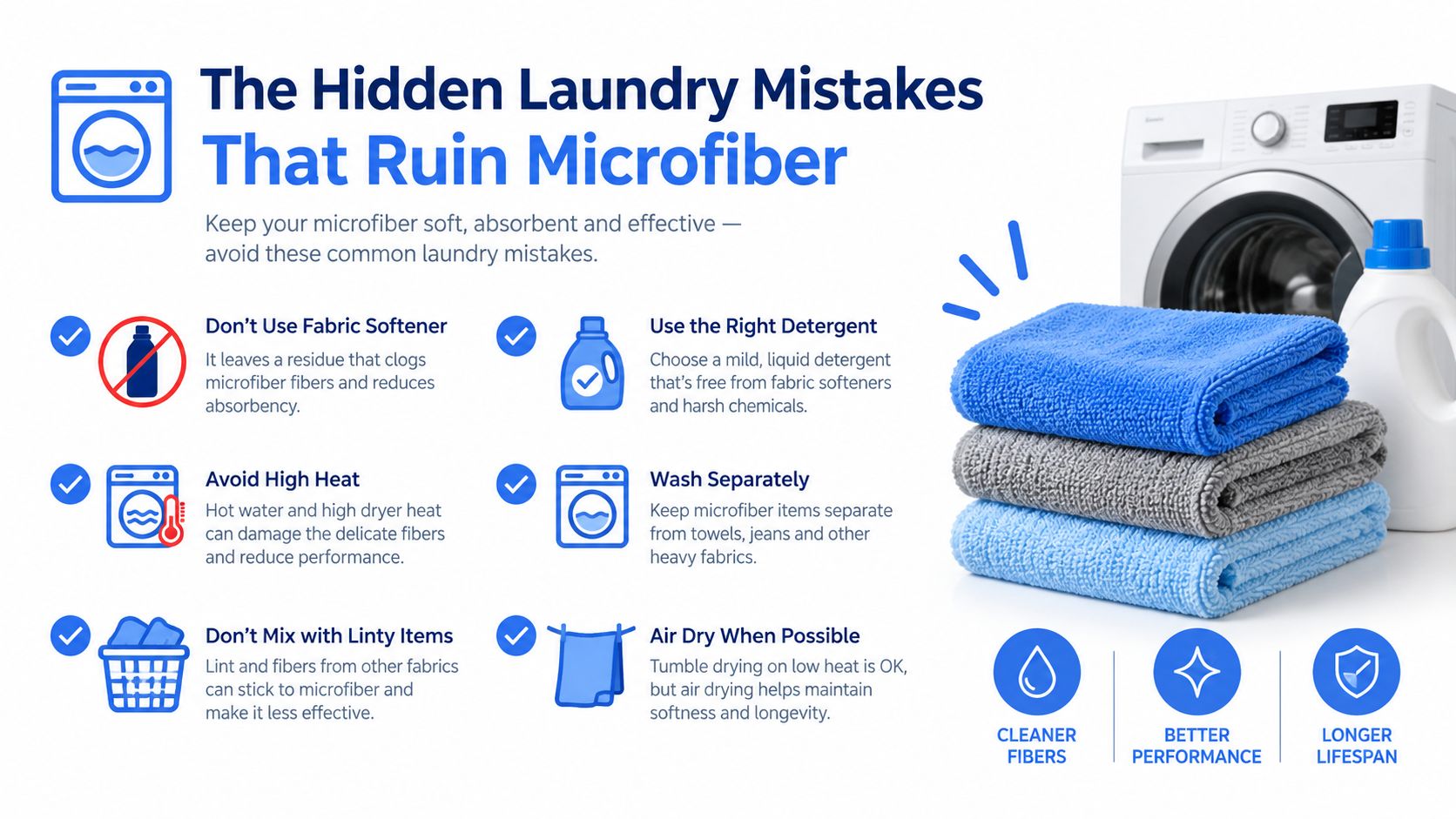
Many microfiber failures begin in the laundry room, not on the window. Operators buy a low-lint cloth, then wash it with cotton towels, add softener, dry it on excessive heat, and conclude that the product was defective. The material may have been suitable. The process wasn't.
Microfiber specialists warn against fabric softener and dryer sheets because their coatings can clog the microscopic spaces that hold dust and liquid. Cotton towels create a separate problem. They release lint that can lodge in microfiber's split fibers, then transfer onto glass during the next job.
Wash microfiber separately from cotton, terry, and lint-producing garments. Use a mild detergent, avoid bleach, and don't overload the machine. Heavy soil should be shaken or rinsed out before laundering, otherwise the wash cycle can redistribute grit across otherwise serviceable cloths.
Warm water is commonly recommended in cleaning-cloth guidance, while a recent window-cloth care guide recommends washing microfiber separately and using air drying or low heat. The safe operational principle is to follow the cloth manufacturer's care label, avoid excessive heat, and never use dryer sheets.
A clean cloth shouldn't be thrown into a damp bucket or left on a dusty vehicle floor. Dry it fully, fold it, and store it in a clean container where it won't contact used towels, abrasive debris, or chemicals. In commercial operations, a simple color or task system helps prevent a frame cloth from becoming a glass-finishing cloth by accident.
Laundry also gives you a replacement signal. Retire a cloth when it remains greasy after washing, stops absorbing, sheds visible lint, develops a persistent odor, or drags across glass. Don't keep a failing textile in circulation because it still looks intact. A cloth can appear clean while its capillary performance has already declined.
A streaking cloth often needs a change in laundry protocol before it needs a replacement.
The most reliable maintenance routine is boring and consistent. Shake out debris, sort materials, wash with compatible cloths, dry gently, inspect, and store clean. That routine protects performance across repeated use far better than buying progressively more expensive textiles.
Microfiber has a real environmental trade-off. Its synthetic fibers perform exceptionally well on glass, but washing can release plastic fibers into wastewater. A recent environmental explainer cites research indicating that one load of synthetic fabrics can release up to 700,000 microfibers into water systems, while wastewater treatment may not capture all of them. The environmental discussion of microfiber shedding places that concern alongside microfiber's practical value.
The answer isn't to pretend the problem doesn't exist, or to replace every microfiber cloth with a material that performs worse for final glass. A better approach reduces unnecessary washing, extends useful service life, and limits fiber release wherever possible.
Rinse heavily soiled cloths at the worksite when appropriate, rather than allowing grit and residue to remain embedded until a full wash. Don't reuse a cloth across incompatible surfaces just to avoid adding it to the laundry. That can spread soil and force more aggressive washing later.
Choose durable cloths with a defined role. A short-pile finishing cloth may last longer in service when it isn't used for gritty sills. A separate frame textile absorbs the rougher work, protecting the tool that must remain low-lint.
Operators can also consider microfiber-catching laundry bags or filters, especially where commercial laundry volumes are high. Cold-water laundering may reduce energy demand, and lower heat reduces the risk of damaging the cloth. Always balance these steps with the manufacturer's care instructions and the actual hygiene requirements of the work.
Reusable does not mean impact-free. It means the operation has an opportunity to manage impacts through longer use, controlled laundering, and careful disposal. A sustainability policy that measures only the number of disposable towels avoided misses the textile and wastewater side of the decision.
The most responsible purchasing standard is practical: buy enough quality to avoid premature replacement, assign each cloth to the right surface, launder it without contaminating other textiles, and use capture measures where feasible. That preserves the streak-free performance professionals need without treating synthetic cleaning cloths as environmentally neutral.
Local conditions change how quickly a pane dries, how much dust reaches the glass, and how urgently a technician needs to detail an edge. The same window washing cloth can behave well in one service area and become frustrating in another because the workflow, not just the textile, has changed.
In Phoenix and Scottsdale, intense sun and rapid evaporation make timing important. Work in shade where possible, keep the working area controlled, and have an absorbent detailing cloth ready before water begins drying at the perimeter. A cloth that holds enough moisture for controlled detailing is more useful than a delicate polishing cloth that saturates immediately.
In Denver and Las Vegas, operators may face dust, mineral residue, or hard-water-related spotting. Pure-water rinsing is especially valuable where dissolved minerals threaten the finish, but the cloth still needs to be clean and low-lint. Don't polish mineral deposits into the glass with a contaminated textile. Remove the source, rinse properly, then use a dedicated finishing cloth.
Homes and businesses in Tempe, Chandler, Gilbert, and Flagstaff also benefit from task separation. Keep one group for interior glass, another for frames and sills, and a third for heavier wet work. This reduces cross-contamination and makes it easier to identify whether a streak comes from the water, technique, glass condition, or laundry.
Professional Window Cleaning has operated since 1999, and company information identifies its founder as David Kaminski. That gives the business over 26 years of operating history as of 2026. Its work includes residential, commercial, and high-rise window cleaning, where cloth selection and maintenance must support both squeegee and pure-water workflows.
Regional conditions change the details, but clean glass still depends on the same discipline: suitable water, controlled technique, and a cloth that hasn't been ruined in the laundry.
Professional Window Cleaning provides residential, commercial, and high-rise window cleaning with squeegee and pure-water methods, including careful edge and frame detailing. If streaks keep returning despite better products, visit Professional Window Cleaning to arrange service built around the glass, climate, and operating conditions of your property.
Read our blog posts regularly and keep learning.