
Care and Maintenance
Best Commercial Window Cleaning: Top Providers for 2026
Compare the best commercial window cleaning providers across AZ, CO, and NV, with criteria for high-rise access, pricing factors, and how to choose a vendor.


You're halfway through a commercial route when a full bucket leaves the ground and the thin grip starts biting into your palm. Water and surfactant shift toward the rim, your wrist bends to keep the bucket level, and every step turns a simple carry into a fight against momentum. A weak 5 gallon bucket handle doesn't always fail dramatically. More often, it begins with a squeaky pivot, a loose sleeve, or a rim connection that moves just enough to make you distrust the bucket.
Professional window cleaning uses only two professional methods, a squeegee or a pure-water system. Both methods still depend on reliable equipment for mixing, rinsing, staging, and moving water around a property. Professional Window Cleaning has been cleaning windows for over 26 years, and the practical lesson applies to every crew: the handle is a working component, not a decorative accessory.
A five-gallon bucket can look harmless beside a water-fed pole or a commercial squeegee kit. On a third-floor job, though, the handle is the only part you may trust while moving a heavy, sloshing load across a landing, up stairs, or over finished pavement. If the grip shifts or the attachment lets go, the result can be a strained wrist, damaged landscaping, contaminated rinse water, or a dropped container.
Handles also absorb the repetitive abuse that crews rarely notice during a busy day. Sunlight, cleaning chemicals, cold weather, wet gloves, hard set-downs, and repeated lifting all work on the grip and pivot points. A wire bail can deform. A plastic grip can split. A molded handle can develop a crack near its attachment boss, where the damage stays hidden until the next loaded carry.
Practical rule: If a handle feels different from the last time you used it, take the bucket out of service until you know why.
A squeaky rivet isn't automatically dangerous, but it deserves inspection. The same goes for a handle that no longer sits evenly, a grip sleeve that slides, or a pivot that lifts away from the bucket rim when you pull upward. Crews often find these issues only after their hand, shoulder, or lower back has started compensating for poor control.
Bucket-handle design has been reworked for generations. A history of patents includes an 1875 patent, a 1985 plastic handle assembly, and design patents filed as recently as 2016, showing that attachment and ergonomics remain active design concerns in a mature product category. The broader patent record also documents repeated solutions from 1940, 1956, 1976, 1989, 1995, 2005, 2011, and 2014, with a related patent granted on January 8, 2019. Those details come from the history of five-gallon buckets and the bucket-handle patent record.
The useful takeaway isn't that newer automatically means better. It's that carry comfort, pivot stability, and attachment strength have always been the main problems. The rest of this guide focuses on the points that decide whether a handle belongs on a daily route, a light residential setup, or nowhere near a full bucket.
Most crews encounter two basic construction families. The first is the wire bail, a bent metal loop that pivots from attachment points on opposite sides of the bucket. It often includes a separate plastic sleeve or coated grip, and it folds beneath the bucket when the container is set down or stacked.
The second is the molded plastic handle. It may be an arch formed with the bucket or a separate plastic arm that connects to molded bosses. Plastic avoids the exposed metal pinch point, won't rust in the same way, and feels less harsh in cold conditions. Its weakness is aging. Ultraviolet exposure, chemical residue, and repeated flexing can make plastic less forgiving over time.
Verified industry guidance places common wire-bail carry ratings at 55 to 70 pounds, while molded plastic handles are commonly listed at 40 to 55 pounds, depending on construction and use case. Those ranges come from pail and bucket size guidance, but a catalog rating still isn't a substitute for inspecting the actual bucket, pivot, and rim.
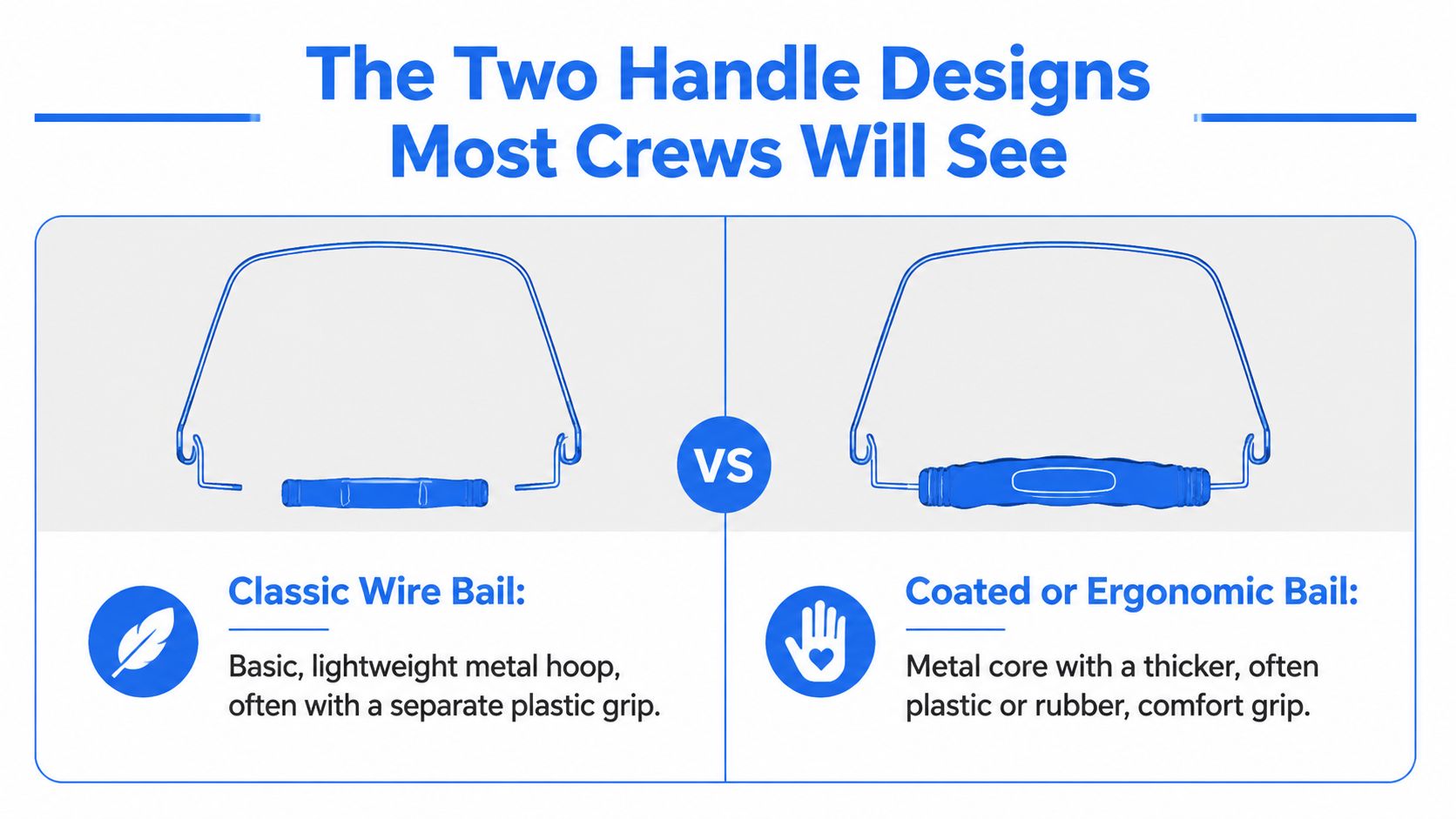
A wire bail generally tolerates rough handling and repeated loading better, especially when the metal is sound and the attachment points are reinforced. It can flex slightly rather than transmitting every shock directly to the bucket wall, but that same flexibility becomes a problem when the wire kinks or the grip sleeve moves.
Molded plastic handles are cleaner around chemical solutions and eliminate some hand contact with metal. They're often comfortable for short carries, but a crack at the pivot can progress quickly. Don't choose by appearance. Look at how the handle connects, how much the bucket wall supports that connection, and whether the grip stays stable with a gloved hand.
A large bucket changes the mechanics of a carry before you add a single tool. In a CDC study, the large bucket measured 36.8 centimeters tall and 30.0 centimeters in diameter. Participants carried loads at 10% and 20% of body weight, using lead shot to control the test load. Compared with a smaller bucket, the larger five-gallon format changed upper-extremity and lower-back loading, demonstrating that both container size and load magnitude affect the moment demands of transport. The study is available through the CDC bucket-carry biomechanics report.
For a window cleaner, the important point is practical. A filled bucket isn't just a container you happen to hold. It's a load positioned away from the body, and every step, turn, stair, and uneven surface changes how your hand, shoulder, and back control it.
Water alone in a typical five-gallon bucket weighs about 41.7 pounds, while practical estimates including the bucket commonly fall between 43 and 49 pounds. Industrial-grade buckets are often described as supporting up to 80 pounds, and many household models are rated around 55 to 60 pounds, according to bucket load-capacity guidance.
Those figures don't mean a crew should routinely fill a bucket to its maximum rating. A rating describes structural capacity under defined conditions. It doesn't account for sloshing, a wet glove, a damaged rim, a sudden stop, or a worker carrying the load down stairs.
Keep a route bucket as close to the body as the work allows, and shorten the carry instead of treating maximum capacity as a target.
The CDC testing supports treating 10% of body weight as a more conservative reference point than 20%, particularly when a crew repeats the task throughout a route. Reducing carry distance also reduces the time your joints spend controlling the bucket's moment arm. A cart, staged container, hose-fed rinse setup, or smaller working fill can matter more than buying a stronger grip.
A tall, narrow bucket can position the grip differently from a shorter, wider one. A thin or flexible lip may allow the bail connection to shift, while a reinforced rim keeps the pivot relationship more consistent. Before blaming the handle, inspect the bucket body. A strong handle attached to a weak rim is still an unreliable system.
The right choice depends less on the label and more on how the bucket travels during the job. A long commercial route with repeated lifting puts different demands on a handle than a short residential task where the bucket stays near the work area.
| Feature | Wire Bail | All-Plastic | Side Handle Add-On |
|---|---|---|---|
| Carry behavior | Flexible, durable, and suited to repeated lifting | Comfortable and corrosion-resistant | Supports a two-handed carry |
| Main advantage | Usually the stronger option | No exposed metal grip and good chemical resistance | Can reduce wrist loading on longer carries |
| Main concern | Kinking, sharp damage, or grip-sleeve movement | Aging, brittleness, and cracks at attachment points | Fit depends on bucket wall and lip geometry |
| Best use | Heavy route work and general-purpose carrying | Lighter-duty or chemical-heavy work | Stairs, longer carries, and controlled two-handed handling |
Wire bail handles are usually the sensible default for crews that carry full buckets repeatedly. The metal core has more tolerance for hard set-downs, though a bent bail can become a hand hazard and a distorted pivot can make the bucket swing unpredictably.
All-plastic handles are attractive for chemical-heavy work because they resist the corrosion associated with metal components. They also feel warmer in winter. The trade-off is that plastic failure can be sudden once a crack reaches a stressed attachment area. Inspect the bosses and hinge points instead of assuming the handle is safe because it has no rust.
Side handles can help when the route includes stairs, narrow walkways, or long carries where two hands provide better control. They aren't universal, though. A side accessory must grip the actual bucket wall securely, clear the lid and tools, and avoid interfering with the bail. A handle accessory such as the Bear Grip side handle specifically warns buyers to measure the bucket lip because fit varies by bucket style.
A side grip is an aid to control, not permission to overload the container. If the bucket is unstable, too full, or poorly balanced, a second grip only gives you another place to hold a bad setup.
A replacement handle is not universal because the package says “fits five-gallon buckets.” Bucket manufacturers vary the lip geometry, pivot-hole position, wall thickness, and attachment shape. Two buckets with the same nominal capacity can accept different handles, and a handle that snaps into place empty may lift, rotate, or pop free when loaded.
Start with the bucket itself, not the replacement listing. Measure the rim thickness with calipers, inspect whether the lip is rolled or folded, and compare the attachment points with the handle you plan to install. The provided fit guidance identifies a typical rim range of 2.5 to 4 millimeters, so the replacement needs to match the actual rim rather than an assumed standard.
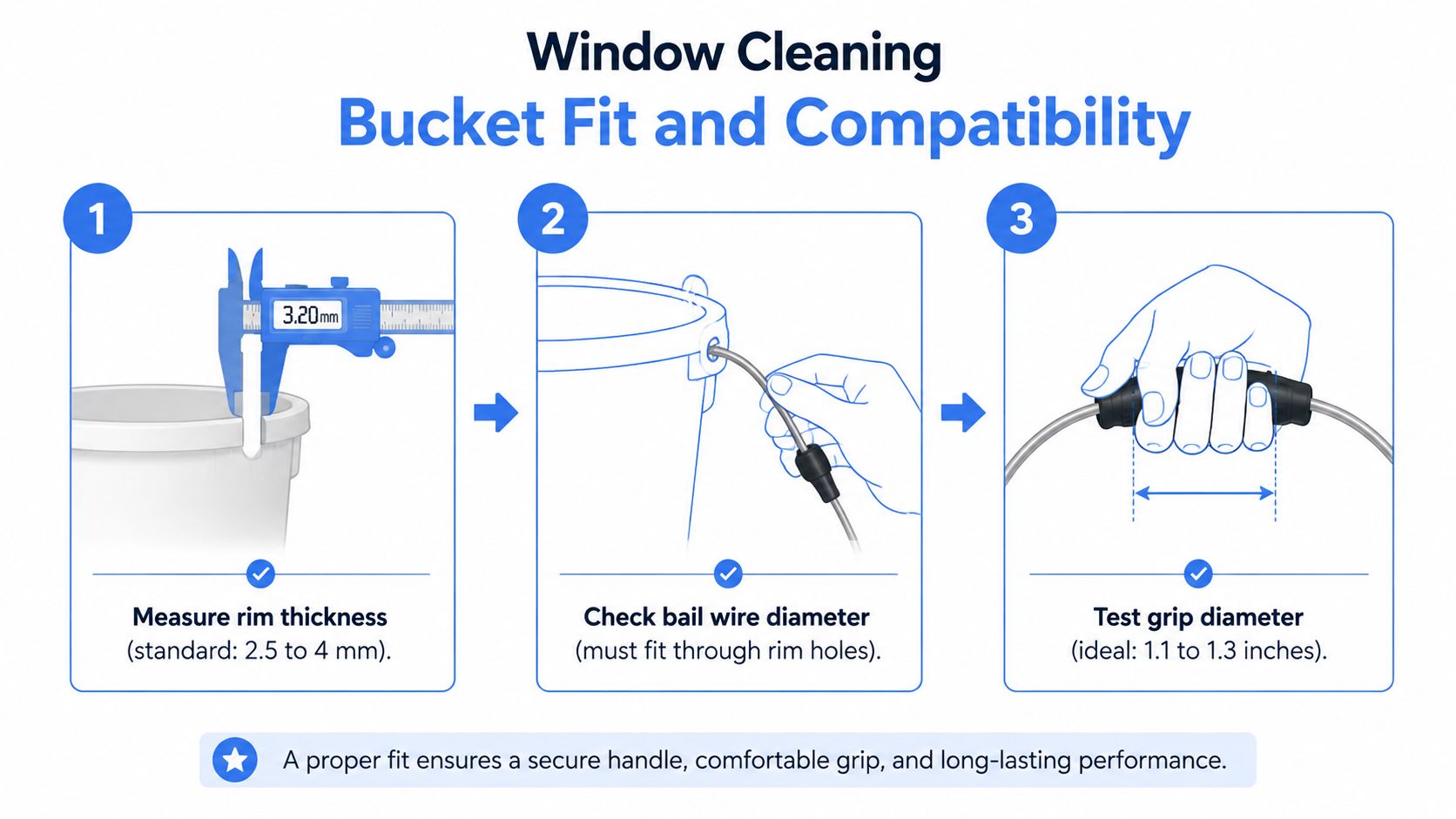
Skipping the test fit is how a crew discovers a compatibility problem beside a customer's property. For broader equipment planning, a practical Charlotte window contractor SEO resource can also help contractors think about how tools, service operations, and customer-facing work fit together.
A short demonstration can make the attachment points easier to recognize:
Handle failures usually begin at the interface between parts. The grip gets attention because it touches your hand, but the pivot, rim, sleeve, and bucket wall determine whether the load stays attached. A weekly inspection should focus on movement, not just visible damage.
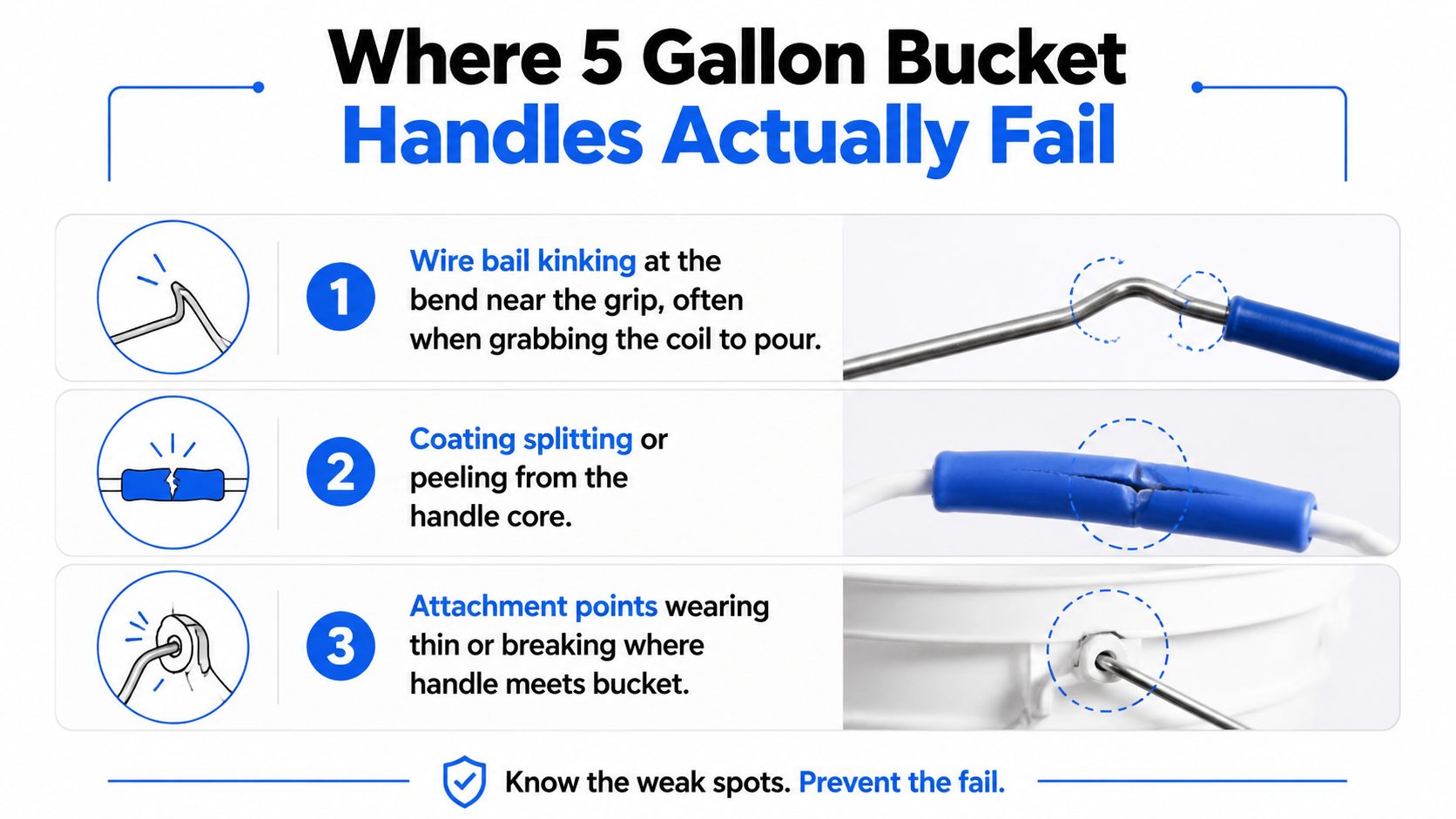
Wire bails deserve a close look near the bend by the grip. Workers often grab that area when pouring, and repeated side loading can distort the wire. Run a cloth along the metal. If it catches, the wire may have developed a burr or sharp deformation.
Plastic grips and coatings can split, peel, or slide along the core. A loose sleeve changes where the hand applies force and can expose metal exactly where the palm expects cushioning. Replace a damaged sleeve rather than wrapping it with a temporary material that can absorb cleaning solution and become slippery.
Attachment points may loosen without obvious cracking. Pull the handle upward from each side, then squeeze the pivot area and watch for lift. On a molded plastic handle, inspect the boss for whitening, hairline cracks, or distortion. On a wire bail, check whether the ears, rivets, or holes have enlarged.
A handle that moves at the bucket wall is already giving you useful information. Don't wait for a complete separation.
Set each bucket on a stable surface and run the same inspection every week:
Patent and engineering records show that repeated loading is a serious design concern across handle systems. A separate biomechanics study tested bucket-handle repair constructs through 100,000 loading cycles, with reported failure loads ranging from about 76.6 to 151.3 newtons depending on the repair design. Those results come from research on repeated bucket-handle loading, and they reinforce a field habit worth keeping: inspect the attachment, not only the grip.
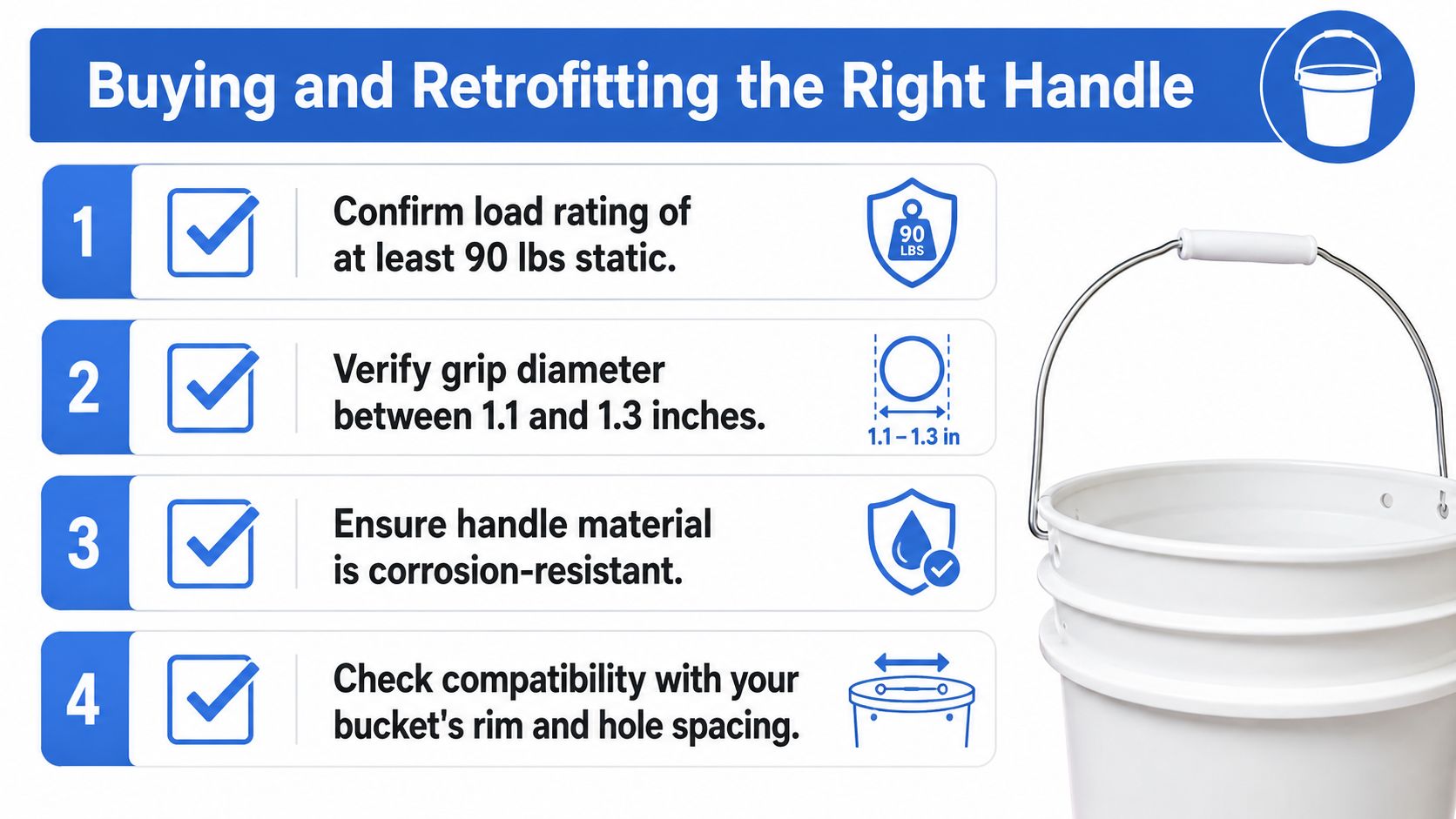
Buy the handle and bucket as a matched system whenever possible. A universal retrofit may be convenient, but the word “universal” doesn't confirm the rim, pivot spacing, wire clearance, or wall strength on your particular pail.
Before ordering, write down the bucket model, measure the rim, photograph the attachment points, and note anything molded into the sides. A five-gallon HDPE bucket listing from U.S. Plastic shows a common arrangement, a high-density polyethylene body, a wire handle, and a built-in bottom handle. That combination illustrates why a replacement must clear both the carrying bail and other molded features. The example is shown in this HDPE bucket product listing.
A molded retrofit handle needs real support at its attachment bosses. Snap-in tabs alone aren't enough if the bucket wall flexes under load. OEM replacements may cost more or limit interchangeability, but they usually reduce guesswork and may protect the bucket manufacturer's warranty. Universal parts can work well when measurements match, but the responsibility for that match sits with the buyer.
For crews building a complete kit, the guide to professional window cleaning equipment provides useful context for evaluating buckets alongside the rest of the route setup. Keep spare handles in the van according to how many buckets the route depends on, and inspect every replacement before it carries water.
A better handle won't fix every lifting problem. It won't make an overloaded bucket light, correct a badly balanced tool belt, or remove the need to stage water near the work. It can, however, improve the point where your hand controls the load and reduce the temptation to carry a questionable bucket because the job is already underway.
Grip force and body position matter. Occupational guidance recommends reducing grip force, keeping loads close to the body, and avoiding awkward wrist positions. Canadian Centre for Occupational Health and Safety guidance also supports handle shapes that reduce forceful gripping and awkward joint positions. The CCOHS tool-design guidance specifically supports padded or auxiliary bucket handles as practical ways to enlarge the grip and improve control.
A weekly inspection prevents small problems from becoming roadside repairs. A crew that checks the bail, sleeve, rim, and attachment before loading the van has more control over the day than a crew that discovers a failure beside a customer's landscaping.
Use the handle to support sound carrying habits:
The best 5 gallon bucket handle is the one that matches the bucket, carries the intended load without shifting, and stays comfortable through the workday. It should also have a clear end-of-life plan. Municipal guidance from Calgary and LRSWMD says plastic buckets up to five gallons can often enter recycling streams, while metal handles should be removed and handled separately as scrap metal. Sonoma County's 2026 recycling-day rules also require removing plastic or metal handles and rings from accepted containers, so crews should check local requirements rather than placing the entire assembly in a curbside bin. The Calgary guidance is available through local bucket recycling instructions.
Professional Window Cleaning offers residential, commercial, and high-rise window cleaning for properties that need dependable equipment and careful work. If you want a crew that treats handles, buckets, squeegees, and pure-water systems as part of service reliability, visit Professional Window Cleaning and request a route built around your property's access and cleaning needs.
Read our blog posts regularly and keep learning.